Is a Lexus EV Worth Buying in 2026?
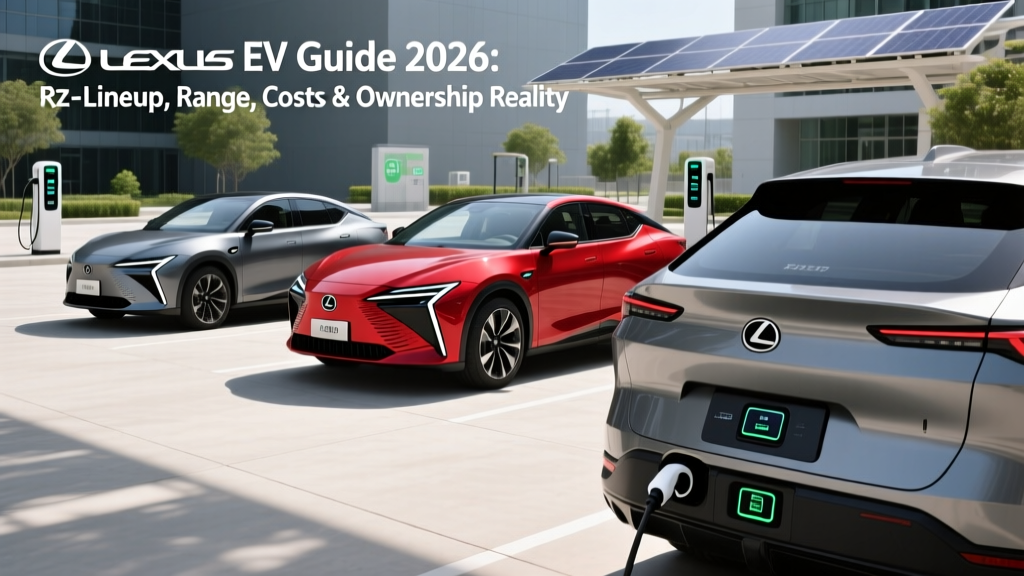
The Lexus EV lineup centers on the RZ, a luxury electric crossover built on Toyota's e-TNGA platform. The RZ 300e (FWD) delivers an EPA-estimated 266 miles of range with a 72.8 kWh battery, while the dual-motor RZ 450e AWD offers 220 miles. Starting around $45,000 (RZ 300e) to $55,000 (RZ 450e), the RZ undercuts rivals like the BMW iX and Mercedes EQB, but trails Hyundai Ioniq 5 and Tesla Model Y in charging speed and interior space. If you prioritize Lexus reliability, dealership service, and a quiet, refined ride over maximum range or cutting-edge tech, the RZ is a compelling entry. If you road-trip frequently or live in a cold climate, the modest range and 150 kW peak DC charging rate demand careful planning.
The Lexus EV Lineup: What You Can Actually Buy
Lexus entered the BEV market cautiously. As of 2026, the RZ remains the brand's sole dedicated electric vehicle available in the U.S. market, offered in two powertrain configurations. A larger, three-row Lexus EV SUV has been announced for the late-2026/2027 timeframe, but specs remain preliminary.
| Spec | RZ 300e (FWD) | RZ 450e (AWD) |
|---|---|---|
| Base MSRP | $45,050 | $54,800 |
| Battery (usable) | 72.8 kWh (NMC) | 72.8 kWh (NMC) |
| EPA Range | 266 mi | 220 mi (18" wheels) / 196 mi (20" wheels) |
| Combined MPGe | 117 MPGe | 102 MPGe |
| Motor Output | 201 hp / 196 lb-ft | 308 hp / 325 lb-ft |
| 0–60 mph | ~7.4 sec | ~5.0 sec |
| Peak DC Fast Charge | 150 kW | 150 kW |
| 10–80% DCFC Time | ~30 min | ~30 min |
| Level 2 (240V) Rate | 7.2 kW | 7.2 kW |
| Drivetrain | FWD | AWD (DIRECT4) |
| Battery Warranty | 8 yr / 100,000 mi | 8 yr / 100,000 mi |
| Vehicle Warranty | 4 yr / 50,000 mi | 4 yr / 50,000 mi |
Real-World Range Reality
The EPA estimates 266 miles for the RZ 300e, but expect roughly 230–245 miles on mixed highway driving at 70+ mph. In cold weather (below 32°F), range can drop 20–30%, meaning a realistic winter highway figure closer to 185–210 miles. The RZ 450e with 20-inch wheels (196 mi EPA) may deliver as little as 145–160 miles in freezing highway conditions. The RZ lacks a heat pump on lower trims — a critical efficiency factor for cold-climate buyers. Always precondition the battery before DC fast charging to avoid sluggish charge curves in low temperatures.
Lexus EV vs. Gas and Hybrid: Cost & Efficiency Compared
Many Lexus shoppers cross-shop the RZ against the NX hybrid (NX 350h) or NX gas (NX 250). Here's how they stack up on real numbers, not marketing.
| Metric | RZ 450e AWD | NX 350h (HEV) | NX 250 (Gas) |
|---|---|---|---|
| EPA Combined | 102 MPGe | 39 MPG | 28 MPG |
| Annual Miles (assumed) | 12,000 | 12,000 | 12,000 |
| Energy/Fuel Cost (est.) | $540–$720 (home charging, $0.15–0.20/kWh) | $1,170 (gas $3.80/gal) | $1,630 (gas $3.80/gal) |
| Annual Fuel Savings vs. NX 250 | ~$910–$1,090 | ~$460 | — |
| Base MSRP (2026) | $54,800 | $43,900 | $39,500 |
| Price Premium Over NX 250 | +$15,300 | +$4,400 | — |
At $0.15/kWh (typical residential off-peak rate), the RZ costs roughly $0.045–$0.06 per mile to "fuel" at home. The NX 250 gas model costs about $0.136/mile. That's a savings of roughly $1,000/year for an average driver. However, the RZ 450e's $15,300 price premium over the NX 250 means it takes approximately 14–15 years of fuel savings alone to break even — before accounting for tax credits. The NX 350h hybrid occupies a compelling middle ground: 39 MPG combined, no range anxiety, no charging infrastructure needed, and a far smaller price gap.
Charging the Lexus RZ: Speed, Connectors, and Infrastructure
The RZ uses the CCS1 connector for DC fast charging and J1772 for Level 2 AC charging. Lexus has confirmed future models will adopt NACS (Tesla's connector), but the current RZ requires a CCS-to-NACS adapter for access to Tesla Supercharger stations — a significant practical consideration given Tesla's network dominance.
| Level | Power | Miles Added per Hour | Typical Use Case |
|---|---|---|---|
| Level 1 (120V) | ~1.4 kW | ~4–5 mi/hr | Emergency / overnight trickle |
| Level 2 (240V, 32A) | 7.2 kW | ~22–25 mi/hr | Home daily charging (full charge ~10 hrs) |
| DC Fast Charge | Peak 150 kW | ~150 mi in 30 min (10–80%) | Road trips; tapers above 80% |
The 150 kW peak DC charge rate is the RZ's weakest competitive metric. The Hyundai Ioniq 5 peaks at 240 kW (10–80% in ~18 minutes), and the Kia EV6 at 239 kW. The RZ's ~30-minute 10–80% time is acceptable for road trips but noticeably slower on longer routes with multiple stops. The charge curve also tapers significantly past 60% state of charge (SoC), meaning the final 20% takes disproportionately longer.
Total Cost of Ownership: 5-Year Breakdown
| Cost Category | RZ 450e AWD | NX 350h AWD |
|---|---|---|
| Purchase Price (base MSRP) | $54,800 | $43,900 |
| Federal Tax Credit (§30D, if eligible) | –$0 (currently does not qualify due to battery sourcing) | N/A (not a BEV) |
| Home Charger Install (Level 2) | $800–$2,000 | $0 |
| Fuel/Energy (5 yrs, 12k mi/yr) | $2,700–$3,600 | $5,850 |
| Maintenance (5 yrs) | $1,200–$1,800 | $2,800–$3,500 |
| Insurance (5 yrs, avg.) | $9,500–$12,000 | $7,500–$9,500 |
| Estimated Depreciation (5 yrs) | $22,000–$27,000 | $16,000–$19,000 |
| Approx. 5-Year Total | $91,000–$101,200 | $76,050–$82,750 |
Key takeaways from this breakdown:
- Tax credit: As of 2026, the Lexus RZ does not qualify for the full $7,500 federal §30D tax credit because its battery components and critical minerals do not meet the domestic sourcing thresholds required by the IRS clean vehicle credit rules. Always verify current eligibility on IRS.gov before purchasing — rules change frequently.
- Insurance: EV insurance premiums run 15–25% higher than equivalent gas models, driven by higher repair costs and battery replacement risk. Get quotes before committing.
- Maintenance savings: EVs eliminate oil changes, transmission fluid, spark plugs, and exhaust system repairs. Brake wear is also reduced thanks to regenerative braking. Expect roughly 40–50% lower maintenance costs versus the NX 350h.
- Depreciation: Luxury EVs have depreciated faster than their hybrid counterparts in recent years, partly due to Tesla-led price wars and rapid tech obsolescence. Lexus brand cachet may cushion this, but data is still limited for the RZ.
Tax Credit and Incentive Reality for Lexus EV Buyers
§30D Federal Tax Credit Requirements (2026)
- MSRP Cap: SUVs/vans/pickups ≤ $80,000; sedans ≤ $55,000. The RZ qualifies on MSRP.
- Buyer Income Cap: AGI ≤ $300,000 (joint), $225,000 (head of household), $150,000 (single).
- Battery Sourcing: Critical minerals and battery components must meet escalating domestic/free-trade-agreement thresholds. The RZ currently fails this test, disqualifying it from the full $7,500 credit.
- Point-of-Sale Transfer: If eligible, the credit can be transferred to the dealer at purchase for an immediate price reduction — but only if the vehicle qualifies.
- Assembly: Final assembly must occur in North America. The RZ is assembled in Japan, which is an additional disqualifying factor under current rules.
This is a critical ownership consideration. Without the $7,500 federal credit, the RZ's price premium over the NX hybrid becomes harder to justify purely on economics. Some states offer their own EV rebates (California's Clean Fuel Rebate, for example), but these vary widely by jurisdiction and income. Check your state energy office or the fueleconomy.gov tax incentive page for current local incentives.
Common Lexus EV Misconceptions: Myth vs. Fact
| Myth | Fact |
|---|---|
| "Lexus EVs have the same reliability as their gas cars." | Lexus's EV track record is new. The RZ has fewer moving parts (no transmission, no ICE), but early software bugs and charging-system issues have been reported in owner forums. Long-term data is limited. |
| "The RZ charges as fast as other luxury EVs." | At 150 kW peak, the RZ charges slower than the BMW iX (200 kW), Hyundai Ioniq 5 (240 kW), and Genesis GV60 (240 kW). Plan longer stops on road trips. |
| "I don't need home charging — public chargers are everywhere." | Public DCFC reliability remains inconsistent. Electrify America, EVgo, and ChargePoint stations vary in uptime. Without home Level 2 charging, EV ownership becomes significantly less convenient and more expensive ($0.30–$0.50/kWh at public DCFC vs. $0.15 at home). |
| "The battery will need expensive replacement soon." | Lexus warranties the RZ battery for 8 years/100,000 miles with a 70% capacity retention guarantee. NMC batteries typically degrade 10–15% over 100,000 miles under normal use. Full replacement (if out of warranty) costs $15,000–$22,000, but is rarely needed within the first decade. |
| "AWD means the RZ 450e is great in snow." | DIRECT4 AWD provides confident traction, but winter range loss (20–30%) is the bigger concern. The RZ 450e's 196-mile EPA range (20" wheels) can shrink to ~145 miles in freezing highway driving. Preconditioning and seat heaters help preserve range. |
Who Should Buy a Lexus EV — Decision Framework
Choose the Lexus RZ 300e if:
- You have reliable home Level 2 charging access
- Your daily commute is under 60 miles round-trip
- You value Lexus dealership service and brand reliability
- You rarely take road trips over 200 miles one-way
- You want a luxury EV under $50,000
- You live in a mild climate (minimal cold-weather range loss)
Choose the Lexus RZ 450e if:
- You need AWD for snow or mountain driving
- You want quicker acceleration (5.0 sec 0–60) and value performance
- Your daily driving stays under 150 miles
- You accept the range/charging trade-off for the powertrain upgrade
Choose the Lexus NX 350h Hybrid Instead if:
- You lack home charging access or live in an apartment
- You frequently drive 300+ miles between stops
- You live in an extreme cold climate where EV range loss is severe
- You want to minimize upfront cost and depreciation risk
- The federal EV tax credit ineligibility makes the RZ hard to justify financially
Look at Competing EVs (Ioniq 5, Model Y, GV60) if:
- Fast DC charging speed is a priority (200+ kW)
- You need more cargo space or a frunk (the RZ has no front trunk)
- You want access to the Tesla Supercharger network without an adapter
- Maximum range per dollar matters more than Lexus brand prestige
First-Time Lexus EV Buyer Checklist
Before signing a purchase agreement, work through these practical steps:
- Get a home electrical assessment. A Level 2 charger requires a 240V circuit (typically NEMA 14-50 or hardwired). Installation costs $800–$2,000 for a straightforward setup, but older homes may need a panel upgrade ($2,000–$5,000). Consult a licensed electrician for final specifications.
- Request insurance quotes. EV premiums can surprise first-time buyers. Get at least three quotes before committing.
- Verify tax credit eligibility. Check IRS.gov for the current clean vehicle credit status of the specific RZ trim and VIN.
- Test-charge at a DCFC station. Experience the RZ's charge curve firsthand. Download the Electrify America or EVgo app and try a fast charge before buying.
- Map your common routes. Use PlugShare or A Better Routeplanner to confirm charging availability on your regular long drives.
- Ask the dealer about complimentary charging. Some Lexus dealerships include 1–2 years of complimentary DC fast charging on partner networks.
Does the Lexus RZ have a frunk (front trunk)?
No. The RZ does not include a front trunk. Cargo volume is 34.9 cubic feet behind the rear seats, which is competitive for the segment but less than the Tesla Model Y (76 cu ft with seats folded) or Hyundai Ioniq 5 (59 cu ft). The absence of a frunk is a missed opportunity for additional storage.
Can I charge a Lexus RZ at Tesla Superchargers?
Not natively. The RZ uses CCS1/J1772 connectors. You would need a CCS-to-NACS adapter (typically $200–$400) to access Tesla's Supercharger network. Lexus has indicated future models will adopt NACS natively, but current RZ owners must rely on the adapter workaround. Confirm adapter compatibility with your specific model year before purchasing.
How long does a Lexus RZ battery last?
Lexus warranties the high-voltage battery for 8 years or 100,000 miles, guaranteeing at least 70% of original capacity retention. Based on NMC chemistry degradation data from similar Toyota/Lexus platforms, expect 85–90% capacity at 100,000 miles under normal use (avoiding repeated DC fast charging to 100% and deep discharges). A full out-of-warranty battery replacement would cost an estimated $15,000–$22,000, though this is rarely needed within the first 10 years.
Is the Lexus RZ self-driving?
No. The RZ comes equipped with Lexus Safety System+ 3.0, which includes adaptive cruise control, lane-centering assist, and automatic emergency braking. This is an SAE Level 2 driver-assistance system — meaning the driver must remain fully attentive, with hands on or near the wheel, at all times. It is not autonomous or self-driving.
What is MPGe and how does the RZ compare?
MPGe (miles per gallon equivalent) translates electricity consumption into a gasoline-familiar metric. One gallon of gasoline contains roughly 33.7 kWh of energy; MPGe tells you how far the vehicle travels on that equivalent amount of electricity. The RZ 300e achieves 117 MPGe combined, which is respectable but trails the Tesla Model Y (122 MPGe) and Hyundai Ioniq 5 (114–132 MPGe depending on trim). For a more precise efficiency measure, look at kWh per 100 miles: the RZ 300e consumes approximately 29 kWh/100mi.