Quick Verdict: Is the Black Tesla Cybertruck Worth It in 2026?
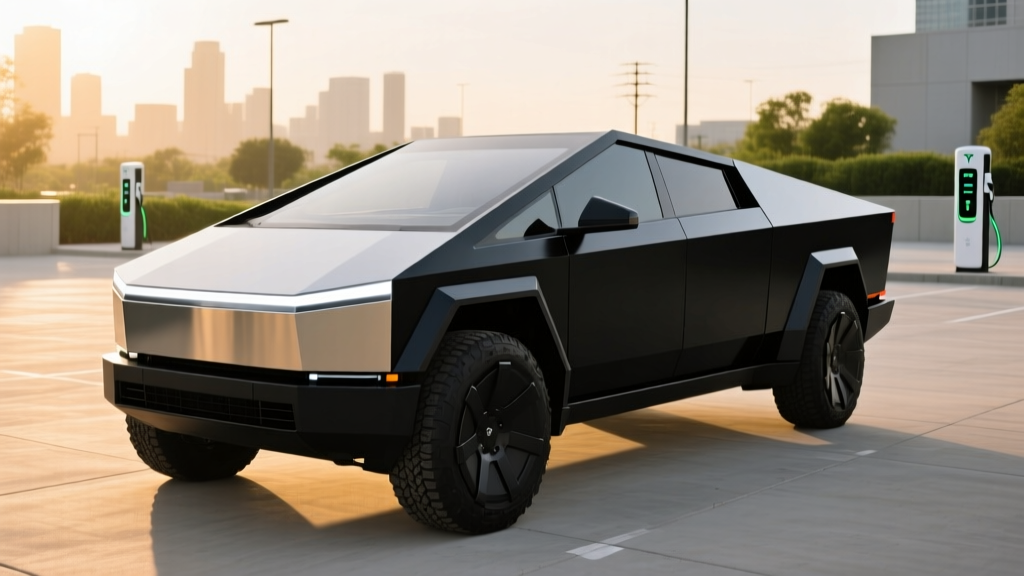
The black Tesla Cybertruck remains one of the most polarizing electric vehicles on the road. Whether you're drawn to the stealthy matte-black Stealth Wrap or the glossy Solid Black paint option, the Cybertruck's angular stainless-steel exoskeleton turns heads at every stoplight. But beyond the aesthetics, the 2026 Cybertruck lineup delivers genuine truck capability paired with Tesla's Supercharger network and over-the-air updates. With the AWD model offering an EPA-estimated 340 miles of range and the Cyberbeast dropping to 325 miles, the real question is whether the Cybertruck's real-world efficiency, charging speed, and daily usability justify its premium pricing — especially as rival electric trucks like the Rivian R1T and Ford F-150 Lightning continue to close the gap.
2026 Cybertruck Trim Lineup and Pricing
| Trim | Drivetrain | Base MSRP | As-Tested (Typical) |
|---|---|---|---|
| Long Range AWD | Dual-Motor AWD | $79,990 | $83,000–$86,000 |
| Tri-Motor AWD (formerly Foundation Series features) | Tri-Motor AWD | $99,990 | $103,000–$108,000 |
| Cyberbeast | Tri-Motor AWD | $119,990 | $122,000–$127,000 |
All three trims are available in a factory Solid Black finish. Tesla also offers aftermarket-style Stealth (matte black) and Satin Black paint protection film wraps through its service centers, typically adding $3,000–$5,000 to the out-the-door cost. The black aesthetic pairs particularly well with the Cybertruck's raw stainless-steel panels, giving it a monochromatic, stealth-bomber look that has become one of the most requested configurations.
Range, Battery, and Real-World Efficiency
Long Range AWD: EPA 340 mi | Real-world highway (70 mph): ~285–305 mi | Cold weather (below 32°F): ~240–270 mi
Tri-Motor AWD: EPA 325 mi | Real-world highway: ~275–295 mi | Cold weather: ~230–260 mi
Cyberbeast: EPA 325 mi | Real-world highway: ~260–285 mi | Cold weather: ~220–250 mi
The 2026 Cybertruck uses a structural battery pack with an estimated 123 kWh usable capacity (approximately 135 kWh gross) based on NMC (nickel manganese cobalt) cell chemistry supplied by Panasonic's 4680-format cells produced at Tesla's Austin Gigafactory. NMC chemistry offers higher energy density than LFP, which is essential for a vehicle of this mass — the Cybertruck tips the scales at roughly 6,600–7,000 lbs depending on trim.
Efficiency lands at approximately 56–59 MPGe combined (Long Range AWD) according to fueleconomy.gov, translating to roughly 56–60 kWh per 100 miles. That figure is competitive for the electric truck segment, though notably lower than Tesla's sedan lineup. The Cybertruck's boxy aerodynamics and substantial weight work against highway efficiency — expect a noticeable 10–15% range drop at sustained 80 mph speeds compared to the EPA combined estimate.
In cold weather, the Cybertruck benefits from Tesla's heat pump system, which manages cabin heating and battery thermal conditioning more efficiently than resistive heaters. Still, any EV loses range in freezing temperatures. Budget-conscious buyers in northern climates should plan for 20–30% range reduction in winter, particularly on short trips where the battery doesn't reach optimal operating temperature.
Charging Speed: DC Fast Charge and Home Level 2
| Charging Level | Max Power | Speed / Time | Connector |
|---|---|---|---|
| DC Fast Charge (V4 Supercharger) | ~350 kW peak | 10–80% in ~15–18 min | NACS (native) |
| DC Fast Charge (V3 Supercharger) | ~250 kW peak | 10–80% in ~20–25 min | NACS (native) |
| Level 2 Home (Tesla Wall Connector) | 11.5 kW (48A) | ~34 mi/hr added | NACS |
| Level 2 Home (Mobile Connector, 240V/32A) | 7.7 kW | ~23 mi/hr added | NACS |
| Level 1 (120V standard outlet) | ~1.4 kW | ~3–4 mi/hr added | NACS w/ adapter |
The Cybertruck's 800V-capable electrical architecture enables some of the fastest charging in the electric truck segment. On Tesla's newest V4 Superchargers, the truck can accept a peak rate around 350 kW, though sustained rates taper significantly above 50–60% state of charge. Expect the 10–80% charge to take approximately 15–18 minutes on a V4 cabinet and 20–25 minutes on the more common V3 Superchargers that still dominate the network. The charge curve is aggressive in the low-to-mid SoC range but flattens considerably past 80% — a common trait with NMC cells optimized for longevity.
For home charging, Tesla's Wall Connector at 48 amps delivers roughly 34 miles of range per hour of charging. A full overnight charge from 20% to 80% takes about 6–7 hours, which suits most daily driving patterns. Installation of a 240V/60A circuit typically costs $800–$2,500 depending on panel proximity and local permitting, though some homes may require a panel upgrade adding $1,500–$3,000.
The Cybertruck ships with the NACS (North American Charging Standard) connector natively. For non-Tesla public DC fast chargers using CCS, Tesla provides an adapter. Access to the full Supercharger network — now numbering over 20,000 stalls in North America — remains a significant ownership advantage, particularly for road trips through rural corridors where third-party charger reliability remains inconsistent.
Performance, Capability, and Towing
| Spec | Long Range AWD | Tri-Motor AWD | Cyberbeast |
|---|---|---|---|
| 0–60 mph | 3.9 sec | 2.6 sec | 2.6 sec (w/ rollout subtracted: ~2.4 sec) |
| Horsepower | ~600 hp | ~845 hp | ~845 hp |
| Torque | ~590 lb-ft | ~740 lb-ft | ~740 lb-ft |
| Top Speed | 130 mph | 130 mph | 149 mph |
| Max Towing | 11,000 lbs | 11,000 lbs | 11,000 lbs |
| Payload Capacity | 2,500 lbs | 2,500 lbs | 2,500 lbs |
| Bed Length | 6 ft (72 in) lockable tonneau | ||
The Cybertruck's performance numbers are staggering for a vehicle of its size. The dual-motor Long Range AWD hits 60 mph in 3.9 seconds — quicker than most sports sedans — while the Tri-Motor and Cyberbeast trims demolish the sprint in 2.6 seconds. For context, that puts the Cyberbeast in supercar territory while towing up to 11,000 pounds.
Towing range is the elephant in the room. When pulling a 7,000–10,000 lb trailer, expect range to drop by 40–55%. That means a 340-mile EPA truck effectively becomes a 150–190-mile truck under heavy tow. Tesla's integrated trailer brake controller and tow-assist camera views help manage the load, but long-distance towing still requires careful Supercharger planning. The bed's motorized tonneau cover (standard) and built-in 120V/240V outlets (up to 11.5 kW output via Powershare) make the Cybertruck a capable mobile worksite or tailgate platform.
Interior, Cargo Space, and Daily Usability
The Cybertruck seats five across two rows, though the rear seat is best suited for children or shorter adults on longer trips. Front legroom measures approximately 41.5 inches; rear legroom comes in at roughly 38.5 inches — adequate but not generous compared to a full-size F-150 SuperCrew. The cabin's minimalist design centers on an 18.5-inch touchscreen that handles virtually all vehicle controls, including a digital instrument cluster rendered on the left third of the display.
Cargo volume behind the rear seats is limited compared to traditional trucks — approximately 34 cubic feet in the enclosed "frunk" (front trunk) and cabin combined, plus the 6-foot lockable bed with roughly 67 cubic feet of enclosed volume under the tonneau. The bed features integrated ramps, a 120V/240V outlet panel, and LED lighting. The Cybertruck's steer-by-wire system eliminates the mechanical steering column, creating a slightly more open driver footwell, though it takes some acclimation at low speeds.
Build quality on 2026 models has improved substantially over early 2024 production units. Panel gaps are tighter, the stainless-steel shell shows fewer cosmetic imperfections, and the interior materials — while still heavily synthetic — feel more durable and better assembled. The vault-like quietness of the cabin at highway speed is genuinely impressive, aided by acoustic glass and the absence of drivetrain noise.
Technology, Driver Assistance, and Safety
Every Cybertruck comes with Tesla's Autopilot suite, which includes Traffic-Aware Cruise Control and Autosteer — a SAE Level 2 driver-assistance system. The driver must maintain hands-on-wheel awareness and full attention at all times. Tesla's Full Self-Driving (Supervised) package, available as a $8,000 add-on or $99/month subscription in 2026, adds automatic lane changes, intersection handling, and parking assist — but remains a Level 2 system requiring continuous driver supervision. This is not autonomous driving.
Tesla Autopilot and FSD (Supervised) are Level 2 driver-assist systems. They do not make the Cybertruck self-driving. The driver is legally and practically responsible for all vehicle operation. Only Level 4 robotaxi services (Waymo, Zoox in limited geofenced areas) operate without a human driver.
On the safety front, the Cybertruck's stainless-steel exoskeleton and large crumple zones provide substantial crash protection. The truck earned top marks in NHTSA frontal and side crash testing. Standard safety features include automatic emergency braking, blind-spot monitoring, lane-departure warning, and 360-degree camera views. The Cybertruck's size and weight provide inherent crash compatibility advantages, though its width (nearly 80 inches without mirrors) can make urban parking and narrow-lane navigation challenging.
The infotainment system runs Tesla's proprietary OS, supporting streaming media (Netflix, YouTube, Spotify), gaming, and a built-in web browser. Apple CarPlay and Android Auto are not supported — a dealbreaker for some buyers. Tesla's over-the-air update pipeline continues to add features post-purchase, including UI refinements, efficiency optimizations, and entertainment additions.
Federal Tax Credit and Ownership Economics
- Maximum credit: Up to $7,500 (split between critical minerals and battery components)
- MSRP cap for trucks/SUVs: $80,000 — only the Long Range AWD trim at base MSRP qualifies
- Buyer income caps: AGI ≤ $150,000 (single), ≤ $225,000 (head of household), ≤ $300,000 (married filing jointly)
- Battery sourcing: Must meet critical mineral and battery component requirements per IRS guidelines — subject to annual tightening
- Point-of-sale transfer: Eligible buyers can apply the credit as an upfront price reduction at the dealer (Tesla) rather than waiting for tax filing
Important: Tax credit eligibility depends on your specific income, the vehicle's battery sourcing compliance in the delivery year, and MSRP configuration. Consult a tax professional before relying on the credit. The Tri-Motor AWD ($99,990) and Cyberbeast ($119,990) exceed the $80,000 MSRP cap and do NOT qualify.
| Category | Estimated Cost |
|---|---|
| Purchase Price (after $7,500 credit) | ~$72,490 |
| Home Charger Install (Level 2) | $1,200–$2,500 |
| Electricity (5 yrs, 12k mi/yr, $0.14/kWh avg) | ~$5,200 |
| Insurance (5 yrs, avg) | $14,000–$18,000 |
| Maintenance (tires, cabin filter, wiper fluid) | $1,800–$2,500 |
| Estimated Depreciation (5 yr) | $28,000–$35,000 |
| Total (approx.) | $122,000–$135,000 |
Insurance is a significant ownership variable. Cybertruck premiums run 30–60% higher than comparable F-150 Lightning policies, driven by repair costs for the stainless-steel body and high claim severity. Shop multiple insurers before purchase. Electricity costs remain far below gasoline on a per-mile basis — roughly $0.04–$0.06 per mile on home charging versus $0.14–$0.18 per mile for a gas truck averaging 18 mpg.
Warranty Coverage
Tesla provides the following warranty coverage for the 2026 Cybertruck:
- Basic Vehicle Limited Warranty: 4 years / 50,000 miles
- Battery & Drive Unit Warranty: 8 years / 120,000 miles (whichever comes first), with minimum 70% battery capacity retention guaranteed over the warranty period
- Restraint System: 5 years / 60,000 miles
- Corrosion Perforation: 12 years (unlimited miles)
The 8-year/120,000-mile battery warranty is competitive within the segment. Tesla's vertical integration — manufacturing its own 4680 cells — gives it direct control over warranty claims without third-party battery supplier complications. For buyers concerned about long-term battery degradation, NMC chemistry in Tesla packs has historically shown 10–15% capacity loss over 150,000–200,000 miles based on fleet data, though individual results vary with charging habits and climate.
Pros and Cons
✅ Pros
- Class-leading acceleration (2.6 sec 0–60 Cyberbeast)
- Access to Tesla Supercharger network (20,000+ stalls)
- 11,000-lb towing capacity with integrated brake controller
- 800V architecture with ~350 kW peak DC fast charging
- Stainless-steel body resists dents and corrosion
- 240V bed outlet (11.5 kW) for job-site or camping power
- Over-the-air updates add features post-purchase
❌ Cons
- High starting price; only base AWD qualifies for tax credit
- Rear seat space limited for tall adults
- Towing range drops 40–55% under heavy loads
- No Apple CarPlay / Android Auto support
- Insurance premiums significantly above segment average
- Steer-by-wire takes acclimation at low speeds
- Width makes tight urban parking difficult
Who Should Buy the Black Cybertruck?
Choose the Cybertruck if: You want a high-performance electric truck with Supercharger access, need genuine towing and payload capability, value Tesla's software ecosystem, and can accommodate its size and insurance costs. The black configuration appeals to buyers who want a monochromatic, stealth aesthetic without chrome or bright trim.
Consider the Rivian R1T or F-150 Lightning instead if: You need more rear-seat space, prefer Apple CarPlay integration, want a lower entry price (Lightning starts under $55,000), or need a more conventional truck driving feel without steer-by-wire. The R1T also offers a larger battery option and a more refined interior for family use.
Frequently Asked Questions
What is the real-world range of the black Tesla Cybertruck?
The Long Range AWD achieves an EPA-estimated 340 miles, but expect 285–305 miles on sustained highway driving at 70 mph and 240–270 miles in freezing temperatures. The Cyberbeast drops to 325 EPA / ~260–285 real-world highway. Cold weather, high speeds, and towing all significantly reduce range.
How fast does the Cybertruck charge at home and on the road?
On a V4 Supercharger, peak charging reaches ~350 kW, achieving 10–80% in roughly 15–18 minutes. At home on a Tesla Wall Connector (11.5 kW / 48A), you'll add about 34 miles of range per hour — enough to fully replenish overnight from typical daily driving.
Does the Cybertruck qualify for the $7,500 federal EV tax credit?
Only the Long Range AWD at its $79,990 base MSRP qualifies, since the §30D credit caps eligible trucks/SUVs at $80,000 MSRP. The Tri-Motor AWD and Cyberbeast exceed this cap. Even for the Long Range, your adjusted gross income must fall below IRS thresholds ($150K single / $300K joint), and the battery must meet critical-mineral sourcing requirements for the delivery year. Verify current eligibility on irs.gov or with a tax professional.
Is the Cybertruck worth buying versus the Rivian R1T or Ford F-150 Lightning?
The Cybertruck wins on raw performance, charging speed, and Supercharger network access. The F-150 Lightning offers a lower price, more conventional truck ergonomics, and better rear-seat space. The Rivian R1T delivers a more premium interior, a quad-motor option, and greater off-road articulation. Your choice depends on budget, space needs, and whether Tesla's ecosystem and performance numbers outweigh the Cybertruck's compromises.
Can I get the Cybertruck in matte black from the factory?
Tesla offers Solid Black as a factory paint option across all trims. A matte or satin black paint protection film (PPF) wrap is available through Tesla service centers and authorized installers, typically costing $3,000–$5,000 additional. Many black Cybertruck owners opt for the stealth PPF wrap for both aesthetics and paint protection.
How long will the Cybertruck battery last?
Tesla warranties the battery for 8 years / 120,000 miles with at least 70% capacity retention. Based on historical Tesla NMC pack data, most owners see 10–15% degradation over 150,000–200,000 miles with normal charging habits (avoiding consistent 100% charges and extreme heat exposure). Battery replacement, if ever needed out of warranty, is estimated at $15,000–$25,000 depending on future cell costs.