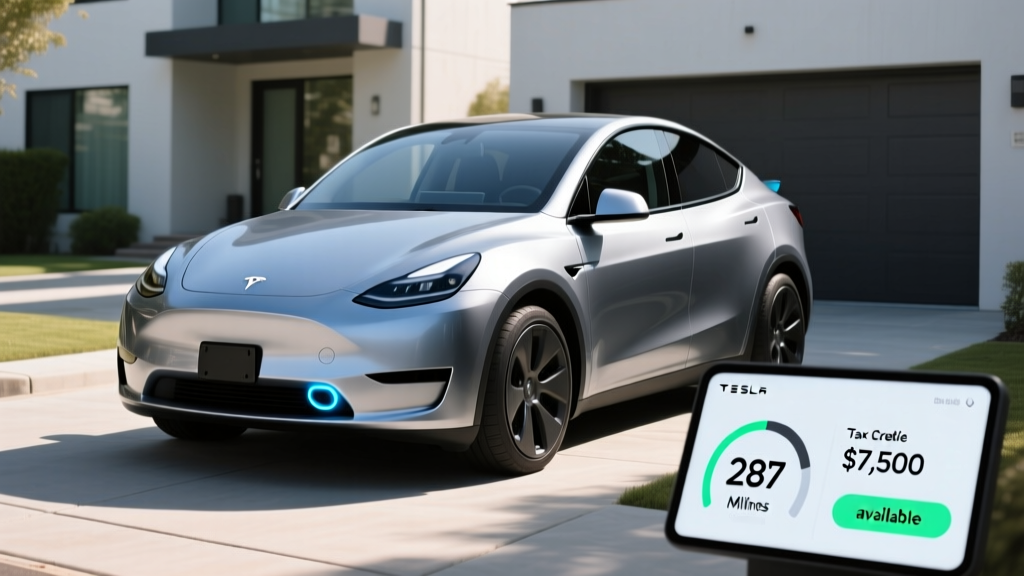
If you've searched "lease Model Y" in 2026, you're likely weighing Tesla's refreshed crossover against a purchase — or against competitors like the Hyundai Ioniq 5 and Ford Mustang Mach-E. Leasing a Model Y changes the math significantly: you sidestep depreciation risk, lock in a monthly payment, and in many cases capture a $7,500 federal incentive that purchase buyers may not qualify for due to income or battery-sourcing rules.
Below is a data-driven teardown of what you're actually getting in a 2026 Tesla Model Y — real-world range, charging behavior, cargo space, and whether the lease route is the financially smarter play this year.
2026 Model Y at a Glance: Specs That Matter
| Spec | Model Y Long Range AWD | Model Y Performance |
|---|---|---|
| EPA Range | 320 miles | 293 miles |
| Battery (usable) | ~75 kWh, NMC | ~75 kWh, NMC |
| Drivetrain | Dual-Motor AWD | Dual-Motor AWD |
| Horsepower | 384 hp | 456 hp |
| 0–60 mph | 4.8 sec | 3.5 sec |
| Max DC Fast Charge | 250 kW | 250 kW |
| 10–80% DCFC Time | ~25 min | ~25 min |
| Level 2 Home Charge | 11.5 kW (~37 mi/hr) | 11.5 kW (~37 mi/hr) |
| MPGe (combined) | 122 MPGe | 111 MPGe |
| Base MSRP | $44,990 | $49,990 |
| Battery Warranty | 8 yr / 120,000 mi | 8 yr / 120,000 mi |
Real-World Range: What the EPA Sticker Doesn't Tell You
Real-World Expectation: 270–290 miles on mixed highway driving at 70 mph; 240–260 miles in freezing weather with cabin heat; 300+ miles in city/regen-heavy commuting.
The Model Y Long Range AWD carries an EPA-rated 320 miles on its ~75 kWh NMC (nickel-manganese-cobalt) battery pack. That's competitive for the segment, but EPA testing cycles don't reflect sustained highway speeds or winter conditions.
In real-world highway testing at 70–75 mph with moderate climate use, expect to use roughly 26–28 kWh per 100 miles — yielding about 270–290 miles before you'd want to stop. Cold weather (below 30°F) compounds this: battery chemistry slows and cabin heating draws significant power, often cutting usable range by 15–25%. A winter road trip that the EPA suggests should take one charge may require a brief 10-minute DC top-up.
City drivers who lean on regenerative braking will see numbers closer to — or occasionally above — the EPA sticker. The Model Y's heat pump (standard since the 2021 refresh) helps mitigate cold-weather losses compared to older EVs with resistive heaters, but physics still applies.
Charging Speed: DC Fast, Home Level 2, and the Curve Reality
Tesla's Supercharger network remains the strongest public-charging ecosystem in the U.S., and the Model Y is optimized for it. But understanding the charge curve matters more than the peak kW number.
| Charging Level | Power (kW) | Miles Added Per Hour | Notes |
|---|---|---|---|
| Level 1 (120V household) | ~1.4 kW | ~4–5 mi/hr | Emergency/trickle only |
| Level 2 (240V, 48A Wall Connector) | 11.5 kW | ~37 mi/hr | Full overnight charge in ~8 hrs |
| DC Fast (Supercharger V3/V4) | Peak 250 kW | ~200 mi in 15 min | Peak only below ~50% SoC |
The charge curve reality: The Model Y peaks at 250 kW only when the battery is preconditioned and at a low state of charge (typically below 40–50%). Above 60% SoC, the rate tapers to roughly 100–120 kW, and above 80% it drops further to protect battery longevity. A 10–80% session takes approximately 25 minutes at a V3 Supercharger. Plan road-trip stops around the 15–20 minute mark — charging from 80% to 100% at a DC fast charger is painfully slow and rarely worth the wait.
For home charging, Tesla's Wall Connector at 48 amps on a 240V/60A circuit delivers 11.5 kW, adding roughly 37 miles of range per hour. Most owners who plug in nightly never need public charging except on road trips. Budget $500–$1,500 for a licensed electrician to install a NEMA 14-50 outlet or hardwired Wall Connector, depending on your panel capacity and run length.
Leasing vs. Buying: The Tax Credit Advantage
Here's where the "lease Model Y" search pays off. Under IRS §30D rules, purchasing a Model Y may or may not qualify you for the full $7,500 federal tax credit — it depends on your adjusted gross income, the vehicle's MSRP, and whether the battery's critical minerals and components meet U.S. sourcing requirements (which shift annually and have tightened significantly by 2026).
However, leasing changes the game. Under the commercial clean vehicle credit (§45W), the leasing company (the lessor) claims a $7,500 credit and can — though isn't required to — pass it through as a "lease cash" reduction. Most Tesla leases in 2026 reflect this as a capitalized cost reduction, effectively lowering your monthly payment.
- Vehicle MSRP must not exceed $80,000 for SUVs (Model Y qualifies)
- Buyer AGI must not exceed $150K single / $300K joint
- Battery critical minerals must meet escalating U.S./FTA-country sourcing thresholds
- Battery components must not be from a "foreign entity of concern"
- Point-of-sale transfer available at participating dealers
| Scenario | Model Y Long Range AWD |
|---|---|
| Base MSRP | $44,990 |
| Typical Lease (36 mo, 10K mi/yr, with $7,500 lease cash) | ~$449–$529/mo (est., varies by region & money factor) |
| Purchase with Full §30D Credit | ~$37,490 effective (if eligible) |
| Purchase without Credit (sourcing/income disqualification) | $44,990 + state fees |
The lease path essentially guarantees you benefit from the federal incentive regardless of your personal tax situation or the battery's sourcing compliance at the time of delivery. That alone makes leasing the Model Y in 2026 the more predictable financial move for many buyers.
Interior, Cargo, and Tech: Daily Livability
The 2026 Model Y continues with Tesla's minimalist cabin — a single 15.4-inch center touchscreen handles navigation, climate, media, and vehicle settings. There is no instrument cluster; speed and range info live in the upper-left corner of the main display.
Cargo space: 30.2 cubic feet behind the second row, expanding to 72.1 cubic feet with the 60/40 split seats folded. The rear trunk opening is wide and the load floor is flat, making it one of the most practical crossovers in its class for bulky items. A small front trunk (frunk) adds roughly 2.1 cubic feet for charging cables or a small bag.
Passenger space: Front legroom is generous at 41.8 inches; rear legroom measures 37.3 inches — adequate for adults on moderate trips but tighter than a Hyundai Ioniq 5's rear seat. The panoramic glass roof creates an airy feel but does let in heat; Tesla includes a tinted panel, though some owners add an aftermarket sunshade for summer.
Driver assistance: Basic Autopilot (traffic-aware cruise control and lane centering) is standard. Full Self-Driving (Supervised) remains a $8,000 option or $99/month subscription. It is critical to understand that FSD is an SAE Level 2 system — it does not make the car autonomous. You must keep your hands on the wheel and eyes on the road at all times. The system handles highway lane changes, on-ramps, and some city intersections impressively, but it requires constant supervision and can make unpredictable decisions in construction zones or unusual traffic patterns.
How It Stacks Up: Model Y vs. Key Competitors
The Model Y doesn't exist in a vacuum. Here's how it compares to the two most cross-shopped rivals for lease-minded buyers:
| Spec | 2026 Tesla Model Y LR AWD | 2026 Hyundai Ioniq 5 Limited AWD | 2026 Ford Mustang Mach-E Premium AWD |
|---|---|---|---|
| EPA Range | 320 mi | 290 mi | 300 mi |
| Max DC Charge | 250 kW | 238 kW (350 kW capable) | 150 kW |
| 10–80% Time | ~25 min | ~18 min (on 350 kW charger) | ~38 min |
| 0–60 mph | 4.8 sec | 5.1 sec | 5.2 sec |
| Cargo (rear seats up) | 30.2 cu ft | 27.2 cu ft | 29.7 cu ft |
| Base MSRP (AWD) | $44,990 | $49,500 | $45,995 |
| Charging Network Access | Supercharger (native NACS) | Supercharger (NACS adapter included) | Supercharger (NACS adapter included) |
The Ioniq 5 charges faster on compatible 350 kW Electrify America stations and offers a more conventional interior with physical buttons and a proper instrument display. The Mach-E has a car-like driving feel and strong dealership support. But the Model Y still leads in range-per-dollar, Supercharger seamlessness, and cargo volume — which matters if you lease based on monthly efficiency.
Consider the Ioniq 5 instead if: You want faster peak charging, a more traditional cabin layout, and don't mind slightly less range.
Consider the Mach-E instead if: You prefer a car-like driving dynamic, want Ford dealership service access, and your commute doesn't demand maximum range.
Pros and Cons: The Honest Scorecard
Pros
- 320-mile EPA range is among the best in its class
- Supercharger network remains the most reliable DC charging ecosystem
- $7,500 lease credit bypasses §30D sourcing/income restrictions
- 30.2 cu ft cargo space beats most competitors
- OTA updates continuously add features post-delivery
- Heat pump standard for better cold-weather efficiency
- Strong resale value reduces lessor's depreciation (helps lease rates)
Cons
- Minimalist interior isn't for everyone — no physical buttons or gauges
- Rear seat legroom tighter than Ioniq 5 and some rivals
- FSD (Supervised) is expensive and still requires full driver attention
- 250 kW peak charge rate is slower than Ioniq 5's 350 kW capability
- Glass roof can make cabin warm in direct summer sun
- Tesla service center availability varies significantly by region
- Ride quality is firm — sporty, not plush
Who Should Lease the Model Y in 2026?
Daily commuters (20–60 miles round trip): Ideal. Home Level 2 charging covers all daily needs, and you'll rarely visit a Supercharger. The 320-mile range means charging 2–3 times per week at most.
Small families: The cargo space handles strollers, groceries, and road-trip luggage well. Two car seats fit comfortably in the second row, though the center position is tight. Families needing three-across seating should look at the Model X or a three-row EV like the Kia EV9.
Road trippers: Supercharger coverage along major U.S. interstates is excellent. Plan 20-minute stops every 250 miles and you'll average 65–70 mph including charging — competitive with gas-car stops. Use Tesla's built-in trip planner or A Better Route Planner for accurate estimates.
Towing: The Model Y is rated for 3,500 pounds — enough for a small utility trailer or a pair of dirt bikes, but not a camper. Towing cuts range roughly in half; plan accordingly.
Lease-averse buyers who keep cars 8+ years: If you plan to drive the car into the ground, purchasing (and qualifying for the credit) may be cheaper long-term. But if you prefer cycling into new vehicles every 3 years and avoiding battery degradation risk, the lease is the right structure.
Frequently Asked Questions
What is the real-world range of the 2026 Model Y?
The EPA rates the Long Range AWD at 320 miles. Expect 270–290 miles in real-world highway driving at 70 mph, and 240–260 miles in sub-freezing winter conditions. City driving with regenerative braking can approach or slightly exceed the EPA number.
How fast does the Model Y charge at home and on the road?
On a 240V Level 2 home charger (11.5 kW), the Model Y adds about 37 miles of range per hour — a full charge takes roughly 8 hours. On a Tesla V3 Supercharger, it peaks at 250 kW and charges from 10% to 80% in about 25 minutes, though the rate tapers significantly above 60% state of charge.
How much does it cost to lease a Model Y after the federal tax credit?
With the $7,500 lease cash credit applied as a capitalized cost reduction, typical 36-month leases for the Long Range AWD range from roughly $449 to $529 per month depending on your region, credit tier, and annual mileage allowance. Exact terms vary by Tesla Financial Services and are subject to money factor adjustments.
Does leasing a Model Y qualify for the $7,500 federal tax credit?
The lessee does not directly claim the §30D credit. Instead, the leasing entity claims the commercial clean vehicle credit (§45W) and typically passes the $7,500 benefit through as a lease cash incentive that reduces your monthly payment. This bypasses the income caps, battery-sourcing rules, and MSRP limits that apply to purchase buyers. Consult IRS guidance and your tax advisor for specifics.
Is the Model Y worth leasing over the Hyundai Ioniq 5 or Ford Mach-E?
The Model Y wins on EPA range (320 vs. 290–300 miles), cargo volume (30.2 cu ft), and Supercharger network seamlessness. The Ioniq 5 charges faster at compatible 350 kW stations (10–80% in ~18 minutes) and offers a more conventional interior. The Mach-E delivers a more car-like driving feel. Your choice depends on whether range and charging infrastructure (Model Y), charging speed and cabin ergonomics (Ioniq 5), or driving dynamics (Mach-E) matter most.
What is the Model Y's battery warranty?
Tesla covers the Model Y's battery and drive unit for 8 years or 120,000 miles (whichever comes first), with a minimum 70% capacity retention threshold. If the battery degrades below 70% of its original capacity within that period, Tesla will repair or replace it. In practice, Tesla's NMC packs have shown strong longevity — most owners report less than 10% degradation at 100,000 miles based on fleet data.
Can I buy the Model Y at the end of the lease?
Tesla Financial Services lease terms have historically varied on purchase-option availability. Some Tesla leases include a residual purchase option at a predetermined price; others do not. Confirm this detail in your lease agreement before signing, as it affects your long-term strategy.
Leasing a Model Y in 2026 remains one of the most financially efficient ways to drive a long-range electric crossover — particularly if your income, tax situation, or the vehicle's battery sourcing would disqualify you from the purchase credit. With 320 miles of EPA range, a best-in-class charging network, and practical cargo space, it continues to set the benchmark in its segment. Just go in with realistic expectations about real-world range, the minimalist cabin, and the fact that FSD is a driver-assist tool, not a chauffeur.