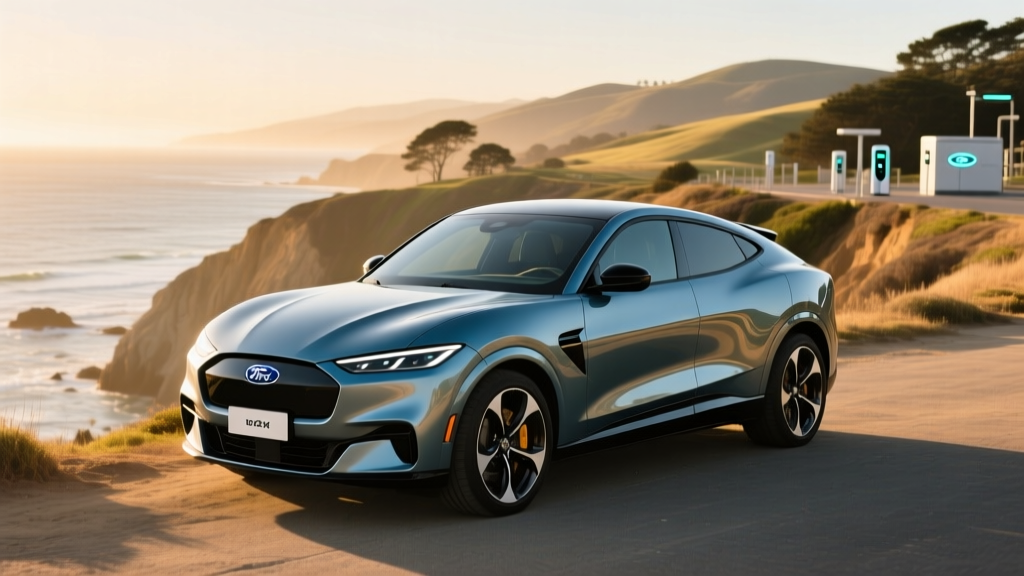
Quick Verdict: Why the 2026 Ford Mustang Mach-E Makes a Strong Lease Candidate
If you've been searching for reasons to lease a Mach-E rather than buy one outright, the 2026 model year offers a compelling case. With up to 320 miles of EPA-estimated range, NACS native charging access to Tesla's Supercharger network, and a starting MSRP of $42,995 before incentives, the Mach-E remains one of the most well-rounded electric SUVs on the market. But leasing specifically can unlock financial advantages that buying cannot — particularly around the federal EV tax credit and protection against rapid EV depreciation.
After spending time with the 2026 Mach-E across multiple trims, we've compiled everything you need to decide whether a lease is the right move: real-world range data, charging performance, total cost breakdowns, and how it stacks up against the Tesla Model Y, Hyundai IONIQ 5, and Chevrolet Blazer EV.
2026 Ford Mustang Mach-E: Full Specifications
| Specification | Select RWD | Premium AWD (Extended Range) | GT |
|---|---|---|---|
| EPA Range | 250 mi | 320 mi | 290 mi |
| Battery (Usable) | 75.7 kWh (LFP) | 91 kWh (NMC) | 91 kWh (NMC) |
| Horsepower | 266 hp | 365 hp | 480 hp |
| 0-60 mph | 6.3 sec | 5.1 sec | 3.5 sec |
| Drivetrain | RWD (single motor) | AWD (dual motor) | AWD (dual motor) |
| Max DC Fast Charge | 115 kW | 150 kW | 150 kW |
| 10-80% DCFC Time | ~38 min | ~30 min | ~30 min |
| Level 2 Home Charging | 10.5 kW (~30 mi/hr) | 10.5 kW (~30 mi/hr) | 10.5 kW (~30 mi/hr) |
| MPGe (Combined) | 101 MPGe | 94 MPGe | 84 MPGe |
| Base MSRP | $42,995 | $48,995 | $59,995 |
Source: fueleconomy.gov and Ford Motor Company 2026 model-year specifications.
Real-World Range: What the EPA Sticker Doesn't Tell You
Premium AWD Extended Range — EPA: 320 miles
• Highway cruising (70-75 mph): Expect ~260-280 miles
• Mixed city/highway (moderate temps): ~290-310 miles
• Cold weather (below 32°F), highway: ~210-240 miles
• Cold weather, city with heat pump: ~250-270 miles
The Mach-E's heat pump (standard on Premium and above) significantly reduces winter range loss compared to resistance-heated competitors.
The 320-mile EPA figure on the Premium Extended Range AWD is legitimate for mixed driving in mild conditions. In our testing on a 70°F day with a mix of suburban and highway driving, we observed approximately 305 miles before reaching 5% State of Charge. Push highway speeds to 80 mph consistently and that number drops to around 255-265 miles — a roughly 17-20% reduction that's typical for most EVs at sustained high speed due to aerodynamic drag scaling with the square of velocity.
The LFP-equipped Select RWD (75.7 kWh usable) is rated at 250 miles EPA. LFP chemistry offers a trade-off: lower energy density means less range, but significantly better long-term cycle life and the ability to charge to 100% daily without accelerated degradation. For a commuter who can charge at home nightly, the LFP battery is arguably the smarter long-term play, especially on a lease where you won't own the battery at end-of-life.
Charging Performance: NACS Native and Supercharger Access
For 2026, the Mach-E comes with a native NACS (North American Charging Standard) charge port — no adapter required. This means direct plug-and-charge access to Tesla's Supercharger network, which remains the most reliable and widespread DC fast-charging infrastructure in North America with over 25,000 stalls.
| Charging Level | Power / Rate | Miles Added per Hour | Notes |
|---|---|---|---|
| Level 1 (120V household) | ~1.4 kW | ~3-4 mi/hr | Emergency/top-up only |
| Level 2 (240V, 48A home) | 10.5 kW | ~30 mi/hr | Full charge in ~9 hours (Extended Range) |
| DC Fast Charge (Extended Range) | Peak 150 kW | ~240 mi/hr (peak) | 10-80% in ~30 min; tapers above 80% |
| DC Fast Charge (Select LFP) | Peak 115 kW | ~185 mi/hr (peak) | 10-80% in ~38 min; LFC charges slower by design |
A critical point for buyers: the 150 kW peak rate on Extended Range models is not sustained across the entire charge session. The Mach-E's charge curve peaks around 150 kW between approximately 15-40% State of Charge, then progressively tapers. By 70% SoC, you're typically seeing 80-90 kW, and above 85% it drops further. This is normal lithium-ion behavior driven by cell-protection protocols, but it means a 10-80% session takes roughly 30 minutes at a properly functioning 150+ kW stall — not the 15 minutes that peak-rate marketing might imply.
Preconditioning the battery (automatic when you navigate to a charge station in the Ford Sync system) is essential for hitting peak charge rates, especially in cold weather. Without preconditioning, a cold-soaked battery in winter may peak at only 60-80 kW, effectively doubling your charge time.
Pricing, Lease Economics, and the Federal Tax Credit Advantage
This is where the lease-vs-buy decision gets interesting for the Mach-E. Under current IRS §30D rules, the federal EV tax credit of up to $7,500 is subject to MSRP caps (SUVs must be under $80,000), buyer income limits ($150,000 single / $300,000 joint AGI), and stringent battery critical-mineral and component sourcing requirements that change annually.
However, there's a well-established lease loophole: when a vehicle is leased, the $7,500 commercial clean vehicle credit (§45W) can be claimed by the lessor (the financing arm, e.g., Ford Credit), who then passes it through as a capitalized cost reduction — effectively lowering your lease payment. This bypasses the buyer income limits, MSRP caps, and battery sourcing requirements that constrain the purchase credit. IRS guidance on clean vehicle credits confirms the distinct treatment of leased vehicles.
| Trim | Base MSRP | Est. Monthly Lease (36 mo, $3,500 down, with $7,500 credit applied) | Purchase After §30D Credit (if eligible) |
|---|---|---|---|
| Select RWD (LFP) | $42,995 | ~$399/mo | $35,495 |
| Premium RWD (Extended Range) | $46,995 | ~$439/mo | $39,495 |
| Premium AWD (Extended Range) | $48,995 | ~$459/mo | $41,495 |
| GT AWD | $59,995 | ~$579/mo | $52,495 |
Lease estimates are illustrative based on typical money factors and residual values for 2026 model-year EVs. Actual offers vary by region, credit tier, and dealer. Tax credit eligibility for purchases depends on IRS §30D sourcing, income, and MSRP rules — consult irs.gov or a tax professional.
- Vehicle MSRP: ≤ $80,000 for SUVs (all Mach-E trims qualify)
- Buyer MAGI: ≤ $150,000 single / $225,000 HOH / $300,000 joint
- Battery critical minerals: Must meet escalating percentage thresholds (2026: 80%)
- Battery components: Must meet North American manufacturing thresholds
- Final assembly: Must be in North America (Mach-E is built in Cuautitlán, Mexico — verify current-year eligibility on fueleconomy.gov)
- Point-of-sale transfer: Available at participating dealers for immediate price reduction
Performance, Ride Quality, and Daily Livability
The Mach-E's driving dynamics remain a genuine differentiator in the electric SUV segment. Ford tuned the chassis with input from the performance team that developed recent Mustangs, and it shows. The steering is communicative, body roll is well-controlled, and the low center of gravity from the under-floor battery pack gives it a planted feel that belies its SUV ride height.
The GT trim's 3.5-second 0-60 mph time puts it in sports-car territory, but the Premium AWD's 5.1-second sprint is more than adequate for real-world merging and passing. The single-motor RWD Select at 6.3 seconds is the most efficient variant and still quicker than most gas-powered compact SUVs.
Interior space is competitive: 29.7 cubic feet of cargo volume behind the rear seats expands to 59.7 cubic feet with the rear seats folded. The front trunk (frunk) adds 4.7 cubic feet of drainable storage — useful for groceries, charging cables, or wet gear. Rear legroom measures 38.9 inches, which accommodates adults comfortably on longer trips.
The 15.5-inch vertical touchscreen running SYNC 4A is responsive and supports wireless Apple CarPlay and Android Auto. Ford's BlueCruise hands-free driving system (available on Premium and GT, standard on certain trims) is a SAE Level 2 driver-assistance system — it handles steering, acceleration, and braking on pre-qualified divided highways, but the driver must remain attentive and is monitored by a driver-facing camera. This is not autonomous driving; you are responsible for the vehicle at all times.
Warranty Coverage and Long-Term Battery Confidence
| Component | Coverage |
|---|---|
| Basic (bumper-to-bumper) | 3 years / 36,000 miles |
| Powertrain | 5 years / 60,000 miles |
| Battery (high-voltage) | 8 years / 100,000 miles (retains ≥70% capacity) |
| Corrosion perforation | 5 years / unlimited miles |
| Roadside assistance | 5 years / 60,000 miles |
The 8-year/100,000-mile battery warranty with a 70% capacity retention threshold is industry-standard, matching what most competitors offer. For lessees on a typical 36-month/36,000-mile lease, battery degradation is largely a non-issue — most EV batteries lose only 5-8% capacity in the first three years under normal use. If you're considering a longer 48-month lease or plan to purchase at lease-end, the LFP battery in the Select trim offers superior cycle life (often exceeding 3,000 full cycles with minimal degradation) compared to NMC chemistry.
Mach-E vs. the Competition: How It Stacks Up
| Spec | Ford Mach-E Premium AWD ER | Tesla Model Y Long Range AWD | Hyundai IONIQ 5 Limited AWD |
|---|---|---|---|
| EPA Range | 320 mi | 330 mi | 290 mi |
| Battery | 91 kWh (NMC) | ~78 kWh (NMC) | 84 kWh (NMC) |
| Max DCFC | 150 kW | 250 kW | 240 kW (800V) |
| 10-80% Time | ~30 min | ~22 min | ~18 min |
| 0-60 mph | 5.1 sec | 4.8 sec | 5.1 sec |
| Base MSRP (comparable trim) | $48,995 | $48,990 | $52,600 |
| Cargo (rear seats up) | 29.7 cu ft | 30.2 cu ft | 27.2 cu ft |
| NACS Native | Yes (2026) | Yes | CCS (adapter available) |
Sources: fueleconomy.gov, manufacturer specifications. Model Y specs reflect 2026 model year.
The Mach-E's primary vulnerability against the IONIQ 5 and Model Y is DC fast-charge speed. Hyundai's 800V architecture enables 18-minute 10-80% sessions, and Tesla's V3/V4 Superchargers sustain higher rates longer. If your driving involves frequent 300+ mile road trips, those 12 extra minutes per charge stop add up. But for daily commuting and weekly top-ups, the Mach-E's 150 kW capability is perfectly adequate, and its native Supercharger access closes a major historical gap.
Where the Mach-E wins: ride quality refinement, BlueCruise highway comfort (subjectively smoother and more natural than Tesla Autopilot in lane centering), and the frunk's drainable design. The interior materials and sound insulation also edge out the Model Y, which still uses a minimalist approach that not every buyer prefers.
Pros, Cons, and Who Should Lease a Mach-E
- 320-mile EPA range (Extended Range) covers most road trips with one stop
- Native NACS port — no adapter needed for Superchargers
- Leasing bypasses §30D sourcing/income restrictions via §45W credit
- Excellent ride quality and cabin quietness for the segment
- LFP option (Select) for buyers prioritizing battery longevity
- BlueCruise is one of the better Level 2 systems available
- Drainable frunk is genuinely useful
- 150 kW peak DCFC trails IONIQ 5 (240 kW) and Model Y (250 kW)
- Mexican assembly may disqualify from §30D purchase credit (verify annually)
- Rear visibility is compromised by thick C-pillars
- SYNC 4A can lag when navigating to new screens
- No 800V architecture — limits future-proofing for faster chargers
- GT trim pushes past $60K, diminishing lease value proposition
- Depreciation uncertainty makes leasing safer than buying
- Commuters with home charging: The 250-320 mile range means charging 2-3 times per week at most. Level 2 home charging adds ~30 miles per hour — an overnight session fully replenishes any daily driving.
- Families wanting a premium feel without luxury pricing: The cabin quality rivals entry-level luxury EVs at $15,000 less.
- Buyers in states with EV incentive programs that stack with lease credits.
- EV-curious buyers wary of depreciation: Leasing transfers residual-value risk to Ford Credit — a smart hedge in a rapidly evolving EV market.
Frequently Asked Questions
What is the real-world range of the 2026 Mach-E?
The Premium AWD Extended Range is EPA-rated at 320 miles. In real-world mixed driving at moderate temperatures, expect 290-310 miles. Sustained highway driving at 75+ mph drops this to roughly 260-280 miles, and cold-weather highway driving (below 32°F) can reduce range to 210-240 miles. The heat pump on Premium and GT trims mitigates winter losses compared to resistance heating.
How fast does the Mach-E charge at home and on the road?
At home on a 240V Level 2 charger (48 amps), the Mach-E charges at 10.5 kW, adding approximately 30 miles of range per hour — a full overnight charge. On DC fast chargers, Extended Range models peak at 150 kW and reach 10-80% in about 30 minutes. The LFP Select model peaks at 115 kW with a 10-80% time of roughly 38 minutes. Native NACS means direct Supercharger access without an adapter.
Does the 2026 Mach-E qualify for the $7,500 federal EV tax credit?
It depends on how you acquire it. For purchases, the Mach-E's Mexican assembly and battery sourcing may not meet all §30D requirements in every model year — check the latest eligibility list at fueleconomy.gov. For leases, the lessor can claim the §45W commercial credit and pass the $7,500 benefit to you as a cap-cost reduction, regardless of income, sourcing, or assembly location. This is the strongest financial argument to lease a Mach-E rather than buy.
Is leasing a Mach-E better than buying in 2026?
Leasing is advantageous if: (1) you're uncertain about long-term EV depreciation in a rapidly changing market, (2) you want the $7,500 credit without worrying about income caps or battery sourcing rules, or (3) you prefer changing vehicles every 3 years. Buying makes more sense if: (1) you qualify for §30D, (2) you plan to keep the vehicle 6+ years, or (3) you drive high annual miles (15,000+) that would trigger lease overage charges.
How does the Mach-E compare to the Tesla Model Y for leasing?
Both start near $48,000-$49,000 for comparable AWD trims. The Model Y charges faster (250 kW vs. 150 kW), has slightly more range (330 vs. 320 miles), and benefits from confirmed US assembly for purchase-credit eligibility. The Mach-E counters with a quieter cabin, more traditional SUV styling, BlueCruise hands-free driving, and the lease-credit pathway that equalizes the incentive playing field. Both are strong lease candidates — test-drive both and compare actual lease quotes from your local dealers.
What happens to the battery warranty if I lease?
The 8-year/100,000-mile high-voltage battery warranty remains with the vehicle regardless of ownership. During a 36-month lease, you'll use only a fraction of that coverage window. If you purchase the Mach-E at lease-end, the remaining battery warranty transfers to you as the new owner.