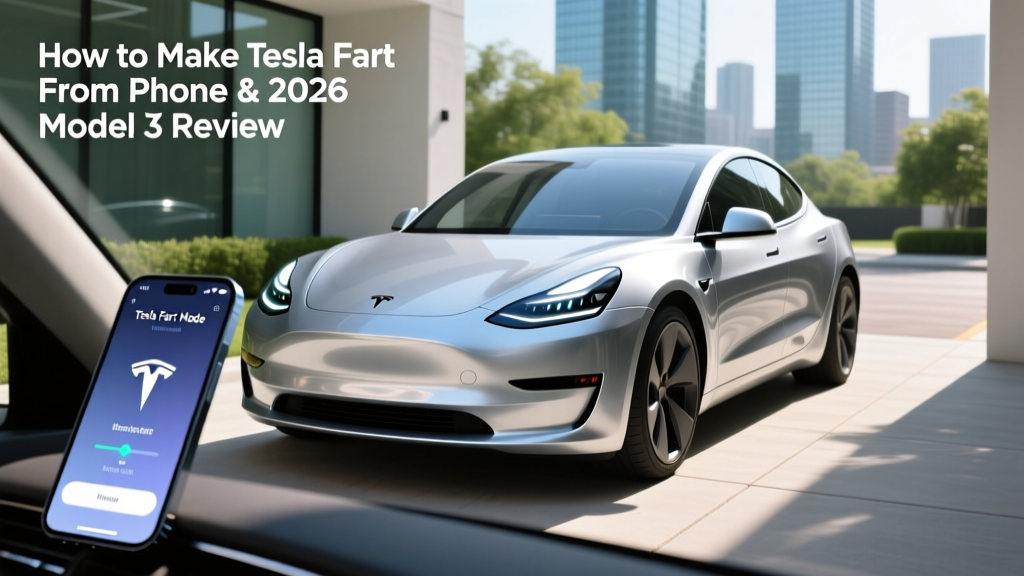
The Tesla Model 3 has long been the benchmark electric sedan — and it also hides one of the internet's favorite party tricks. If you've been searching for how to make Tesla fart from phone, you're not alone. But beyond the novelty, the 2026 Tesla Model 3 (Highland refresh) remains a serious contender in the compact EV sedan segment with competitive range, blistering charge speeds, and a minimalist tech-first cabin. Below, we break down every spec that matters to real buyers, then show you exactly how to trigger the Fart Mode easter egg.
2026 Tesla Model 3: Quick Verdict
The refreshed Model 3 (internally called "Highland") carries forward into the 2026 model year with minor software and pricing adjustments. It remains the most affordable way into a new Tesla, and it's the one most buyers cross-shop against the Hyundai Ioniq 6, BMW i4, and Polestar 2. Its strengths — class-leading efficiency, Supercharger access, and over-the-air updates — are balanced by a polarizing interior, the absence of physical controls, and the ongoing Full Self-Driving (FSD) Supervised debate. For 2026, Tesla dropped the base Long Range RWD starting price slightly, keeping the Model 3 under the §30D MSRP cap.
Range, Battery & Real-World Efficiency
Real-World Expectation: Plan for ~290–320 miles on a highway-heavy road trip in the Long Range AWD. In sub-freezing winter conditions, expect a 15–25% reduction — roughly 270–300 miles usable before you're hunting for a Supercharger.
The 2026 Model 3 Long Range AWD uses a ~79 kWh usable lithium-ion pack (NMC chemistry, nickel-manganese-cobalt) supplied primarily by LG Energy Solution and Panasonic. The Standard Range RWD trims use a ~60 kWh LFP (lithium iron phosphate) battery from CATL. The chemistry choice matters: LFP cells tolerate daily 100% charging without accelerated degradation but are heavier and offer less energy density; NMC delivers more range per pound but Tesla recommends daily charging to 80–90% to preserve longevity.
Efficiency is where Tesla still leads the pack. The Long Range AWD achieves an EPA-rated 132 MPGe combined (25 kWh/100mi), besting the Ioniq 6 (140 MPGe on some trims, but with less range) and crushing the BMW i4 xDrive40 (~109 MPGe). That efficiency translates directly into lower charging costs and longer real-world miles per kWh.
| Spec | Standard Range RWD | Long Range RWD | Long Range AWD | Performance |
|---|---|---|---|---|
| EPA Range | 272 mi | 341 mi | 363 mi | 315 mi |
| Battery (usable) | ~60 kWh (LFP) | ~79 kWh (NMC) | ~79 kWh (NMC) | ~79 kWh (NMC) |
| 0–60 mph | 5.8 s | 4.9 s | 4.2 s | 2.9 s |
| Horsepower | 271 hp | 346 hp | 384 hp | 510 hp |
| Drivetrain | RWD | RWD | Dual-Motor AWD | Dual-Motor AWD |
| MPGe (combined) | 134 | 137 | 132 | 118 |
| Base MSRP | $38,990 | $42,490 | $47,490 | $52,990 |
Charging Speed: DC Fast, Level 2 & Home Setup
The 2026 Model 3 Long Range and Performance trims support a peak DC fast-charge rate of 250 kW on V3 and V4 Superchargers (and compatible CCS/NACS third-party stations). The Standard Range LFP models peak around 170 kW.
| Level | Power | Speed / Time |
|---|---|---|
| DC Fast (Supercharger V3/V4) | Up to 250 kW peak | 10–80% in ~25 min; ~170 mi added in 15 min |
| Level 2 (Home Wall Connector) | 11.5 kW (48A) | ~44 miles of range per hour |
| Level 2 (Public / 40A) | 9.6 kW | ~37 miles per hour |
| Level 1 (120V outlet) | ~1.4 kW | ~3–5 miles per hour (emergency only) |
Real-world charging curve note: The 250 kW peak is sustained only between roughly 10–30% State of Charge (SoC). Above 50%, the curve tapers sharply; above 80%, charging slows to ~40 kW. This is normal for NMC packs managed for longevity. If you're road-tripping, precondition the battery (the car does this automatically when you navigate to a Supercharger) to hit peak speeds — skip preconditioning and you may see only 150 kW even at low SoC on a cold day.
For home installation, Tesla's Wall Connector costs about $475 for the hardware. A licensed electrician install typically runs $500–$2,000 depending on panel proximity and whether your home needs a 200A service upgrade ($1,500–$3,500 additional). Always get a quote from a licensed electrician before committing.
Performance, Ride & Handling
The Long Range AWD's 4.2-second 0–60 time is genuinely quick for a $47k sedan, and the dual-motor torque vectoring gives confident all-weather traction. The Highland refresh retuned the suspension — it's noticeably more compliant than pre-2024 Model 3s, with reduced road noise thanks to acoustic glass and improved damping. The Performance trim adds adaptive dampers, track mode, and a 2.9-second 0–60 that embarrasses most sports cars.
Ride quality still falls short of a BMW i4 or even a Hyundai Ioniq 6 on broken pavement — Tesla's firmness bias shows over sharp impacts. But the steering is precise, the center of gravity is low, and one-pedal driving with aggressive regen makes city traffic effortless.
Interior, Cargo & Tech Features
The Highland cabin is a study in minimalism. All controls — climate, mirrors, glovebox — live on the 15.4-inch center touchscreen. There are no stalks: turn signals are buttons on the steering wheel, and gear selection is a swipe on the screen (with a backup overhead touch panel). Love it or hate it, the build quality has genuinely improved: tighter panel gaps, ventilated front seats, ambient lighting, and rear-seat entertainment screen are all standard.
- Cargo: 23 cu ft trunk + 3.1 cu ft frunk (front trunk)
- Rear legroom: 35.2 inches
- Front headroom: 40.3 inches
- Infotainment: 15.4" touchscreen, Netflix/YouTube/arcade while parked, Bluetooth 5.0, no Apple CarPlay or Android Auto
- Driver assist: Basic Autopilot standard (SAE Level 2 — requires active driver supervision); FSD Supervised available as a $99/mo subscription or $8,000 purchase
Pricing, Tax Credits & Total Cost
| Trim | MSRP | Potential §30D Credit | Effective Price |
|---|---|---|---|
| Standard Range RWD | $38,990 | Up to $3,750–$7,500* | ~$31,490–$35,240 |
| Long Range RWD | $42,490 | Up to $3,750–$7,500* | ~$34,990–$38,740 |
| Long Range AWD | $47,490 | Up to $3,750–$7,500* | ~$39,990–$43,740 |
| Performance | $52,990 | Up to $3,750–$7,500* | ~$45,490–$49,240 |
*Federal §30D tax credit caveats: The New Clean Vehicle Credit under IRS §30D is subject to buyer income caps ($150k single / $300k joint MAGI), an MSRP cap ($55,000 for sedans — all Model 3 trims qualify), and critical-mineral plus battery-component sourcing requirements that change annually. For 2026, Tesla's North American battery sourcing typically qualifies for $3,750 (battery components) and may qualify for the additional $3,750 (critical minerals) depending on supply-chain updates. The credit can be transferred to the dealer at point of sale as an upfront discount. Check current IRS §30D rules and consult a tax professional before relying on a specific credit amount.
Over 5 years of ownership, a Model 3 Long Range AWD driven 12,000 miles/year at $0.15/kWh electricity costs roughly $3,600 in "fuel" — vs ~$9,000 in gasoline for a comparable 30 MPG sedan. Add lower maintenance (no oil changes, reduced brake wear from regen) and the TCO advantage is meaningful despite higher insurance premiums (typically 15–30% above gas equivalents).
Pros, Cons & Who Should Buy
- Class-leading efficiency (132 MPGe combined)
- 250 kW peak DC charging on NACS/Supercharger network
- Strong real-world range (300+ mi highway in Long Range)
- OTA updates continuously add features
- Excellent safety ratings (IIHS Top Safety Pick+)
- Access to 50,000+ Supercharger stalls nationwide
- No Apple CarPlay / Android Auto
- All controls on touchscreen — steep learning curve
- Turn-signal buttons on wheel frustrate some drivers
- FSD subscription cost adds up; still Level 2
- Insurance costs above segment average
- Rear visibility compromised by sloped roofline
Best for: Tech-forward commuters, road-trippers who value Supercharger access, and drivers who want a quick, efficient sedan under $50k. Consider alternatives if you need CarPlay, prefer physical controls, or want a plusher ride (BMW i4, Hyundai Ioniq 6).
Battery Warranty & Longevity
Tesla covers the Model 3 battery and drive unit for 8 years / 100,000 miles (Standard Range) or 8 years / 120,000 miles (Long Range / Performance), whichever comes first, with a guaranteed minimum 70% capacity retention. Real-world data from fueleconomy.gov and Tesla's own impact reports show average degradation of ~12% at 200,000 miles for NMC packs — well above the warranty floor. Out-of-warranty battery replacement currently costs $12,000–$16,000 depending on pack size, but is rarely needed within typical ownership periods.
How to Make Tesla Fart From Phone (Fart Mode)
Now for the easter egg you came for. Tesla's Fart Mode is a built-in novelty feature that plays a, well, flatulence sound effect through the car's exterior pedestrian-warning speaker — controllable from your phone or the touchscreen. Here's how:
- Open the Tesla mobile app on your phone (iOS or Android).
- Make sure your Model 3 is parked and within Bluetooth/cellular range.
- Scroll to the Toybox section at the bottom of the app's vehicle controls.
- Tap Fart Mode.
- Select who you want to "target" — options include a specific seat (driver, passenger, rear left, rear right) or "All Seats."
- Tap Fart. The exterior PWS speaker emits the sound. Mischief accomplished.
You can also trigger it from inside the car: on the touchscreen, tap Controls → Toybox → Fart Mode. It works on all current Model 3, Model Y, Model S, and Model X vehicles running recent software. Perfect for startling friends outside the car — though we'd recommend restraint in drive-throughs and school zones.
FAQ
What is the real-world range of the 2026 Tesla Model 3?
The Long Range AWD is EPA-rated at 363 miles, but expect ~290–320 miles on highway trips at 70–80 mph, and ~270–300 miles in freezing weather. The Standard Range RWD delivers roughly 220–250 real-world miles.
How fast does the Model 3 charge at home and on the road?
DC fast charging peaks at 250 kW (Long Range/Performance), adding 10–80% in about 25 minutes. At home on a Tesla Wall Connector (11.5 kW / 48A), you gain ~44 miles per hour — a full overnight charge for most commutes.
Does the 2026 Model 3 qualify for the federal EV tax credit?
Yes, conditionally. All trims fall under the $55,000 sedan MSRP cap. Buyers must meet income limits ($150k single / $300k joint) and the vehicle must satisfy battery-sourcing requirements. For 2026, expect $3,750–$7,500 depending on critical-mineral sourcing — verify at irs.gov and with a tax professional.
Is the Model 3 worth buying over the Ioniq 6 or BMW i4?
Choose the Model 3 if Supercharger network access, OTA updates, and efficiency are top priorities. The Ioniq 6 offers a smoother ride, CarPlay-like integration via Android Auto, and slightly higher MPGe on base trims. The BMW i4 wins on cabin luxury and physical controls but costs more and charges slower.
Can Fart Mode be used while driving?
Tesla restricts most Toybox features while the vehicle is in motion for safety reasons. Fart Mode is intended for use while parked — which is arguably when it's funniest anyway.
What's the battery warranty on the 2026 Model 3?
8 years / 100,000 miles (Standard Range) or 8 years / 120,000 miles (Long Range and Performance), with a minimum 70% capacity retention guarantee.
For official EPA figures, see the fueleconomy.gov Model 3 listing. Safety ratings available via IIHS.