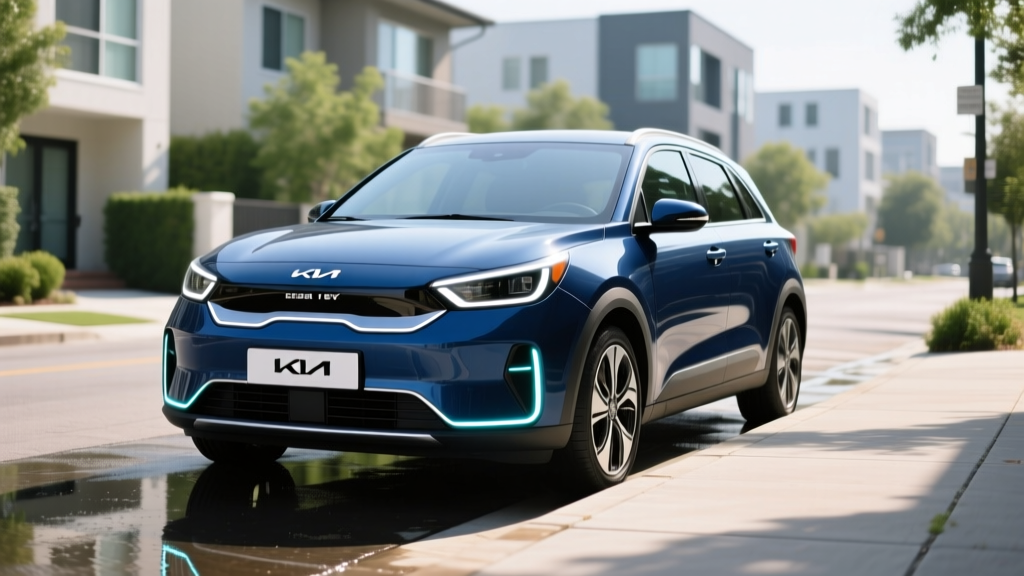
Quick Verdict: Who Should Buy the 2024 Kia Niro EV?
The 2024 Kia Niro EV is a practical, affordable compact electric crossover best suited for daily commuters and small families who have access to home Level 2 charging and drive fewer than 200 miles per day. With an EPA-estimated 239 miles of range, a base MSRP around $39,600, and excellent efficiency (113 MPGe combined), it undercuts rivals like the Hyundai Ioniq 5 and Volkswagen ID.4 on price while delivering competitive real-world usability. However, its DC fast-charging speed peaks at just 85 kW — meaning road-trip charging stops take noticeably longer than newer 800V-platform EVs. If you mostly drive locally and can charge at home overnight, the Niro EV remains one of the most cost-effective ways to go electric in 2026.
Range and Efficiency: EPA Numbers vs. Real-World Driving
The 2024 Kia Niro EV carries a 64.8 kWh lithium-ion battery pack (NMC chemistry) powering a single front-mounted electric motor producing 201 horsepower and 291 lb-ft of torque. The EPA rates it at 239 miles of combined range with an efficiency of 113 MPGe (29 kWh/100 miles).
Real-World Range Expectations
EPA sticker: 239 miles
Highway driving (70-75 mph): Expect roughly 200–215 miles. The Niro EV's boxy crossover shape creates more aerodynamic drag at sustained highway speeds, reducing efficiency to approximately 32–34 kWh/100 mi.
Cold weather (below 32°F): Plan for 170–195 miles. The Niro EV uses a resistive PTC heater rather than a heat pump, which draws significant battery energy in winter. Preconditioning while plugged in helps mitigate this loss.
City/commuter driving: You can match or slightly exceed the EPA figure — regenerative braking in stop-and-go traffic recovers energy, and some owners report 245–260 miles in mild-weather urban driving.
For context, the 2024 Chevrolet Bolt EUV offers 247 EPA miles at a lower price, while the Hyundai Ioniq 5 (Long Range RWD) delivers 303 miles but starts several thousand dollars higher. The Niro EV sits in a sensible middle ground: enough range for most daily needs without paying a premium for 300+ mile batteries you may never fully use.
Charging Speeds: Home and DC Fast Charging
Understanding charging requires distinguishing between kW (power — how fast energy flows) and kWh (energy — how much the battery holds). Think of kW as the width of a hose and kWh as the size of the bucket.
| Charging Level | Power (kW) | Speed (miles/hour) | Full Charge Time |
|---|---|---|---|
| Level 1 (120V household outlet) | ~1.4 kW | ~4–5 mi/hr | ~48–55 hours |
| Level 2 (240V home/public) | ~10.9 kW (max onboard) | ~32–36 mi/hr | ~6.5–7 hours (10–100%) |
| DC Fast Charging | 85 kW peak | ~170–200 mi/hr (at peak) | 10–80% in ~45 minutes |
The Niro EV's 85 kW peak DC fast-charging rate is its most significant limitation for road-trippers. While competitors like the Hyundai Ioniq 5 (peak 240 kW, 10–80% in ~18 minutes) and the Tesla Model Y (peak ~250 kW, 10–80% in ~20 minutes) can recharge during a quick lunch stop, the Niro EV requires closer to 45 minutes for the same 10–80% session. The charge curve also tapers significantly above 60% state of charge (SoC), dropping from the 85 kW peak to roughly 40–50 kW in the 60–80% range.
The Niro EV uses a CCS1 (Combined Charging System) connector for DC fast charging and a standard J1772 connector for Level 1/Level 2 AC charging. It does not have a native NACS (Tesla-style) port, though adapters are available for accessing Tesla Supercharger networks that support CCS vehicles.
Home Charging Setup
For daily ownership, Level 2 home charging is essential. A 48-amp Level 2 charger on a 60-amp circuit will deliver the Niro EV's maximum 10.9 kW AC rate, giving you a full overnight charge. Installation costs vary widely:
| Item | Typical Cost Range |
|---|---|
| Level 2 charger (40–48A, hardwired) | $400–$750 |
| Electrician labor (standard install) | $500–$1,500 |
| Electrical panel upgrade (if needed, 200A) | $1,500–$3,500 |
| Permit and inspection | $50–$250 |
| Total (no panel upgrade) | $950–$2,500 |
| Total (with panel upgrade) | $2,450–$6,000 |
Always consult a licensed electrician for your specific home's electrical capacity. Some utility companies offer rebates for charger installation — check with your local provider.
Cost of Ownership: Niro EV vs. Gas and Hybrid Alternatives
The financial case for the Niro EV hinges on your driving volume, local electricity rates, and whether you qualify for federal or state incentives. Let's compare it against its gas-powered sibling, the 2024 Kia Niro (gas), and the Niro Hybrid over a 5-year ownership period assuming 15,000 miles/year.
| Cost Factor | Niro EV (2024) | Niro Hybrid (2024) | Niro Gas (2024) |
|---|---|---|---|
| Base MSRP | $39,600 | $26,940 | $26,940 |
| Federal tax credit (§30D) | Up to $7,500* | $0 | $0 |
| Effective purchase price | ~$32,100* | $26,940 | $26,940 |
| Fuel/energy cost (5 yr, 75K mi) | $4,500–$6,000 | $7,500–$9,000 | $10,500–$12,500 |
| Maintenance (5 yr) | $1,200–$1,800 | $2,500–$3,500 | $3,000–$4,200 |
| Insurance (5 yr avg) | $7,500–$9,500 | $6,000–$8,000 | $6,000–$8,000 |
| Est. 5-year total cost | $45,300–$49,400 | $42,940–$47,440 | $46,440–$51,640 |
*Federal §30D tax credit eligibility depends on MSRP caps (vans/SUVs/trucks: $80,000), buyer income limits ($150K single / $300K joint AGI), battery critical-mineral sourcing, and North American assembly requirements. The 2024 Niro EV is built in South Korea, which may disqualify it from the full new-vehicle credit under current IRS §30D sourcing rules. Always verify current-year eligibility with a tax professional. Some buyers may qualify for a used-EV credit (up to $4,000) when purchasing pre-owned.
Key takeaways from the cost comparison:
- Energy savings are real: At a national average of $0.16/kWh, the Niro EV costs roughly $0.05–$0.06 per mile to "fuel." The gas Niro, at 29 MPG combined and $3.50/gallon, costs about $0.12 per mile. That's a $4,500–$6,500 fuel savings over 75,000 miles.
- Maintenance is cheaper: No oil changes, no transmission fluid, no spark plugs. Brake pads last far longer thanks to regenerative braking. Expect to spend mostly on tire rotations, cabin air filters, and wiper fluid.
- Insurance is typically higher: EVs generally carry 15–25% higher insurance premiums due to higher repair costs and specialized parts. Get quotes before purchasing.
- The tax credit is the swing factor: If you qualify for the full $7,500 credit (via point-of-sale transfer), the Niro EV's effective price drops to roughly $32,100, making it highly competitive. If you don't qualify, the price gap vs. the hybrid becomes harder to justify purely on economics unless you drive high annual miles.
What First-Time EV Buyers Must Know Before Purchasing
| Common Misconception | Fact |
|---|---|
| "239 miles of range means I can drive 239 miles before stopping." | The EPA estimate assumes mixed driving. Sustained highway speeds, cold weather, hills, and HVAC use reduce real range to 170–215 miles depending on conditions. |
| "I can charge at any public station." | The Niro EV uses CCS1. Tesla Superchargers require an adapter (and not all support CCS). Electrify America, EVgo, and ChargePoint stations with CCS connectors are your primary DC fast-charging networks. |
| "EVs need no maintenance at all." | Tires wear 15–20% faster due to instant torque and heavier weight. Cabin filters, brake fluid checks, coolant, and 12V battery monitoring are still required. |
| "The battery will need expensive replacement in a few years." | Kia covers the high-voltage battery with a 10-year/100,000-mile warranty (capacity retention above ~70%). Most EV batteries degrade 1–2% per year; real-world data suggests 90%+ capacity at 100K miles is common for liquid-cooled packs like the Niro EV's. |
| "I don't need home charging — public stations are everywhere." | Public DC charging costs $0.30–$0.50/kWh (vs. $0.12–$0.18/kWh at home) and is less reliable. Without home charging, EV ownership becomes significantly more expensive and inconvenient. |
Critical Ownership Considerations
Home charging access is non-negotiable for most buyers. If you live in an apartment without charging infrastructure or lack a garage/driveway, relying solely on public charging will erode the Niro EV's cost advantage and add significant time to your routine. Confirm your charging plan before purchasing.
Cold-climate buyers should note the lack of a heat pump. The 2024 Niro EV uses a resistive PTC heater, which consumes more battery energy in winter than a heat pump system. If you live in a region with prolonged sub-freezing temperatures, expect 25–35% range reduction and plan accordingly. Preconditioning the battery and cabin while plugged in at home can recover some of this loss.
The Niro EV is front-wheel drive only. There is no AWD option. If you need all-wheel drive for snow or rough roads, consider the Hyundai Ioniq 5 (AWD available) or the Ford Mustang Mach-E (AWD available) instead.
Specs at a Glance: 2024 Kia Niro EV
| Specification | Value |
|---|---|
| EPA Range | 239 miles |
| Battery Capacity | 64.8 kWh (usable), NMC chemistry |
| Motor / Drivetrain | Single front motor, FWD |
| Horsepower / Torque | 201 hp / 291 lb-ft |
| 0–60 mph | ~7.2 seconds |
| Efficiency | 113 MPGe combined (29 kWh/100 mi) |
| Max DC Fast Charge | 85 kW peak (CCS1) |
| 10–80% DC Charge Time | ~45 minutes |
| Level 2 AC Charge Rate | 10.9 kW max (J1772) |
| Cargo Volume | 19.1 cu ft (rear seats up) / 53.0 cu ft (folded) |
| Base MSRP (Wind trim) | $39,600 |
| Top Trim MSRP (Wave trim) | $44,600 |
| Battery/Powertrain Warranty | 10 years / 100,000 miles |
| Basic Warranty | 5 years / 60,000 miles |
| IIHS Rating | Check current IIHS rating |
Decision Framework: Is the 2024 Kia Niro EV Right for You?
Choose the 2024 Kia Niro EV If:
- You have reliable home Level 2 charging (garage or driveway with 240V access)
- Your daily driving is under 100 miles round-trip, with occasional trips up to 200 miles
- You want a practical, no-nonsense EV with low running costs and don't prioritize fast road-trip charging
- You value Kia's 10-year/100,000-mile battery warranty and strong dealer network
- You qualify for federal or state EV incentives that narrow the price gap vs. hybrids
- You live in a mild-to-moderate climate where cold-weather range loss is manageable
Look Elsewhere If:
- You frequently take road trips exceeding 250+ miles — the 85 kW charge speed will add significant stop time vs. 800V-platform EVs
- You need all-wheel drive for snow, ice, or off-pavement driving
- You lack home charging access and would rely entirely on public infrastructure
- You live in a severe cold-weather climate and need maximum winter range (consider EVs with heat pumps like the Ioniq 5 or Tesla Model Y)
- You don't qualify for any tax credits and the full $39,600+ MSRP stretches your budget — the Niro Hybrid at $26,940 may make more financial sense at lower annual mileage
2024 Kia Niro EV vs. Key Competitors
| Attribute | Kia Niro EV | Hyundai Ioniq 5 (LR RWD) | Chevrolet Bolt EUV | Volkswagen ID.4 (Pro) |
|---|---|---|---|---|
| EPA Range | 239 mi | 303 mi | 247 mi | 275 mi |
| Base MSRP | $39,600 | $45,500 | $28,800 (discontinued after 2023 — used market) | $39,735 |
| Peak DC Charge | 85 kW | 240 kW | 55 kW | 135 kW |
| 10–80% DC Time | ~45 min | ~18 min | ~60+ min | ~30 min |
| Horsepower | 201 hp | 168 hp | 200 hp | 201 hp |
| Heat Pump | No | Yes | No | Yes (optional) |
| AWD Option | No | Yes | No | Yes |
The Niro EV's strongest advantage is its combination of competitive range, practical cargo space, and Kia's industry-leading warranty. Its weakest point — the 85 kW charge speed — matters primarily to road-trippers. For the 80% of driving that happens within 50 miles of home, the Niro EV is as capable as any competitor at a lower effective cost when incentives apply.
Frequently Asked Questions
Does the 2024 Kia Niro EV qualify for the $7,500 federal tax credit?
Eligibility is complex and subject to change. The Niro EV is manufactured in South Korea, which may disqualify it from the new-vehicle §30D credit under current battery-sourcing and North American assembly requirements. However, if you purchase a pre-owned Niro EV from a dealer for $25,000 or less, you may qualify for the used-EV credit (up to $4,000, or 30% of sale price). Always check the latest rules on IRS.gov and consult a tax professional before relying on credit eligibility in your purchase decision.
How long does the Niro EV battery last, and what does replacement cost?
Kia warranties the high-voltage battery for 10 years or 100,000 miles against capacity loss below approximately 70%. Based on industry degradation data for liquid-cooled NMC packs, most owners can expect 85–92% capacity retention at the 100,000-mile mark. A full battery replacement outside warranty would cost an estimated $8,000–$14,000 (parts and labor), though this is rare within the vehicle's typical lifespan.
Can I use Tesla Superchargers with the Niro EV?
Not natively. The Niro EV uses a CCS1 connector. Tesla has begun opening select Supercharger stalls to non-Tesla EVs via the "Magic Dock" built-in adapter or through third-party CCS-to-NACS adapters. However, availability is limited, and charge speeds may be constrained. Your primary DC fast-charging networks will be Electrify America, EVgo, and ChargePoint — all of which support CCS1 natively.
Is the Niro EV good for road trips?
It's adequate but not ideal. The 239-mile range means you'll stop every 180–200 miles on the highway, and the 85 kW peak charge rate means each stop takes roughly 40–45 minutes (10–80%). Compare that to an Ioniq 5, which can do the same in about 18 minutes. If you take 2+ road trips per year exceeding 300 miles, the Niro EV's charging speed will be a noticeable frustration. For mostly local driving with 1–2 longer trips annually, it's manageable with route planning.
How does the Niro EV compare to the Niro Hybrid for daily commuting?
For a 30-mile daily commute, the Niro EV uses approximately $1.40 in electricity (at $0.16/kWh) vs. the Niro Hybrid's ~$3.60 in gasoline (at $3.50/gal, 53 MPG combined). Over a year (250 workdays), that's roughly $350 vs. $900 in energy costs — a $550 annual savings with the EV. However, the hybrid's lower purchase price ($26,940 vs. $39,600) means you need several years of driving to close the gap unless tax credits apply. If you drive more than 15,000 miles/year, the EV's savings compound faster.
What should I check before buying a used 2024 Niro EV?
Request a battery State of Health (SoH) report from a Kia dealer — this shows remaining capacity as a percentage of original. Look for SoH above 90% on a 1–2 year old vehicle. Verify the charging port and CCS connector are undamaged. Confirm the vehicle's software is updated (Kia has issued updates for charging and thermal management). Check NHTSA.gov for any open recalls.
Sources: EPA Fuel Economy — 2024 Kia Niro EV, IRS Clean Vehicle Credits (§30D), Kia America — Niro EV Specifications.