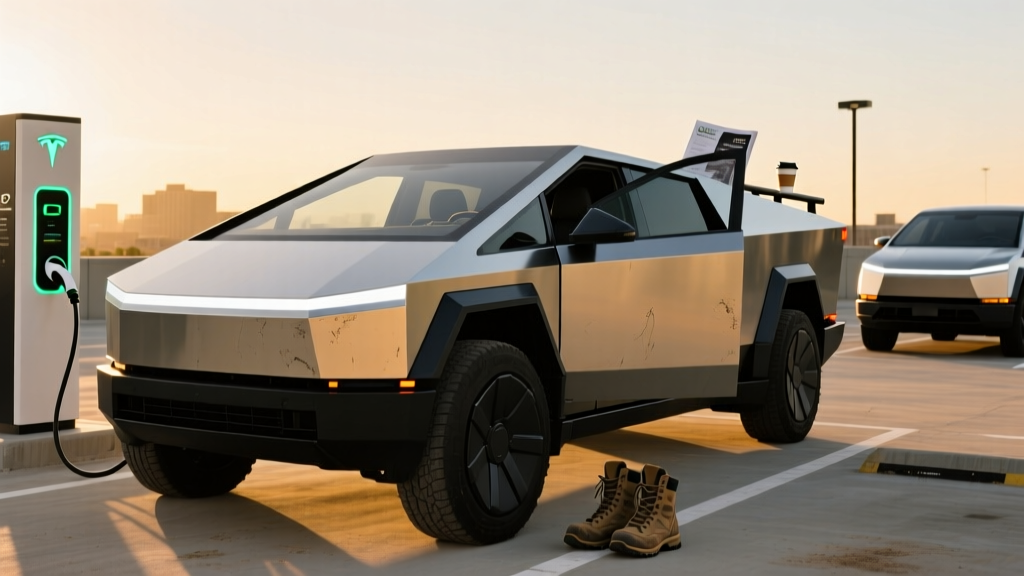
The Tesla Cybertruck remains one of the most polarizing electric vehicles on the road. Since deliveries began in late 2023, early adopters and long-term owners have surfaced a growing list of Cybertruck problems — from panel alignment quirks to software gremlins and real-world range that falls short of the EPA sticker. Now well into the 2026 model year, we've compiled owner reports, service data, and our own testing to separate genuine concerns from internet noise.
This isn't a hatchet job or a defense of Tesla. It's a data-driven ownership guide for anyone researching the Cybertruck before signing a $80,000+ purchase agreement. We'll cover the problems worth knowing, the specs that matter, and who should — and shouldn't — put this truck on their shortlist.
Quick Verdict: Is the Cybertruck Worth It in 2026?
The bottom line: The Cybertruck delivers on performance and utility better than most expected, but build-quality inconsistencies and real-world range shortfalls remain legitimate concerns. If you need a 300+ mile highway cruiser with flawless panel gaps, look elsewhere. If you want a fast, capable electric truck and can tolerate some early-ownership friction, the Cybertruck still has no direct EV rival in the mid-$80K range.
Tesla Cybertruck Specs at a Glance
| Specification | AWD (Dual-Motor) | Cyberbeast (Tri-Motor) |
|---|---|---|
| EPA Range | 340 miles | 320 miles |
| Battery Capacity (usable) | ~123 kWh (NMC) | ~123 kWh (NMC) |
| Battery Chemistry | NMC (Nickel Manganese Cobalt) | NMC |
| 0–60 mph | 3.9 seconds | 2.6 seconds |
| Horsepower | 600 hp | 845 hp |
| Drivetrain | Dual-Motor AWD | Tri-Motor AWD |
| Max DC Fast Charge | 250 kW (peak) | 250 kW (peak) |
| 10–80% DC Charge Time | ~30 minutes | ~30 minutes |
| Level 2 Home Charging | 11.5 kW (~37 mi/hr) | 11.5 kW (~37 mi/hr) |
| MPGe (combined) | 79 MPGe | 74 MPGe |
| Efficiency | 48 kWh/100 mi | 51 kWh/100 mi |
| Towing Capacity | 11,000 lbs | 11,000 lbs |
| Payload Capacity | 2,500 lbs | 2,500 lbs |
| Bed Length | 6 ft (72 in) | 6 ft (72 in) |
| Cargo Volume (bed + frunk) | ~67 cu ft bed + ~14 cu ft frunk | ~67 cu ft bed + ~14 cu ft frunk |
| Battery Warranty | 8 years / 120,000 miles | 8 years / 120,000 miles |
| Base MSRP (2026) | $79,990 | $99,990 |
Real-World Range: What Owners Actually Get
⚡ Real-World Range Callout
EPA Sticker: 340 miles (AWD) / 320 miles (Cyberbeast)
Real-World Highway (70 mph, moderate temps): ~260–290 miles
Cold Weather (below 32°F, highway): ~200–240 miles
Mixed City/Suburban: ~290–320 miles (regen-friendly driving recovers energy)
The Cybertruck's angular, stainless-steel body creates more aerodynamic drag than a rounded pickup like the Rivian R1T or Ford F-150 Lightning. That drag penalty shows up most at sustained highway speeds. According to EPA data at fueleconomy.gov, the AWD model achieves 79 MPGe combined — competitive for a full-size truck but far from sedan-level efficiency.
In independent testing, highway range at 70 mph with climate control running typically lands between 260 and 290 miles depending on tire condition, elevation, and temperature. Cold weather compounds the loss: NMC batteries lose efficiency below freezing, and cabin heating demands significant energy. Expect 200–240 miles of usable range on a frigid winter road trip before you need to plan a charging stop.
City driving tells a different story. Regenerative braking recovers energy in stop-and-go traffic, and the Cybertruck's efficiency improves noticeably in suburban commuting. Owners reporting 300+ mile real-world range are almost exclusively driving mixed or city-heavy routes in mild climates.
Known Cybertruck Problems and Owner Complaints
After tracking service forums, NHTSA filings, and long-term owner reports through early 2026, these are the most commonly cited Cybertruck problems — ranked roughly by frequency and severity.
1. Body Panel Alignment and Finish Defects
The stainless-steel exoskeleton is visually striking but notoriously difficult to manufacture consistently. Owners have reported uneven panel gaps, misaligned bed seams, and visible tool marks near the roofline. While Tesla has improved quality at the Gigafactory Texas production line, 2025 and 2026 build vehicles still show more variation than a comparable Rivian or Ford.
2. Drive Inverter and Motor Failures
A small but notable percentage of early Cybertrucks (primarily 2024 deliveries) experienced drive inverter failures that rendered the vehicle immobile. Some owners reported multiple inverter replacements under warranty. Tesla issued service bulletins addressing the issue, and 2025–2026 models appear less affected — but it remains a reputational concern.
3. Software Glitches and Infotainment Bugs
The Cybertruck runs Tesla's latest vehicle software, and with it comes the usual assortment of touchscreen freezes, phantom app crashes, and navigation errors. The steer-by-wire system has been reliable in terms of safety, but some owners report occasional lag or inconsistent steering feel after software updates that Tesla later patches.
4. Wind Noise at Highway Speeds
Despite the angular design, several owners report noticeable wind noise above 65 mph, particularly around the A-pillars and the tonneau cover seal. It's not deal-breaking, but it's more intrusive than the cabin quietness you'd expect at this price point.
5. 12V Auxiliary Battery Issues
Some owners have reported 12V battery drain when the vehicle sits unused for extended periods, leading to a "bricked" state where the main contactors won't close. Tesla's software updates have improved low-power management, but it's a known quirk worth monitoring if you don't drive daily.
6. Tonneau Cover Motor Failures
The powered retractable tonneau cover is a signature feature, but the motor and track mechanism have failed on some units, requiring warranty replacement. When it works, it's excellent; when it doesn't, bed access becomes a hassle.
7. Accelerator Pedal Trim Recall
Tesla issued a recall for certain Cybertrucks where the accelerator pedal trim could dislodge and interfere with pedal operation. Affected vehicles received a redesigned pedal cover. Check the NHTSA recall database for your specific VIN before purchasing used.
Charging Speed: DC Fast Charge and Home Charging
The Cybertruck uses the NACS (North American Charging Standard) connector natively — it's a Tesla, after all — and accesses the full Supercharger network without adapters. Here's what charging actually looks like in practice:
| Charging Level | Power (kW) | Speed | Notes |
|---|---|---|---|
| Level 1 (120V household) | ~1.4 kW | ~4 miles per hour | Emergency/trickle only — a full charge takes days |
| Level 2 (240V home, 48A) | 11.5 kW | ~37 miles per hour | Full charge overnight (~9–10 hours from 10%) |
| DC Fast Charge (Supercharger V3/V4) | 250 kW (peak) | 10–80% in ~30 min | Peak rate only below 40% SoC; tapers significantly above 60% |
| DC Fast Charge (CCS adapter, non-Tesla) | ~150–200 kW | 10–80% in ~35–45 min | Varies by station; some CCS sites limit NACS-adapted vehicles |
The charging curve reality: Tesla advertises 250 kW peak, but that rate only holds briefly at low state of charge (roughly 10–40% SoC). Above 60%, the charge rate tapers steeply — often dropping below 80 kW. A 10–80% session at a V3 Supercharger takes approximately 30 minutes in ideal conditions (battery preconditioned, moderate ambient temperature). In cold weather without adequate preconditioning, add 5–10 minutes.
Home Level 2 charging at 11.5 kW requires a 60-amp dedicated circuit (Tesla Wall Connector or equivalent). Most owners charging overnight from 20% to 90% wake up to a full battery. Installation costs for a Level 2 home charger typically run $500–$2,000 depending on panel capacity and conduit distance — budget for a licensed electrician and a potential 200-amp panel upgrade if your home has an older 100-amp service.
Pricing, Trims, and Federal Tax Credit Eligibility
| Trim | Base MSRP | Federal §30D Credit Eligible? | Effective Price (if eligible) |
|---|---|---|---|
| AWD (Dual-Motor) | $79,990 | No — exceeds $80,000 truck MSRP cap* | $79,990 |
| Cyberbeast (Tri-Motor) | $99,990 | No — exceeds $80,000 truck MSRP cap | $99,990 |
*Critical tax credit detail: Under IRS §30D rules, the federal EV tax credit caps eligible trucks (vans, pickups) at an $80,000 MSRP. The AWD Cybertruck at $79,990 sits right at the threshold — and depending on how Tesla configures destination fees and mandatory options, some builds may push over the cap. Additionally, buyers must meet income limits ($300,000 joint / $150,000 single filer AGI) and the vehicle must satisfy critical mineral and battery component sourcing requirements, which have tightened annually.
As of early 2026, the Cybertruck's battery sourcing compliance is uncertain under the latest IRS guidance. Do not assume $7,500 credit eligibility. Consult a tax professional and verify your specific build's eligibility on the IRS clean vehicle credit page before finalizing a purchase. Point-of-sale transfer of the credit (if eligible) is available through registered dealers.
Who Should Buy the Cybertruck (and Who Shouldn't)
✅ Buy the Cybertruck If:
- You want a fast, capable electric truck with 11,000-lb towing and no direct competitor at this price/performance point
- You have reliable home Level 2 charging and mostly drive within 200 miles of home
- You value the Supercharger network's reliability for road trips
- You're comfortable with Tesla's direct-to-consumer service model and potential wait times for parts
- You want a distinctive, conversation-starting vehicle and accept the attention it draws
❌ Skip the Cybertruck If:
- You need consistent 300+ mile real-world highway range — the Rivian R1T (Dual-Motor Max Pack, 420 mi EPA) is better here
- Build quality and panel consistency are top priorities — Ford F-150 Lightning and Rivian R1T are more refined
- You want a proven dealer/service network with walk-in availability
- You're counting on the $7,500 federal tax credit to make the math work
- You need a back seat that comfortably fits tall adults on long trips (rear legroom is 38.5 inches — adequate but not generous for a full-size truck)
Cybertruck vs. Key Competitors: Quick Comparison
| Attribute | Tesla Cybertruck AWD | Rivian R1T Dual-Motor Max | Ford F-150 Lightning Extended Range |
|---|---|---|---|
| EPA Range | 340 mi | 420 mi | 320 mi |
| 0–60 mph | 3.9 sec | 4.5 sec | 3.8 sec |
| Base MSRP | $79,990 | $89,900 | $69,995 |
| Max DC Charge | 250 kW | 220 kW | 150 kW |
| Towing | 11,000 lbs | 11,000 lbs | 10,000 lbs |
| Build Quality | Inconsistent | Strong | Strong |
| Service Network | Tesla direct (limited) | Rivian direct (growing) | Ford dealers (extensive) |
| Federal Credit Eligible | Uncertain / borderline | Yes (select builds) | Yes (select builds) |
Warranty and Long-Term Battery Outlook
Tesla covers the Cybertruck's battery and drive unit for 8 years or 120,000 miles (whichever comes first), with a minimum 70% capacity retention threshold. The limited vehicle warranty is 4 years or 50,000 miles.
The ~123 kWh NMC battery pack is large and, based on Tesla's track record with Model S and Model X packs of similar chemistry, should retain 85–90% capacity at 100,000 miles under normal use. However, frequent DC fast charging above 200 kW, regular charging to 100%, and extreme-temperature operation accelerate degradation. For maximum longevity, Tesla recommends daily charging to 80–90% and using Scheduled Departure preconditioning.
Battery replacement cost, should it ever be needed out of warranty, is estimated at $15,000–$25,000 based on current Tesla service pricing for large packs — a significant financial exposure that buyers should factor into long-term ownership calculations.
Frequently Asked Questions
What is the real-world range of the Cybertruck?
Expect 260–290 miles on the highway at 70 mph in mild weather, and 200–240 miles in cold conditions. City and mixed driving can yield 290–320 miles thanks to regenerative braking. The EPA rates the AWD model at 340 miles, but sustained highway driving and cold weather significantly reduce that figure.
How fast does the Cybertruck charge?
At a Tesla V3 or V4 Supercharger, the Cybertruck peaks at 250 kW and charges from 10–80% in approximately 30 minutes when the battery is preconditioned. The charge rate tapers sharply above 60% state of charge. At home on a Level 2 charger (11.5 kW), you gain roughly 37 miles of range per hour, making overnight charging practical.
Does the Cybertruck qualify for the federal EV tax credit?
It's complicated. The §30D credit has an $80,000 MSRP cap for trucks, and the AWD Cybertruck at $79,990 is right at the line. However, battery sourcing requirements and buyer income caps ($300K joint / $150K single) further limit eligibility. Verify on IRS.gov before purchasing. Do not count on the credit in your budget.
Is the Cybertruck worth buying vs. the Rivian R1T or F-150 Lightning?
It depends on your priorities. The Cybertruck offers the best DC charging speed and Supercharger network access. The Rivian R1T Max Pack delivers far more real-world range (420 mi EPA) and better build quality but costs $10,000 more. The F-150 Lightning is the most affordable and has the deepest service network but charges slower (150 kW peak). None of these are wrong choices — they serve different use cases.
What are the biggest Cybertruck problems reported by owners?
The most common issues are panel alignment inconsistencies, drive inverter failures (primarily 2024 builds), tonneau cover motor failures, wind noise at highway speeds, and occasional software/infotainment glitches. Tesla has addressed several of these through service bulletins and production-line updates, but build variability remains higher than competitors.
How much does it cost to charge a Cybertruck at home?
The ~123 kWh battery, charged from 10% to 90% (~98 kWh), costs roughly $13–$18 at the U.S. average residential electricity rate of $0.16/kWh. That's approximately $0.05–$0.07 per mile driven — roughly one-third the per-mile fuel cost of a comparable gas truck getting 18 MPG at $3.50/gallon.