The Mainstream Three-Row EV Benchmark
The transition to electric vehicles has historically left large families with a difficult compromise: either opt for expensive luxury electric SUVs or settle for smaller, two-row crossovers that cannot accommodate more than five passengers comfortably. The Kia EV9 has arrived to fundamentally disrupt this paradigm, offering a mainstream, relatively accessible three-row electric SUV that does not sacrifice interior volume, technology, or driving dynamics. As automotive journalists and consumers scrutinize the growing EV landscape, the EV9 stands out not just for its bold, geometric styling, but for the hard data supporting its utility as a daily family hauler.
In this comprehensive, data-driven review, we analyze the Kia EV9 across critical metrics that matter most to families: real-world range efficiency, third-row ergonomics, charging architecture, towing capabilities, and total ownership costs. By comparing these data points against segment benchmarks, we can determine whether the EV9 truly earns its title as the ultimate family EV.
Powertrain Configurations and Real-World Range Data
Kia offers the EV9 in multiple configurations, primarily divided by battery size and drivetrain. The base 'Light' trim features a 76.1 kWh battery pack and a single rear-mounted electric motor producing 215 horsepower and 258 lb-ft of torque. However, the volume seller for families is the Long Range model, equipped with a larger 100.0 kWh battery and available in both Rear-Wheel Drive (RWD) and All-Wheel Drive (AWD) layouts.
The Long Range RWD generates 201 horsepower and boasts an EPA-estimated range of 304 miles. The Long Range AWD, which adds a front motor for a combined output of 379 horsepower and 516 lb-ft of torque (with the optional Boost package), sees a slight range reduction to 283 miles. According to extensive testing by Car and Driver, the EV9 GT-Line AWD managed an impressive 70-mph highway range test, achieving results that closely mirror or slightly exceed its EPA estimates, a rarity in the EV segment where high-speed aerodynamic drag typically decimates range.
Efficiency Metrics
- Light RWD (76.1 kWh): 3.4 kWh/mile (Combined EPA)
- Wind/Land AWD (100.0 kWh): 2.9 kWh/mile (Combined EPA)
- GT-Line AWD (100.0 kWh): 2.7 kWh/mile (Combined EPA)
For a vehicle with a curb weight exceeding 5,800 pounds, achieving an efficiency rating below 3.0 kWh/mile in AWD form is a testament to Kia's advanced thermal management system and aerodynamic optimizations, including active air flaps and a flat underbody.
Dimensional Analysis: EV9 vs. The Competition
For families, interior volume is often the deciding factor. The EV9 is built on Hyundai Motor Group's E-GMP (Electric Global Modular Platform), which features a flat floor and a remarkably long wheelbase of 122.0 inches. This allows for genuinely usable space in all three rows. Below is a data table comparing the EV9's interior dimensions and cargo capacity against its primary electric rivals.
| Metric | Kia EV9 (Land/GT-Line) | Tesla Model X | Rivian R1S |
|---|---|---|---|
| Wheelbase | 122.0 in | 116.7 in | 121.1 in |
| 2nd-Row Legroom | 42.8 in | 41.1 in | 36.6 in |
| 3rd-Row Legroom | 32.0 in | 32.7 in | 30.4 in |
| Cargo (Behind 3rd Row) | 20.2 cu-ft | 12.6 cu-ft | 10.8 cu-ft |
| Total Cargo (Rows Folded) | 81.7 cu-ft | 77.9 cu-ft | 83.5 cu-ft |
The data reveals a crucial advantage for the Kia EV9: cargo space behind the third row. With 20.2 cubic feet available, families can easily fit a double stroller, several grocery bags, and sports equipment without needing to fold down the rear seats or invest in a roof cargo box. While the Rivian R1S offers slightly more total maximum cargo volume, its third-row legroom is notably more cramped, making the EV9 the superior choice for carrying teenagers or adults in the back.
Interior Ergonomics and Family Practicality
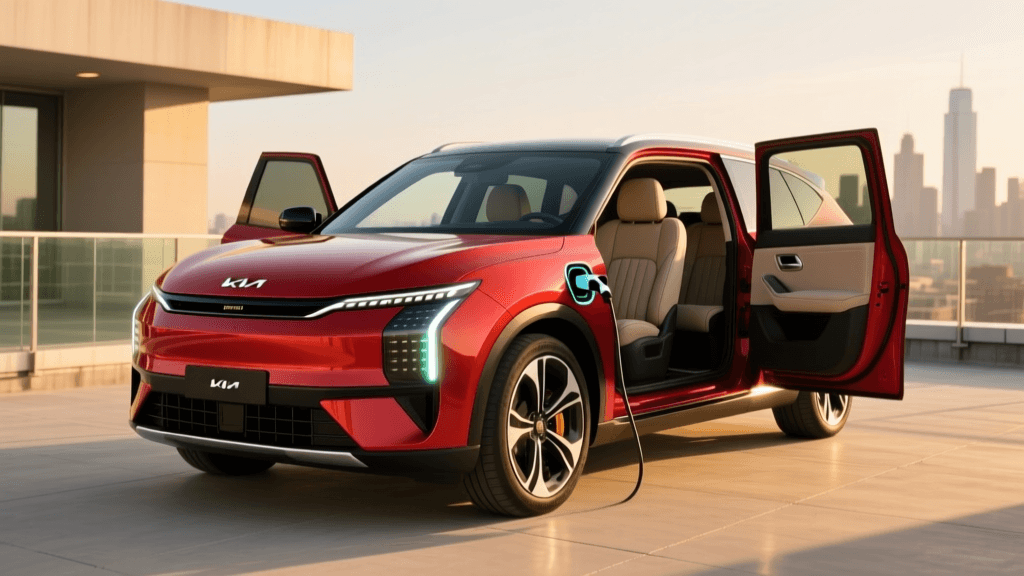
Beyond raw measurements, the EV9 excels in family-centric ergonomics. The available second-row captain's chairs offer power recline and heating/ventilation. In select markets, Kia offers 'Swivel' seats that rotate 180 degrees to face the third row when the vehicle is parked, facilitating easier interaction with children or serving as a mobile lounge. While regulatory hurdles have complicated the US release of the swivel mechanism, the standard captain's chairs still provide exceptional comfort and easy pass-through access to the third row.
Technology is managed through a panoramic dual-screen setup, combining a 12.3-inch digital instrument cluster and a 12.3-inch infotainment touchscreen, alongside a dedicated 5-inch HVAC control panel. The physical buttons for climate control are a welcome relief for parents trying to adjust cabin temperatures while driving, avoiding the frustration of menu-diving common in rival vehicles.
800-Volt Charging Architecture: A Data Perspective
Range anxiety is quickly being replaced by charging anxiety, especially for families embarking on road trips. The Kia EV9 utilizes an 800-volt electrical architecture, allowing it to accept DC fast-charging rates that leave 400-volt competitors behind. Kia claims a peak charging rate of 238 kW. In controlled testing, the EV9 can charge from 10% to 80% in approximately 24 minutes when connected to a 350-kW charger.
Furthermore, the EV9 is equipped with Vehicle-to-Load (V2L) capability. Using the available V2L adapter, the SUV can output up to 3.6 kW of power. This allows families to power camping equipment, tailgate appliances, or even provide emergency backup power to essential home circuits during a grid outage, adding a layer of utility that internal combustion vehicles cannot match.
Safety Ratings and Structural Integrity
Safety is non-negotiable for family vehicles. The EV9's E-GMP platform was engineered with ultra-high-strength steel and specialized load paths to protect the battery pack and occupants during a collision. Official crash test data and safety evaluations are rigorously tracked by government agencies. You can review the comprehensive crashworthiness ratings and safety recall information for the 2024 model year directly via the National Highway Traffic Safety Administration (NHTSA). The EV9 comes standard with Highway Driving Assist 2 (HDA2), which includes adaptive cruise control with stop-and-go, lane centering, and automatic lane changing, significantly reducing driver fatigue on long interstate family road trips.
Towing Capacity and Payload Data
Many three-row SUV buyers require towing capabilities for boats, campers, or horse trailers. The EV9 Long Range AWD models are rated to tow up to 5,000 pounds when properly equipped with the factory tow hitch and harness. While this falls short of the Ford F-150 Lightning, it is highly competitive for unibody electric SUVs and matches the towing capacity of many midsize gasoline SUVs like the Toyota Highlander. Payload capacity hovers around 1,500 pounds, meaning a full cabin of passengers and a loaded cargo area will not easily exceed the vehicle's Gross Vehicle Weight Rating (GVWR).
Ownership Costs, Depreciation, and Value Proposition
The Kia EV9 starts at an MSRP of approximately $54,900 for the Light RWD trim, scaling up to around $73,900 for the fully loaded GT-Line AWD. While this is a premium price for a Kia badge, the data shows it significantly undercuts the Tesla Model X (starting over $80,000) and the Rivian R1S (starting around $75,000). Additionally, because the EV9 is assembled in West Point, Georgia, qualifying buyers can take advantage of the $7,500 federal EV tax credit at the point of sale, effectively bringing the entry price down to the high-$40,000 range.
Maintenance costs are projected to be substantially lower than gasoline equivalents. Without oil changes, spark plugs, or transmission fluid replacements, and with regenerative braking extending the life of brake pads, the EV9's scheduled maintenance is largely limited to cabin air filters, tire rotations, and fluid top-offs. Detailed manufacturer specifications and warranty coverage information, including the 10-year/100,000-mile powertrain warranty, can be verified through Kia's official media and specification portal.
Final Verdict: The Data Speaks
When analyzing the hard numbers, the Kia EV9 emerges as the most well-rounded three-row electric SUV on the market for families. It successfully bridges the gap between the affordability of mainstream brands and the space, technology, and charging speeds previously reserved for luxury marques. Its 304-mile maximum range, class-leading cargo space behind the third row, 800V fast-charging capabilities, and 5,000-pound towing capacity make it a remarkably versatile tool for the modern household. For families ready to make the leap to electric without compromising on passenger comfort or road-trip utility, the data unequivocally points to the Kia EV9 as the benchmark to beat.