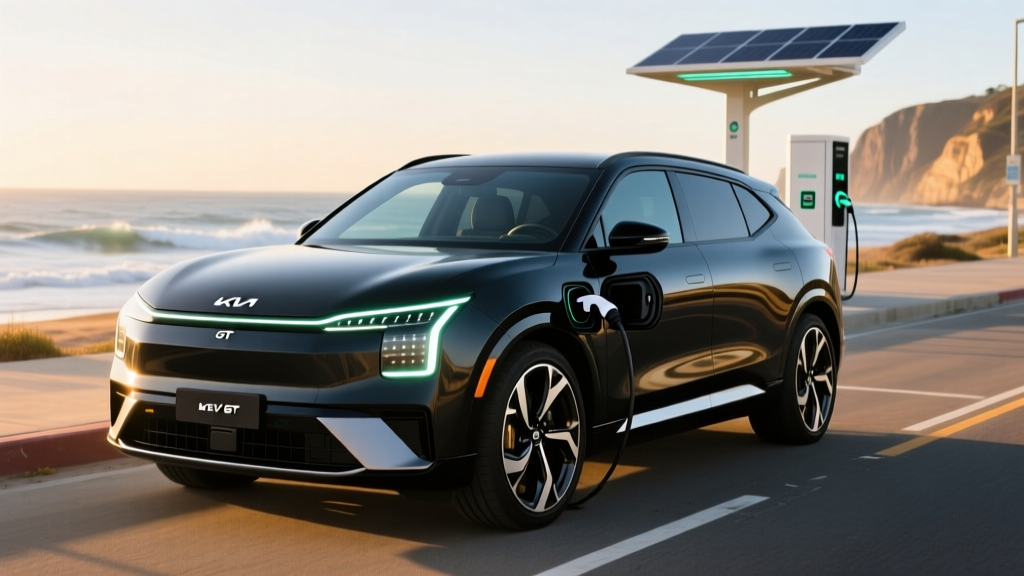
Quick Verdict: The EV9 GT Is the Fastest Three-Row EV You Can Buy
Kia took its already-capable EV9 three-row SUV and injected serious performance DNA into the GT variant. With a dual-motor all-wheel-drive powertrain pushing an estimated 576 horsepower, the 2026 Kia EV9 GT sprints to 60 mph in roughly 4.3 seconds — remarkable for a vehicle that still seats up to seven passengers and offers genuine cargo utility. But performance SUVs live and die by their efficiency and charging practicality, and here the EV9 GT asks buyers to accept real trade-offs. The larger performance-oriented motors and tuning reduce EPA-estimated range compared to the standard EV9 AWD, and the price of admission sits well above the threshold where the full federal tax credit becomes straightforward. This is an enthusiast's family hauler — thrilling, tech-rich, and honest about its compromises.
| Specification | 2026 Kia EV9 GT (AWD) |
|---|---|
| Drivetrain | Dual-motor AWD |
| Horsepower | ~576 hp (est.) |
| 0-60 mph | ~4.3 seconds |
| Battery Capacity (usable) | 100.0 kWh (NMC lithium-ion) |
| EPA Est. Range | ~270 miles (est., pending final EPA cert.) |
| Max DC Fast Charge | 239 kW peak |
| 10-80% DC Fast Charge | ~24 minutes (est.) |
| Level 2 Home Charge Rate | 10.9 kW (AC) |
| Efficiency | ~76 MPGe combined (est.) |
| Base MSRP | ~$73,000 (est.) |
| Battery/Powertrain Warranty | 10 years / 100,000 miles |
Note: The 2026 EV9 GT was announced by Kia with preliminary specifications. Final EPA-certified range, efficiency, and pricing may vary at retail launch. We will update this review as confirmed data becomes available.
Range and Efficiency: What the EPA Sticker Won't Tell You
Real-world expectation: Plan for approximately 220-245 miles in mixed highway driving at 70+ mph. In cold-weather conditions (below 30°F), expect a 15-25% reduction, bringing usable range down to roughly 200-230 miles before you need to find a charger. City driving with regenerative braking recovers energy more effectively, potentially pushing range closer to the EPA sticker.
The EV9 GT shares the same 100.0 kWh (usable) NMC battery pack found in the standard EV9 AWD models. However, the GT's performance-tuned motors, more aggressive acceleration mapping, and stickier summer-biased tire compound all conspire against efficiency. Where the standard EV9 Light RWD achieves an EPA-estimated 304 miles, the GT sacrifices roughly 30-40 miles of range in exchange for its power advantage.
This is the central tension of the EV9 GT: it's a large, heavy three-row SUV asking its battery to do two competing jobs — propel 5,000+ pounds with authority and deliver cross-country range. For most daily commutes and school runs, 270 miles is more than sufficient. But road-trippers should plan charging stops every 200 miles or so on the interstate to keep state of charge (SoC) in the fast-charging sweet spot below 80%.
The EV9 GT uses NMC (nickel manganese cobalt) battery chemistry, which offers higher energy density than LFP (lithium iron phosphate) — essential for fitting 100 kWh into the vehicle's floor without raising the cabin. The trade-off is that NMC batteries prefer not to sit at 100% SoC for extended periods. Kia's battery management system includes a top and bottom buffer to protect long-term health, and owners should set daily charge limits to 80-90% for routine use, reserving 100% for long trips.
Charging Speed: DC Fast Charging and Home Level 2
| Charging Level | Power | Speed / Time | Best Use Case |
|---|---|---|---|
| Level 1 (120V household) | ~1.4 kW | ~3-4 miles per hour | Emergency top-ups only |
| Level 2 (240V home) | 10.9 kW | ~29 miles per hour / full charge ~10 hrs | Daily overnight charging |
| DC Fast Charge (peak) | 239 kW | 10-80% in ~24 min | Road trips, rapid top-ups |
| DC Fast Charge (sustained avg) | ~150-170 kW | 10-80% realistic average | Actual charging curve |
The EV9 rides on Hyundai Motor Group's E-GMP 800-volt architecture, which is the same platform underpinning the Ioniq 5 and EV6. This gives it a genuine advantage at DC fast chargers: while many competing EVs are limited to 400V systems that peak around 150 kW, the EV9 GT can accept up to 239 kW at compatible 350 kW chargers (such as Electrify America's newest stalls or Tesla Superchargers with the NACS adapter).
However, peak charge rate is not sustained charge rate — a distinction every EV buyer should understand. The EV9 GT will hit its 239 kW peak only when the battery is preconditioned (warmed to optimal temperature), SoC is low (around 10-15%), and ambient temperature is moderate. As SoC climbs past 50-60%, the charge curve tapers significantly to protect the cells. Expect the 10-80% session to average around 150-170 kW in real-world conditions, translating to roughly 24 minutes on a capable 350 kW charger. On a 150 kW station, plan for 35-40 minutes for the same 10-80% fill.
For home charging, the EV9 GT's 10.9 kW onboard charger is a strong point. On a 48-amp Level 2 home charger (hardwired, 60-amp circuit), you'll recover roughly 29 miles of range per hour — enough to fully replenish the battery overnight in about 10 hours. Home Level 2 installation typically runs $800-$2,000 depending on panel capacity and run length; if your home has a 200-amp electrical panel with spare capacity, expect the lower end. Homes needing a panel upgrade to 200A could see costs of $2,500-$5,000+.
Kia equips the EV9 with a NACS (North American Charging Standard) port starting with the 2025 model year refresh, meaning direct access to Tesla's Supercharger network — currently the most reliable DC fast-charging infrastructure in the US. This is a significant practical advantage over CCS-only vehicles in 2026.
Performance: 576 Horsepower in a Family SUV
The EV9 GT's dual-motor AWD system pairs a front motor with a more powerful rear motor for a combined output Kia estimates at approximately 576 horsepower. That's a substantial jump from the standard EV9 GT-Line AWD's 379 hp, and it transforms the driving character entirely.
The claimed 0-60 mph time of roughly 4.3 seconds places the EV9 GT in sports-sedan territory, not family-SUV territory. Kia's GT tuning includes a sport-tuned adaptive suspension, upgraded brakes, and a specific drive mode (GT Mode) that sharpens throttle response, firms up damping, and adjusts the AWD torque split for maximum grip off the line.
In practice, the EV9 GT's performance is most impressive in its accessibility. Unlike dedicated sports cars, this is a vehicle you can drive to 60 mph with child seats in the second row and groceries in the cargo area. The instant torque delivery of electric motors means there's no turbo lag or transmission hesitation — just immediate, linear thrust. The trade-off is tire wear; aggressive drivers will find the stock rubber wearing faster than on the standard EV9, and replacement tires in the GT's size are not inexpensive.
Towing capacity for the EV9 GT is expected to match the standard AWD model's 5,000-pound rating when properly equipped with the factory tow package, though the performance suspension tuning may result in a firmer ride when hauling heavy loads.
Interior, Cargo, and Technology
The EV9 GT retains the spacious three-row cabin that makes the standard EV9 compelling. Key interior dimensions include:
- Cargo volume (behind 3rd row): ~20.2 cu ft
- Cargo volume (3rd row folded): ~43.5 cu ft
- Cargo volume (max, 2nd and 3rd folded): ~81.7 cu ft
- Second-row legroom: ~42.8 inches
- Third-row legroom: ~32.0 inches
- Front headroom: ~40.2 inches
The GT trim adds sport-specific interior elements: bolstered front seats with GT badging, a flat-bottom steering wheel, unique interior ambient lighting, and metal pedals. The dual 12.3-inch curved display setup handles infotainment and the digital instrument cluster, running Kia's latest connected-car software with wireless Apple CarPlay and Android Auto.
On the driver-assistance front, the EV9 GT includes Kia's Highway Driving Assist 2 (HDA2), which provides adaptive cruise control with stop-and-go, lane centering, and automatic lane changes on divided highways. This is a SAE Level 2 system — the driver must remain attentive with hands on or near the steering wheel at all times. It is not autonomous driving, despite marketing language from some competitors. HDA2 is competent for reducing fatigue on long trips, but it does not handle construction zones, unmapped roads, or complex urban intersections without driver intervention.
Notable tech drawbacks include the EV9's reliance on capacitive touch controls for climate and some secondary functions, which can be frustrating to operate while driving. The second-row captain's chairs (standard on GT) reduce maximum seating from seven to six, which may matter for larger families.
Pricing, Trims, and Federal Tax Credit Eligibility
| Trim | Est. Base MSRP | Federal §30D Credit Eligibility | Est. Effective Price |
|---|---|---|---|
| EV9 GT (AWD) | ~$73,000 | See eligibility rules below | ~$65,500-$73,000 |
| EV9 GT w/ Premium Pkg | ~$78,000 | See eligibility rules below | ~$70,500-$78,000 |
The 2026 Kia EV9 GT is expected to start around $73,000, placing it in premium territory alongside the BMW iX, Mercedes EQB, and Tesla Model X (base). Kia has not finalized all trim and option pricing at publication time.
Federal tax credit eligibility under IRS §30D is complex for the EV9 GT and requires careful attention to current-year rules:
- MSRP Cap: SUVs must have an MSRP at or below $80,000 to qualify. The base EV9 GT at ~$73,000 clears this threshold, but loaded configurations may exceed it.
- Buyer Income Cap: Modified adjusted gross income must not exceed $150,000 (single), $225,000 (head of household), or $300,000 (married filing jointly).
- Battery Sourcing: The credit is split into two halves ($3,750 each) based on critical-mineral sourcing and battery-component manufacturing requirements. Full $7,500 eligibility depends on Kia's supply chain compliance for the specific model year. Check the official fueleconomy.gov listing for the exact credit amount assigned to the 2026 EV9 GT.
- Point-of-Sale Transfer: Eligible buyers can transfer the credit to the dealer at purchase, reducing the purchase price upfront rather than waiting for a tax refund.
- Assembly: The EV9 for the US market is assembled at Kia's West Point, Georgia plant, satisfying the North American final-assembly requirement.
Important: Tax credit eligibility changes frequently as battery-sourcing rules tighten. Always verify current status on irs.gov and consult a tax professional before making a purchase decision based on the credit.
Ownership Costs: Warranty, Efficiency, and Long-Term Value
Kia backs the EV9 GT with one of the strongest warranty packages in the segment:
- Battery warranty: 10 years / 100,000 miles (capacity retention above 70%)
- Powertrain warranty: 10 years / 100,000 miles
- Bumper-to-bumper: 5 years / 60,000 miles
- Roadside assistance: 5 years / 60,000 miles
The 10-year battery warranty is particularly reassuring given the EV9 GT's high-performance tuning, which puts more thermal stress on the pack than the standard model. Kia's 70% capacity retention threshold is industry-standard; if the battery degrades below that within the warranty period, Kia will repair or replace it.
Estimated efficiency of ~76 MPGe combined translates to roughly 43 kWh per 100 miles. At the US average residential electricity rate of ~$0.17/kWh, that's about $7.31 per 100 miles of driving — compared to roughly $13-$15 per 100 miles for a comparable gas-powered three-row SUV at 20 mpg and $3.00/gallon. Over 15,000 annual miles, the fuel savings alone approach $900-$1,150 per year, though insurance premiums for the EV9 GT are likely to run 15-25% higher than the standard model due to its performance classification and repair costs.
How the EV9 GT Stacks Up Against Competitors
The EV9 GT's most direct competitors include the Tesla Model X, Rivian R1S Dual-Motor Performance, and to a lesser extent the BMW iX M60. The Model X wins on range and Supercharger access (though the EV9's NACS port narrows this gap). The Rivian R1S offers superior off-road capability and a more adventurous character. The BMW iX is more of a two-row crossover and doesn't offer three-row seating. For buyers who prioritize a genuine third row, strong performance, and Kia's warranty, the EV9 GT occupies a unique niche.
Pros and Cons
- 576 hp dual-motor AWD with 4.3-sec 0-60 in a three-row SUV
- 800V architecture enables 239 kW DC fast charging
- NACS port provides native Tesla Supercharger access
- 10-year / 100,000-mile battery and powertrain warranty
- Genuine third-row seating with usable cargo space
- Strong standard safety tech and HDA2 driver assist
- US-built (Georgia assembly) supporting §30D credit eligibility
- Estimated ~270-mile range is modest for the price and battery size
- Cold-weather range loss significant (~20-25%)
- MSRP near the $80,000 §30D cap — loaded trims may exceed it
- Capacitive touch controls frustrating while driving
- Higher tire wear expected with performance driving
- Insurance premiums likely 15-25% above standard EV9
- Third-row legroom tight for adults on long trips
Who Should Buy the Kia EV9 GT?
- You need a three-row SUV but want genuine sports-sedan acceleration
- You have reliable home Level 2 charging and can charge overnight
- You take road trips but plan around 200-mile charging intervals
- You value Kia's 10-year warranty and US-based assembly
- Your household income and the vehicle's MSRP qualify for the §30D credit
- Maximum range is your top priority (consider Tesla Model X Long Range or standard EV9 RWD)
- You frequently drive in extreme cold without garage parking
- You need to seat seven (the GT's captain's chairs limit you to six)
- You want off-road capability (consider Rivian R1S)
- Your budget is firm below $65,000 (the standard EV9 Wind AWD is a strong alternative)
Frequently Asked Questions
What is the real-world range of the 2026 Kia EV9 GT?
While the EPA estimate is approximately 270 miles (pending final certification), expect 220-245 miles in real-world highway driving at 70+ mph. In winter conditions below 30°F, range can drop to 200-230 miles. City driving with frequent regenerative braking will get you closer to the EPA sticker. Always plan road-trip charging stops at around 200-mile intervals to stay in the fast-charging sweet spot.
How fast does the EV9 GT charge at home and on the road?
At home on a Level 2 (240V, 48-amp) charger, the EV9 GT charges at 10.9 kW, adding roughly 29 miles of range per hour — a full charge takes about 10 hours overnight. On a 350 kW DC fast charger, it peaks at 239 kW and can go from 10-80% in approximately 24 minutes, though real-world averages are closer to 150-170 kW sustained due to charge-curve tapering above 50% SoC.
Does the 2026 Kia EV9 GT qualify for the $7,500 federal tax credit?
It depends. The base MSRP of ~$73,000 falls under the $80,000 SUV cap, and the EV9 is assembled in Georgia, satisfying the final-assembly requirement. However, full credit eligibility depends on battery-critical-mineral sourcing (which changes annually), your household income (capped at $150K single / $300K joint), and whether the loaded trim stays under $80K. Verify on fueleconomy.gov and consult a tax professional before purchasing.
Is the EV9 GT worth buying over the Tesla Model X or Rivian R1S?
The EV9 GT offers a unique combination: three-row seating, 576 hp, 800V fast charging, and Kia's 10-year warranty at a lower starting price than the Model X. However, the Model X wins on range (~348 mi) and the Rivian R1S wins on off-road versatility. If you prioritize a balance of performance, warranty, and value in a three-row package, the EV9 GT is compelling. If range or off-road capability are paramount, look at the alternatives.
Is the EV9 GT self-driving?
No. The EV9 GT's Highway Driving Assist 2 (HDA2) is an SAE Level 2 driver-assistance system. It provides adaptive cruise control, lane centering, and automatic lane changes on mapped highways, but the driver must remain fully attentive and ready to take over at any moment. It is not autonomous or self-driving.
What battery chemistry does the EV9 GT use?
The EV9 GT uses NMC (nickel manganese cobalt) lithium-ion cells, which offer higher energy density than LFP chemistry — necessary to fit 100 kWh in the vehicle's floor. For longevity, set daily charge limits to 80-90% and avoid routinely charging to 100% unless preparing for a long trip.
Sources: Kia America press specifications, fueleconomy.gov, IRS §30D Clean Vehicle Credit guidelines. Specifications reflect announced/estimated figures for the 2026 model year and are subject to change at retail launch.