Quick Verdict: The 2027 Hummer EV in Context
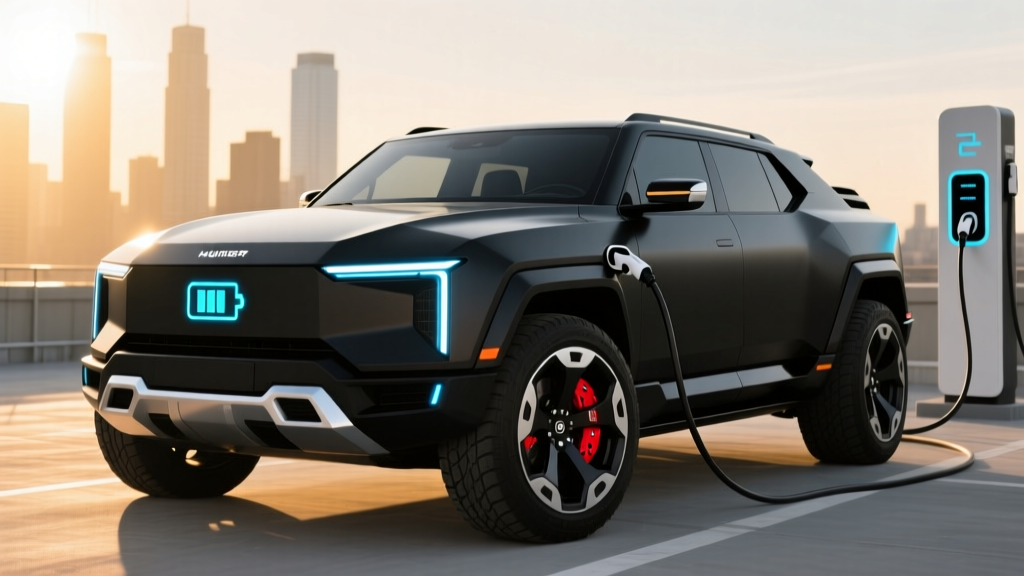
The 2027 GMC Hummer EV remains one of the most polarizing vehicles on the road — a 9,000-pound electric supertruck that pairs absurd straight-line acceleration with genuine off-road capability and a footprint that dominates any lane it occupies. For the 2027 model year, GMC has carried over the dual-motor 2X and tri-motor 3X powertrains while introducing modest software and efficiency refinements. If you are shopping for a full-size electric truck with maximum presence and don't need to fit in a compact garage, the Hummer EV is unmatched. If efficiency, price, or daily practicality top your list, the Ford F-150 Lightning and Rivian R1T offer more rational alternatives.
| Spec | Edition 1 / 3X | 2X (Dual-Motor) |
|---|---|---|
| EPA Range (est.) | ~329 miles | ~313 miles |
| Battery Capacity | ~246 kWh gross (212 usable), Ultium NMC | ~246 kWh gross (212 usable), Ultium NMC |
| Peak DC Fast Charge | 200 kW (800V architecture) | 200 kW (800V architecture) |
| 10–80% DC Charge Time | ~34 minutes (est.) | ~34 minutes (est.) |
| Level 2 Home Charging | 19.2 kW (~40 mi/hr) | 19.2 kW (~40 mi/hr) |
| Horsepower | 1,000 hp (Watts to Freedom mode) | 625 hp |
| 0–60 mph | ~3.0 seconds | ~4.5 seconds |
| Drivetrain | Tri-motor AWD (e4WD) | Dual-motor AWD |
| Towing Capacity | 7,500 lbs | 7,500 lbs |
| Base MSRP | ~$106,495 | ~$89,495 |
| MPGe (combined, est.) | 47 MPGe | 49 MPGe |
| Efficiency (kWh/100 mi) | ~72 kWh/100 mi | ~69 kWh/100 mi |
| Battery/Powertrain Warranty | 8 years / 100,000 miles | 8 years / 100,000 miles |
Note: 2027 model-year specifications are based on GMC's latest preliminary disclosures and carryover data from the 2026 model year. Final EPA certifications and pricing will be confirmed closer to the on-sale date. Check GMC's official Hummer EV page for updates.
Range and Efficiency: What the EPA Sticker Won't Tell You
EPA Estimated Range: ~329 miles (3X) / ~313 miles (2X)
Real-World Expectation: 260–290 miles at sustained highway speeds (70–80 mph). In cold weather (below 32°F), expect a 20–30% reduction, dropping effective range to roughly 210–250 miles depending on cabin heating load and terrain.
The Hummer EV's massive Ultium battery pack — one of the largest ever fitted to a production passenger vehicle — gives it headline-grabbing range numbers. But physics is unforgiving. At 212 kWh of usable capacity, you are carrying enormous weight, and that weight demands energy. Efficiency hovers around 69–72 kWh per 100 miles, which is roughly double what a Tesla Model Y consumes per mile. On the EPA's mixed driving cycle, the 3X achieves an estimated 47 MPGe, but real-world highway driving tells a different story.
During sustained 75-mph highway runs, the Hummer EV's brick-like aerodynamics (despite GMC's aero-sculpting efforts) and rolling resistance from 35-inch all-terrain tires push consumption toward 80+ kWh/100 mi. That translates to approximately 260–280 miles of real-world highway range on a full charge. Cold weather compounds the issue: the battery's thermal management system draws energy to keep the NMC cells in their optimal operating window, and resistive cabin heating (the Hummer EV uses a heat pump, which helps, but the cabin volume is enormous) further cuts range.
For context, a 300-mile road trip is achievable in mild weather with conservative driving, but a winter highway run through mountain passes could require a charge stop at the 200-mile mark. Plan accordingly.
Charging Speed: 200 kW Peak, but the Curve Matters
| Charging Level | Max Power | Rate (Approx.) | Notes |
|---|---|---|---|
| Level 1 (120V) | 1.4 kW | ~3 mi/hr | Emergency/trickle only |
| Level 2 (240V, 80A) | 19.2 kW | ~40 mi/hr | Full charge in ~12 hours |
| DC Fast Charge | 200 kW peak | 10–80% in ~34 min | Tapers significantly above 80% |
The Hummer EV's 800-volt Ultium architecture enables a peak DC fast-charge rate of 200 kW. That sounds competitive until you consider the battery size: charging 212 kWh of usable capacity means even at peak rate, you are moving a lot of electrons. The 10–80% charge time of approximately 34 minutes is respectable, but here is where the charge curve matters.
GMC's charging profile sustains near-peak rates between roughly 15% and 55% state of charge, then tapers progressively. Above 80% SoC, the rate drops sharply — often below 50 kW — to protect cell longevity. That means an 80–100% top-off can add another 45–60 minutes. On a road trip, the practical strategy is to charge from 10% to 80% (adding roughly 185 miles of range in ~34 minutes at a 350-kW-capable station), then drive on.
At home, the onboard 19.2 kW Level 2 charger is among the fastest in the segment. A hardwired 80-amp Level 2 station (like the ChargePoint Home Flex or Emporia Vue with appropriate circuit) will replenish roughly 40 miles of range per hour, meaning a depleted battery reaches full in about 12 hours. Most owners will plug in overnight and wake up to a full charge every morning — the ideal EV ownership pattern. Budget $1,200–$2,500 for a professional Level 2 installation, including the station, 240V/80A circuit, and permit; a panel upgrade to 200A service may add $2,000–$4,000 if your home's electrical panel is older.
The Hummer EV ships with a CCS1 connector. With the industry's shift to NACS (Tesla's connector), GMC has confirmed that adapters will be available for Tesla Supercharger access, though native NACS ports are expected in future model years. Verify adapter compatibility with your local Electrify America or Supercharger network before relying on it for road trips.
Performance: 1,000 HP and the Watts to Freedom Trick
GMC's tri-motor 3X powertrain, when engaged in Watts to Freedom (WTF) mode, unleashes an estimated 1,000 horsepower and 1,200 lb-ft of torque. The result is a 0–60 mph time of approximately 3.0 seconds — supercar territory in a vehicle that weighs over 9,000 pounds. The dual-motor 2X is no slouch either, with 625 hp and a 4.5-second 0–60 time.
WTF mode is more than a software toggle: the vehicle lowers its adaptive air suspension, preconditions the battery for maximum discharge rate, and adjusts throttle mapping for maximum aggression. The launch is genuinely startling the first time you experience it, though the novelty fades when you realize you are burning through range at an alarming rate during repeated pulls.
Beyond straight-line speed, the Hummer EV's four-wheel steering (CrabWalk) allows diagonal movement at low speeds — a genuine off-road advantage for navigating tight trail obstacles. The adaptive air suspension provides up to 15.9 inches of ground clearance in Extract Mode, and the underbody armor protects the battery pack during rock crawling. This is not a poseur's off-roader; the hardware is real, though the vehicle's width (over 96 inches with mirrors) limits trail accessibility compared to a Jeep Wrangler.
Interior, Cargo, and Daily Livability
The Hummer EV's interior is spacious but not luxurious in the way a $100,000+ vehicle should be. Hard plastics appear in lower-touch areas, and while the 13.4-inch infotainment touchscreen running GM's latest Ultifi software is responsive, the interface can feel cluttered with off-road telemetry menus. Wireless Apple CarPlay and Android Auto are standard, as is a 12.3-inch digital driver display.
Passenger space is generous: front legroom exceeds 44 inches, and rear legroom sits around 38 inches — comfortable for adults on longer drives. The five-seat configuration means no third row, which is fine given the vehicle's truck architecture.
Cargo capacity is where the truck bed shines. The five-foot bed offers approximately 41 cubic feet of space with the tailgate up, and the available MultiPro tailgate provides six configurations for loading. The front trunk (frunk) is modest — roughly 5 cubic feet — because the massive front motor and electronics occupy most of the space. For comparison, the Ford F-150 Lightning's frunk offers over 14 cubic feet.
Towing capacity is rated at 7,500 pounds across trims, which trails the F-150 Lightning Extended Range (10,000 lbs) and the Rivian R1T with the Max Tow package (11,000 lbs). If heavy towing is a priority, the Hummer EV is not the segment leader.
Pricing, Tax Credits, and Ownership Costs
| Trim | Base MSRP (est.) | §30D Federal Credit | Effective Price |
|---|---|---|---|
| 2X (Dual-Motor) | ~$89,495 | Not eligible (MSRP exceeds $80,000 pickup cap) | ~$89,495 |
| 3X (Tri-Motor) | ~$106,495 | Not eligible (MSRP exceeds $80,000 pickup cap) | ~$106,495 |
| Edition 1 (3X-based) | ~$112,595 | Not eligible | ~$112,595 |
Here is the tax-credit reality for the Hummer EV: it does not qualify for the $7,500 federal EV tax credit under IRS §30D rules. The credit caps MSRP at $80,000 for trucks, and every Hummer EV trim exceeds that threshold. Additionally, buyer income caps ($150,000 single / $300,000 joint for modified AGI) and battery critical-mineral/battery-component sourcing requirements further limit eligibility even for cheaper EVs. The Hummer EV's price places it firmly outside the federal incentive structure.
Some state and local incentives may still apply — California's CVRP, Colorado's state credit, and various utility rebates can offset a few thousand dollars — but these vary by jurisdiction and often have their own income or price caps. Check your state's energy office or utility provider for current programs.
Ownership costs extend beyond the sticker price. Insurance premiums for the Hummer EV run 30–50% higher than a comparably priced gas truck due to repair-cost data on the Ultium battery pack and specialized body panels. Expect annual premiums in the $3,500–$5,000 range depending on your driving record and location. Charging at home at the national average electricity rate of $0.16/kWh costs roughly $34 for a full 212-kWh charge, translating to about $0.11 per mile — significantly cheaper than gasoline, though the Hummer's poor efficiency dulls the advantage compared to a more aerodynamic EV.
Who Should Buy the 2027 Hummer EV?
Choose the Hummer EV if:
- You want the most attention-grabbing EV on the road and budget is secondary.
- Off-road capability (CrabWalk, Extract Mode, underbody armor) is a genuine priority.
- You have home charging access and mostly drive within 200 miles round-trip.
- Acceleration thrills in a 9,000-lb vehicle appeal to you.
Look elsewhere if:
- Efficiency and low cost-per-mile are top priorities (consider the F-150 Lightning or Rivian R1T).
- You need to tow more than 7,500 lbs regularly.
- Federal tax credit eligibility matters to your purchase math.
- You live in an area with narrow streets, tight garages, or limited DC fast-charging infrastructure.
Pros and Cons
Pros
- 1,000 hp tri-motor performance with 3.0-sec 0–60
- Class-leading off-road hardware (CrabWalk, Extract Mode, armor)
- 329-mile EPA range (3X) is impressive for the segment
- 19.2 kW Level 2 charging — fastest home charge in its class
- Massive 212-kWh usable battery minimizes range anxiety on moderate trips
Cons
- Starts near $90,000; no federal tax credit eligibility
- Efficiency is poor (~70 kWh/100 mi) — expensive to charge on the road
- Real-world highway/cold-weather range drops significantly
- 7,500-lb towing capacity trails F-150 Lightning and R1T
- Interior quality doesn't match the six-figure price tag
- Width and weight make urban driving and parking challenging
Frequently Asked Questions
What is the real-world range of the 2027 Hummer EV?
The EPA estimates approximately 329 miles for the 3X trim and 313 miles for the 2X. In real-world highway driving at 70–80 mph, expect 260–290 miles. Cold weather (below freezing) can reduce range by 20–30%, bringing effective range down to 210–250 miles.
How fast does the Hummer EV charge at home and on the road?
At a DC fast charger, it peaks at 200 kW and charges from 10–80% in approximately 34 minutes, though the rate tapers sharply above 80%. At home on a 19.2 kW Level 2 station, it adds roughly 40 miles per hour, reaching a full charge in about 12 hours.
Does the 2027 Hummer EV qualify for the $7,500 federal tax credit?
No. Under current IRS §30D rules, the credit is capped at vehicles with an MSRP of $80,000 or less for trucks. Every Hummer EV trim exceeds this threshold. Additional buyer income caps and battery-sourcing requirements also apply to the credit broadly.
Is the Hummer EV worth buying vs. the F-150 Lightning or Rivian R1T?
It depends on your priorities. The Hummer EV wins on raw performance (1,000 hp), off-road capability (CrabWalk, Extract Mode), and sheer presence. The F-150 Lightning wins on towing (10,000+ lbs), frunk space, tax-credit eligibility, and value. The Rivian R1T wins on build quality, efficiency, adventure versatility, and charging network access. Choose based on which trade-offs you can live with.
What is the battery warranty on the Hummer EV?
GMC covers the Ultium battery pack and electric powertrain components for 8 years or 100,000 miles, whichever comes first. The warranty guarantees that the battery will retain at least 70% of its original capacity during that period.
Can I use Tesla Superchargers with the Hummer EV?
GMC has confirmed NACS adapter availability for Ultium-based vehicles, enabling access to Tesla's Supercharger network. Confirm adapter availability and compatibility for the 2027 model year with your dealer before purchase, as supply and network integration details are still being finalized.