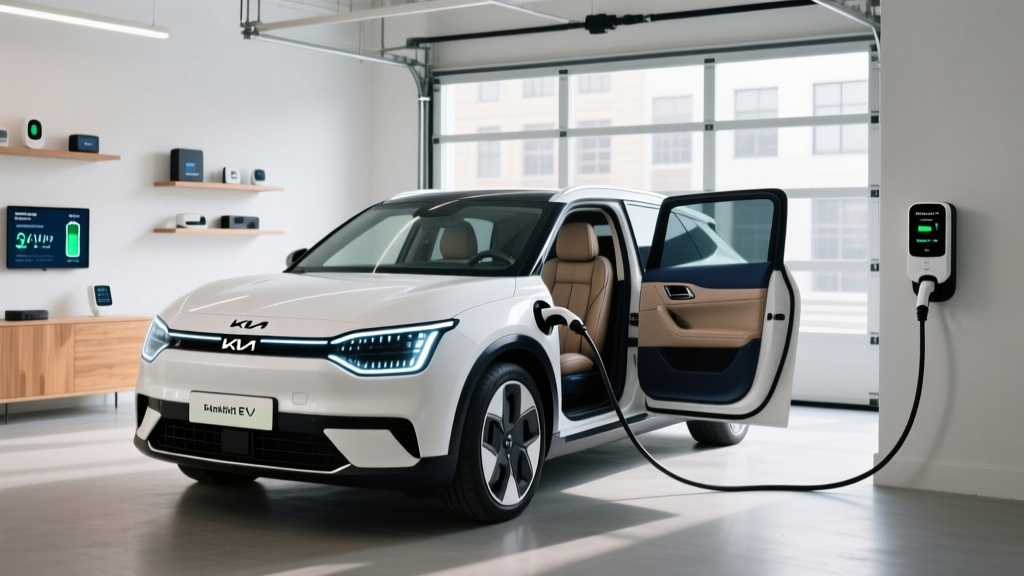
The Kia EV9 remains one of the few mainstream three-row electric SUVs on the market in 2026, but its window sticker tells only part of the financial story. Between the federal §30D tax credit, home charging economics, higher-than-average insurance premiums, and EV depreciation curves, the real cost to own Kia's flagship EV shifts dramatically depending on your zip code, electricity rate, and driving habits.
This guide breaks down every dollar — from MSRP to year-five resale — so you can decide whether the EV9 pencils out against gas-powered rivals like the Toyota Grand Highlander or Hyundai Palisade.
2026 Kia EV9 Starting Price and Trim Breakdown
Before incentives, the 2026 Kia EV9 lineup spans a wide price corridor. Kia has adjusted pricing modestly since the EV9's 2024 launch, and here is where the trims land for the current model year:
| Trim | Drivetrain | Battery (kWh, usable) | EPA Range | MSRP |
|---|---|---|---|---|
| Light (RWD) | Rear-wheel drive | 76.1 kWh, NMC | 230 mi | $54,900 |
| Wind (RWD) | Rear-wheel drive | 100.0 kWh, NMC | 304 mi | $59,900 |
| Land (AWD) | Dual-motor AWD | 100.0 kWh, NMC | 282 mi | $63,900 |
| GT-Line (AWD) | Dual-motor AWD | 100.0 kWh, NMC | 270 mi | $73,900 |
All trims include DC fast charging capability. The 100 kWh trims peak at approximately 210 kW on a 350 kW CCS charger, achieving a 10–80% charge in roughly 24 minutes under optimal battery preconditioning. The smaller 76.1 kWh pack in the Light trim peaks around 170 kW. Real-world highway range at 70 mph typically falls 10–15% below EPA estimates — expect roughly 260 miles from the Wind RWD on a flat, temperate interstate run, and closer to 220 miles in freezing weather due to cabin heating demand and increased battery resistance.
Federal Tax Credit: Do You Qualify for §30D?
The federal EV tax credit under IRS §30D can reduce the effective purchase price of the EV9 by up to $7,500 — but eligibility is not automatic. The rules have tightened significantly since the Inflation Reduction Act reshaped the credit, and they continue to evolve. Here is the 2026 checklist:
- MSRP cap: The EV9 is classified as an SUV/van, so the MSRP cap is $80,000. All current EV9 trims fall under this threshold.
- Buyer income limits: Modified adjusted gross income (MAGI) must not exceed $300,000 (joint filers), $225,000 (head of household), or $150,000 (single filers). This is based on the year of delivery or the prior year — whichever is lower.
- Battery component sourcing: At least 70% of battery components must be manufactured or assembled in North America for the full $3,750 component credit. Kia's Georgia-built EV9s use battery cells sourced from SK On's U.S. plants, which currently satisfies this requirement.
- Critical minerals: At least 60% of critical minerals must be sourced from the U.S. or a free-trade-agreement partner for the other $3,750. Supply chains shift, so verify current sourcing on the fueleconomy.gov credit lookup before purchasing.
- Point-of-sale transfer: As of 2024, buyers can elect to transfer the credit to the dealer at purchase, receiving the $7,500 as an immediate price reduction rather than waiting to claim it on their tax return. This is now the most common method.
- One vehicle per four years: You can only claim the new-vehicle credit once every four years per taxpayer.
Effective price after full credit: A Wind RWD at $59,900 drops to approximately $52,400 — a significant repositioning that puts it in the territory of well-equipped gas three-row SUVs.
State, Local, and Utility Incentives
Federal credits are just the starting line. Depending on where you live, additional incentives can shave thousands more off the effective cost:
- State rebates: California's Clean Vehicle Rebate Project (CVRP) and similar programs in Colorado, Massachusetts, New York, and Oregon can add $1,000–$5,000. Some states (like Colorado) offer refundable tax credits that function like cash even if you owe no state tax.
- Utility rebates: Many investor-owned utilities offer $500–$1,500 rebates for purchasing an EV, particularly if you enroll in a time-of-use (TOU) rate plan. Examples include PG&E, ConEdison, Xcel Energy, and Duke Energy programs.
- HOV lane access: States like California, Virginia, and Maryland offer free or discounted HOV/carpool lane stickers for EVs — a non-cash benefit worth $1,000+ annually in time savings for commuters.
- Home charger rebates: Utility and state programs frequently cover $300–$1,000 of Level 2 charger purchase and installation costs.
Charging Costs vs. Gas: The Per-Mile Math
The most tangible day-to-day savings from owning an EV9 comes at the "pump." But the exact savings depend on your electricity source and rate structure.
The EV9 Wind RWD achieves a combined EPA efficiency of approximately 88 MPGe, which translates to roughly 38 kWh per 100 miles (0.38 kWh/mi). The AWD trims are slightly less efficient at around 84–86 MPGe, or about 40 kWh per 100 miles.
| Scenario | Rate / Cost | Cost per Mile | Annual (15,000 mi) |
|---|---|---|---|
| Home charging (national avg. $0.16/kWh) | $0.16/kWh × 0.38 kWh/mi | $0.061/mi | $915 |
| Home charging on TOU off-peak ($0.09/kWh) | $0.09/kWh × 0.38 kWh/mi | $0.034/mi | $510 |
| Public DC fast charging ($0.40/kWh avg.) | $0.40/kWh × 0.38 kWh/mi | $0.152/mi | $2,280 |
| Gas SUV comparison (22 MPG combined, $3.40/gal) | $3.40 ÷ 22 MPG | $0.155/mi | $2,325 |
The takeaway: If you charge primarily at home on a standard rate, you will spend roughly $900/year on electricity for 15,000 miles — saving about $1,400/year versus a comparable gas SUV. If you can access off-peak TOU rates, savings widen to $1,800/year. However, if you rely exclusively on public DC fast charging at $0.40/kWh, your "fuel" cost nearly matches gasoline, eliminating most of the operating-cost advantage.
This is why home charging access is the single most important variable in EV ownership economics. Without it, the financial case narrows considerably.
Maintenance: Where EVs Quietly Save Money
Electric vehicles eliminate several routine maintenance items that gas-vehicle owners take for granted — and the savings compound over five years.
| Maintenance Item | Gas SUV (5-yr cost) | Kia EV9 (5-yr cost) |
|---|---|---|
| Oil changes (synthetic, ~2× per year) | $600–$900 | $0 |
| Transmission fluid | $150–$300 | $0 (single-speed reducer) |
| Brake pads/rotors | $600–$1,200 | $0–$300 (regen extends life 2–3×) |
| Engine air filter | $100–$200 | $0 |
| Cabin air filter | $100–$200 | $100–$200 |
| Coolant flush | $150–$250 | $150–$250 (battery thermal system) |
| Tire rotation | $150–$250 | $150–$250 |
| Estimated 5-yr total | $1,850–$3,300 | $400–$1,000 |
Regenerative braking is the unsung hero here. Because the EV9's motors handle most deceleration, the friction brakes see far less use. Many EV owners report original brake pads lasting 80,000–100,000+ miles. The trade-off: EV tires tend to wear 15–25% faster than those on equivalent gas vehicles due to the EV9's ~5,600 lb curb weight and instant torque delivery. Budget for a tire replacement around 35,000–45,000 miles ($800–$1,400 for a set of EV-rated touring tires).
Insurance: The Cost Item That Catches Buyers Off Guard
Here is where the EV9's ownership math gets less rosy. Electric vehicles cost more to insure than comparable gas vehicles, typically 15–30% more. The reasons are structural:
- Higher repair costs: Battery pack damage from even minor collisions can result in total-loss declarations. Repair shops need specialized EV training and equipment.
- Higher vehicle value: The EV9's MSRP is higher than gas rivals, so comprehensive and collision premiums scale accordingly.
- Parts scarcity: EV-specific body panels, sensors, and structural components can have longer lead times, increasing rental-car and labor costs for insurers.
- Limited actuarial data: Insurers are still building long-term claims databases for newer EV models, and uncertainty is priced into premiums.
Based on national averages for a 40-year-old driver with a clean record and full coverage, expect annual EV9 insurance premiums in the range of $2,200–$3,400, depending on your state, ZIP code, and deductible choices. A comparably equipped gas Grand Highlander Hybrid might run $1,700–$2,600. That is roughly $500–$800 more per year, or $2,500–$4,000 over five years — a figure that partially offsets the fuel and maintenance savings.
Shop quotes from at least three insurers before purchase. Some carriers (like Progressive, Geico, and Tesla Insurance where available) have become more competitive on EV premiums, and bundling with home insurance can narrow the gap.
Depreciation and Resale Value: The Wildcard
EV depreciation has been volatile. The 2023–2024 wave of Tesla price cuts, combined with rapid battery-technology advancement and shifting consumer demand, caused used EV values to drop faster than the historical norm for gas vehicles. The EV9, as a relatively new model, does not yet have a deep resale track record.
Here is what the data suggests for 2026:
- Typical gas SUV 5-year depreciation: 40–50% of original MSRP.
- Recent EV 5-year depreciation trend: 45–60%, with some models experiencing steeper drops in the first two years.
- EV9-specific factors: Strong initial demand, Kia's 10-year/100,000-mile battery warranty, and limited three-row EV competition may support better-than-average retention. However, the arrival of competing three-row EVs (Rivian R2, potential Hyundai Ioniq 9, next-gen platforms) could pressure values by 2029–2031.
Conservative estimate: plan for the EV9 to retain approximately 40–48% of its purchase price after five years and 75,000 miles. On a $59,900 Wind RWD purchased at $52,400 after the federal credit, that implies a residual value of roughly $21,000–$25,000 and a depreciation cost of $27,400–$31,400 over five years. Note that depreciation applies to your net purchase price (after incentives), not the sticker — so the tax credit effectively reduces your depreciation exposure.
5-Year Total Cost of Ownership: The Full Picture
Pulling all of these numbers together, here is what a realistic five-year ownership scenario looks like for a 2026 Kia EV9 Wind RWD, assuming 15,000 miles per year, home charging at the national average rate, and full §30D credit eligibility:
| Cost Category | 5-Year Total | Notes |
|---|---|---|
| Purchase price (after $7,500 credit) | $52,400 | Wind RWD, no dealer markups |
| State/utility incentives | –$1,000 | Varies; assumed moderate |
| Home charging electricity | $4,575 | $0.16/kWh avg., 75,000 mi total |
| Insurance | $14,000 | $2,800/yr avg. |
| Maintenance & tires | $2,200 | Incl. one tire replacement |
| Depreciation (net) | $28,400 | ~46% of net purchase price |
| Total 5-Year Cost | ~$100,575 | |
| Effective cost per mile | ~$1.34/mi | Incl. depreciation |
For comparison, a similarly equipped 2026 Toyota Grand Highlander Hybrid (MSRP ~$52,000, 35 MPG combined, no federal credit) would land in the ballpark of $92,000–$98,000 over the same period, with higher fuel costs but lower insurance and potentially stronger resale value. The gap is narrow — and it flips in the EV9's favor if you have access to cheap off-peak electricity, a state rebate, or lower insurance quotes.
Kia EV9 Ownership FAQ
How much does it really cost to own a Kia EV9 over 5 years?
Approximately $98,000–$105,000 all-in for a Wind RWD trim, including depreciation, insurance, electricity, and maintenance. Your actual number shifts based on electricity rates, insurance premiums in your state, and whether you qualify for the full $7,500 federal tax credit and any state incentives.
Do I qualify for the $7,500 federal EV tax credit on the EV9?
You likely qualify if your household MAGI is under $300,000 (joint) or $150,000 (single), the vehicle's MSRP is under $80,000 (all trims qualify), and the battery meets current critical-mineral and component-sourcing thresholds. The EV9's Georgia production and SK On U.S. battery supply chain currently satisfy these requirements, but always verify at irs.gov before purchase, as rules can shift with supply-chain changes.
How much do I save on fuel and maintenance vs. a gas SUV?
With home charging at the national average rate, expect to save roughly $1,400/year on fuel versus a 22 MPG gas SUV. Maintenance savings add another $300–$500/year from eliminated oil changes and reduced brake wear. Combined annual savings: approximately $1,700–$1,900. Over five years, that is $8,500–$9,500 — though higher insurance premiums ($2,500–$4,000 over five years) partially offset this.
Are EVs more expensive to insure than gas cars?
Yes, typically 15–30% more. The EV9's higher MSRP, expensive battery repair costs, and limited collision-repair infrastructure push premiums to roughly $2,200–$3,400/year with full coverage. Shop multiple insurers and consider higher deductibles to manage costs.
How well does the Kia EV9 hold its value?
EV depreciation has been steeper than gas vehicles in recent years, but the EV9 benefits from Kia's 10-year/100,000-mile battery and powertrain warranty, limited three-row EV competition, and strong initial demand. Plan conservatively for 40–48% value retention after five years. The federal tax credit reduces your depreciation exposure because it lowers your effective purchase price.
What happens if I can't charge at home?
Public DC fast charging at $0.35–$0.50/kWh brings per-mile costs close to gasoline, eliminating most of the fuel-cost advantage. If you lack home or workplace charging, the financial case for the EV9 narrows, and a hybrid like the Grand Highlander Hybrid may be the more economical choice. The EV9's 210 kW peak charging speed (10–80% in ~24 min) makes road-trip charging manageable, but daily reliance on public chargers is both expensive and inconvenient.