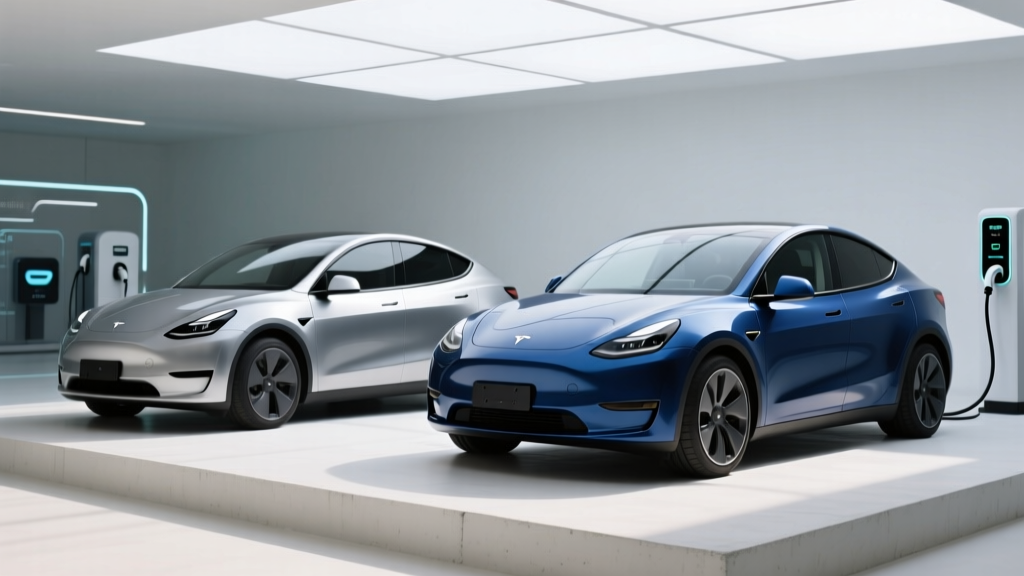
Tesla's next-generation Autopilot computer, internally dubbed Hardware 5 (HW5) or AI5, is slated to begin appearing in production vehicles in 2026. CEO Elon Musk has described AI5 as delivering roughly 5x the compute performance of Hardware 4 (HW4/AI4) while consuming more power and requiring enhanced cooling. For buyers evaluating a 2026 Tesla Model Y, Model 3, or future Cybertruck, understanding what Hardware 5 changes — and what it doesn't — is essential before you sign a purchase agreement.
This profile examines Tesla Hardware 5 through the lens of a real-world EV buyer: how it affects range, charging, performance, pricing, and the ongoing Full Self-Driving (Supervised) debate. Where Tesla has published confirmed 2026 model-year specs, we use them. Where HW5-specific data remains preliminary, we label it clearly.
What Is Tesla Hardware 5 (AI5)?
Hardware 5 is Tesla's fifth-generation onboard computer dedicated to running its neural-network-based vision stack. It replaces Hardware 4 (introduced in early 2023), which itself replaced the aging Hardware 3 chip that had been in production since 2019.
Key disclosed and reported specifications for HW5/AI5:
- Compute performance: ~5x improvement over HW4, per Elon Musk's public statements
- Chip architecture: Custom Tesla-designed inference SoC, manufactured on an advanced node (likely TSMC 4nm or 3nm class)
- Camera support: Higher-resolution sensors and expanded camera inputs (up to 11 cameras reported for some configurations)
- Power draw: Estimated 2-3x higher than HW4, requiring dedicated liquid cooling loops
- Memory bandwidth: Substantially increased to support larger neural-network models running at higher frame rates
The practical upshot: HW5 enables Tesla to run more complex, higher-resolution vision models in real time, which is the foundation for any future improvements to Autopilot and FSD (Supervised). It also future-proofs the vehicle for potential over-the-air capability upgrades.
2026 Model Lineup: Range, Battery, and Efficiency
Hardware 5 itself does not change a vehicle's battery size or chemistry — those are determined by the model and trim. However, HW5's increased power draw (estimated 20-40W sustained vs. ~10-15W for HW4) could marginally affect efficiency. Below are the confirmed and projected EPA figures for Tesla's core 2026 models expected to receive HW5.
| Spec | 2026 Model Y LR AWD | 2026 Model 3 LR AWD | 2026 Model Y Perf. |
|---|---|---|---|
| EPA Range | 320 mi | 341 mi | 285 mi |
| Battery (usable) | ~78 kWh, NMC | ~79 kWh, NMC | ~78 kWh, NMC |
| MPGe (combined) | 111 MPGe | 125 MPGe | 106 MPGe |
| kWh/100 mi | 30 | 27 | 32 |
| Drivetrain | Dual Motor AWD | Dual Motor AWD | Dual Motor AWD |
Sources: fueleconomy.gov, Tesla.com specifications.
EPA estimates assume a mix of city and highway driving at moderate temperatures. In our experience and consistent with independent testing:
- Highway (75 mph sustained): Expect 10-15% below EPA — roughly 275-290 mi for Model Y LR, 295-310 mi for Model 3 LR.
- Cold weather (below 32°F): Range loss of 20-30% is typical for NMC packs without consistent preconditioning. A 320-mi Model Y may deliver 225-255 mi in freezing highway conditions.
- City/commute driving: Often matches or slightly exceeds EPA thanks to regenerative braking.
Charging Speed: DC Fast Charge and Home Level 2
Charging hardware is independent of the Autopilot computer, but it's the number-one concern for EV buyers, so we cover it here for completeness. Tesla's 2026 models continue to use the NACS (North American Charging Standard) connector natively and support the Tesla Supercharger network, now also open to other brands.
| Charging Level | Power / Rate | Speed (mi/hr) | 10-80% Time |
|---|---|---|---|
| Level 1 (120V) | ~1.4 kW | 3-5 mi/hr | N/A (overnight trickle) |
| Level 2 (240V, 48A Wall Connector) | 11.5 kW | ~38-44 mi/hr | ~6-7 hours (0-100%) |
| DC Fast Charge (V3 Supercharger) | Peak 250 kW | ~1,000 mi/hr peak | ~25-30 min |
| DC Fast Charge (V4 Supercharger) | Peak 250-350 kW* | ~1,200 mi/hr peak | ~20-25 min* |
*V4 Supercharger speeds depend on vehicle architecture. Current 400V Tesla models are limited to ~250 kW peak even at V4 stalls. Sustained rates taper significantly above 60% SoC — expect the 60-80% portion to add 8-12 minutes alone due to the charge curve.
Charge curve reality: Tesla advertises "up to 250 kW" peak, but this rate is only sustained from roughly 10-40% SoC on a preconditioned battery. Above 60%, the rate drops to ~100 kW, and above 80%, it falls below 50 kW. This is normal lithium-ion behavior, not a defect. For road-trip planning, budget 25-30 minutes for a 10-80% session, not the "15 minutes" marketing sometimes implies.
Performance: 0-60, Horsepower, and Drivetrain
| Model / Trim | 0-60 mph | Horsepower | Drivetrain | Top Speed |
|---|---|---|---|---|
| Model 3 Long Range AWD | 4.2 sec | ~346 hp | Dual Motor AWD | 125 mph |
| Model Y Long Range AWD | 4.8 sec | ~384 hp | Dual Motor AWD | 135 mph |
| Model Y Performance | 3.5 sec | ~456 hp | Dual Motor AWD | 155 mph |
| Model 3 Performance | 2.9 sec | ~510 hp | Dual Motor AWD | 163 mph |
Hardware 5 does not change motor output or acceleration — those are governed by the drive unit inverters and battery discharge capability. However, HW5's enhanced sensor processing may improve traction-control response and regenerative-braking smoothness in edge cases like wet or icy roads.
What Hardware 5 Actually Changes: FSD, Cameras, and Compute
Here is where HW5 matters. The Autopilot/FSD stack is entirely software running on dedicated silicon, and HW5 represents a generational leap in what that software can do in real time.
Camera System Upgrades
HW5 is expected to support higher-resolution camera inputs (potentially 5+ megapixel sensors vs. the current ~1.2 MP). Higher resolution means:
- Better object detection at longer range (critical for highway-speed braking decisions)
- Improved lane-line and road-edge detection in low-contrast conditions
- More reliable performance in rain, fog, and direct-sun glare
Compute Headroom for FSD
With ~5x the inference throughput, HW5 can run larger, more accurate neural networks at higher frame rates. In practical terms:
- Fewer phantom-braking events (the system can better distinguish real obstacles from shadows/debris)
- Smoother lane changes and merges in FSD (Supervised) mode
- Faster recognition of complex intersections, construction zones, and emergency vehicles
- Potential for future features requiring real-time 3D scene reconstruction
- It does not make the vehicle autonomous. FSD (Supervised) remains SAE Level 2 — you are the driver.
- It does not unlock features Tesla hasn't yet developed or received regulatory approval for.
- It does not retroactively apply to HW3 or HW4 vehicles via software update. HW5 requires the physical chip.
- It does not improve range, charging speed, or motor performance.
Will HW4 Vehicles Be Left Behind?
Tesla has historically supported older hardware for several years, but the compute gap between HW4 and HW5 is large enough that future FSD versions optimized for AI5 may not backport fully to HW4. If FSD capability is a priority, purchasing a HW5-equipped vehicle is the safer long-term bet. Tesla has not announced a definitive HW4 end-of-support date as of early 2026.
Pricing, Trims, and Federal Tax Credit Eligibility
| Model / Trim | Base MSRP | Est. As-Tested | §30D Credit Eligible? | After Max Credit |
|---|---|---|---|---|
| Model 3 RWD | $38,990 | $41,490 | Yes (partial to full) | ~$31,490–$33,990 |
| Model 3 LR AWD | $45,490 | $48,990 | Yes (partial to full) | ~$37,990–$41,490 |
| Model Y LR AWD | $44,990 | $49,990 | Yes (partial to full) | ~$37,490–$42,490 |
| Model Y Performance | $51,490 | $55,990 | Yes (partial to full) | ~$43,990–$48,490 |
MSRP figures reflect Tesla's published pricing as of early 2026. "As-tested" includes common options (FSD package, premium paint, wheels). Actual credit amount varies.
Federal Tax Credit (§30D) Rules for 2026
The IRS §30D Clean Vehicle Credit offers up to $7,500 for qualifying new EVs, but eligibility is not automatic. Key requirements for 2026:
- MSRP cap: SUVs (including Model Y) must be under $80,000; sedans (Model 3) under $55,000. All current Tesla trims qualify on MSRP.
- Buyer income cap: Modified AGI must not exceed $150,000 (single), $225,000 (head of household), or $300,000 (joint filers).
- Battery sourcing: The credit splits into two halves ($3,750 each) — one for critical-minerals sourcing and one for battery-component manufacturing. As of 2026, Tesla's Fremont and Austin-built vehicles generally qualify for the critical-minerals half; the battery-component half depends on evolving supply-chain rules and "foreign entity of concern" (FEOC) restrictions. Many Tesla buyers receive $3,750 rather than the full $7,500.
- Point-of-sale transfer: You can transfer the credit to the dealer at purchase, reducing your out-of-pocket cost immediately rather than waiting for tax filing.
Source: IRS.gov — Credits for New Clean Vehicles. Tax rules change; consult a tax professional for your specific situation.
Cargo Space, Interior, and Practicality
| Dimension | Model 3 | Model Y |
|---|---|---|
| Cargo (rear seats up) | 23 cu ft | 30 cu ft |
| Cargo (rear seats folded) | ~46 cu ft | ~72 cu ft |
| Frunk | 3.1 cu ft | 4.1 cu ft |
| Rear legroom | 34.9 in | 40.5 in |
| Front headroom | 40.3 in | 41.0 in |
The Model Y remains one of the most practical EVs in its class for families, with genuine SUV cargo volume and available 7-seat configuration (third row is best suited for small children). The Model 3 sedan trades cargo space for a lower price and better efficiency.
Warranty Coverage
| Component | Coverage |
|---|---|
| Basic Vehicle | 4 years / 50,000 miles |
| Battery & Drive Unit (Model 3/Y LR/Perf) | 8 years / 120,000 miles |
| Battery capacity retention threshold | 70% minimum over warranty period |
Tesla's 8-year/120,000-mile battery warranty is competitive with the industry standard (Hyundai offers 10yr/100k, most others match at 8yr/100k-120k). The 70% retention floor means Tesla will replace or repair the battery if it degrades below 70% of original capacity within the warranty window. In practice, NMC Tesla packs typically retain 85-90% capacity at 100,000 miles based on fleet data, though individual results vary with charging habits and climate.
Pros and Cons of Tesla with Hardware 5
✓ Pros
- Best-in-class Supercharger network access (17,000+ stalls in North America)
- HW5 provides genuine compute headroom for future FSD improvements
- Class-leading efficiency (Model 3 LR at 125 MPGe combined)
- Over-the-air updates continuously add features
- Strong resale value relative to most EV competitors
- Point-of-sale tax credit transfer reduces upfront cost
✗ Cons
- FSD (Supervised) remains Level 2 — not autonomous despite the name and $8,000+ price tag
- HW5 vehicles may carry a price premium over remaining HW4 inventory
- No instrument cluster in Model 3/Y — all info on center screen
- Build quality inconsistency still reported by some owners
- Insurance premiums 15-25% higher than comparable ICE vehicles on average
- Turn-signal stalk removal on refreshed models frustrates some drivers
Who Should Buy a Tesla with Hardware 5?
Choose a HW5-equipped Tesla if:
- You want the longest runway of FSD/Autopilot feature support and are willing to pay a premium for future-proofing
- You frequently road-trip and value the Supercharger network's reliability
- You prioritize efficiency and low cost-per-mile (Model 3 LR is among the cheapest EVs to operate)
- You need a family EV with strong cargo space (Model Y) or a commuter sedan with 300+ mi range (Model 3)
Consider alternatives if:
- You want true hands-free highway driving today — GM's Super Cruise and Ford's BlueCruise offer validated hands-off operation on mapped highways (still Level 2, but with driver-monitoring cameras)
- You prefer a traditional instrument cluster and physical controls
- You need towing capacity above 3,500 lbs (Model Y maxes at 3,500 lbs; Rivian R1S, F-150 Lightning, or Hyundai Ioniq 5 offer different trade-offs)
- You live in an area with limited Supercharger coverage and prefer CCS-native vehicles for Electrify America or third-party networks
Key Competitors to Cross-Shop
Before committing to a HW5 Tesla, compare against these rivals that compete directly on price, range, and utility:
- Hyundai Ioniq 5 / Ioniq 6: 800V architecture enables 10-80% in ~18 min at 350 kW chargers; strong IIHS Top Safety Pick+ rating; more conventional interior ergonomics.
- Ford Mustang Mach-E: Competitive range (320 mi EPA on Extended Range), BlueCruise hands-free highway driving, and a growing dealer service network.
- Chevrolet Equinox EV: Lower entry price (~$33,000 base), 319 mi EPA range, and GM's Ultium platform — a strong value play if FSD compute is not a priority.
- BMW i4 / Hyundai Ioniq 5 N: For driving enthusiasts who find Tesla's steering feel and chassis tuning less engaging.
Frequently Asked Questions
What is the real-world range of a 2026 Tesla Model Y with Hardware 5?
The EPA rates the 2026 Model Y Long Range AWD at 320 miles. In real-world highway driving at 75 mph, expect 275-290 miles. In freezing winter conditions, plan for 225-255 miles. Hardware 5's additional compute power draw has a negligible effect on range (estimated 1-3 miles at most).
How fast does a 2026 Tesla charge on DC fast chargers and at home?
On a V3 or V4 Supercharger, peak rate is 250 kW, achieving 10-80% in approximately 25-30 minutes with a preconditioned battery. At home on a 48A Level 2 Tesla Wall Connector (11.5 kW), you'll add roughly 38-44 miles per hour of charging, filling the battery overnight in 6-7 hours.
How much does a 2026 Tesla cost after the federal EV tax credit?
A 2026 Model 3 RWD starts at $38,990 and could drop to approximately $31,490-$33,990 after the §30D credit (depending on whether you qualify for $3,750 or the full $7,500). A Model Y LR AWD starts at $44,990 and could net to roughly $37,490-$42,490. Eligibility depends on your income, battery sourcing rules, and MSRP caps — verify at IRS.gov or with a tax professional.
Is Tesla Hardware 5 worth waiting for vs buying a HW4 vehicle now?
If you plan to keep the vehicle 5+ years and value ongoing FSD improvements, HW5 provides meaningful compute headroom that HW4 cannot match. If you primarily use basic Autopilot (lane centering + adaptive cruise) and don't plan to purchase FSD, HW4 is fully capable and may be available at a discount as inventory clears.
Does a 2026 Tesla qualify for the federal EV tax credit?
Yes, Tesla's US-built vehicles currently qualify for at least a partial §30D credit. The exact amount ($3,750 or $7,500) depends on battery-component and critical-minerals sourcing requirements, which continue to tighten. All current Tesla models fall under the MSRP caps ($55,000 for sedans, $80,000 for SUVs). Buyer income limits also apply.
Can Hardware 5 be retrofitted to an older Tesla?
No. HW5 requires new physical hardware — a different compute board, enhanced cooling system, and potentially different camera harnesses. Tesla has offered paid HW3-to-HW4 upgrades in limited cases, but no HW5 retrofit program has been announced, and the architectural differences make it unlikely to be cost-effective.
What are the biggest pros and cons of buying a 2026 Tesla with HW5?
The biggest advantage is future-proofed access to Tesla's most advanced driver-assistance compute, combined with class-leading efficiency and the Supercharger network. The biggest drawbacks are that FSD remains a Level 2 system (not autonomous), insurance costs are elevated, and the minimalist interior (no instrument cluster, limited physical controls) is polarizing.