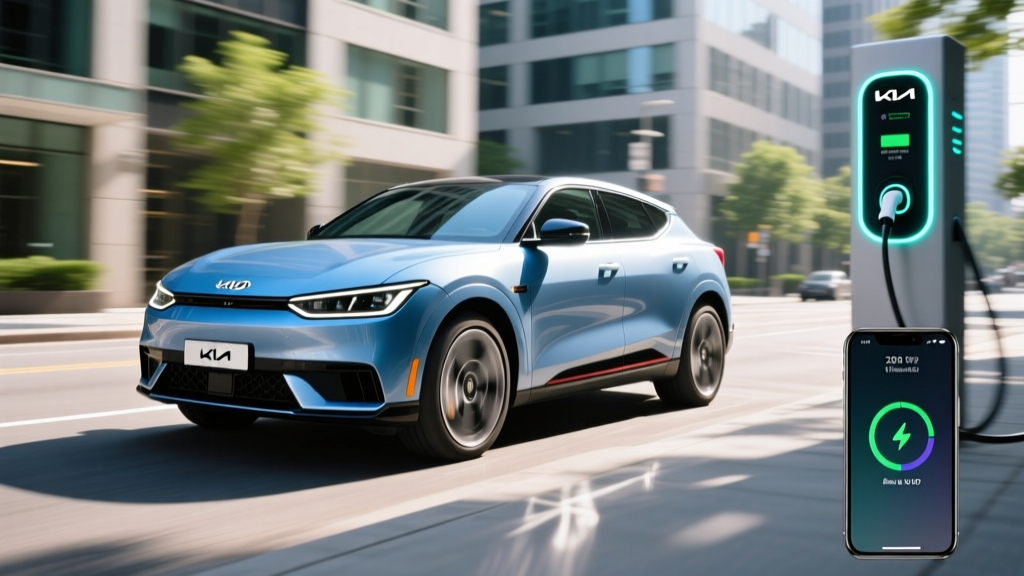
The 2026 Kia EV6 Wind AWD sits in the middle of Kia's electric crossover lineup — not the range-topping GT, not the entry-level Light, but the trim most buyers actually put on their driveway. It pairs dual motors with a 77.4 kWh usable battery, delivers genuine sports-sedan acceleration, and leverages the Hyundai Motor Group's E-GMP 800-volt architecture for some of the fastest DC fast charging in the segment. But the Wind AWD's blend of performance and practicality comes with range and pricing trade-offs worth examining before you sign.
2026 Kia EV6 Wind AWD: Core Specifications
| Spec | Value |
|---|---|
| EPA Range | 282 miles |
| Battery (usable) | 77.4 kWh, NMC lithium-ion |
| Drivetrain | Dual-motor AWD |
| Horsepower | 320 hp combined |
| Torque | 446 lb-ft |
| 0-60 mph | 4.5 seconds |
| Top Speed | 115 mph (electronically limited) |
| Max DC Fast Charge | 240 kW peak (800V) |
| 10-80% DC Time | ~18 minutes (ideal conditions) |
| Level 2 Home Charge (AC) | 10.9 kW (~36 mi/hr) |
| Efficiency | 117 MPGe combined / 29 kWh/100 mi |
| Cargo (rear seats up) | 24.4 cu ft |
| Cargo (rear seats folded) | 50.2 cu ft |
| Frunk | 0.7 cu ft (cable storage) |
| Rear Legroom | 39.4 inches |
| Curb Weight | ~4,600 lbs |
| Towing Capacity | 2,700 lbs (with brake) |
| Battery Warranty | 10 years / 100,000 miles |
| Base MSRP (Wind AWD) | $52,200 (before destination) |
Range and Real-World Efficiency
The EPA rates the 2026 EV6 Wind AWD at 282 miles on a full charge. That figure is derived from a blended city/highway cycle, and as with every EV, your actual mileage will vary based on speed, temperature, terrain, and climate-control use.
- City / moderate-speed commuting: 280–300+ mi (regen braking recovers energy)
- Highway (70-75 mph sustained): ~235–255 mi
- Cold weather (below 32°F, highway): ~195–220 mi (battery heating + cabin HVAC draw)
- Mixed driving, temperate conditions: ~255–275 mi
The EV6's standard heat pump helps mitigate cold-weather losses compared to EVs without one, but expect a 20-30% range reduction in sustained sub-freezing highway driving. Source: fueleconomy.gov.
Efficiency lands at 117 MPGe combined (29 kWh per 100 miles), which is competitive with the Ford Mustang Mach-E AWD but slightly behind the Tesla Model Y Long Range AWD's 122 MPGe. The AWD system's added weight and the dual-motor drag penalty account for the roughly 25-mile range gap versus the Wind RWD trim (310 mi EPA).
Charging Speed: 800V Architecture Advantage
This is where the EV6's E-GMP platform earns its reputation. The 800-volt electrical architecture allows peak DC charge rates up to 240 kW on compatible 350 kW chargers — a capability most competitors in this price bracket still can't match (the Mach-E peaks around 150 kW, the Ioniq 5 shares the 240 kW architecture).
| Charge Level | Power (kW) | Speed (mi/hr added) | 10-80% Time |
|---|---|---|---|
| Level 1 (120V household) | ~1.4 kW | ~4 mi/hr | N/A (days) |
| Level 2 (240V / 48A home) | 10.9 kW | ~36 mi/hr | ~7 hours |
| DC Fast (50 kW station) | 50 kW | ~150 mi/hr | ~55 min |
| DC Fast (150 kW station) | ~150 kW sustained | ~450 mi/hr | ~25 min |
| DC Fast (350 kW station) | 240 kW peak | ~700+ mi/hr (peak) | ~18 min |
Charging curve reality check: The 240 kW figure is a peak, not a sustained rate. In real-world testing on 350 kW Electrify America or Tesla Supercharger stalls (via NACS adapter, now included with new EV6 models), expect the EV6 to hold ~200-240 kW from 10% to roughly 55% SoC, then taper progressively through the 60-80% window. The 18-minute 10-80% claim assumes an ideal-temperature battery that has been preconditioned via the navigation-linked charging preconditioning feature. Without preconditioning — say, pulling into a charger on a cold morning without routing through the nav — expect 22-28 minutes for the same window.
For home Level 2 charging, the onboard 10.9 kW charger fills the 77.4 kWh battery from empty in about 7 hours. Most owners charging overnight from a typical 20-30% residual will wake up full every morning. A 48-amp Level 2 wall connector on a dedicated 60-amp circuit is the recommended home setup; installation costs typically run $800-$2,000 depending on panel proximity and local permitting.
Performance: The 0-60 Story
The keyword that brought you here — the Kia EV6 Wind AWD 0-60 time — clocks in at 4.5 seconds in manufacturer testing and independent instrumented tests. That puts it in the company of a base Porsche Cayenne, a BMW X3 M40i, or a Tesla Model Y Long Range (4.8 sec). For a family crossover starting in the low $50Ks, that's genuinely quick.
The dual-motor AWD powertrain produces 320 horsepower and 446 lb-ft of torque, distributed between a front induction motor and a rear permanent-magnet motor. The instant torque delivery characteristic of EVs makes the 4.5-second sprint feel even more immediate than the number suggests — there's no turbo lag, no transmission downshift, just a linear surge.
Daily driving manners are composed. The EV6 Wind AWD rides on a multi-link rear suspension that absorbs broken pavement better than the stiffer GT model, and the steering is accurate if not communicative. Three drive modes (Eco, Normal, Sport) adjust throttle mapping, regen intensity, and steering weight. In Sport mode with regen set to maximum, you can approach one-pedal driving in most city scenarios, though the EV6 does not come to a complete hold without touching the brake — it creeps at very low speed.
Pricing, Trims, and Federal Tax Credit
The 2026 EV6 lineup includes Light, Wind, GT-Line, and GT trims. The Wind AWD is positioned as the value-performance sweet spot:
| Trim | Drivetrain | MSRP (incl. destination) | Est. After §30D Credit* |
|---|---|---|---|
| Light | RWD | $44,050 | $36,550 |
| Wind | RWD | $48,750 | $41,250 |
| Wind | AWD | $53,550 | $46,050 |
| GT-Line | AWD | $58,250 | $50,750 |
| GT | AWD | $63,150 | $55,650 |
*The $7,500 reduction assumes full eligibility under IRS §30D clean vehicle credit rules. Eligibility is NOT automatic — it requires meeting ALL of the following:
- MSRP cap: Vehicle MSRP must not exceed $80,000 for SUVs (the EV6 qualifies as an SUV per IRS classification)
- Buyer income cap: Modified AGI must not exceed $150,000 (single), $225,000 (head of household), or $300,000 (joint filers)
- Battery sourcing: Critical minerals and battery components must meet escalating percentage thresholds from qualifying trade partners — verify current-year compliance with your dealer
- Point-of-sale transfer: As of 2024+, you can transfer the credit to the dealer at purchase for an immediate price reduction rather than claiming it on your tax return
- VIN registration: The dealer must report the sale and your VIN to the IRS within 3 days
The EV6 Wind AWD's $53,550 MSRP clears the $80K SUV cap comfortably, but battery-sourcing rules are the variable most likely to affect eligibility. Always confirm current-year compliance with your dealer and consult a tax professional before counting on the full credit. Kia also frequently offers lease incentives that may bypass sourcing requirements via the commercial clean vehicle credit (§45W) — ask about lease-vs-buy comparisons.
Interior, Cargo, and Daily Practicality
The EV6's interior is one of its strongest selling points. The dual 12.3-inch curved displays (instrument cluster + infotainment) run Kia's latest connected-car software with wireless Apple CarPlay and Android Auto. The Wind trim adds heated and ventilated front seats, a heated steering wheel, a power liftgate, and a hands-free smart liftgate — features that competitors like the base Model Y omit or charge extra for.
Cargo capacity is competitive for the class:
- 24.4 cu ft behind the second row — enough for a week's groceries or two large suitcases
- 50.2 cu ft with the 60/40 rear seats folded — sufficient for furniture-store runs or camping gear
- 39.4 inches of rear legroom — adults sit comfortably behind tall front-seat occupants
- 0.7 cu ft frunk — essentially a cable-storage cubby, not a usable luggage compartment
The small frunk is a genuine drawback versus the Ford Mustang Mach-E (which offers a drainable 3.4 cu ft frunk suitable for ice and beverages). If you expected a proper front trunk, you'll be disappointed.
Driver Assistance and Technology
The EV6 Wind AWD comes equipped with Kia's Highway Driving Assist 2 (HDA2), which combines adaptive cruise control with lane-centering steering and automated lane changes when you activate the turn signal. This is a SAE Level 2 driver-assistance system — you must keep your hands on the wheel and eyes on the road at all times. It is not self-driving.
Other standard tech on the Wind trim includes blind-spot view monitors (camera feed in the instrument cluster when signaling), rear cross-traffic avoidance, a surround-view camera, remote smart parking assist (the car can park itself while you stand outside with the key fob), and over-the-air software updates for the powertrain and infotainment systems.
One notable gripe: Kia uses haptic-touch climate controls below the main screen rather than physical knobs. Gloved operation in winter is frustrating, and the glossy black panel attracts fingerprints. This is a recurring complaint among EV6 owners.
Pros, Cons, and the Verdict
What We Like
- 4.5-second 0-60 — sports-sedan acceleration in a crossover body
- 800V architecture enables 240 kW DC charging; 10-80% in ~18 min
- 10-year / 100,000-mile battery warranty — among the best in the industry
- Generous standard features on the Wind trim (ventilated seats, HDA2, power liftgate)
- Comfortable ride quality, especially vs. the stiffer GT trim
- Competitive rear-seat legroom (39.4 in)
- V2L (Vehicle-to-Load) capability — power a laptop, campsite, or tailgate from the charge port
Where It Falls Short
- 282-mile EPA range is below the Tesla Model Y Long Range (320+ mi) and EV6 Wind RWD (310 mi)
- Tiny 0.7 cu ft frunk — essentially useless for luggage
- Haptic-touch climate panel is a usability misstep
- Cold-weather highway range drops to ~200 mi realistically
- AWD premium ($4,800 over Wind RWD) costs both dollars and range
- Insurance premiums run 15-25% higher than comparable ICE crossovers
How the EV6 Wind AWD Stacks Up Against Rivals
The Wind AWD competes in one of the most crowded segments in the EV market. Here's how it compares on the metrics that matter:
| Spec | Kia EV6 Wind AWD | Tesla Model Y LR AWD | Ford Mach-E Premium AWD | Hyundai Ioniq 5 SEL AWD |
|---|---|---|---|---|
| EPA Range | 282 mi | 320 mi | 290 mi | 276 mi |
| 0-60 mph | 4.5 sec | 4.8 sec | 5.1 sec | 5.2 sec |
| Peak DC Charge | 240 kW | 250 kW | 150 kW | 240 kW |
| 10-80% DC Time | ~18 min | ~20 min | ~35 min | ~18 min |
| Battery (usable) | 77.4 kWh (NMC) | ~78 kWh (NMC) | 91 kWh (NMC) | 77.4 kWh (NMC) |
| Base MSRP (AWD) | $53,550 | $49,990 | $52,495 | $51,550 |
| Battery Warranty | 10 yr/100K mi | 8 yr/120K mi | 8 yr/100K mi | 10 yr/100K mi |
- Choose the EV6 Wind AWD if: You prioritize charging speed, interior material quality, and Kia's 10-year warranty, and 280 miles of range covers your daily needs.
- Choose the Model Y Long Range if: Maximum range (320 mi), Supercharger network access (though NACS adapters are closing this gap), and Tesla's software ecosystem matter most.
- Choose the Mach-E if: You want a larger battery, a usable frunk, and Ford's dealer network, and don't mind slower DC charging.
- Choose the Ioniq 5 if: You prefer its retro-futuristic styling and slightly lower price, and can accept ~6 fewer miles of range.
Frequently Asked Questions
What is the real-world range of the Kia EV6 Wind AWD?
The EPA rates it at 282 miles, but expect roughly 235-255 miles on sustained highway driving at 70-75 mph, and as low as 195-220 miles in cold-weather highway conditions (below 32°F). City driving with regenerative braking can approach or slightly exceed the EPA figure.
How fast does the EV6 Wind AWD charge?
On a 350 kW DC fast charger with battery preconditioning, it peaks at 240 kW and charges from 10-80% in approximately 18 minutes. On a home Level 2 charger (10.9 kW / 48A), a full charge takes about 7 hours, adding roughly 36 miles of range per hour.
Does the Kia EV6 qualify for the $7,500 federal EV tax credit?
It can, but eligibility depends on current-year IRS §30D rules including battery-sourcing requirements, buyer income caps ($300K joint / $150K single), and the $80K MSRP cap for SUVs. The EV6's MSRP clears the cap, but sourcing compliance changes periodically — verify with your dealer and a tax professional before purchase. Point-of-sale transfer is available, allowing you to apply the credit as an immediate price reduction at the dealership.
Is the EV6 Wind AWD worth buying over the Tesla Model Y?
It depends on your priorities. The EV6 charges faster (on compatible chargers), has a longer battery warranty (10 vs. 8 years), and offers a more traditional dealership experience. The Model Y wins on range (320 vs. 282 mi), price ($50K vs. $53.5K), and access to Tesla's proprietary Supercharger network without an adapter. Both are strong choices — test-drive both before deciding.
What are the biggest pros and cons?
Pros: 4.5-second 0-60 acceleration, 240 kW DC fast charging, 10-year battery warranty, well-equipped Wind trim, comfortable ride, V2L capability. Cons: 282-mile range trails some rivals, tiny frunk, haptic climate controls, cold-weather range loss, and AWD price premium over RWD.
Is the EV6 Wind AWD a good family vehicle?
Yes, for most families. Rear legroom is generous at 39.4 inches, cargo space is 24.4 cu ft (50.2 with seats folded), and safety ratings from both NHTSA and IIHS are top-tier. The 2,700-lb towing capacity handles a small utility trailer. Families who regularly drive more than 250 miles between stops should consider the Wind RWD (310 mi) or plan charging stops carefully.
Sources: fueleconomy.gov (EPA range and efficiency data), IRS §30D Clean Vehicle Credit rules, Kia America official specifications. Pricing and tax-credit eligibility reflect 2026 model year data and are subject to change. Always verify with your dealer and a qualified tax professional before purchase.