What We Know About the Jeep Wrangler Electric
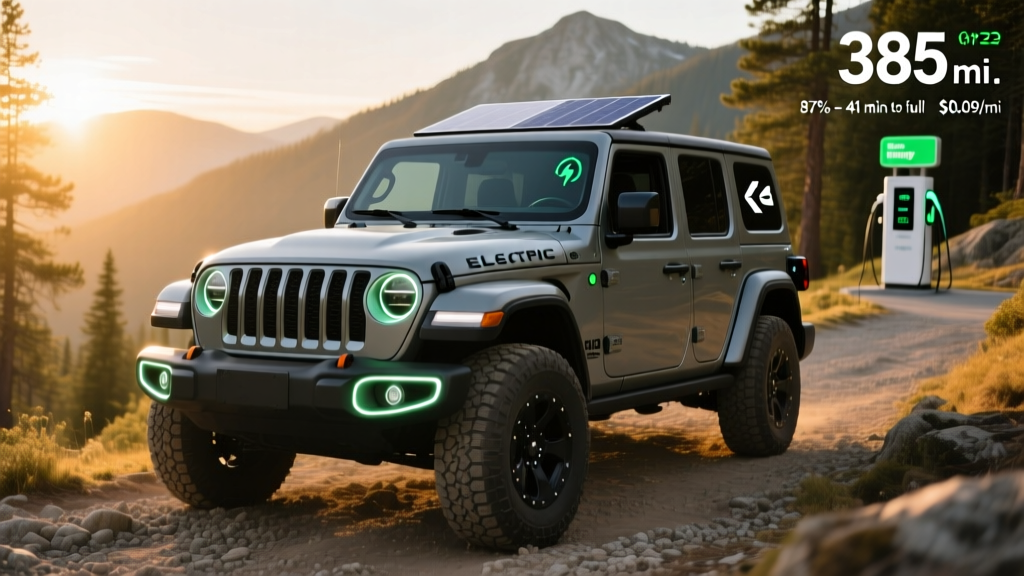
Bottom line: The fully electric Jeep Wrangler (often referred to as the Wrangler EV or Recon-based Wrangler replacement) has been announced by Stellantis but, as of early 2026, has not yet reached U.S. dealerships. Jeep has confirmed an all-electric Wrangler successor is in development, expected to ride on the STLA Large platform with an estimated 85–110 kWh battery, 300+ miles of EPA range, and off-road hardware including solid axles and Selec-Trac 4x4. Until official EPA certification and pricing are published, all specs below are preliminary based on STLA Large platform data and Jeep's public statements.
If you need a plug-in Jeep today, the Wrangler 4xe (PHEV) remains the current electrified option with 22 miles of electric-only range and 49 MPGe combined (source: EPA).
Projected Specs: Jeep Wrangler Electric (STLA Large Platform)
Jeep has not released a finalized spec sheet for a battery-electric Wrangler, but the STLA Large platform — which underpins the 2025+ Dodge Charger Daytona EV and upcoming Jeep Cherokee EV — gives us reliable engineering benchmarks. Here's what the data suggests:
| Specification | Projected / Preliminary |
|---|---|
| Battery capacity (usable) | ~90–105 kWh (NMC chemistry) |
| EPA range (estimated) | 300–350 miles (real-world highway: ~250–280 mi) |
| Peak DC fast charge rate | ~200–250 kW |
| 10–80% DC charge time | ~22–28 minutes (estimated) |
| Level 2 AC charge rate | 11.5 kW (~30–35 mi/hr added) |
| Drivetrain | Dual-motor AWD / 4xe-style 4WD |
| Horsepower (combined) | ~400–500 hp (depending on trim) |
| 0–60 mph | ~4.5–5.5 seconds (est.) |
| Towing capacity | ~3,500–5,000 lbs (target) |
| Off-road hardware | Solid axles, locking diffs, sway-bar disconnect (target) |
| Battery warranty | 8 years / 100,000 miles (minimum per federal mandate) |
| Base MSRP (estimated) | $55,000–$65,000 (before incentives) |
Real-world range caveat: The Wrangler's boxy aerodynamics (high drag coefficient, likely Cd ~0.43–0.48) will hit efficiency hard at highway speeds. Expect 70–75% of EPA range at sustained 75 mph, and potentially 50–60% in sub-30°F winter conditions with the cabin heater running. A heat pump — confirmed on STLA Large — will mitigate but not eliminate cold-weather losses. If you see 320 miles EPA, plan for ~230 miles on a cold winter highway trip.
Wrangler EV vs. Wrangler 4xe vs. Gas Wrangler: Cost and Efficiency
For buyers cross-shopping the electric Wrangler against what's available now, here's how the three powertrains stack up on paper and in real ownership cost:
| Metric | Wrangler EV (Projected) | Wrangler 4xe (2025 PHEV) | Wrangler Gas (3.6L V6) |
|---|---|---|---|
| EPA combined | ~90–100 MPGe (est.) | 49 MPGe / 20 MPG gas | 20 MPG combined |
| Electric-only range | 300–350 mi (full EV) | 22 mi | N/A |
| Fuel/energy cost per mile | ~$0.04–0.06 (home L2) | ~$0.06–0.14 | ~$0.17–0.20 |
| Annual fuel cost (15k mi) | ~$600–$900 | ~$1,200–$2,100 | ~$2,550–$3,000 |
| Oil changes / year | 0 | 2–3 | 2–3 |
| Base MSRP | ~$55,000–$65,000 | ~$51,790 | ~$33,890 |
| Federal tax credit (§30D) | Potential up to $7,500* | Up to $7,500* | $0 |
| Credit-adjusted base price | ~$47,500–$57,500* | ~$44,290* | $33,890 |
* §30D credit eligibility depends on MSRP caps ($80,000 for SUVs), buyer AGI limits ($300k MFJ / $150k single), and battery critical-mineral and component sourcing requirements that change annually. Verify current-year rules at IRS.gov or consult a tax professional. Point-of-sale transfer is available if eligible.
5-Year Estimated Total Cost of Ownership (60,000 miles)
| Category | Wrangler EV (Proj.) | Wrangler 4xe | Gas Wrangler |
|---|---|---|---|
| Purchase (after credit) | $52,500 | $44,290 | $33,890 |
| Energy/fuel (5 yr) | $3,750 | $8,250 | $14,000 |
| Maintenance (5 yr) | $1,200 | $3,500 | $4,000 |
| Insurance (5 yr est.) | $10,500 | $9,000 | $7,500 |
| Depreciation (est.) | $22,000 | $18,000 | $14,000 |
| 5-year total | ~$89,950 | ~$83,040 | ~$73,390 |
EV insurance premiums run 15–30% higher than gas equivalents due to battery replacement cost exposure. Depreciation estimates assume 40–45% retention at 5 years for EV; verify with current market data at purchase time.
Charging the Wrangler EV: Home Setup and Public Networks
Charging a 90+ kWh battery at home requires planning — especially if your electrical panel is older or undersized.
| Level | Power (kW) | Miles Added per Hour | Full 0–100% Time |
|---|---|---|---|
| Level 1 (120V outlet) | 1.2–1.4 kW | ~3–4 mi/hr | ~3–4 days |
| Level 2 (240V, 48A) | 11.5 kW | ~30–35 mi/hr | ~8–9 hours |
| DC Fast Charge | 200–250 kW peak | ~600–800 mi/hr (peak) | 10–80% in ~22–28 min |
Home charging reality: A Level 2 home charger (like a ChargePoint Home Flex or Wallbox Pulsar Plus) on a 60-amp circuit will refill the Wrangler EV overnight — roughly 8 hours from near-empty. But if your home has a 100-amp main panel, you'll likely need a panel upgrade ($1,500–$3,000) before adding a 48A EV circuit. Always get a load calculation from a licensed electrician before committing to equipment.
DC fast charging curve: Expect peak charge rates only between ~10–40% State of Charge. Above 60%, the rate tapers significantly to protect battery health. A "250 kW" peak does not mean you'll sustain that rate — average delivery from 10–80% is typically 120–150 kW on NMC batteries of this size. Preconditioning the battery (via the vehicle's navigation-routed charging) is essential to hit peak rates.
Connector standard: The Wrangler EV is expected to use the NACS (Tesla-style) connector, aligning with Stellantis's announced transition to NACS for all North American EVs starting 2025. This opens access to Tesla Supercharger stations (the largest U.S. network) via native plug, plus Electrify America, EVgo, and ChargePoint networks with NACS compatibility.
Off-Road Capability on Electrons: What Changes and What Doesn't
Jeep has stated the electric Wrangler successor will retain solid axles, locking differentials, and the Trail Rated badge — but the physics of a 5,500+ lb EV (heavier than the gas Wrangler due to the battery pack) introduces trade-offs:
- Instant torque advantage: Electric motors deliver peak torque at 0 RPM, which is ideal for rock crawling and low-speed technical terrain. No need to build revs or manage a clutch.
- Weight penalty: Heavier curb weight means more momentum on descents, more stress on suspension components, and deeper ruts in soft terrain (sand, mud).
- Range impact off-road: Low-range crawling at high torque draws significant current. Expect energy consumption of 3–5 kWh/mile in extreme off-road use — that's roughly 20–30 miles of range per hour of technical trail driving.
- Regen braking: Aggressive regenerative braking can substitute for engine braking on descents, reducing brake wear on trails.
- Water fording: EVs have no air intake to flood, potentially improving water crossing capability — but battery pack sealing and connector waterproofing become the limiting factors. Jeep will need to publish IP ratings and fording depth specs.
Federal Tax Credit Eligibility: What to Verify Before You Buy
The §30D federal clean vehicle credit offers up to $7,500 for qualifying new EVs, but eligibility is not guaranteed. Here's your pre-purchase checklist:
- MSRP cap: Vehicle base price must not exceed $80,000 for SUVs/trucks (Wrangler EV should qualify).
- Buyer income cap: Modified AGI must not exceed $300,000 (married filing jointly), $225,000 (head of household), or $150,000 (single). Your AGI in the purchase year OR the prior year must qualify.
- Battery sourcing: Critical minerals and battery components must meet escalating domestic-content and FEOC (Foreign Entity of Concern) thresholds that tighten each year. Stellantis's STLA Large battery supply chain compliance for 2026–2027 is not yet fully confirmed.
- Point-of-sale transfer: If eligible, you can transfer the credit to the dealer at purchase, reducing your out-of-pocket cost immediately rather than waiting for tax filing.
- Final assembly: Vehicle must undergo final assembly in North America (likely satisfied if built at a U.S. or Canadian Stellantis plant).
Always confirm eligibility at fueleconomy.gov and consult a tax professional before relying on the credit in your purchase math.
Common Misconceptions About an Electric Wrangler
| Myth | Fact |
|---|---|
| "An EV can't handle real off-road trails." | Instant torque, low center of gravity (battery pack under floor), and precise motor control are advantages in rock crawling. Weight is the trade-off. |
| "I'll get the full EPA range on the highway." | The Wrangler's boxy shape creates high aerodynamic drag. Expect 70–75% of EPA range at 75 mph, and 50–60% in cold weather. |
| "DC fast charging always delivers peak kW." | Peak rates only occur at low State of Charge (~10–40%). The charge curve tapers sharply above 60% to protect battery longevity. |
| "The $7,500 tax credit applies to everyone." | Income caps, MSRP caps, and battery-sourcing rules all apply. Many buyers are disqualified by one or more criteria. |
| "I can charge on any standard outlet overnight." | A 120V Level 1 outlet adds only ~3–4 miles per hour — roughly 36–48 miles overnight. With a 90+ kWh battery, that's inadequate for daily use unless your commute is very short. |
| "EV batteries need replacement every few years." | Modern NMC and LFP packs are warrantied for 8 years/100,000 miles with a minimum 70% capacity retention threshold. Real-world data shows most packs retain 85–90% at 100k miles. |
Decision Framework: Should You Wait for the Wrangler EV or Buy Now?
Wait for the Wrangler EV if:
- You have reliable Level 2 home charging (or can install it)
- Your daily driving is under 200 miles and you take 1–2 longer road trips per year
- Off-road capability matters but you don't need maximum ground clearance or the lightest trail rig
- You want the lowest per-mile energy cost and minimal maintenance
- You're not in a rush — official specs and delivery are likely late 2026 or 2027
Buy the Wrangler 4xe now if:
- You lack home charging access and rely on street parking or apartment living
- You regularly take multi-hundred-mile trips through areas with sparse DC fast-charging infrastructure (rural West, remote trails)
- You want a proven, available powertrain with current tax-credit eligibility
- 22 miles of electric-only range covers your daily commute and you want gas flexibility for weekends
Stick with the gas Wrangler if:
- Upfront purchase price is your primary constraint (the gas model starts ~$20,000 lower)
- You tow frequently near maximum capacity and need every pound of payload margin
- You drive in extreme cold climates where EV range loss is most punishing
Frequently Asked Questions
Is the Jeep Wrangler electric available to buy in 2026?
No. As of early 2026, Jeep has confirmed an all-electric Wrangler successor is in development on the STLA Large platform, but it has not reached production or dealerships. The Jeep Recon (available 2025–2026) is a related but separate all-electric model. The closest electrified Wrangler you can buy today is the Wrangler 4xe plug-in hybrid.
Will the electric Wrangler be Trail Rated?
Jeep has publicly stated its intent to maintain Trail Rated capability in its electric off-roaders, including solid axles, locking differentials, and high ground clearance. However, the official Trail Rated certification for a Wrangler EV has not yet been published. The added weight of a 90+ kWh battery pack (~1,200–1,500 lbs more than a gas Wrangler) will affect approach/departure angles and soft-terrain performance.
How much will it cost to charge the Wrangler EV at home?
At the U.S. average residential electricity rate of ~$0.16/kWh (per EIA data), fully charging a ~95 kWh battery costs roughly $15.20 — translating to about $0.04–0.05 per mile. Compare that to $0.17–0.20 per mile for a gas Wrangler at $3.50/gallon and 20 MPG.
Can I tow with the electric Wrangler?
Projected towing capacity is 3,500–5,000 lbs based on STLA Large platform targets, comparable to the gas Wrangler Unlimited. However, towing dramatically increases energy consumption — expect range to drop 40–60% when pulling a loaded trailer at highway speeds. Plan charging stops accordingly.
What battery chemistry will it use?
STLA Large platform vehicles are expected to use NMC (nickel-manganese-cobalt) chemistry for higher energy density and cold-weather performance, though Stellantis has also announced LFP (lithium iron phosphate) options for lower-cost trims on some models. LFP offers longer cycle life and 100% daily charging tolerance but lower energy density — a trade-off that may not suit the Wrangler's off-road range demands. Final chemistry by trim has not been confirmed.
Will the Wrangler EV qualify for the $7,500 federal tax credit?
It's likely but not guaranteed. The vehicle must meet MSRP caps ($80,000 for SUVs), North American final assembly, and escalating battery-sourcing requirements. Buyer income caps also apply. Check IRS.gov for the current-year qualifying vehicle list before making purchase decisions based on the credit.