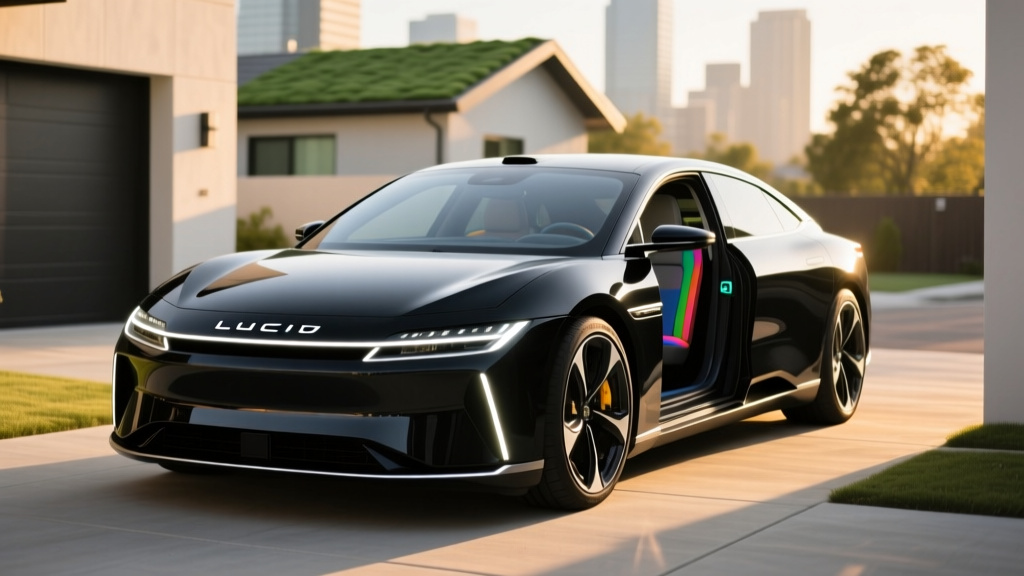
The Lucid Gravity is the luxury electric SUV that promises to reshape the three-row EV segment with sedan-rivaling efficiency and class-leading range. But for prospective buyers, the biggest question isn't whether the Gravity is impressive on paper — it's whether Lucid Motors can actually build and deliver it at scale. With the Gravity entering its first full year of production in 2026, understanding Lucid Gravity production estimates is essential for anyone considering a reservation or weighing this SUV against the Tesla Model X, Rivian R1S, or BMW iX.
This review breaks down the Gravity's confirmed specifications, real-world range expectations, charging performance, pricing, and federal tax credit eligibility — alongside a data-driven look at where Lucid's manufacturing capacity actually stands heading into 2026.
Lucid Gravity Production Estimates: Where Things Stand in 2026
Lucid officially began Gravity production at its Casa Grande, Arizona factory in late 2024, with initial deliveries reaching reservation holders in early 2025. However, Lucid's historical production cadence — the Air sedan ramped slowly, peaking at roughly 140,000 units of annualized capacity across both models — means Gravity output has been constrained by supply-chain factors and the company's deliberate quality-over-volume approach.
As of early 2026, industry analysts and Lucid's own guidance suggest the company is targeting a combined annual production run rate of approximately 20,000–30,000 vehicles (Air + Gravity) at the Arizona facility, with Gravity representing the majority of new orders. Lucid's second factory in Saudi Arabia (AMP-2) is expected to supplement output later in 2026, though initial AMP-2 capacity is allocated primarily to international and fleet markets.
What this means for buyers: If you place a Gravity reservation today, expect a delivery window of 6–12 months depending on trim selection and configuration. Grand Touring and Dream Edition reservations are being fulfilled first, with the lower-priced Pure trim following later in 2026. This is a meaningful improvement over the 12–18 month waits some Air reservation holders experienced, but it still requires patience compared to walking into a BMW or Mercedes dealership.
Range, Battery, and Efficiency: The Numbers That Matter
The Gravity leverages the same 900-volt electrical architecture that gives the Lucid Air its remarkable efficiency. Here's what the EPA and Lucid have confirmed for the primary trims:
| Specification | Grand Touring AWD | Pure RWD (Est.) |
|---|---|---|
| EPA Range | 440 miles | ~400 miles (preliminary) |
| Battery Capacity (usable) | ~118 kWh (NMC) | ~118 kWh (NMC) |
| Battery Chemistry | Nickel Manganese Cobalt (NMC) | NMC |
| Drivetrain | Dual-Motor AWD | Rear-Wheel Drive |
| Horsepower | 800+ hp | ~600 hp (est.) |
| 0–60 mph | ~3.5 seconds | ~5.0 seconds (est.) |
| Efficiency | ~110 MPGe / ~30 kWh/100mi | ~120 MPGe (est.) |
| Max DC Fast Charge | 300+ kW | 300+ kW |
| 10–80% DC Charge | ~20 minutes | ~20 minutes |
| Level 2 Home Charge | 19.2 kW (~70 mi/hr) | 19.2 kW (~70 mi/hr) |
| Towing Capacity | 6,000 lbs | 6,000 lbs |
The Grand Touring's EPA estimate of 440 miles is exceptional — the highest of any three-row electric SUV. However, real-world highway driving at 75+ mph typically reduces range by 10–15%, putting realistic highway range around 370–395 miles. In cold weather (below 30°F), expect an additional 15–25% reduction, bringing effective range to roughly 310–350 miles on a full charge. The Gravity's heat pump and advanced thermal management help mitigate cold-weather losses compared to competitors without active battery preconditioning, but physics still applies.
Lucid's efficiency advantage comes from its miniaturized drive units and 900V architecture, which reduces energy waste in the powertrain. At roughly 30 kWh per 100 miles in mixed driving, the Gravity consumes less energy per mile than the Rivian R1S (~38 kWh/100mi) or Tesla Model X (~33 kWh/100mi), meaning cheaper charging costs and more miles per minute at a DC fast charger.
Charging Speed: 900V Architecture Pays Off
The Gravity's 900-volt platform is one of the highest-voltage architectures in any production EV, rivaling the Hyundai Ioniq 5 and Porsche Taycan. Higher voltage allows faster charging at lower current, reducing heat buildup and sustaining peak charge rates longer.
| Charging Level | Power (kW) | Miles Added per Hour | Notes |
|---|---|---|---|
| Level 1 (120V household) | ~1.4 kW | ~4 mi/hr | Emergency/trickle only |
| Level 2 (240V home) | 19.2 kW | ~70 mi/hr | Full overnight recharge in ~7 hrs |
| DC Fast (350 kW station) | 300+ kW peak | ~1,200 mi/hr equivalent | 10–80% in ~20 min; tapers above 80% |
At a 350 kW Electrify America or Tesla Supercharger station (with NACS adapter), the Gravity can add approximately 200 miles of range in 10 minutes under ideal conditions. The charge curve holds near peak rates through roughly 50% State of Charge before tapering — a characteristic of the 900V system's thermal efficiency. Expect 10–80% in about 20 minutes and 10–90% in roughly 28 minutes.
For home charging, the Gravity's onboard 19.2 kW charger is among the fastest in the segment. Most residential Level 2 installations deliver 11.5 kW (48A on a 60A circuit) or 19.2 kW (80A on a 100A circuit). At 19.2 kW, a full 0–100% charge takes approximately 7 hours — meaning you'll wake up to a full battery every morning with a properly equipped garage.
Home charging installation note: A 100A dedicated circuit for 19.2 kW charging requires a 200A+ electrical panel and professional installation. Budget $1,500–$3,500 for a complete Level 2 home charging setup (charger unit + electrician + permit), depending on panel capacity and run length. Always consult a licensed electrician for your specific situation.
Pricing, Trims, and Federal Tax Credit Eligibility
The Lucid Gravity positions itself firmly in the luxury SUV segment, competing with vehicles priced well above $80,000. Here's the current pricing landscape:
| Trim | Base MSRP | As-Tested (typical) | §30D Federal Credit Eligible? |
|---|---|---|---|
| Pure RWD | $79,900 | $82,000–$86,000 | No — exceeds SUV MSRP cap of $80,000 |
| Grand Touring AWD | $99,900 | $105,000–$115,000 | No — exceeds SUV MSRP cap of $80,000 |
| Dream Edition | $119,900 | $125,000+ | No — exceeds SUV MSRP cap of $80,000 |
- MSRP Cap: SUVs, vans, and pickups must have an MSRP of $80,000 or less. The Gravity Pure RWD starts at $79,900, but with destination charges and mandatory options, it typically exceeds the cap. Even if a base Pure configuration technically qualifies, Lucid's current production priority is Grand Touring and Dream trims.
- Buyer Income Limits (2026): Modified AGI must not exceed $300,000 (joint), $225,000 (head of household), or $150,000 (single).
- Battery Sourcing Requirements: Critical minerals and battery components must meet escalating domestic-content thresholds. Lucid sources cells from multiple suppliers, and compliance varies by build date.
- Point-of-Sale Transfer: Eligible buyers can apply the credit at purchase rather than waiting for tax filing — but only if the vehicle itself qualifies.
Source: IRS Clean Vehicle Credits. Consult a tax professional for your specific eligibility.
The lack of federal credit eligibility is a real financial consideration. Compared to a Tesla Model X (which also typically exceeds the MSRP cap) or a Rivian R1S Dual-Motor Standard (which can be configured under $80,000 and has qualified for the credit in certain configurations), Gravity buyers should budget for the full MSRP without federal incentive offset.
Interior Space, Cargo, and Practicality
The Gravity is a true three-row SUV designed for families who need genuine seven-passenger seating without the bulk of a full-size truck-based SUV. Key dimensions:
- Cargo volume (behind 3rd row): ~28 cu ft
- Cargo volume (3rd row folded): ~62 cu ft
- Cargo volume (all rear rows folded): ~105 cu ft
- Front trunk (frunk): ~12 cu ft — fits a carry-on or charging cables
- Second-row legroom: ~39 inches
- Third-row legroom: ~32 inches — usable for children and shorter adults on trips under 2 hours
The Gravity's glass canopy roof creates an airy cabin feel and adds roughly 1.5 inches of effective headroom compared to a conventional steel roof. The second row features captain's chairs (standard on Grand Touring) or an optional bench for seven-passenger config. Third-row access is via a one-touch fold-and-tumble mechanism on the passenger side.
Compared to the Rivian R1S, the Gravity offers slightly less third-row headroom but more cargo length with both rear rows folded. Compared to the Tesla Model X, the Gravity trades the Model X's falcon-wing doors (which aid third-row entry in tight parking spots) for a more conventional — and mechanically simpler — liftgate design.
Technology, Driver Assistance, and Standout Features
Lucid's software and technology approach is distinctive — minimalist in philosophy but dense in capability:
- 34-inch curved glass cockpit display: A single floating glass panel spans the driver's field of view, replacing a traditional instrument cluster and center stack. The lower portion is a secondary 17-inch retractable touchscreen for media and navigation.
- DreamDrive Pro ADAS: Lucid's driver-assistance suite includes adaptive cruise, lane-centering, automatic emergency braking, and highway assist. This is a SAE Level 2 system — the driver must remain attentive and keep hands on or near the wheel at all times. It is not autonomous driving.
- Over-the-air updates: Lucid pushes regular OTA software updates covering powertrain calibration, infotainment features, and ADAS improvements.
- NACS compatibility: The Gravity ships with a native NACS charge port (as of 2025), granting access to the Tesla Supercharger network without an adapter.
- V2L (Vehicle-to-Load): The Gravity supports V2L, allowing you to power external devices (camping equipment, tools, emergency home backup) at up to 3.6 kW through the charge port.
Lucid's DreamDrive Pro is a Level 2 driver-assist system. It does not enable hands-free or eyes-off driving. Unlike GM's Super Cruise or Ford's BlueCruise, Lucid does not currently offer a hands-free highway driving mode on mapped roads. You are the driver at all times — the system assists with steering and speed but will disengage if it detects inattention.
Pros, Cons, and the Verdict
Pros
- Class-leading 440-mile EPA range (Grand Touring)
- 300+ kW DC fast charging — 200 miles in ~10 minutes
- Best-in-class efficiency (~30 kWh/100mi) reduces charging costs
- Genuine three-row seating with usable cargo space
- 900V architecture future-proofs for next-gen charging infrastructure
- 6,000-lb towing capacity covers most boat and camper trailers
- Native NACS port for Supercharger access
Cons
- Production constraints mean 6–12 month delivery wait in 2026
- Does not qualify for $7,500 federal EV tax credit (MSRP cap)
- No hands-free driving mode (Level 2 only, no Super Cruise equivalent)
- Lucid's service center network is still expanding — limited in rural areas
- Third-row space is tight for tall adults on long trips
- Higher insurance premiums typical of $100K+ luxury EVs
Choose the Gravity if: You want the longest-range three-row EV on the market, prioritize charging speed for frequent road trips, and can absorb a premium price without relying on the federal tax credit. It's ideal for families who road-trip 4+ times per year and want to minimize charging stops.
Look elsewhere if: You need immediate delivery (consider the Rivian R1S or BMW iX), you want hands-free highway driving (GM Super Cruise on the Cadillac Escalade IQ), or your budget depends on the $7,500 federal credit (look at the R1S Dual-Motor Standard or a configured Model X under $80K MSRP).
Warranty and Long-Term Ownership
Lucid backs the Gravity with a competitive warranty package:
- Basic vehicle warranty: 4 years / 50,000 miles
- Battery and drive unit warranty: 8 years / 100,000 miles (with a minimum 70% capacity retention threshold)
- Roadside assistance: 4 years / 50,000 miles
The 8-year/100,000-mile battery warranty is standard for the luxury EV segment and matches Tesla and Rivian. Lucid's NMC battery chemistry, managed by the 900V thermal system, is designed for longevity — Lucid has stated it targets less than 10% degradation over 150,000 miles, though long-term fleet data is still accumulating as the Gravity is a newer model. Battery replacement cost, should it be needed out of warranty, is estimated at $18,000–$25,000 based on current NMC pack pricing — a figure worth factoring into 10-year ownership projections.
Frequently Asked Questions
What is the real-world range of the Lucid Gravity?
The EPA rates the Grand Touring AWD at 440 miles. In real-world highway driving at 70–80 mph, expect approximately 370–395 miles. In cold weather (below 30°F), plan for 310–350 miles on a full charge. These figures still beat every other three-row EV on the market.
How fast does the Lucid Gravity charge?
At a 350 kW DC fast charger, the Gravity peaks above 300 kW and charges from 10–80% in approximately 20 minutes, adding roughly 200 miles of range in 10 minutes. At home on a Level 2 charger (19.2 kW), a full charge takes about 7 hours.
Does the Lucid Gravity qualify for the federal EV tax credit?
Most likely not. The IRS §30D credit requires SUVs to have an MSRP at or below $80,000. The Gravity Pure starts at $79,900 but typically exceeds the cap with destination and options. The Grand Touring and Dream Edition are well above the limit. Always check current IRS guidance and consult a tax professional.
Is the Lucid Gravity worth buying over the Rivian R1S or Tesla Model X?
The Gravity wins on range (440 mi vs. R1S's ~352 mi or Model X's ~326 mi) and charging speed. The R1S offers better off-road capability, faster delivery timelines, and potential tax credit eligibility on lower trims. The Model X provides the Supercharger ecosystem natively and falcon-wing doors for easier third-row access. Your priority — range, delivery speed, or feature set — determines the winner.
When will I get my Lucid Gravity if I order now?
Based on 2026 Lucid Gravity production estimates, new reservations are seeing delivery windows of 6–12 months. Grand Touring configurations are prioritized. The Pure trim, expected to follow later in 2026, may have shorter waits as production ramps.
Can the Lucid Gravity tow?
Yes. The Gravity is rated for 6,000 pounds of towing capacity across all trims — sufficient for most boat trailers, small campers, and utility trailers. Expect a 30–40% range reduction when towing near max capacity.
Sources: EPA Fuel Economy, Lucid Motors Official, IRS §30D Clean Vehicle Credits.