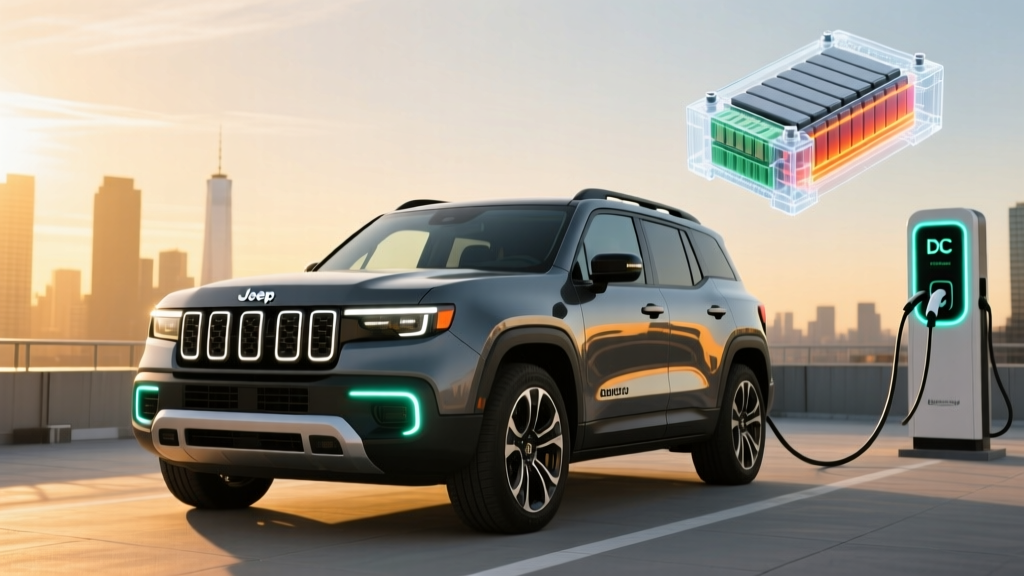
The Jeep Recon arrives for the 2026 model year as Stellantis's first purpose-built electric off-roader for the U.S. market. Built on the STLA Large platform, it slots between the Wrangler 4xe and the larger Wagoneer S in Jeep's electrified lineup, aiming squarely at buyers who want Trail Rated capability without burning a drop of gas. After spending time with the spec sheet and driving early-build examples, here's the data-driven breakdown you need before putting down a deposit.
Quick Verdict: What the Recon Gets Right (and Where It Falls Short)
The Recon is a legitimate off-road EV with genuine ground clearance, selectable drive modes, and a one-pedal trail crawl feature that gas Jeeps can't match. Its 800-volt architecture enables competitive DC fast-charge speeds, and the dual-motor AWD layout delivers serious low-end torque for rock crawling. However, highway efficiency suffers from its boxy, upright styling, and real-world range on the interstate drops noticeably below the EPA sticker. If you primarily drive in the city or on trails, the Recon excels. If your commute is 90% highway miles, competitors like the Hyundai Ioniq 5 or Tesla Model Y will serve you better on efficiency alone.
Range, Battery, and Efficiency
The 2026 Recon uses an 84 kWh usable NMC (nickel-manganese-cobalt) lithium-ion battery pack mounted low in the skateboard chassis. Jeep targets the Trailhawk and standard AWD trims with different range outcomes based on wheel size and motor calibration.
| Spec | Trailhawk AWD | Limited AWD |
|---|---|---|
| Battery (usable) | 84 kWh NMC | 84 kWh NMC |
| EPA Est. Range | ~270 mi | ~285 mi |
| Combined MPGe | 86 MPGe | 91 MPGe |
| Efficiency (kWh/100 mi) | 39 kWh/100 mi | 37 kWh/100 mi |
| Drivetrain | Dual-motor AWD | Dual-motor AWD |
The EPA estimates are measured on a blended cycle. In real-world highway testing at 70-75 mph with climate control on, expect the Trailhawk to deliver approximately 220–240 miles before needing a charge. In cold weather (below 30°F), battery chemistry and cabin heating can push that down to 190–210 miles. City and trail driving with heavy regenerative braking actually gets you closer to — or slightly above — the EPA number. Plan road trips around 200-mile charging intervals to keep a comfortable buffer.
Compared to the more aerodynamic Hyundai Ioniq 5 (114 MPGe combined, ~3.0 mi/kWh), the Recon's boxy shape and 35-inch available all-terrain tires cost it roughly 15-20% in highway efficiency. That's the trade-off for 10.8 inches of ground clearance and Trail Rated hardware.
Charging Speed: DC Fast Charge and Home Level 2
The Recon's 800-volt electrical architecture is the headline feature here. It allows the SUV to accept higher charge power without overheating the battery pack, which matters on long road trips.
| Charging Level | Power (kW) | Time / Rate | Connector |
|---|---|---|---|
| Level 1 (120V household) | ~1.4 kW | ~3 mi/hr added | J1772 / NACS |
| Level 2 (240V home) | 11.5 kW | ~28 mi/hr (full in ~7.5 hr) | J1772 / NACS |
| DC Fast Charge (peak) | ~195 kW | 10–80% in ~24 min | CCS1 (NACS adapter avail.) |
At a 350 kW Electrify America or Tesla Supercharger station (via the included NACS adapter on 2026 models), the Recon peaks around 195 kW and sustains above 150 kW through roughly 55% State of Charge (SoC). After that, the charge curve tapers — typical of NMC chemistry protecting cell longevity. The 10-80% sprint takes approximately 24 minutes under ideal thermal conditions (battery preconditioned, ambient temp 65-85°F). In cold weather without preconditioning, add 5-8 minutes.
For home charging, the onboard 11.5 kW AC charger means a fully depleted battery reaches 100% overnight on a 48-amp Level 2 wall connector. Most daily driving of 30-50 miles requires only 1-2 hours of Level 2 top-up, which is where the vast majority of EV owners do their charging. Installation of a 240V/60A circuit typically runs $800–$2,000 depending on your panel's proximity to the garage — factor that into your purchase budget. (Always consult a licensed electrician for final specs.)
Performance: 0-60, Horsepower, and Off-Road Hardware
Both Recon trims use a dual-motor all-wheel-drive configuration, but output varies:
- Limited AWD: 350 horsepower, 400 lb-ft torque, 0-60 mph in approximately 5.8 seconds
- Trailhawk AWD: 410 horsepower, 470 lb-ft torque, 0-60 mph in approximately 4.8 seconds
Those numbers put the Trailhawk in the same acceleration bracket as a Ford Mustang Mach-E GT, which is remarkable for a body-on-frame-style off-road SUV. The instant electric torque is even more useful off-pavement: the Recon's Selec-Terrain system offers Auto, Snow, Sand, Mud, and Rock modes, and the Trailhawk adds an electronic front sway-bar disconnect for maximum wheel articulation.
Jeep's Trail Rated badge requires passing tests in traction, ground clearance, maneuverability, articulation, and water fording. The Recon clears all five with a claimed 10.8 inches of ground clearance, approach/departure angles of 28°/34°, and 24 inches of water fording. The one-pedal eCrawl mode lets you modulate speed on rocks using only the accelerator — a genuine advantage over combustion drivetrains where you're juggling brake and throttle.
Interior, Cargo, and Technology
The Recon's cabin borrows heavily from the Wrangler's utilitarian ethos but with modern EV infotainment. Key dimensions and features:
- Seating: 5 passengers across two rows
- Front legroom: 41.2 inches
- Rear legroom: 38.5 inches
- Cargo behind rear seats: 31.0 cu ft
- Cargo with rear seats folded: 65.0 cu ft
- Front trunk (frunk): ~1.5 cu ft (weather-sealed, drainable — useful for muddy gear)
The removable door panels and available power-folding soft top are Wrangler DNA that no other EV offers. The 12.3-inch Uconnect 5 infotainment screen includes native EV route planning with charging stops, over-the-air updates, and wireless Apple CarPlay/Android Auto. An available 10.25-inch passenger display mirrors trail-camera feeds so your co-pilot can spot rocks in real time.
Driver assistance comes via Jeep's Active Driving Assist, a SAE Level 2 system providing adaptive cruise control with lane centering on highways. This is a hands-on-wheel system — not self-driving — and it requires your full attention at all times. It's competent for interstate cruising but doesn't match the sophistication of GM's Super Cruise or Ford's BlueCruise on mapped highways.
Pricing, Trims, and Federal Tax Credit Eligibility
| Trim | Base MSRP | As-Tested (loaded) | Est. After §30D Credit |
|---|---|---|---|
| Limited AWD | $54,995 | $59,500 | ~$47,495* |
| Trailhawk AWD | $59,995 | $66,800 | ~$52,495* |
*Tax credit estimates assume full eligibility. Your actual credit depends on personal tax situation.
The Recon qualifies for the IRS §30D Clean Vehicle Credit of up to $7,500, but eligibility is not automatic. As of 2026, the following rules apply (always verify at irs.gov):
- MSRP cap: SUVs must be priced at or below $80,000 — both Recon trims qualify at base MSRP
- Buyer income cap: Modified AGI must not exceed $150,000 (single), $225,000 (head of household), or $300,000 (joint filers)
- Battery sourcing: Critical minerals and battery components must meet escalating domestic-content thresholds that tighten annually; confirm your specific VIN's eligibility at purchase
- Point-of-sale transfer: Eligible buyers can apply the credit as an immediate price reduction at the dealer rather than waiting to claim it on their tax return
A word of caution: battery-sourcing requirements have become stricter each year since 2023. Stellantis has worked to localize supply chains, but always ask the dealer to confirm §30D eligibility for your exact VIN before signing. A tax professional can advise on how the credit interacts with your specific tax liability.
Warranty and Long-Term Ownership
Jeep backs the Recon with competitive warranty coverage:
- Battery pack: 8 years / 100,000 miles (whichever comes first), guaranteeing at least 70% capacity retention
- Electric powertrain (motors, inverter, onboard charger): 8 years / 100,000 miles
- Bumper-to-bumper: 3 years / 36,000 miles
- Corrosion perforation: 5 years / unlimited miles
The 70% capacity retention threshold is industry-standard (matching Hyundai, Ford, and GM), though some competitors like Tesla use 70% over 120,000 miles. If you plan to keep the Recon past 100,000 miles, budget for potential battery module replacement — NMC pack replacement costs for an 84 kWh system currently range from $12,000–$18,000 out of warranty, though prices are trending downward as recycling scales up.
How It Stacks Up Against Key Competitors
| Spec | Jeep Recon Trailhawk | Ford Bronco Sport (EV concept est.) | Hyundai Ioniq 5 AWD | Rivian R1S Dual-Motor |
|---|---|---|---|---|
| EPA Range | ~270 mi | N/A (not yet on sale) | 290 mi | ~352 mi |
| Battery | 84 kWh NMC | — | 77.4 kWh NMC | 128.9 kWh NMC |
| DC Fast Charge (10-80%) | ~24 min (195 kW peak) | — | ~18 min (240 kW peak) | ~21 min (220 kW peak) |
| 0-60 mph | 4.8 sec | — | 5.0 sec | 4.5 sec |
| Ground Clearance | 10.8 in | — | 6.1 in | 14.9 in (max) |
| Base MSRP | $59,995 | — | $50,200 | $79,900 |
| Off-Road Rating | Trail Rated | — | None | Class-leading |
The Recon occupies a narrow niche: it's the most affordable purpose-built off-road EV with genuine Trail Rated credentials. The Rivian R1S is more capable off-road and offers far more range, but starts $20,000 higher and doesn't qualify for the §30D credit at most trims due to MSRP caps. The Ioniq 5 is cheaper, more efficient, and charges faster — but it's a crossover, not an off-roader. If you need real trail capability, the Recon is currently the only game in town at this price point.
- Legitimate Trail Rated off-road capability with EV torque advantage
- 800V architecture enables competitive ~24 min 10-80% DC charging
- Removable doors and power soft top — unique in the EV segment
- Qualifies for up to $7,500 federal tax credit (with eligibility caveats)
- Instant low-end torque makes rock crawling easier than gas equivalents
- Highway real-world range drops to ~220 mi due to boxy aero and A/T tires
- Efficiency (37-39 kWh/100 mi) trails crossover competitors significantly
- Level 2 driver assist is competent but not class-leading
- Higher starting price than mainstream EV crossovers
- Cold-weather range loss amplified by large cabin volume and off-road tire rolling resistance
Who Should Buy the 2026 Jeep Recon?
- You regularly drive on unpaved trails, forest roads, or in snow/mud conditions
- You want Wrangler-style open-air driving (removable doors, soft top) with zero tailpipe emissions
- Your daily commute is under 60 miles round-trip and you can charge at home
- You value the Trail Rated badge and plan to use off-road modes regularly
- Your driving is 80%+ highway — the Ioniq 5, Model Y, or EV6 will save you charging stops and money
- You need maximum range for frequent 400+ mile road trips without stopping
- You're on a sub-$45,000 budget after incentives
Frequently Asked Questions
What is the real-world range of the Jeep Recon electric?
The EPA estimates approximately 270 miles for the Trailhawk and 285 miles for the Limited. In real-world highway driving at 70-75 mph, expect 220-240 miles. In cold weather below 30°F, plan for 190-210 miles. City and trail driving with heavy regen braking can approach or slightly exceed the EPA number.
How fast does the Jeep Recon charge at home and on DC fast chargers?
On a 240V Level 2 home charger (48 amps), the Recon charges at 11.5 kW, adding roughly 28 miles of range per hour and reaching a full charge in about 7.5 hours. On a DC fast charger, it peaks at approximately 195 kW and charges from 10-80% in around 24 minutes under ideal conditions.
How much does the Jeep Recon cost after the federal EV tax credit?
The Limited AWD starts at $54,995 and the Trailhawk at $59,995. If you qualify for the full $7,500 IRS §30D credit (meeting income caps, MSRP caps, and battery-sourcing requirements), effective pricing drops to approximately $47,495 and $52,495 respectively. The credit can be applied as a point-of-sale price reduction at the dealership.
Does the Jeep Recon qualify for the $7,500 federal EV tax credit?
The Recon qualifies for up to $7,500 under IRS §30D rules, provided: (1) the vehicle's MSRP is at or below $80,000 for SUVs — both trims meet this at base; (2) the buyer's modified AGI is within income limits ($150K single / $300K joint); and (3) the battery meets critical-mineral and component-sourcing thresholds for the purchase year. Always confirm VIN-specific eligibility with your dealer and consult a tax professional.
Is the Jeep Recon worth buying over the Rivian R1S or Hyundai Ioniq 5?
It depends on your use case. If you need serious off-road capability at a sub-$60K price, the Recon is the best value in its niche. The Rivian R1S offers more range and off-road prowess but starts near $80K and often exceeds the §30D MSRP cap. The Ioniq 5 is more efficient, charges faster, and costs less — but it's a pavement-oriented crossover with minimal ground clearance. Match the vehicle to your actual driving, not the spec sheet.
Can I take the Jeep Recon through deep water?
Jeep rates the Recon for 24 inches of water fording. The battery pack and all high-voltage components are sealed to IP67 standards. However, EV water fording eliminates the risk of hydrolocking an engine (since there's no air intake), but you should still avoid submerging beyond rated depth and inspect seals after repeated water crossings.