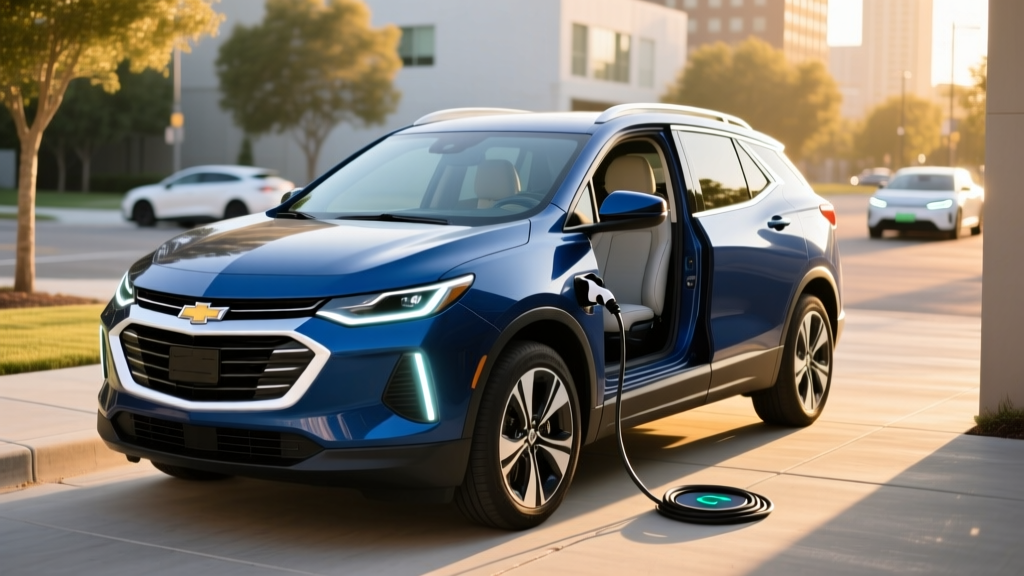
The 2026 Chevrolet Equinox EV 4dr LT1 w/PCY Sterling G represents Chevrolet's bid to make electric-vehicle ownership genuinely mainstream. Starting under $35,000 before incentives, this compact crossover targets buyers who want real daily range without paying luxury-EV premiums. But spec-sheet value only matters if the vehicle delivers on the road. We break down the Equinox EV LT1's actual range, charging behavior, tech stack, and ownership math to help you decide whether this is the affordable EV you've been waiting for — or whether competitors do it better.
2026 Equinox EV LT1 at a Glance: Full Spec Sheet
| Specification | 2026 Equinox EV LT1 (FWD) |
|---|---|
| EPA Range | 319 miles |
| Battery (Usable) | 85 kWh, NMC lithium-ion |
| Drivetrain | Front-wheel drive, single motor |
| Horsepower / Torque | 213 hp / 236 lb-ft |
| 0–60 mph | ~8.0 seconds |
| Max DC Fast Charge | 150 kW peak |
| 10–80% DC Charge Time | ~40 minutes |
| Level 2 Home Charging | 11.5 kW (~34 mi/hr) |
| Efficiency | 109 MPGe combined (31 kWh/100 mi) |
| Cargo (behind rear seats) | 26.4 cu ft |
| Cargo (seats folded) | 57.2 cu ft |
| Base MSRP (LT1 FWD) | $33,600 + $1,395 destination |
| Battery/Powertrain Warranty | 8 years / 100,000 miles |
Real-World Range: What the 319-Mile EPA Number Actually Means
Real-World Highway (70–75 mph): Expect ~260–280 miles in mild weather
Cold-Weather (below 32°F): Expect ~220–250 miles, depending on cabin heat use and preconditioning
City / Mixed Commuting: 290–315 miles is achievable thanks to regenerative braking
The 319-mile EPA rating applies to the FWD LT1 and LT2 trims with the standard 85 kWh (usable) battery. AWD trims and the RS model drop to between 280 and 307 miles depending on wheel size and powertrain. The Equinox EV uses GM's Ultium platform with NMC (nickel manganese cobalt) chemistry — chosen here for its higher energy density compared to LFP, which keeps weight manageable in this compact crossover form factor.
In practice, highway driving at sustained speeds above 70 mph will pull the real range closer to 260–280 miles. This is typical for EVs: aerodynamic drag dominates at highway speed, and the Equinox EV's crossover profile is less slippery than a sedan. Cold weather compounds this — battery heating and cabin climate demands can knock 15–25% off your range. If you live in the Upper Midwest or Northeast, plan for ~220 miles of usable range in January.
Preconditioning the battery while still plugged in at home (using the vehicle's scheduled departure feature) mitigates cold-weather losses substantially. The Equinox EV supports this through the myChevrolet app, and it's a habit every new EV owner should build.
Charging Speed: DC Fast, Level 2, and the Curve Reality
Charging speed is where budget EVs often cut corners, and the Equinox EV LT1 is competent rather than class-leading. The peak DC fast-charge rate is 150 kW, which translates to a 10–80% session in approximately 40 minutes under ideal conditions (warm battery, low state of charge, capable charger).
| Charging Level | Power (kW) | Speed (miles of range added per hour) | Typical Use Case |
|---|---|---|---|
| Level 1 (120V household) | ~1.4 kW | ~4 mi/hr | Overnight top-up, emergency |
| Level 2 (240V home) | 11.5 kW | ~34 mi/hr | Daily home charging (full overnight) |
| DC Fast Charge | 150 kW peak | Up to ~230 mi/hr (at peak) | Road trips, 10–80% in ~40 min |
The 150 kW peak rate means the Equinox EV can add roughly 100 miles of range in about 15–18 minutes when starting from a low state of charge. However, like all EVs, the charge curve tapers significantly above 80% SoC. Charging from 80–100% on DC can take nearly as long as the 10–80% session — so on road trips, plan to charge to 80% and move on rather than waiting for a full battery.
For home charging, the onboard 11.5 kW charger is a strong point. On a Level 2 home station (48-amp circuit, hardwired), you'll recover the full 319-mile range in roughly 9 hours. A typical overnight session from 30% to 80% takes about 3.5–4 hours. Note: kW (kilowatts) measures charging power — the rate of energy delivery — while kWh (kilowatt-hours) measures battery capacity. The 85 kWh battery charged at 11.5 kW takes ~7.4 hours from empty to full.
The Equinox EV uses the NACS (North American Charging Standard) connector, giving it native access to Tesla Supercharger stations alongside GM's Ultium Charge network and other NACS-equipped providers. This is a significant advantage over vehicles still relying on CCS-only connectors with adapters.
Performance, Ride, and Drivetrain
The LT1 FWD model uses a single front-mounted motor producing 213 horsepower and 236 lb-ft of torque. The 0–60 mph time of approximately 8.0 seconds is adequate for merging and passing but won't impress anyone coming from a performance EV. Instant torque delivery means the Equinox EV feels quicker in city driving than the 0–60 figure suggests — off-the-line response is immediate and smooth.
AWD trims (available on LT2, RS, and LT3) add a rear motor for a combined 288 hp and a 0–60 time around 6.5 seconds, at the cost of 12–39 miles of EPA range depending on configuration.
Ride quality is tuned toward comfort, with composed highway manners and acceptable body roll in corners. The low center of gravity from the under-floor battery pack helps stability. Cabin noise levels are low — a typical EV benefit — and the suspension handles potholes and expansion joints with a firmness that suits the crossover segment.
Towing is rated at up to 1,500 pounds when properly equipped — enough for a small utility trailer or a pair of dirt bikes, but not a camper. This is par for the compact EV crossover class.
Interior, Cargo, and Technology
The Equinox EV's cabin centers on an 11.3-inch diagonal infotainment touchscreen running Google Built-In (Google Maps, Google Assistant, Play Store). A 17.7-inch driver information display stretches across the instrument panel — larger than most competitors in this price range. Wireless Apple CarPlay and Android Auto are standard.
Interior materials on the LT1 are hard-plastic-heavy but durable and well-assembled. Cloth seating is standard; heated front seats and a heated steering wheel are available through option packages. Rear-seat legroom measures 37.8 inches — sufficient for adult passengers on longer trips. Front legroom is 42.5 inches.
Cargo volume is 26.4 cubic feet behind the second row and 57.2 cubic feet with the 60/40 split rear seats folded. There is no front trunk (frunk) — the space is occupied by HVAC and power electronics. A hands-free power liftgate is standard on LT2 and above.
Driver-assistance technology includes Chevy's Super Cruise availability on higher trims (LT3, RS) — GM's Level 2 hands-free driving system for mapped divided highways. The LT1 comes standard with Chevy Safety Assist: automatic emergency braking, forward collision alert, lane keep assist, following distance indicator, and IntelliBeam automatic high beams. This is SAE Level 2 driver assistance — you must remain engaged and supervising at all times. It is not self-driving.
Pricing, Trims, and Federal Tax Credit Eligibility
| Trim | Drivetrain | Base MSRP (+ dest.) | Est. After §30D Credit* |
|---|---|---|---|
| LT1 | FWD | $34,995 | ~$27,495 |
| LT2 | FWD / AWD | $37,395 / $40,395 | ~$29,895 / ~$32,895 |
| RS | FWD / AWD | $39,995 / $43,595 | ~$32,495 / ~$36,095 |
| LT3 | AWD | $43,395 | ~$35,895 |
*Federal tax credit estimates assume full $7,500 eligibility under IRS §30D rules. Eligibility depends on buyer income, vehicle MSRP, and battery component/mineral sourcing. The credit is available as a point-of-sale transfer at participating dealers. Verify your eligibility with a tax professional.
- MSRP Cap: SUVs, vans, and pickups must be ≤$80,000 — the Equinox EV qualifies at all trims.
- Buyer Income Cap: Modified AGI ≤$150,000 (single), ≤$225,000 (head of household), ≤$300,000 (joint).
- Battery Sourcing: Critical minerals and battery components must meet escalating domestic/free-trade-partner thresholds. Full $7,500 requires meeting both halves ($3,750 each).
- Point-of-Sale Transfer: Eligible buyers can apply the credit as an instant rebate at purchase through registered dealers.
- Assembly: Vehicle must undergo final assembly in North America (Equinox EV is built in Ramos Arizpe, Mexico — verify current-year assembly status with the NHTSA VIN decoder).
The LT1 at ~$35,000 before incentives is the value play. With the full $7,500 credit applied at point of sale, the effective price drops to under $28,000 — territory that undercuts nearly every competing EV and many gas-powered compact SUVs on total cost of ownership.
However, the assembly location is a critical variable. If the 2026 Equinox EV continues production in Mexico, it must still satisfy the North American final assembly requirement (Mexico qualifies under USMCA). Battery component and critical-mineral sourcing rules tighten annually — check fueleconomy.gov for the most current eligibility status of your specific trim and build date.
Who Should Buy the Equinox EV LT1 — and Who Shouldn't
- 319-mile EPA range at a sub-$35K price point
- NACS connector — native Supercharger access
- Strong Level 2 home charging (11.5 kW)
- Spacious cabin with class-leading screen real estate
- 8-year/100,000-mile battery warranty
- Eligible for full $7,500 federal credit (verify sourcing annually)
- 150 kW peak DC charging is slower than Hyundai/Kia's 800V rivals
- No frunk (front trunk)
- FWD-only LT1 can feel underpowered for highway merging
- Hard-plastic interior at the LT1 trim level
- Super Cruise not available on LT1
- Cold-weather range loss is significant without preconditioning discipline
Best for: Daily commuters with home Level 2 charging who prioritize range and value over performance. The LT1 FWD is ideal for two-adult households or small families in moderate climates who drive 30–60 miles round-trip and want to charge overnight without thinking about it. It's also a strong candidate for budget-conscious buyers who want a new EV under $30K after incentives.
Look elsewhere if: You regularly road-trip more than 300 miles in a day (the 150 kW charge rate adds ~15 minutes per stop vs. 800V competitors). You need AWD for snow-belt driving (step up to the LT2 AWD). You want hands-free highway driving (Super Cruise requires LT3 or RS). You tow anything over 1,500 pounds.
How It Stacks Up Against Key Competitors
The Equinox EV LT1 competes against a tightening field of affordable compact EV crossovers:
- Hyundai Ioniq 5 (Standard Range): Faster 800V charging (~18 min 10–80%), but starts ~$42K and offers less range on the base battery.
- Kia EV6 (Light): Similar 800V advantage, but higher starting price and slightly less cargo room.
- Nissan Ariya (Engage FWD): Comparable range (~304 mi), but slower DC charging and CCS connector (requires adapter for Superchargers).
- Tesla Model Y (Long Range RWD): Superior charging and Supercharger ecosystem, but starts ~$45K and has a sparser interior.
The Equinox EV LT1 wins on price-to-range ratio. Nothing else at ~$35K delivers 319 miles of EPA range with NACS native charging. If your priority is minimizing upfront cost while maximizing daily range, the LT1 is the segment value leader for 2026.
Ownership Costs and Warranty Coverage
GM backs the Equinox EV's battery and electric drive components with an 8-year / 100,000-mile limited warranty covering defects and capacity loss below a specified threshold (typically 60–70% state of health, though exact retention terms should be confirmed with your dealer). The limited vehicle warranty is 3 years / 36,000 miles bumper-to-bumper.
Charging at home on Level 2 at the national average electricity rate of ~$0.16/kWh costs approximately $13.60 for a full 85 kWh charge — roughly $0.043 per mile. Compare this to a 28 MPG gas crossover at $3.40/gallon ($0.121/mile) and the Equinox EV saves roughly $1,100–$1,300 per year in energy costs at 15,000 miles driven annually. Over five years, that's $5,500–$6,500 in fuel savings alone.
Insurance premiums for the Equinox EV tend to run 10–20% higher than comparable gas crossovers — a common EV pattern driven by repair cost data. Get quotes before purchasing to build an accurate total-cost picture.
Frequently Asked Questions
What is the real-world range of the 2026 Chevrolet Equinox EV LT1?
The EPA rates the LT1 FWD at 319 miles. In real-world highway driving at 70–75 mph, expect 260–280 miles. In cold weather (below 32°F), plan for 220–250 miles. City driving with regenerative braking can approach the EPA figure.
How fast does the Equinox EV charge at home and on the road?
On a Level 2 home charger (240V, 48A), the 11.5 kW onboard charger adds ~34 miles of range per hour, fully charging overnight in ~9 hours. On DC fast chargers, it peaks at 150 kW, reaching 10–80% in approximately 40 minutes.
Does the 2026 Equinox EV qualify for the $7,500 federal tax credit?
It can, but eligibility depends on your income (≤$150K single / ≤$300K joint), the vehicle's MSRP (all trims qualify under the $80K SUV cap), and battery component/critical-mineral sourcing compliance. The credit is available as a point-of-sale transfer. Always verify current-year sourcing eligibility on fueleconomy.gov and consult a tax professional.
Is the Equinox EV LT1 worth buying over the Hyundai Ioniq 5 or Tesla Model Y?
If your priority is the lowest possible price with the longest range, the Equinox EV LT1 wins — nothing matches 319 miles at ~$35K. If you value faster road-trip charging (800V architecture) or a more premium interior, the Ioniq 5 or Model Y are worth the premium.
Does the LT1 trim include Super Cruise?
No. Super Cruise (GM's Level 2 hands-free highway driving system) is available only on the LT3 and RS trims. The LT1 includes Chevy Safety Assist with standard Level 2 driver-assistance features like lane keep assist and automatic emergency braking.
Can I charge the Equinox EV at Tesla Superchargers?
Yes. The 2026 Equinox EV uses the NACS connector natively, giving it direct access to Tesla's Supercharger network without an adapter.