The Quick Answer
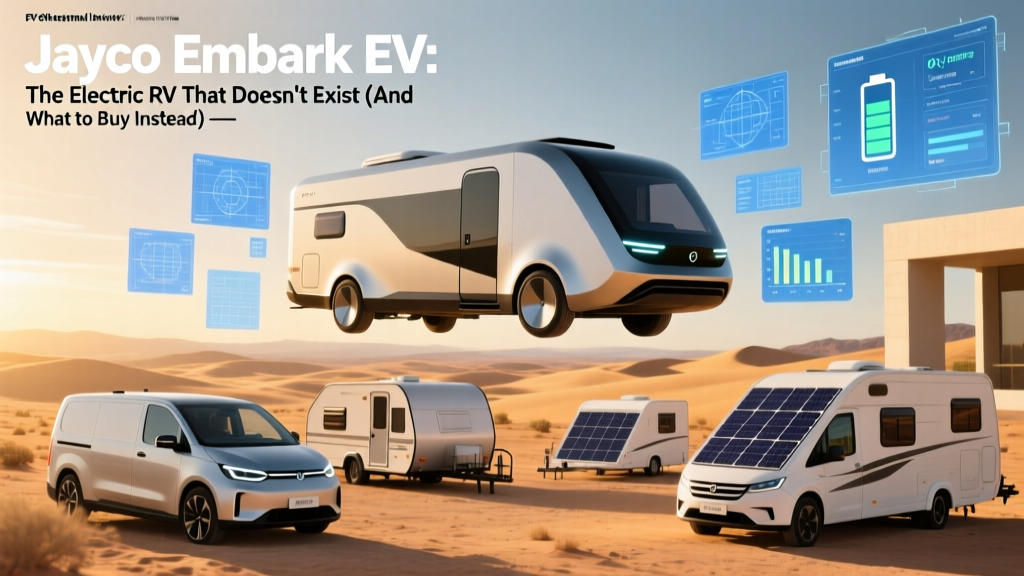
There is no such vehicle as the "Jayco Embark EV." Jayco, a subsidiary of Thor Industries, currently manufactures only internal-combustion motorhomes, travel trailers, and fifth wheels under the Embark, Entegra, and other nameplates. As of the 2026 model year, Jayco has not announced, previewed, or trademarked any fully electric motorhome or travel trailer. If you've encountered "Jayco Embark EV" in forums or search results, it is either a rumor, a misidentification of the diesel-powered Jayco Embark Class C, or confusion with electric tow-vehicle concepts from other manufacturers.
Below, we break down what the Jayco Embark actually is, why a full-electric RV remains technically impractical in 2026, and which electrified vehicles can actually tow or serve as your next RV rig.
What the Jayco Embark Actually Is
The Jayco Embark is a Class C motorhome built on a Ford E-Series or Mercedes-Benz Sprinter chassis, depending on model year and floorplan. The 2026 Embark lineup uses either:
- Ford 7.3L Godzilla V8 (gasoline, ~335 hp, 468 lb-ft) on the E-450 cutaway chassis
- Mercedes-Benz 3.0L turbodiesel V6 (188 hp, 325 lb-ft) on Sprinter-based floorplans
Neither powertrain is electrified — no mild-hybrid, no plug-in hybrid, no battery-electric variant exists. Fuel economy for the gas V8 hovers around 7–9 mpg combined; the diesel Sprinter chassis achieves 14–17 mpg depending on load and terrain. These figures are consistent with fueleconomy.gov data for the underlying chassis, as Jayco does not submit completed motorhomes for EPA testing.
Why a Fully Electric RV Isn't Here Yet
The engineering barriers to a battery-electric Class C motorhome like an "Embark EV" are substantial and won't be resolved by 2026 production timelines:
Weight vs. Range Physics
A loaded Class C motorhome weighs 12,000–14,500 lbs GVWR. For context, the heaviest consumer EVs on the road — the GMC Hummer EV Pickup (9,063 lbs) and Rivian R1T (7,148 lbs) — already sacrifice significant range to move their mass. Scaling a battery pack to push a 14,000-lb aerodynamic brick even 150 miles would require roughly 250–300 kWh of usable capacity, adding 3,000+ lbs of battery weight alone and further compounding the efficiency penalty.
Charging Infrastructure Gap
Even if a 250 kWh electric motorhome existed, DC fast-charging it would be a logistical nightmare. A 350 kW peak charge rate (the current consumer ceiling) would still require 45–55 minutes for a 10–80% session on that hypothetical pack. Worse, most RV parks and campgrounds lack any DC fast-charging infrastructure. Level 2 destination charging at a campground (typically 30-amp or 50-amp shore power, yielding 3.6–11.5 kW) would take 18–30+ hours to fully replenish such a pack.
Cost Reality
Current Jayco Embark Class C models carry MSRPs between $115,000 and $165,000. An electric powertrain conversion at this scale — assuming solid-state or next-gen LFP packs achieve the necessary energy density — would likely push that figure above $250,000, well beyond the market's willingness to pay.
Electrified Vehicles That Can Actually Tow Your RV
While Jayco won't sell you an electric motorhome, several 2026 EVs and PHEVs can tow travel trailers and smaller fifth wheels. Here's how the top contenders stack up:
| Vehicle | Powertrain | Max Tow (lbs) | EPA Range / MPGe | Battery (kWh) | Base MSRP |
|---|---|---|---|---|---|
| Ford F-150 Lightning (Ext. Range) | BEV | 10,000 | 320 mi / 70 MPGe | 131 (usable) | $72,090 |
| Rivian R1T Dual Max | BEV | 11,000 | 352 mi / 73 MPGe | 141 (usable) | $87,900 |
| Chevrolet Silverado EV 4WT | BEV | 10,000 | 380 mi / 68 MPGe | 200 (usable) | $74,800 |
| Toyota Tundra i-FORCE MAX | HEV | 12,000 | 20 mpg combined | 1.87 (hybrid) | $59,645 |
| Ford F-150 PowerBoost | HEV | 12,700 | 23 mpg combined | 1.5 (hybrid) | $56,550 |
Real-World Towing Range Warning
EPA range figures above are for the unladen truck. When towing a 5,000–7,000 lb travel trailer, expect 40–55% range reduction in BEV tow vehicles. A Ford F-150 Lightning rated at 320 miles will realistically deliver 145–190 miles while towing at highway speeds — plan your stops accordingly. Hybrids (Tundra, F-150 PowerBoost) see a smaller mpg penalty (~15–25% reduction) and have no range-anxiety issue at remote campsites.
Cost Breakdown: Electric Tow Vehicle vs. Gas/Diesel Motorhome
Let's compare a realistic 5-year ownership scenario for someone deciding between buying a Jayco Embark Class C (gas) and using an electric pickup to tow a comparable Jayco travel trailer:
| Cost Category | Jayco Embark Class C (Gas V8) | F-150 Lightning + Jayco 26RL Travel Trailer |
|---|---|---|
| Purchase Price (MSRP) | $135,000 | $72,090 (truck) + $48,000 (trailer) = $120,090 |
| Fuel / Electricity | $14,815 (8 mpg avg, $3.50/gal) | $4,320 (home L2 at $0.14/kWh) + $2,160 (DCFC road trips) = $6,480 |
| Maintenance (5 yr) | $4,500 (oil, filters, brakes, chassis) | $1,800 (truck) + $1,200 (trailer axle/bearing) = $3,000 |
| Insurance (5 yr) | $9,000 ($1,800/yr motorhome policy) | $10,500 ($1,500/yr truck + $600/yr trailer) |
| Depreciation (est.) | -$54,000 (40% over 5 yr) | -$42,000 (truck 35%) - $14,400 (trailer 30%) = -$56,400 |
| 5-Year Net Cost | $109,315 | $85,170 |
Note: Federal §30D EV tax credit eligibility for the F-150 Lightning depends on 2026 battery-sourcing and critical-mineral requirements, MSRP caps ($80,000 for trucks), and buyer income limits. Consult the IRS §30D guidelines and a tax professional before assuming the full $7,500 credit.
Common Misconceptions About Electric RVs
| Myth | Fact |
|---|---|
| "Jayco has an electric motorhome coming out soon." | Jayco's parent Thor Industries has invested in EV research via partnerships, but no production electric motorhome has been announced for any model year through 2028. |
| "I can charge an RV at any campground." | Campground shore power (30A/50A) provides 3.6–11.5 kW — sufficient for running appliances and trickle-charging a house battery, but far too slow to recharge a large EV traction battery overnight for extended driving. |
| "Electric tow vehicles can't handle real trailers." | The F-150 Lightning and Silverado EV are rated for 10,000 lbs. The limitation isn't capability — it's range. Towing cuts BEV range roughly in half, requiring careful route planning. |
| "Solar panels on an RV can fully charge the drivetrain battery." | Typical RV roof solar (400–800W) generates 1.5–4 kWh per day in good sun. A 131 kWh truck battery would take 33–87 days of stationary solar to fill — useful for house batteries, irrelevant for propulsion. |
| "Hybrids are just as good as EVs for towing." | Hybrids (Tundra i-FORCE MAX, F-150 PowerBoost) offer excellent towing with no range penalty and better fuel economy than pure gas — a pragmatic choice for remote camping where chargers are scarce. |
Decision Framework: What Should You Actually Buy?
If-This-Then-That for Your Next RV Setup
IF you want a self-contained motorhome (no separate tow vehicle):
→ The Jayco Embark Class C (gas or diesel) remains your practical option. No electric alternative exists. Budget $115K–$165K and accept 7–17 mpg.
IF you prefer a towable trailer and want to go electric:
→ Choose the Ford F-150 Lightning (best value, 10K tow, Pro Power Onboard for campsite power) or Rivian R1T (best range, quad-motor option) — but plan routes around DC fast chargers and accept 150–190 mile real-world towing range.
IF you camp off-grid or in charging deserts:
→ A hybrid truck like the Ford F-150 PowerBoost or Toyota Tundra i-FORCE MAX gives you 20–23 mpg towing, 12,000+ lb capacity, and zero charging dependency. Pair it with any Jayco travel trailer.
IF you need campsite power without a generator:
→ The F-150 Lightning's Pro Power Onboard (up to 9.6 kW of 240V output) can run your trailer's A/C, microwave, and outlets directly from the truck's 131 kWh battery — effectively replacing a gas generator.
IF you were specifically searching for "Jayco Embark EV" hoping it exists:
→ Set a price alert on Jayco's official channels and Thor Industries investor updates. Battery-electric Class A/C motorhomes may arrive in the 2028–2030 timeframe as solid-state cells reach production, but nothing is confirmed.
What a First-Time EV Buyer (or RVer) Should Know
Whether you're considering an electric tow vehicle or simply exploring EVs for daily driving alongside your RV lifestyle, these fundamentals matter:
- Home charging is non-negotiable for convenience. A Level 2 home charger (240V, 32–48A / 7.7–11.5 kW) adds 25–40 miles of range per hour and costs $500–$2,000 installed. Without home charging, EV ownership becomes a chore.
- kW and kWh are different things. kW (kilowatts) measures charge speed — how fast energy flows into the battery. kWh (kilowatt-hours) measures battery capacity — how much energy the battery stores. A 131 kWh battery charged at 11.5 kW takes about 11.5 hours from empty.
- Cold weather cuts range 20–35%. If you camp in mountain or northern climates during shoulder seasons, plan for significantly reduced range in any BEV tow vehicle.
- DC fast charging tapers above 80% SoC. A truck that charges from 10–80% in 30 minutes may need another 25 minutes to go from 80–100%. Plan road-trip stops to leave at 80%, not 100%.
- Insurance costs more for EVs. Expect 15–25% higher premiums on electric trucks vs. their gas equivalents due to higher repair costs and total-loss thresholds.
Frequently Asked Questions
Will Jayco ever make an electric motorhome?
Thor Industries (Jayco's parent) has signaled interest in electrified RVs and has partnered with suppliers on EV chassis development, but no production timeline has been announced. Industry analysts expect prototype Class A or C electric motorhomes no earlier than 2028–2029, with pricing likely exceeding $200,000.
Can I tow a Jayco travel trailer with an electric truck?
Yes. Most Jayco travel trailers (Jay Feather, White Hawk, Eagle) have GVWRs between 4,500 and 8,500 lbs — well within the 10,000–11,000 lb tow ratings of the F-150 Lightning, Rivian R1T, and Silverado EV. Use a weight-distribution hitch and plan charging stops every 150–180 miles.
Does the §30D tax credit apply to electric tow vehicles?
It can, but eligibility depends on 2026 IRS rules: the vehicle must have a battery ≥7 kWh, meet critical-mineral and battery-component sourcing thresholds, fall under the $80,000 MSRP cap for trucks/vans, and the buyer must fall under income caps ($150K single / $300K joint). The credit can now be transferred to the dealer at point of sale as an instant discount. Verify current requirements at irs.gov.
What's the most fuel-efficient motorhome I can buy today?
Diesel Sprinter-based Class C motorhomes (Winnebago Navion, Jayco Embark on Sprinter chassis) achieve 14–17 mpg — roughly double the gas V8 alternatives. No hybrid or electric motorhome is currently available for purchase.
Are light-electric trailers (e-trailers) a viable alternative?
Startups like Lightship and Airstream (with its e-Trailer concept) are developing travel trailers with onboard batteries and motors that reduce tow-vehicle energy consumption by an estimated 30–40%. The Lightship L1 is expected to begin deliveries in 2026–2027 with a ~$100,000 starting price. These don't eliminate the need for a capable tow vehicle, but they extend effective range and reduce the tow penalty.