The Short Answer: It Depends on How and Where You Drive
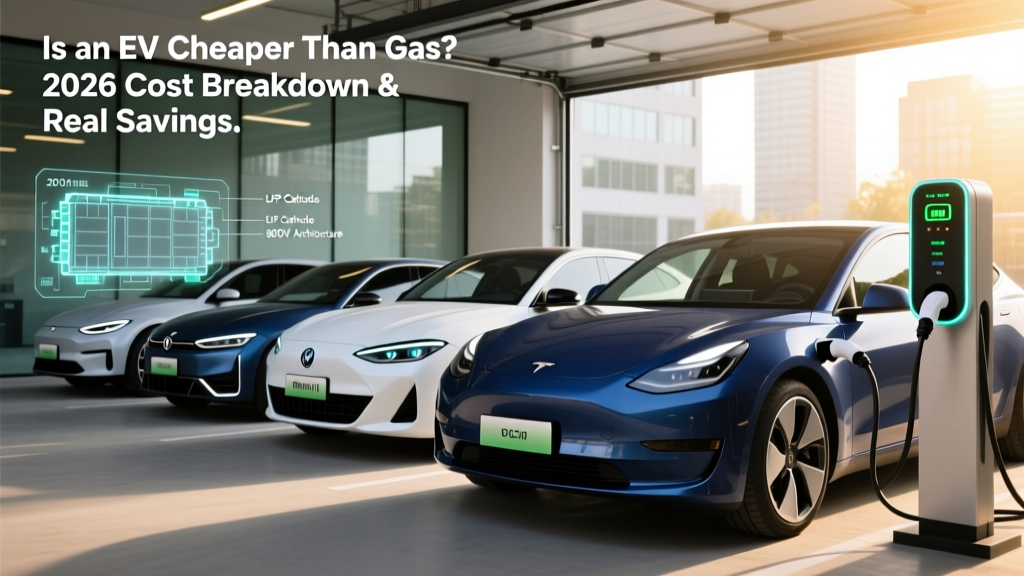
An electric vehicle is cheaper to own than a comparable gas car over five years if you can charge at home, drive 10,000–15,000 miles per year, and qualify for the federal §30D tax credit. Under those conditions, total cost of ownership (TCO) favors the EV by $4,000–$9,000 over five years. However, if you rely exclusively on public DC fast charging, live in an apartment without charging access, or drive very few miles annually, a gas car or hybrid will likely cost less. The upfront sticker price of most EVs remains higher, but fuel and maintenance savings close the gap month by month.
Purchase Price: The Upfront Gap Is Narrowing but Still Real
The average transaction price for a new EV in early 2026 hovers around $45,000, compared to roughly $38,000 for a comparable gas-powered compact SUV, according to Kelley Blue Book data. That $7,000 gap is the first hurdle any buyer faces.
Consider a concrete example: the 2026 Hyundai Ioniq 5 SEL (RWD) starts at an MSRP of approximately $43,175, while a similarly equipped 2026 Toyota RAV4 XLE AWD stickers around $33,400. That's nearly a $10,000 difference before incentives.
The federal IRS §30D tax credit can offset up to $7,500, but eligibility is not universal. The vehicle must meet battery-component and critical-minerals sourcing requirements, the buyer's adjusted gross income must fall below caps ($150,000 single / $300,000 joint), and the MSRP cannot exceed $55,000 for sedans or $80,000 for SUVs/trucks. As of 2026, buyers can transfer the credit to the dealer at the point of sale, effectively reducing the purchase price on the spot — but only if the specific vehicle qualifies. Always verify eligibility on the IRS source-requirements list before committing.
After a full $7,500 credit, the Ioniq 5 SEL drops to an effective $35,675 — still above the RAV4 but far closer. Without the credit, the math shifts dramatically in the gas car's favor at purchase.
Fueling Costs: Electricity vs. Gasoline by the Numbers
This is where EVs make their strongest case — but only with home charging.
The 2026 Ioniq 5 SEL (RWD, 84 kWh usable battery, EPA range 303 miles) achieves roughly 114 MPGe combined, or about 29 kWh per 100 miles, per fueleconomy.gov. The 2026 RAV4 AWD gets 30 MPG combined.
| Scenario | EV (Ioniq 5) | Gas (RAV4 AWD) | Annual Savings |
|---|---|---|---|
| Home charging ($0.14/kWh) + 30 MPG @ $3.30/gal | $501 | $1,320 | $819 |
| Home charging ($0.22/kWh, high-cost state) + $3.80/gal | $788 | $1,520 | $732 |
| Public DC fast charging ($0.48/kWh avg) + $3.30/gal | $1,718 | $1,320 | –$398 (EV costs more) |
| Mixed: 70% home ($0.14) + 30% DCFC ($0.48) + $3.30/gal | $866 | $1,320 | $454 |
The takeaway is stark: at residential electricity rates, the EV saves $700–$820 per year. But if you depend entirely on public DC fast chargers at $0.45–$0.55/kWh, you actually spend more on "fuel" than a 30-MPG gas car. Most EV owners charge at home 80–90% of the time, making the blended-cost scenario the most realistic — and it still favors the EV, just by a smaller margin.
A note on efficiency reality: the Ioniq 5's EPA-rated 29 kWh/100mi assumes moderate conditions. Expect 32–35 kWh/100mi in sustained 75-mph highway driving and 36–40 kWh/100mi in sub-30°F winter conditions due to cabin heating and battery thermal losses. That pushes real-world home-charging costs to roughly $580–$660/year for 12,000 miles — still well below gasoline.
Maintenance, Insurance, and Depreciation: The Hidden Variables
Maintenance. EVs eliminate oil changes, spark plugs, transmission fluid, and exhaust-system repairs. Brake pads last significantly longer thanks to regenerative braking — many EV owners report original pads at 80,000+ miles. Consumer Reports estimates EV maintenance costs at roughly $0.061 per mile versus $0.101 per mile for gas vehicles. Over five years and 60,000 miles, that's approximately $2,400 in savings for the EV.
However, EVs are not maintenance-free. Cabin air filters, wiper blades, brake fluid flushes, coolant checks, and tire rotations still apply. And EV tires wear 15–25% faster due to instant torque and heavier curb weight — budget an extra $200–$400 per tire set over five years.
Insurance. This is where the EV often loses ground. Average EV insurance premiums run 15–25% higher than equivalent gas cars, driven by higher repair costs, specialized parts, and battery-replacement risk. For our Ioniq 5 vs. RAV4 comparison, expect roughly $1,800–$2,200/year for the EV versus $1,400–$1,700/year for the RAV4, depending on your profile and state. That's an additional $300–$500 annually, or $1,500–$2,500 over five years — a meaningful offset to fuel savings.
Depreciation. EV depreciation has historically been steeper than gas cars, partly due to rapid technology turnover and battery-health concerns. A 2026 Ioniq 5 might retain 45–50% of its value after five years, while a RAV4 typically holds 55–60%. On a $43,000 EV, that's roughly $21,500 in depreciation; on a $33,400 RAV4, about $14,700 — a $6,800 gap. However, this varies heavily by model (Teslas and popular models hold value better), market conditions, and battery health data at trade-in.
Five-Year Total Cost of Ownership: The Full Ledger
| Cost Category | Ioniq 5 SEL (EV) | RAV4 XLE AWD (Gas) |
|---|---|---|
| Purchase price (MSRP) | $43,175 | $33,400 |
| Federal §30D credit | –$7,500 | $0 |
| Effective purchase | $35,675 | $33,400 |
| Fueling (5 yrs, 80% home / 20% DCFC) | $3,630 | $6,600 |
| Maintenance (5 yrs) | $2,100 | $4,500 |
| Insurance (5 yrs, avg) | $10,000 | $7,750 |
| Depreciation (5 yrs) | $21,500 | $14,700 |
| Total 5-Year Cost | $72,905 | $66,950 |
In this scenario, the gas car wins by about $5,955 over five years — driven primarily by steeper EV depreciation and higher insurance. However, if the EV's depreciation normalizes (say, 50% retention instead of 45%), and insurance gaps narrow as the repair ecosystem matures, the EV pulls ahead. Also, if you drive 15,000+ miles per year, fuel savings compound faster and flip the result.
One more variable: many states impose annual EV registration fees of $50–$225 to offset lost gas-tax revenue. Check your state's DMV for exact figures.
Common Misconceptions: Myth vs. Fact
| Myth | Fact |
|---|---|
| "EVs always save you money." | Only with home charging and sufficient annual mileage. Public-only charging often costs more than gasoline per mile. |
| "The battery will need a $20,000 replacement." | Federal law mandates battery warranties of at least 8 years / 100,000 miles. Modern LFP and NMC packs show 85–92% capacity retention at 150,000 miles based on fleet data. Full replacement is rare and usually covered under warranty within the coverage period. |
| "EVs are worse in cold weather." | Range drops 15–30% in sub-freezing temperatures due to cabin heating and battery chemistry. A 303-mile EPA EV may deliver 210–250 real-world winter miles. Preconditioning while plugged in mitigates this significantly. Gas cars also lose efficiency in cold, though less noticeably on range. |
| "I'll qualify for the full $7,500 tax credit." | Credit eligibility depends on battery sourcing, your income, and vehicle MSRP caps. Many popular EVs qualify for only $3,750 or nothing at all in 2026. Verify on fueleconomy.gov's credit lookup. |
| "Charging takes too long for road trips." | Modern EVs with 800V architecture (Ioniq 5, EV6, Taycan) charge from 10–80% in 18–20 minutes at a 350 kW DC fast charger. That's a restroom-and-coffee stop. However, charging-curve taper above 80% means the last 20% is much slower — plan to charge to 80% and go. |
What First-Time EV Buyers Must Know Before Purchasing
Home charging is the keystone. A Level 2 home charger (240V, 32–48 amps, delivering 7.7–11.5 kW) adds roughly 25–37 miles of range per hour of charging and fully replenishes most EV batteries overnight. Professional installation of a Level 2 unit typically runs $800–$2,500, including the charger hardware ($400–$700), electrical labor, and permitting. If your home's electrical panel needs an upgrade to 200 amps, add $1,500–$3,500. Without home charging, EV ownership becomes significantly more expensive and inconvenient.
Understand your daily driving pattern. If your round-trip commute is under 60 miles and you can charge overnight, any modern EV with 250+ miles of EPA range will work effortlessly. If you regularly drive 200+ miles in a day or tow frequently, prioritize models with 300+ EPA miles and high sustained DC charge rates (150+ kW sustained, not just peak).
Know the difference between peak and sustained charging. A vehicle might advertise "250 kW peak charging," but that rate may only hold for 5–10 minutes before tapering. What matters is the 10–80% time and the area under the charge curve. The Ioniq 5 peaks at 240 kW and sustains roughly 180 kW through 55% SoC, delivering a 10–80% charge in approximately 18 minutes on a 350 kW charger — among the fastest in its class.
Test the charging ecosystem near you. Before buying, download apps for Electrify America, EVgo, and ChargePoint. Map the chargers along your common routes. Rural areas and some apartment-dense urban corridors remain charging deserts. If the nearest reliable DC fast charger is 20+ miles from your home, factor that deadhead mileage into your costs.
Decision Framework: Should You Buy an EV, Hybrid, or Gas Car?
Choose a Battery EV (BEV) If:
- You have reliable home or workplace Level 2 charging
- Your daily driving is under 150 miles round-trip
- You qualify for the §30D federal credit (check income, MSRP, and sourcing rules)
- You drive 10,000+ miles/year (fuel savings compound faster)
- You want minimal maintenance and zero tailpipe emissions
Choose a Plug-In Hybrid (PHEV) If:
- You can charge at home but also take regular 300+ mile road trips
- You want 25–45 miles of electric-only range for daily commuting with a gas backup
- You live in an area with sparse DC fast-charging infrastructure
- You're not ready to fully commit to electric-only driving
Choose a Gas Car or Traditional Hybrid (HEV) If:
- You cannot install or access home/workplace charging
- You rely exclusively on street parking or apartment living without EV infrastructure
- Your annual mileage is under 6,000 miles (fuel savings won't offset higher EV purchase price)
- You frequently tow heavy loads or drive in extreme cold (below 0°F) where EV range loss exceeds 30%
- You need the lowest possible upfront purchase price
Frequently Asked Questions
How much does it cost to charge an EV at home per month?
For a typical driver covering 1,000 miles per month in an EV rated at 30 kWh/100mi, you'll use about 300 kWh. At the US average residential rate of $0.16/kWh, that's approximately $48 per month. In states with lower rates (Washington, Louisiana), it can drop to $28–$35. In high-cost states (California, Hawaii), expect $70–$90.
Is an EV cheaper than gas if I only use public chargers?
Rarely. Public DC fast charging averages $0.40–$0.55/kWh in 2026. At 30 kWh/100mi, that translates to $0.12–$0.165 per mile — comparable to or slightly above a 30-MPG gas car at $3.30/gallon ($0.11/mile). Public charging makes sense for road trips, not as your primary fueling strategy.
Do EVs really save money on maintenance?
Yes, measurably. No oil changes ($40–$80 each, 2x/year), no spark plugs, no transmission fluid. Regenerative braking extends pad life dramatically. Over five years and 60,000 miles, expect to save $2,000–$3,000 in maintenance versus a gas car. However, budget for faster tire wear ($200–$400 extra) and cabin-filter replacements.
What happens if my EV battery degrades?
Federal law requires manufacturers to warrant the battery for at least 8 years or 100,000 miles (whichever comes first) against capacity loss below a stated threshold — typically 70% of original capacity. Real-world fleet data from sources like Geotab shows average degradation of about 1.8% per year, meaning a typical EV retains roughly 91% capacity at five years and 82% at ten years. Full battery replacement outside warranty is expensive ($8,000–$20,000 depending on the vehicle) but statistically rare within the first decade.
Should I buy an EV now or wait for prices to drop?
EV prices have been declining as battery costs fall and competition intensifies. However, waiting means forgoing current federal credits (which could change with legislation), paying for gas in the interim, and potentially facing different incentive structures. If a current model meets your needs and qualifies for the credit, buying now locks in known savings. If your current vehicle is efficient and reliable, waiting 12–18 months may yield better selection and lower MSRPs as new platforms launch.
The honest answer to "is an EV cheaper than gas" is that it depends on your specific situation — your charging access, your mileage, your climate, and your eligibility for incentives. Run the numbers for your own commute, electricity rate, and insurance profile before deciding. The spreadsheet doesn't lie, even when the marketing does.