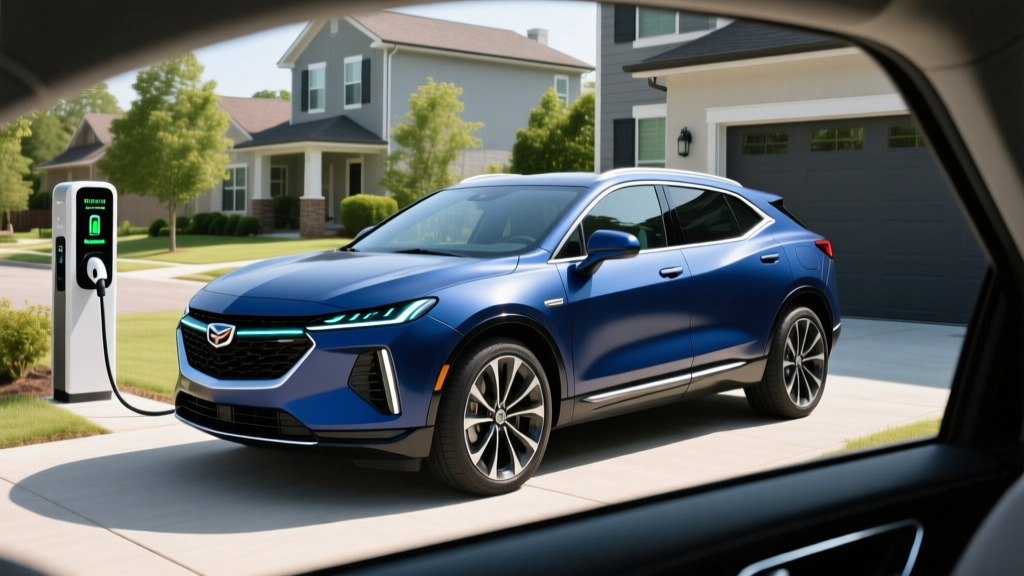
Finding competitive Blazer EV SUV leases near Newnan, Georgia, requires looking past the sticker price and understanding the full ownership picture. The 2026 Chevrolet Blazer EV is a midsize electric crossover that competes directly with the Hyundai IONIQ 5, Ford Mustang Mach-E, and Tesla Model Y. But before you sign a lease agreement at a South Metro Atlanta dealer, you need to know exactly what this EV costs to run, charge, insure, and maintain over a typical ownership cycle.
This guide breaks down the real numbers behind the 2026 Blazer EV — from federal tax credit eligibility under IRS §30D to per-mile charging costs in Georgia, insurance premiums, depreciation trends, and whether leasing or buying makes more financial sense in the Newnan area.
2026 Blazer EV: Quick Specs Before You Lease
Before running the cost math, here's what you're actually getting with the 2026 Chevrolet Blazer EV. Specs vary by trim, so choose carefully — it affects your tax credit eligibility and monthly lease payment.
| Spec | 2LT (FWD) | RS (AWD) | SS (AWD) |
|---|---|---|---|
| Base MSRP | $44,600 | $48,600 | $54,600 |
| EPA Range | 312 mi | 279 mi | 293 mi |
| Battery (usable) | 85 kWh (NMC) | 85 kWh (NMC) | 85 kWh (NMC) |
| Horsepower | 220 hp | 288 hp | 557 hp |
| 0-60 mph | 7.6 sec | 5.5 sec | 3.4 sec (Wide Open Watts) |
| Peak DC Fast Charge | 190 kW | 190 kW | 190 kW |
| 10-80% DC Charge | ~28 min | ~28 min | ~28 min |
| Level 2 (240V) Rate | 11.5 kW | 11.5 kW | 11.5 kW |
| MPGe (combined) | 92 MPGe | 87 MPGe | 84 MPGe |
| Battery Warranty | 8 yr / 100,000 mi | 8 yr / 100,000 mi | 8 yr / 100,000 mi |
5-Year Total Cost of Ownership: Blazer EV vs. Gas Midsize SUV
The real question for anyone searching Blazer EV SUV leases near Newnan isn't the monthly payment alone — it's what you'll spend over five years when you add electricity, insurance, maintenance, and depreciation. Here's a data-driven breakdown comparing the Blazer EV RS (AWD) to a comparably priced gas midsize SUV (like the Chevy Blazer gas model at ~$42,000 MSRP).
| Cost Category | 2026 Blazer EV RS (AWD) | Gas Midsize SUV (AWD) |
|---|---|---|
| Purchase / Lease (5-yr net) | $28,500 (est. net after lease + buyout or depreciation) | $24,200 (est. net) |
| Fuel / Electricity (60k mi) | $4,320 (home charging) | $8,100 (25 MPG avg, $3.38/gal) |
| Insurance (5 years) | $11,400 ($2,280/yr avg) | $9,000 ($1,800/yr avg) |
| Maintenance (5 years) | $1,800 | $4,200 |
| Federal Tax Credit | -$7,500 (if eligible, applied at sale) | $0 |
| 5-Year Total | $38,520 | $45,500 |
The Blazer EV saves roughly $7,000 over five years compared to a gas equivalent — but only if you qualify for the full $7,500 federal tax credit and charge primarily at home. If you rely on public DC fast charging at $0.40-$0.55/kWh, your fuel cost jumps to $6,500-$8,800, narrowing the gap substantially.
Federal Tax Credit: Do You Qualify for §30D on the Blazer EV?
The IRS §30D Clean Vehicle Credit offers up to $7,500 for qualifying new EVs. For the 2026 Blazer EV, this is a critical factor — but eligibility depends on several requirements that change periodically. Here's the current checklist:
- MSRP Cap: SUVs must have a base MSRP at or below $80,000. All 2026 Blazer EV trims qualify (highest is SS at ~$54,600).
- Buyer Income Cap: Modified AGI must not exceed $150,000 (single), $225,000 (head of household), or $300,000 (married filing jointly).
- Battery Component Sourcing: At least 75% of battery components must be manufactured or assembled in North America (for the $3,750 component half).
- Critical Minerals Sourcing: A required percentage of critical minerals must be sourced from the U.S. or a free-trade-agreement country (for the $3,750 minerals half).
- Point-of-Sale Transfer: As of 2024, you can transfer the credit to the dealer at purchase, reducing your out-of-pocket cost immediately — even on a lease, the lessor may pass the benefit through as a capitalized cost reduction.
- Final Assembly: Vehicle must undergo final assembly in North America. The Blazer EV is assembled in Ramos Arizpe, Mexico — verify current eligibility with your dealer, as this has been a point of contention for GM EVs.
How the Tax Credit Works on a Lease
On a lease, the §30D credit technically goes to the lessor (the financing company), not you. However, most major lessors — including GM Financial — typically pass the credit through as a capitalized cost reduction, effectively lowering your monthly payment. On a $48,600 Blazer EV RS, a $7,500 cap cost reduction can shave roughly $140-$160/month off a 36-month lease. Ask the dealer explicitly whether the credit is being passed through before signing.
Charging Costs in Georgia: $/Mile vs. Gas
Newnan and the broader Coweta County area are served primarily by Georgia Power, which offers residential electricity rates that affect your per-mile charging cost. Here's the real math:
| Scenario | Cost/kWh or Gal | Efficiency | Cost Per Mile |
|---|---|---|---|
| Blazer EV — Home (GA Power standard rate) | $0.14/kWh | 0.31 kWh/mi (RS AWD) | $0.043/mi |
| Blazer EV — Home (Time-of-Use off-peak) | $0.08/kWh | 0.31 kWh/mi | $0.025/mi |
| Blazer EV — Public DC Fast (Electrify America) | $0.48/kWh | 0.31 kWh/mi | $0.149/mi |
| Gas SUV (25 MPG combined) | $3.38/gal | 25 MPG | $0.135/mi |
At home on a standard Georgia Power rate, the Blazer EV costs roughly 4.3 cents per mile — about a third of what a 25 MPG gas SUV burns per mile. If you enroll in Georgia Power's Plug-In Electric Vehicle time-of-use plan and charge overnight, that drops to 2.5 cents per mile, saving you nearly $6,600 over 60,000 miles versus gas.
However, if you rely exclusively on public DC fast charging, your cost per mile actually exceeds the gas SUV. This is why home charging access is the single biggest financial variable in EV ownership. A Level 2 home charger installation in the Newnan area typically runs $800-$2,000 depending on panel capacity and run length.
Charging Infrastructure Near Newnan
Newnan has a growing but still limited public charging footprint. You'll find DC fast chargers at select Electrify America and EVgo stations along I-85 (the primary corridor for Newnan commuters to Atlanta). For daily driving, home Level 2 charging at the Blazer EV's 11.5 kW rate adds roughly 37 miles of range per hour — more than enough to replenish a day's commute overnight.
Maintenance Savings: Where the Blazer EV Wins Clearly
EVs eliminate many routine maintenance items that gas vehicles require. Here's what you keep in your pocket over five years:
| Service Item | Blazer EV | Gas SUV |
|---|---|---|
| Oil Changes | $0 (none needed) | $900-$1,200 (6-8 changes) |
| Brake Pads/Rotors | $200-$400 (regen extends life 2-3x) | $800-$1,400 |
| Transmission Fluid | $0 (single-speed reduction gear) | $200-$400 |
| Coolant Flush | $150 (battery thermal loop, longer interval) | $200-$300 |
| Air Filters (engine) | $0 (no engine) | $150-$250 |
| Cabin Air Filter | $100-$150 | $100-$150 |
| Tire Rotation/Replacement | $1,200-$1,600 (EVs wear tires faster due to weight/torque) | $900-$1,200 |
| Total (5-yr est.) | $1,650-$2,350 | $3,250-$4,900 |
The Blazer EV saves roughly $1,500-$2,500 in maintenance over five years. The biggest caveat: EV tires. The Blazer EV RS tips the scales at over 5,300 lbs, and instant electric torque accelerates tread wear. Budget for a tire replacement around 30,000-40,000 miles — a set of four EV-rated touring tires runs $800-$1,200 installed.
Insurance Reality: The Cost Most EV Buyers Underestimate
EV insurance premiums run 15-25% higher than comparable gas vehicles, and the Blazer EV is no exception. Here's why:
- Higher repair costs: Battery pack damage from collisions often requires full replacement ($15,000-$25,000 for an 85 kWh pack), and insurers price this risk in.
- Specialized labor: High-voltage system repairs require certified technicians, which fewer shops offer.
- Vehicle price: The Blazer EV's starting MSRP of ~$44,600-$54,600 places it in a higher insurance tier than many gas crossovers.
- Parts availability: EV-specific body panels and structural components can have longer lead times, increasing rental car costs on claims.
In the Newnan/Coweta County area, expect to pay $2,000-$2,600 annually for full-coverage insurance on a Blazer EV RS, depending on your driving record, age, and deductible. That's roughly $400-$600 more per year than a gas Blazer. Always get quotes from at least three insurers — GEICO, State Farm, and Progressive have varying EV rating models — before finalizing your lease.
Depreciation and Resale Value: What the Data Shows
EV depreciation has been one of the most volatile segments of the used car market since 2022. After Tesla's aggressive price cuts in 2023-2024 rippled through the entire EV used market, resale values for many electric SUVs fell 30-40% faster than gas equivalents.
For the Blazer EV specifically:
- 3-year projected retention: ~48-54% of original MSRP (based on current midsize EV trends from sources like iSeeCars and Kelley Blue Book)
- 5-year projected retention: ~35-42% of MSRP
- Gas midsize SUV average (5-year): ~45-52% retention
This means on a $48,600 Blazer EV RS, you might recover ~$17,000-$20,500 at trade-in after five years, versus ~$21,800-$25,300 for a comparably priced gas SUV. That's a $3,000-$5,000 depreciation penalty that partially offsets fuel and maintenance savings.
Leasing mitigates this risk. On a 36-month lease, the residual value is the lessor's problem, not yours. If you're searching for Blazer EV SUV leases near Newnan specifically, leasing can shield you from EV depreciation volatility — a genuine advantage in the current market.
Georgia and Local Incentives Beyond the Federal Credit
Georgia no longer offers a state EV tax credit (the previous $2,500 credit expired). However, other incentives may apply:
- Georgia Power EV Time-of-Use Rate: Off-peak charging rates as low as ~$0.08/kWh for EV owners enrolled in the PEV plan.
- Georgia Power Home Charging Rebate: Periodic rebates of up to $250 for Level 2 charger installation — check current availability with Georgia Power.
- HOV Lane Access: Georgia's Clean Air Force program previously offered single-occupant HOV lane access for EVs; verify current program status through the Georgia EPD.
- Utility-specific rebates: Some EMCs (electric membership cooperatives) in the South Metro Atlanta area offer their own EV rebates — contact your local provider.
Note: State and local incentives vary significantly by jurisdiction and change frequently. Always verify current programs through official state and utility sources before making a purchase decision.
Blazer EV Lease vs. Buy: Which Makes Sense in Newnan?
Given the depreciation uncertainty, tax credit mechanics, and rapidly evolving EV market, leasing the Blazer EV offers several advantages for Newnan-area buyers:
Choose a LEASE if:
- You want to avoid long-term depreciation risk on an EV
- Your annual mileage is under 12,000-15,000 miles (lease limits)
- You want to upgrade to newer battery/charging tech in 3 years
- The lessor passes the $7,500 tax credit through as a cap cost reduction
Choose to BUY if:
- You drive more than 15,000 miles/year (lease overage penalties add up fast)
- You plan to keep the vehicle 5+ years
- You qualify for the §30D credit and want to apply it directly to your tax liability
- You want to build equity and avoid perpetual car payments
Frequently Asked Questions
How much does a Blazer EV lease cost per month near Newnan in 2026?
Lease payments vary by dealer, trim, credit tier, and down payment. As a baseline, a 2026 Blazer EV RS (AWD) at $48,600 MSRP with $4,000 due at signing and a 36-month/10,000-mile-per-year term typically lands in the $480-$620/month range before tax credit application. If the $7,500 §30D credit is passed through as a cap cost reduction, expect monthly payments to drop to roughly $350-$480/month. Always get itemized lease quotes from multiple South Metro Atlanta GM dealers.
Is the Chevy Blazer EV eligible for the $7,500 federal tax credit in 2026?
Eligibility depends on current battery-sourcing and final-assembly rules under IRS §30D. The Blazer EV is assembled in Mexico, which has historically been a complicating factor. Battery critical-mineral sourcing requirements also tighten annually. Check the latest eligibility status at fueleconomy.gov and confirm with your dealer before signing. Your modified AGI must also be below $150,000 (single) or $300,000 (married filing jointly).
How much do I really save on fuel charging a Blazer EV at home in Georgia?
On Georgia Power's standard residential rate (~$0.14/kWh), charging the Blazer EV RS costs about $0.043/mile — versus $0.135/mile for a 25 MPG gas SUV at $3.38/gallon. Over 12,000 annual miles, that's ~$755/year in electricity vs. ~$1,620/year in gas, saving you roughly $865 annually. On a time-of-use plan with overnight charging at $0.08/kWh, savings widen to ~$1,300/year.
Are EVs like the Blazer EV more expensive to insure?
Yes — typically 15-25% more than a comparable gas vehicle. For the Blazer EV in the Newnan area, budget $2,000-$2,600/year for full coverage. Higher repair costs for battery damage, specialized technician requirements, and the vehicle's MSRP all contribute. Get quotes from multiple insurers before committing.
How well will the Blazer EV hold its value?
Current projections suggest 5-year retention of ~35-42% of MSRP, which is below the gas-SUV average of ~45-52%. EV depreciation has been volatile since 2023. Leasing transfers this risk to the lessor, which is one reason many EV shoppers prefer lease arrangements.
Can I charge the Blazer EV at home with a standard outlet?
Yes, but slowly. A standard 120V Level 1 outlet adds roughly 3-4 miles of range per hour — adequate only if you drive under 30 miles daily. For practical ownership, a 240V Level 2 home charger at the Blazer EV's 11.5 kW acceptance rate adds ~37 miles/hour, fully replenishing the battery overnight. Professional installation in the Newnan area typically costs $800-$2,000, depending on your electrical panel's capacity and the distance from panel to charger location.
What's the real-world range of the Blazer EV on Georgia highways?
The EPA rates the 2LT at 312 miles and the RS (AWD) at 279 miles. On I-85 at sustained 70-75 mph in warm weather, expect ~250-265 miles for the RS before needing to charge. In cooler weather or with aggressive driving, that figure can drop to ~235 miles. Plan road trips around 200-mile charging intervals for comfort.