Quick Answer: Does INFINITI Have an EV?
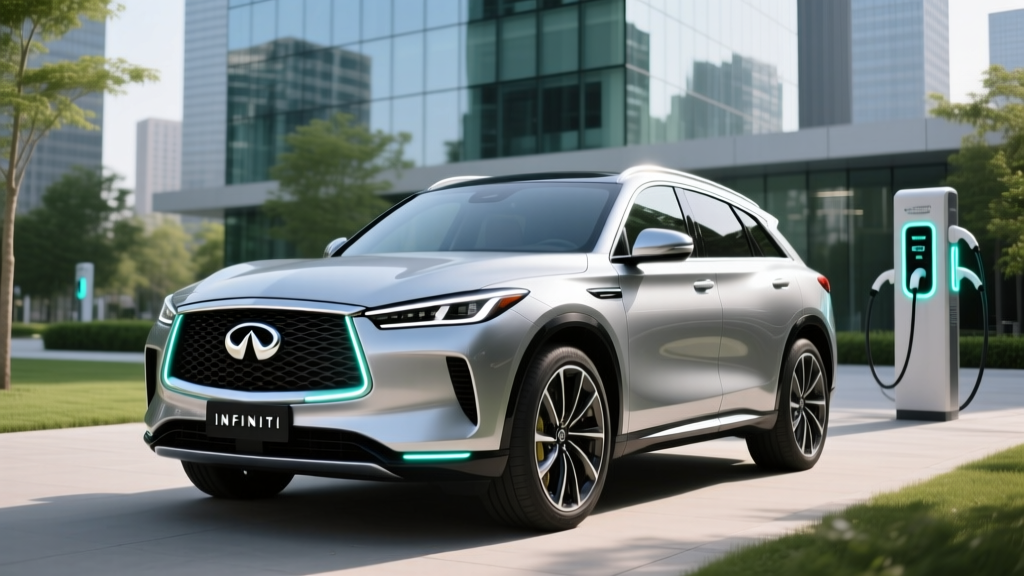
As of the 2026 model year, INFINITI's sole battery-electric offering is the QX65 e-Motion, an all-electric coupe-SUV built on the Renault-Nissan-Mitsubishi Alliance's CMF-EV platform. It is expected to deliver roughly 285–310 miles of EPA range, a 91 kWh usable battery (NMC chemistry), and DC fast charging up to 130 kW. Pricing is anticipated to start near $56,000 before incentives. If you're searching for an "INFINITI EV," this is currently the only model to evaluate — and it carries real trade-offs versus rivals like the Genesis Electrified GV70 and BMW iX.
What Is the INFINITI QX65 e-Motion?
The QX65 e-Motion is INFINITI's first dedicated battery-electric vehicle (BEV). It slots into the midsize luxury crossover segment with a sloping coupe-SUV roofline, targeting buyers who want premium branding, all-electric powertrain, and something less ubiquitous than a Tesla Model Y. The vehicle shares its underpinnings with the Nissan Ariya and the Renault Scenic E-Tech, leveraging the Alliance's CMF-EV skateboard platform.
INFINITI positions the QX65 e-Motion as a performance-luxury alternative, tuning the dual-motor all-wheel-drive system for a more aggressive torque delivery than the Ariya. The brand also emphasizes interior materials — open-pore wood, quilted leather, and a 12.3-inch dual-screen cockpit — to differentiate from its Nissan sibling.
Expected Specs: Range, Battery, Charging, and Performance
Below is the anticipated specification sheet based on INFINITI's announced data and CMF-EV platform benchmarks. Specs marked with an asterisk (*) are preliminary and subject to EPA certification.
| Specification | QX65 e-Motion AWD (Expected) |
|---|---|
| Battery Capacity (Usable) | 91 kWh (NMC lithium-ion) |
| EPA Range (Est.)* | 285–310 miles |
| Real-World Highway Range | ~240–265 miles (70 mph, moderate climate) |
| Cold-Weather Range (20°F) | ~210–235 miles (est. 20–25% loss) |
| Motor Config / Drivetrain | Dual motor / e-AWD |
| Horsepower | 389 hp |
| Torque | 443 lb-ft |
| 0–60 mph | ~5.1 seconds |
| DC Fast Charge Peak | 130 kW (CCS1) |
| 10–80% DC Charge Time* | ~35–40 minutes |
| Level 2 AC Charge Rate | 7.2 kW (onboard charger) |
| Level 2 Full Charge Time | ~13 hours (0–100%) |
| MPGe (Combined, Est.)* | ~95–100 MPGe |
| Base MSRP (Est.) | ~$56,000 |
| Battery / Powertrain Warranty | 8 years / 100,000 miles |
Real-World Range Reality Check
The EPA sticker may say 300 miles, but plan for ~250 miles on highway road trips at 70–75 mph. In freezing temperatures (below 25°F), expect a 20–25% reduction — putting you closer to 215–235 miles before needing a charge. The 91 kWh NMC battery does include a thermal management system with preconditioning, which helps mitigate losses when you navigate to a charger.
Charging: Where the QX65 e-Motion Falls Short
This is the most important section for prospective buyers. The QX65 e-Motion's 130 kW peak DC fast-charging rate is a significant limitation in 2026. Competitors like the Hyundai Ioniq 5 (peak 240 kW), Kia EV6 (peak 240 kW), and even the BMW iX xDrive50 (peak 195 kW) charge substantially faster.
Here's what the charge curve looks like in practice:
- 10–40% SoC: Sustains near 130 kW peak — solid performance
- 40–60% SoC: Tapers to ~100–110 kW
- 60–80% SoC: Drops to ~75–85 kW
- 80–100% SoC: Slows dramatically to ~25–35 kW (typical for NMC protection)
On a road trip, that 10–80% session will take 35–40 minutes, compared to 18–20 minutes in an Ioniq 5 or EV6 on a 350 kW charger. If you road-trip frequently, this is a meaningful compromise.
The 7.2 kW onboard Level 2 charger is also conservative. A full overnight charge from empty takes about 13 hours. Most owners will charge from 20–80% overnight, which takes roughly 8 hours — adequate for daily use but slower than the 11.5 kW chargers in some rivals.
Connector note: The QX65 e-Motion uses the CCS1 connector. With the industry shifting toward NACS (Tesla's standard), INFINITI has not announced a NACS port for this model year. You'll need a CCS-to-NACS adapter to access Tesla Supercharger stalls — confirm adapter availability and compatibility before purchase.
INFINITI EV vs. Gas and Key Rivals
How does the QX65 e-Motion stack up against INFINITI's own gas models and the EV competition? Let's look at the numbers.
| Vehicle | Powertrain | EPA Range / MPG | HP | 0–60 mph | Starting MSRP |
|---|---|---|---|---|---|
| INFINITI QX65 e-Motion AWD | BEV (91 kWh) | ~300 mi / ~97 MPGe | 389 | 5.1 sec | ~$56,000 |
| INFINITI QX55 (Gas) | 2.0T AWD | 28 MPG combined | 268 | 6.5 sec | ~$47,000 |
| Genesis Electrified GV70 | BEV (77.4 kWh) | 236 mi / 95 MPGe | 429 | 4.5 sec | $66,450 |
| BMW iX xDrive50 | BEV (105.2 kWh) | 324 mi / 86 MPGe | 516 | 4.4 sec | $87,250 |
| Cadillac Lyriq AWD | BEV (102 kWh) | 307 mi / 89 MPGe | 500 | 4.6 sec | $60,090 |
The QX65 e-Motion occupies a middle ground: more range than the Electrified GV70, less performance and charging speed than the iX and Lyriq, but at a lower entry price than both. Against INFINITI's own QX55, the EV costs about $9,000 more upfront but delivers 121 more horsepower and dramatically lower fueling costs.
Total Cost of Ownership: 5-Year Breakdown
Let's compare the real costs of owning the QX65 e-Motion versus the gas QX55 over five years and 75,000 miles. This assumes $3.50/gallon gas, $0.14/kWh home electricity, and 80% home / 20% public charging.
| Cost Category | QX65 e-Motion (EV) | QX55 (Gas) |
|---|---|---|
| Purchase Price (Base MSRP) | $56,000 | $47,000 |
| Federal Tax Credit (§30D)* | –$3,750 to $7,500 | $0 |
| Effective Purchase Price | $48,500–$52,250 | $47,000 |
| Fueling (75,000 miles) | $2,625 (home + public mix) | $9,375 (28 MPG avg) |
| Maintenance (5 years) | ~$1,200 | ~$3,500 |
| Insurance (5-year est.) | ~$9,500 | ~$7,800 |
| Estimated Depreciation | ~$22,000 | ~$19,000 |
| 5-Year Total Cost | $83,825–$87,575 | $86,675 |
*The §30D Clean Vehicle Credit ranges from $3,750 to $7,500 depending on battery-component and critical-mineral sourcing requirements. The QX65 e-Motion's Alliance-sourced battery may not meet full $7,500 eligibility — verify current-year status on the IRS qualified vehicles list. Income caps apply: $150K single / $300K joint AGI. MSRP must be ≤$80,000 for SUVs.
The takeaway: over five years, the EV breaks even or saves modestly versus the gas QX55, with the savings growing significantly if you extend ownership to 8–10 years. The biggest variable is the tax credit — if the QX65 e-Motion qualifies for the full $7,500 (or if it's eligible for point-of-sale transfer), the math tips decisively in the EV's favor.
What First-Time INFINITI EV Buyers Must Know
Home Charging Is Non-Negotiable for Most Owners
If you can install a Level 2 (240V) home charger, the QX65 e-Motion works well as a daily driver. A typical Level 2 installation costs $800–$2,200 (charger hardware + electrician + permit), assuming your electrical panel has capacity. If you need a panel upgrade from 100A to 200A, add $1,500–$3,000.
If you cannot charge at home — apartment living, street parking, or no garage access — the QX65 e-Motion's 130 kW charging speed becomes a genuine burden. Weekly public charging sessions of 35–40 minutes add up fast. Evaluate your living situation honestly before committing.
Insurance Costs Are Higher
EV insurance premiums run 15–25% higher than equivalent gas vehicles due to battery replacement costs and specialized repair requirements. Budget an extra $300–$400/year versus the QX55. Get quotes from your insurer before purchasing.
The Dealer Experience May Vary
INFINITI's dealer network is smaller than BMW, Mercedes, or Genesis. EV-specific service capability — high-voltage battery diagnostics, CMF-EV platform familiarity — may be limited at some locations. Call your local dealer and ask specifically about their EV service training and equipment before buying.
| Myth | Fact |
|---|---|
| "The QX65 e-Motion qualifies for the full $7,500 tax credit." | Credit eligibility depends on battery sourcing. CMF-EV batteries may only meet partial ($3,750) requirements. Check the fueleconomy.gov qualified vehicle list. |
| "300 miles of range means 300 miles on the highway." | EPA range includes city driving with heavy regen. Sustained 70–75 mph highway driving yields ~250 miles. Cold weather drops this further. |
| "I can use any fast charger without an adapter." | The CCS1 port won't connect to NACS-only chargers (including most Tesla Superchargers) without a certified adapter. |
| "The battery will need replacing in a few years." | NMC batteries with active thermal management typically retain 85–90% capacity after 100,000 miles. The 8-year/100,000-mile warranty covers drops below ~70% SoH. |
| "It charges as fast as other luxury EVs." | At 130 kW peak, it charges roughly 40–50% slower than an Ioniq 5 or EV6 and 30% slower than a BMW iX on equivalent chargers. |
Decision Framework: Should You Buy the INFINITI QX65 e-Motion?
Choose the QX65 e-Motion If:
- You want a luxury-branded EV under $60,000 and don't road-trip more than 2–3 times per year
- You have reliable Level 2 home charging and drive mostly in urban/suburban settings
- You value INFINITI's dealer relationship and interior luxury over cutting-edge charging tech
- You prefer a coupe-SUV design and don't need third-row seating
- The partial or full §30D tax credit applies to your purchase, bringing effective cost near $50K
Look Elsewhere If:
- You take frequent road trips and can't tolerate 35–40-minute charging stops
- You need NACS-native Supercharger access without adapters
- You want 320+ miles of real-world range (consider the BMW iX or Cadillac Lyriq)
- You lack home charging access — the slow DC charge rate makes public-only charging painful
- You want the latest ADAS tech — INFINITI's ProPILOT Assist is Level 2 and trails GM's Super Cruise and Ford's BlueCruise in hands-free highway capability
INFINITI EV Ownership FAQ
Does INFINITI currently sell an electric vehicle?
Yes. The QX65 e-Motion is INFINITI's first and currently only battery-electric vehicle, arriving for the 2026 model year. INFINITI has not announced additional EV models beyond this, though the Alliance's broader EV roadmap suggests more could follow later in the decade.
How does the QX65 e-Motion compare to the Nissan Ariya?
Both share the CMF-EV platform and a similar battery pack. The QX65 e-Motion gets INFINITI-specific tuning for more horsepower (389 vs. Ariya's 389 in e-4ORCE form), a more premium interior, and a coupe-SUV body style. The Ariya starts around $43,000 — roughly $13,000 less — making it the value pick if luxury branding isn't a priority.
Can I charge the QX65 e-Motion at Tesla Superchargers?
Not natively. The QX65 e-Motion uses a CCS1 connector. To access NACS-equipped Tesla Superchargers, you'll need a CCS-to-NACS adapter. Confirm with INFINITI that the vehicle's software supports adapter-based charging before relying on this for road trips. As of 2026, Electrify America, EVgo, and ChargePoint stations with CCS1 connectors will work directly.
What happens if the battery degrades?
INFINITI covers the battery for 8 years or 100,000 miles against capacity loss below approximately 70% State of Health (SoH). NMC batteries with active thermal management typically lose 1–2% capacity per year under normal use. A full battery replacement outside warranty would cost an estimated $12,000–$18,000 based on current CMF-EV pack pricing — though this is expected to decline as the battery supply chain matures.
Is the INFINITI QX65 e-Motion eligible for the $7,500 federal tax credit?
Possibly, but not guaranteed. Under current IRS §30D rules, the credit splits into two halves: $3,750 for battery-component sourcing and $3,750 for critical-mineral sourcing. The Alliance's battery supply chain may satisfy one requirement but not both. The vehicle's MSRP (under $80,000 SUV cap) and your income must also qualify. Check the IRS qualified vehicle list at the time of purchase, as sourcing determinations change periodically. A point-of-sale transfer to the dealer can apply the credit as a down-payment reduction if eligible.
What's the real-world charging cost per mile?
At the national average residential electricity rate of ~$0.14/kWh and an estimated efficiency of ~3.2 miles/kWh, home charging costs approximately $0.044 per mile. Compare that to the gas QX55 at 28 MPG combined and $3.50/gallon: $0.125 per mile. Over 15,000 annual miles, that's a fuel savings of roughly $1,215 per year charging at home. Public DC fast charging at $0.35–$0.48/kWh narrows the gap to $0.11–$0.15/mile.
Sources: fueleconomy.gov (EPA efficiency data), IRS §30D Clean Vehicle Credit, INFINITI USA press materials. All specifications marked as estimates are based on manufacturer preliminary data and CMF-EV platform benchmarks; final EPA-certified figures may vary.