Quick Verdict: The E-Transit Is a Last-Mile Workhorse, Not a Road-Trip Van
If your business runs predictable urban delivery routes under 100 miles a day, the 2026 Ford E-Transit remains one of the most practical electric commercial vans on the market. With a starting MSRP around $46,895 (before destination and upfits), available point-of-sale commercial clean vehicle credits, and a Pro Power Onboard system that turns the van into a mobile generator, the E-Transit makes a strong case for fleet electrification. But buyers hunting for Ford E-Transit deals need to understand exactly what they're getting — and what they're giving up — before signing a purchase order.
The E-Transit's 126-mile EPA-estimated range is its defining limitation. This van was engineered for depot-based routes: load up in the morning, run 40-80 stops in a metro area, return to base, and plug in overnight. If that matches your operation, the E-Transit's low running costs and familiar Transit architecture make it a compelling choice. If you need intercity range or fast public charging, look at the Mercedes-Benz eSprinter or BrightDrop Zevo 600 instead.
| Spec | Value |
|---|---|
| EPA Range (Cargo Van, Low Roof) | 126 miles |
| Battery Capacity (usable) | 68 kWh, NMC chemistry |
| Max DC Fast Charge Rate | 115 kW (peak) |
| 10–80% DC Charge Time | ~45 minutes |
| Level 2 AC Charge Rate | 10.5 kW / ~11.3 kW (Pro Power Onboard equipped) |
| Motor Output | 266 hp (198 kW) / 317 lb-ft torque |
| Drivetrain | Rear-wheel drive (single motor) |
| 0–60 mph (unloaded) | ~8.5 seconds (estimated) |
| Max Payload | Up to 3,880 lbs (Cutaway) |
| Max Cargo Volume | 487.3 cu ft (Extended High Roof) |
| MPGe (Combined, Cargo Van) | ~84 MPGe / ~2.0 kWh/mi |
| Base MSRP (T-350 Cargo Van, Low Roof) | $46,895 |
| Battery Warranty | 8 years / 100,000 miles |
Range, Efficiency, and the Real-World Delivery Reality
The 2026 Ford E-Transit carries a 68 kWh usable lithium-ion battery pack using NMC (nickel-manganese-cobalt) cell chemistry. The EPA rates the standard T-350 Cargo Van with low roof at 126 miles of combined range. Higher-roof and extended-wheelbase variants see slight reductions due to increased weight and aerodynamic drag.
EPA sticker: 126 miles. In practice, expect 100–115 miles on mixed urban delivery routes with frequent stops and regenerative braking recovery. Highway driving at 65+ mph drops range to roughly 85–95 miles due to the E-Transit's boxy aerodynamics. In cold weather (below 30°F), plan for a 20–30% reduction — that 126-mile rating can fall to 88–100 miles with cabin heat running and no battery preconditioning. For fleet managers, budget your routes around a 90-mile usable daily range in winter conditions to avoid stranding drivers.
Efficiency lands at approximately 2.0 kWh per mile (about 84 MPGe combined) for the cargo van variant, per fueleconomy.gov. That translates to roughly $0.24–$0.32 per mile in electricity costs at commercial utility rates of $0.12–$0.16/kWh — dramatically lower than the $0.55–$0.70 per mile a comparable gasoline Transit costs at current fuel prices.
Charging: Depot-Friendly, But Public DC Speeds Lag
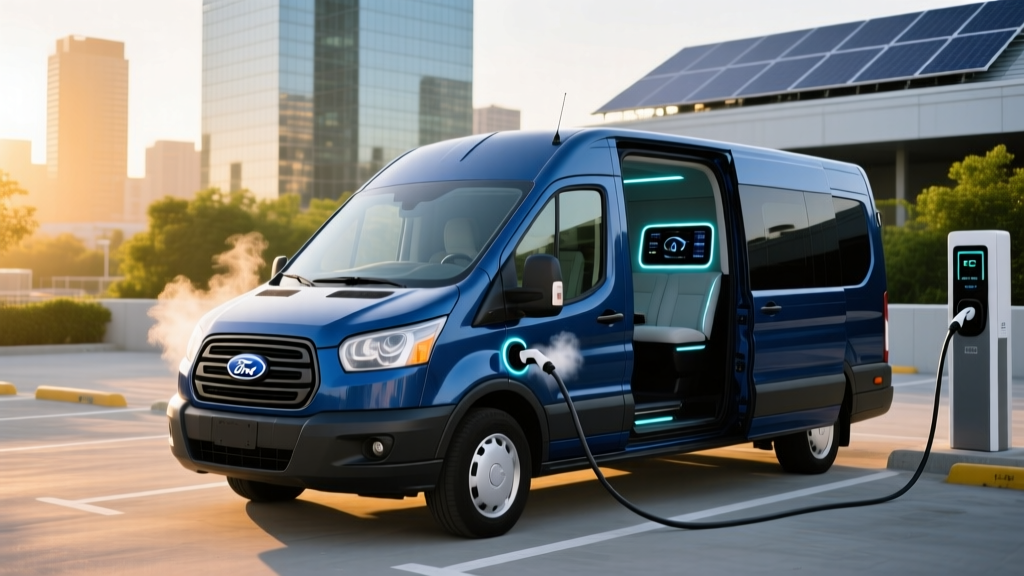
Ford designed the E-Transit around depot charging, and that's where it excels. The onboard AC charger accepts up to 10.5 kW on Level 2 (240V), adding roughly 30–35 miles of range per hour. A full overnight charge from 10% to 100% takes about 8 hours — perfect for vans that return to base each evening.
| Charging Level | Power | Speed | Use Case |
|---|---|---|---|
| Level 1 (120V) | ~1.4 kW | ~4 mi/hr | Emergency/trickle only |
| Level 2 (240V) | 10.5 kW | ~30–35 mi/hr | Overnight depot charging |
| DC Fast Charge | 115 kW (peak) | 10–80% in ~45 min | Mid-day top-ups |
DC fast charging peaks at 115 kW — adequate but not class-leading. The 10–80% session takes approximately 45 minutes. The charge curve tapers significantly above 80% SoC, so plan on spending close to 60 minutes if you need a near-full charge on the road. The E-Transit uses a CCS1 connector, compatible with Electrify America, EVgo, and most public DC networks. Ford's BlueOval Charge Network integration provides route planning and charger status through the SYNC 4 infotainment system and the FordPass app.
One notable advantage: Ford's Pro Power Onboard system (available on certain configurations) can export up to 2.4 kW of AC power from the van's battery through bed-mounted outlets. For tradespeople, this eliminates the need for a separate generator at job sites — you can run power tools, lights, or compressors directly from the E-Transit.
Performance, Payload, and Cargo Configurations
The E-Transit's single rear-mounted electric motor produces 266 horsepower and 317 lb-ft of torque. That torque is available from 0 RPM, which makes the van feel surprisingly responsive in stop-and-go city traffic even when loaded. Ford doesn't publish an official 0–60 time, but independent testing puts unloaded acceleration around 8.5 seconds — adequate for a commercial vehicle, though the van feels heavier and slower once you approach maximum payload.
Ford offers the E-Transit in the same body configurations as the gas Transit, which is a major selling point for fleets already running Transit vans:
- Cargo Van: Three lengths (regular, long, extended) and three roof heights (low, medium, high). Maximum cargo volume of 487.3 cu ft in the extended high-roof variant.
- Cutaway: For upfitters building box trucks, flatbeds, or specialty bodies. Up to 3,880 lbs payload capacity.
- Chassis Cab: For custom commercial upfits requiring a cab with an open rear frame.
Payload ranges from approximately 3,390 lbs (Cutaway) down to around 2,500 lbs for the high-roof cargo van, depending on configuration. The battery pack sits low in the chassis, which helps maintain a flat load floor and keeps the center of gravity favorable for handling.
Pricing, Trim Levels, and Federal Tax Credit Eligibility
The 2026 Ford E-Transit starts at approximately $46,895 for the T-350 Cargo Van with low roof and 130-inch wheelbase. Higher trims, longer wheelbases, and high-roof configurations push pricing into the $52,000–$58,000 range before options. The E-Transit is offered in a single, well-equipped commercial trim — Ford keeps it simple rather than layering on consumer-style option packages.
| Configuration | Base MSRP | Est. Destination | Commercial Credit (§45W) | Effective Cost |
|---|---|---|---|---|
| T-350 Cargo Van (Low Roof, 130" WB) | $46,895 | $1,795 | Up to $7,500 | ~$41,190 |
| T-350 Cargo Van (High Roof, 148" WB) | $51,395 | $1,795 | Up to $7,500 | ~$45,690 |
| T-350 Cutaway (138" WB) | $44,895 | $1,795 | Up to $7,500 | ~$39,190 |
Tax credit note for commercial buyers: The E-Transit typically qualifies under IRS §45W (Commercial Clean Vehicle Credit), not the consumer §30D credit. Section 45W provides up to $7,500 for qualifying commercial EVs with a GVWR under 14,000 lbs, claimed by the business that purchases and places the vehicle in service. Unlike §30D, there is no MSRP cap or buyer income limit — but the vehicle must be used for business purposes, and the credit is non-refundable (your business must have sufficient tax liability to absorb it). Consult a tax professional to confirm eligibility based on your business structure and tax situation. Some states and utility districts also offer additional commercial EV incentives — check the AFDC state incentive database for local programs.
Fleet buyers should also investigate Ford's commercial financing programs and whether their local utility offers make-ready infrastructure incentives for depot charger installation. Several utilities cover a significant portion of Level 2 charger hardware and electrical work for commercial customers.
Tech, Driver Assists, and Interior
The E-Transit's cabin mirrors the gas Transit but adds EV-specific displays. A 12-inch touchscreen running SYNC 4 anchors the dash, with native EV route planning, charge-station locators, and energy-flow displays. Apple CarPlay and Android Auto are wireless. The digital instrument cluster shows range, regen level, and battery temperature — critical information for fleet managers coaching drivers on efficiency habits.
Standard driver-assistance features include:
- Pre-Collision Assist with Automatic Emergency Braking (AEB)
- Lane-Keeping System
- Rear View Camera
- Available Blind Spot Information System (BLIS) with trailer coverage
- Available 360-degree camera (essential for a vehicle this size in tight urban loading docks)
These are SAE Level 1–2 driver-assist features — the driver must remain fully engaged at all times. The E-Transit does not offer hands-free driving systems like BlueCruise (available on the F-150 Lightning and Mustang Mach-E).
Ford's FordPass Connect modem is standard, enabling remote preconditioning, charge scheduling, geofencing, and telematics integration with fleet management platforms. For fleet operators, this connectivity is arguably the E-Transit's most valuable tech feature — it lets managers monitor state of charge, location, and driver behavior across an entire fleet from a single dashboard.
Warranty and Long-Term Battery Outlook
Ford backs the E-Transit's high-voltage battery and electric powertrain components with an 8-year / 100,000-mile warranty (whichever comes first). The warranty covers battery capacity retention below 70% of original capacity — meaning Ford will repair or replace the battery if degradation exceeds 30% during the warranty period.
For fleet buyers running high-mileage urban routes, this is a critical data point. NMC chemistry in commercial applications with daily charge cycles typically shows 10–15% degradation over 5 years and 80,000–100,000 miles based on telematics data from early E-Transit fleets. That leaves meaningful headroom within the warranty threshold. The standard vehicle limited warranty is 3 years / 36,000 miles, with 5 years / 60,000 miles on the powertrain.
How the E-Transit Stacks Up Against Key Competitors
The commercial electric van market has expanded, and the E-Transit faces real competition in 2026:
- Mercedes-Benz eSprinter: Offers up to ~200 miles of range (with the larger 113 kWh battery option) and DC charging up to 115 kW. Significantly more expensive — starting around $74,000 — but the range advantage is substantial for longer routes.
- BrightDrop Zevo 600: GM's commercial van offers ~250 miles of range and 150 kW DC charging, but availability has been limited and pricing sits higher. Targeted at large fleet customers with purchase commitments.
- Rivian EDV (Commercial Van): Purpose-built for delivery with ~150–190 miles of range depending on battery option. Currently primarily committed to Amazon, with limited availability to other fleets.
The E-Transit wins on price and dealer/service network accessibility. Ford's commercial vehicle infrastructure means most fleet buyers already have a relationship with a Ford Pro dealer, and parts availability for the shared Transit platform is robust nationwide. If your routes fit within the range envelope, the E-Transit's value proposition is difficult to beat.
Pros
- Lowest entry price among full-size electric cargo vans
- Familiar Transit architecture — same upfits, racks, and shelving systems work
- Pro Power Onboard eliminates separate job-site generators
- Strong Ford Pro dealer and service network nationwide
- Low operating cost: ~$0.25/mi electricity vs ~$0.60/mi gasoline
- FordPass Connect telematics for fleet management
Cons
- 126-mile EPA range limits use to short urban/suburban routes
- DC fast charging at 115 kW peak is slow for a 68 kWh pack
- No AWD option — rear-wheel drive only
- Cold-weather range loss of 20–30% further constrains already-limited range
- BlueCruise hands-free driving not available
- Payload reduced vs gas Transit due to battery weight
Who Should Buy the Ford E-Transit — And Who Shouldn't
Buy the E-Transit if: Your business runs predictable daily routes under 90 miles, you depot-charge overnight, you value low per-mile operating costs, and you want a van that integrates with existing Transit upfit equipment and Ford Pro service relationships. HVAC contractors, plumbers, last-mile delivery services, and municipal fleets with defined beats are ideal candidates.
Look elsewhere if: Your routes regularly exceed 120 miles, you operate in extreme cold without heated depot parking, you need to make intercity runs, or your drivers need hands-free highway driving assistance. The eSprinter or Zevo 600 better serve those use cases, albeit at higher cost.
What is the real-world range of the Ford E-Transit?
The EPA rates the E-Transit Cargo Van at 126 miles combined. Real-world urban delivery routes with regenerative braking typically yield 100–115 miles. Highway driving drops this to 85–95 miles, and cold weather (below 30°F) can reduce range by 20–30%, bringing winter city range to roughly 88–100 miles.
How fast does the E-Transit charge at home and on DC fast chargers?
On a Level 2 (240V) depot charger, the E-Transit accepts up to 10.5 kW, adding roughly 30–35 miles of range per hour. A full charge takes about 8 hours. On a DC fast charger, it peaks at 115 kW and charges from 10–80% in approximately 45 minutes.
Does the Ford E-Transit qualify for a federal EV tax credit?
The E-Transit generally qualifies for the IRS §45W Commercial Clean Vehicle Credit (up to $7,500 for vehicles under 14,000 lbs GVWR), not the consumer §30D credit. The §45W credit has no MSRP cap or buyer income limit but requires business use and sufficient tax liability. Consult a tax professional to confirm eligibility for your business.
Is the E-Transit worth buying vs the Mercedes-Benz eSprinter?
If your daily routes stay under 100 miles, the E-Transit offers significantly better value — roughly $25,000–$30,000 less than an equivalently configured eSprinter. If you need 150–200 miles of range for longer or less predictable routes, the eSprinter's larger battery option justifies its premium.
What are the biggest drawbacks of the E-Transit?
The 126-mile EPA range is the primary limitation, especially when cold weather reduces it further. DC fast charging at 115 kW peak is adequate but not fast for mid-day top-ups. There's no AWD option, and BlueCruise is unavailable. Payload is also slightly reduced compared to the gasoline Transit due to battery weight.
How long will the E-Transit battery last?
Ford warranties the battery for 8 years or 100,000 miles against capacity loss below 70%. Early fleet data suggests NMC degradation of 10–15% over 5 years and 80,000–100,000 miles in typical commercial use, well within the warranty threshold.