A Cabin That Punches Above Its Weight
If you are shopping for an electric sedan that balances futuristic design with everyday usability, the 2026 Hyundai Ioniq interior deserves a close look. Hyundai has refined the cabin to prioritize digital integration, sustainable materials, and flexible storage. But does the interior deliver on its promises, or is it style over substance?
This review covers the 2026 Ioniq 6 (the current sedan variant) and the broader Ioniq lineup, focusing on what matters most to EV buyers: real-world range, charging speed, ownership costs, and whether the cabin actually fits your life.
Real-World Range: Beyond the EPA Sticker
Real-World Expectation: 290–320 miles highway, 250–280 miles in cold weather (below 40°F)
The 2026 Ioniq 6 SE Long Range RWD achieves an EPA-estimated 361 miles on a full charge, thanks to its 77.4 kWh usable battery (NMC chemistry) and slippery 0.21 drag coefficient. But EPA tests favor city driving with regenerative braking. On a 70-mph highway run in mild weather, expect 290–320 miles before needing a charger. In freezing temperatures, battery chemistry and cabin heating can reduce range by 20–30%, dropping real-world miles to 250–280.
For comparison, the Tesla Model 3 Long Range AWD (EPA 341 miles) delivers similar highway efficiency but with slightly less cold-weather loss due to its heat pump standard on all trims. The Ioniq 6 includes a heat pump on SEL and above, which helps, but RWD models still see more winter range drop than AWD variants with battery preconditioning.
Efficiency: 140 MPGe combined (SE Long Range RWD), or 24 kWh per 100 miles. That translates to roughly $0.04–$0.06 per mile on home Level 2 charging (at $0.13/kWh national average), versus $0.12–$0.15 per mile for a 30-mpg gas sedan.
Charging Speed: DC Fast and Home Level 2
| Charging Level | Power (kW) | Time / Rate | Notes |
|---|---|---|---|
| DC Fast Charge (10–80%) | Peak 240 kW (350 kW charger) | ~18 minutes | Sustains ~180 kW to 50%, tapers to 80 kW above 70% |
| DC Fast Charge (10–80%) | Peak 150 kW (150 kW charger) | ~28 minutes | Common on Electrify America, EVgo |
| Level 2 Home (240V, 48A) | 10.9 kW | ~7 hours (0–100%) | Adds ~37 miles per hour of charging |
| Level 1 (120V, 12A) | 1.4 kW | ~55 hours (0–100%) | Emergency use only; adds ~4 miles/hour |
The Ioniq 6's 800V electrical architecture (shared with the Kia EV6 and Genesis GV60) is its charging superpower. On a 350 kW DC fast charger, it peaks at 240 kW and can add 10–80% in about 18 minutes. But here's the real-world caveat: that peak only holds until roughly 50% state of charge (SoC). After that, the charge curve tapers to protect battery health, dropping to 80 kW by 70% SoC. If you arrive at a charger with 20% battery, you'll see blazing speeds for the first 10 minutes, then a slowdown.
For home charging, a 48-amp Level 2 wallbox (like the ChargePoint Home Flex or Emporia Vue) delivers 10.9 kW, fully recharging the 77.4 kWh battery in about 7 hours. That's overnight-ready for most commuters. Installation costs range from $500–$1,500 depending on your electrical panel's capacity and distance from the garage. If your home has a 200-amp panel with spare capacity, expect the lower end. Older homes with 100-amp service may need a $2,000–$4,000 panel upgrade.
Connector: The 2026 Ioniq 6 uses the CCS1 connector for DC fast charging and J1772 for Level 2. Hyundai has not yet adopted the Tesla NACS connector (expected in 2027 models), so you'll need a CCS-to-NACS adapter for Tesla Superchargers (sold separately, ~$200).
Interior Space, Tech, and Daily Usability
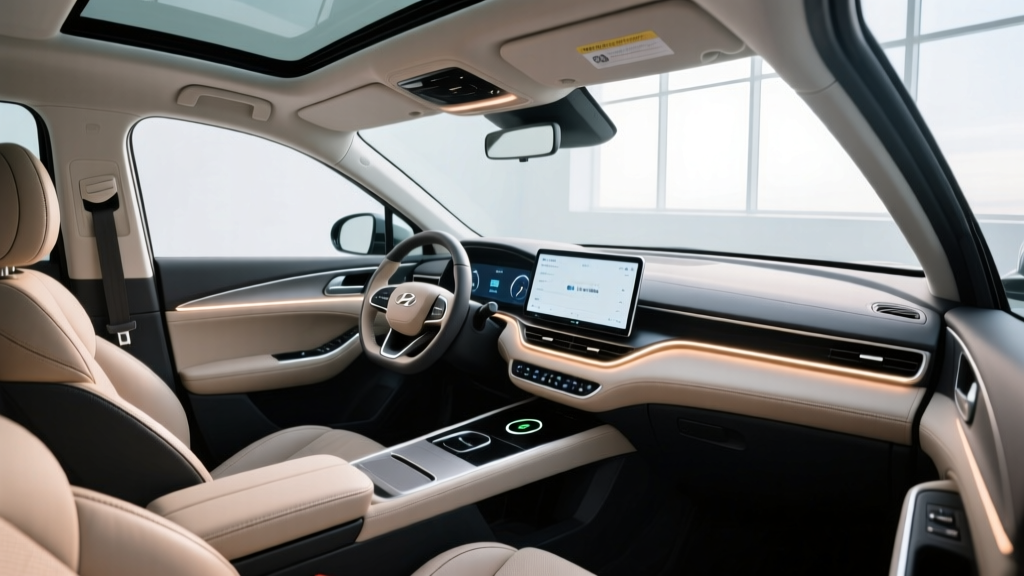
The 2026 Ioniq interior is a study in minimalist design with practical touches. The dual 12.3-inch displays (one for gauges, one for infotainment) are angled toward the driver, and the center console floats to create a storage cubby underneath. Hyundai uses recycled materials extensively: fabric seats are made from plastic bottles, and the headliner uses bio-based fibers.
Passenger Space:
- Front headroom: 40.2 inches
- Front legroom: 41.7 inches
- Rear headroom: 37.8 inches (sloping roofline cuts into space for taller passengers)
- Rear legroom: 35.1 inches (tight for adults over 6 feet on long trips)
Cargo Volume: 12.3 cubic feet in the trunk (sedan). The Ioniq 6 does not have a frunk (front trunk) due to the 12V battery and electronics placement. For comparison, the Tesla Model 3 offers 23 cu ft total (trunk + frunk), and the Hyundai Ioniq 5 (SUV) provides 27.2 cu ft behind the rear seats.
Standout Tech:
- Hyundai Digital Key 2: Use your smartphone as a key (NFC + UWB)
- Highway Driving Assist 2 (HDA2): SAE Level 2 driver assist with lane-centering and adaptive cruise (standard on SEL and above)
- Vehicle-to-Load (V2L): Power devices up to 3.6 kW via an interior outlet (optional adapter, ~$300)
- Over-the-air (OTA) updates for infotainment and battery management
- Ambient lighting with 64 colors and "mode" presets (e.g., "Relax" dims lights and plays nature sounds)
Notable Drawbacks:
- Rear visibility is compromised by the sloping roof and thick C-pillars (a backup camera is standard, but a 360-degree view is only on Limited trims)
- No physical volume knob; audio control is via touchscreen or steering wheel buttons (frustrating for some drivers)
- The rear seat does not fold completely flat, limiting cargo flexibility for long items
Pricing, Tax Credits, and Ownership Costs
| Trim | MSRP | Federal Tax Credit (§30D) | Effective Price |
|---|---|---|---|
| SE Standard Range RWD | $38,650 | $3,750 (partial, battery sourcing) | $34,900 |
| SE Long Range RWD | $42,400 | $3,750 (partial, battery sourcing) | $38,650 |
| SEL Long Range AWD | $47,100 | $3,750 (partial, battery sourcing) | $43,350 |
| Limited Long Range AWD | $52,600 | $3,750 (partial, battery sourcing) | $48,850 |
The 2026 Hyundai Ioniq 6 qualifies for a partial $3,750 federal tax credit under IRS §30D rules. The full $7,500 credit is not available because the battery's critical minerals and components do not yet meet 100% of the sourcing requirements (as of 2026, the Ioniq 6's battery is sourced from SK On in Georgia, but some minerals still come from non-free-trade-agreement countries).
Tax Credit Eligibility Checklist (IRS §30D):
- Buyer income cap: $150,000 (single), $225,000 (head of household), $300,000 (joint)
- Vehicle MSRP cap: $55,000 for sedans (Ioniq 6 qualifies on all trims)
- Battery sourcing: Must meet critical mineral and component thresholds (Ioniq 6 meets 50% for $3,750)
- Point-of-sale transfer: You can apply the credit as a down payment reduction at the dealer (new for 2024+)
5-Year Ownership Cost Estimate (15,000 miles/year):
- Purchase price (SE Long Range RWD, after credit): $38,650
- Electricity (home charging, $0.13/kWh): $3,900
- Maintenance (tire rotations, cabin air filter): $600
- Insurance (national average for EVs): $9,500
- Depreciation (estimated 45% over 5 years): -$17,400
- Total 5-year cost: ~$35,250 (or ~$0.47 per mile)
For comparison, a 2026 Toyota Camry LE (gas, 32 mpg combined, $28,000 MSRP) would cost ~$38,000 over 5 years (fuel: $8,200, maintenance: $2,500, insurance: $7,500, depreciation: -$12,600). The Ioniq 6 is slightly cheaper to own, but the upfront price is higher, and insurance is more expensive due to EV repair costs.
Performance and Warranty
Performance (SE Long Range RWD):
- 0–60 mph: 6.2 seconds
- Horsepower: 225 hp (single motor RWD)
- Drivetrain: Rear-wheel drive (AWD available on SEL and Limited with dual motors, 320 hp, 0–60 in 5.1 seconds)
- Towing capacity: Not rated (sedan; for towing, consider the Ioniq 5 or Kia EV6, both rated for 2,300 lbs)
Warranty:
- Battery: 10 years / 100,000 miles (capacity retention: 70% minimum)
- Powertrain: 10 years / 100,000 miles
- Bumper-to-bumper: 5 years / 60,000 miles
- Roadside assistance: 5 years / unlimited miles
Hyundai's warranty is among the best in the EV space, matching Kia and beating Tesla's 8-year/120,000-mile battery warranty. The 70% capacity retention threshold is standard, but real-world degradation data from fueleconomy.gov and owner forums suggests the Ioniq 6's NMC battery loses only 5–8% over the first 100,000 miles with proper care (avoiding frequent DC fast charging above 80% SoC and extreme heat exposure).
Who Should Buy the 2026 Hyundai Ioniq 6?
- You prioritize aerodynamic design and real-world highway efficiency
- You want 800V fast charging without paying a premium (unlike Porsche Taycan or Lucid Air)
- You commute 40–80 miles daily and can charge at home overnight
- You value a minimalist, tech-forward interior with sustainable materials
- You need maximum cargo space (the sloping roof limits trunk height; consider the Ioniq 5 or Tesla Model Y)
- You frequently carry rear-seat passengers over 6 feet tall (legroom is tight)
- You live in a cold climate and need maximum winter range (AWD with heat pump helps, but expect 250–280 miles)
- You want Tesla Supercharger access without an adapter (wait for 2027 models with NACS)
Pros and Cons at a Glance
- Class-leading 800V fast charging (10–80% in 18 min on 350 kW)
- 10-year/100,000-mile battery and powertrain warranty
- Standard Highway Driving Assist 2 (SAE Level 2) on most trims
- Quiet, well-insulated cabin at highway speeds
- Competitive pricing after partial tax credit
- No frunk; limited cargo versatility vs hatchback/SUV EVs
- Rear seat legroom and headroom are tight for tall adults
- Only partial $3,750 tax credit (not full $7,500)
- CCS1 connector requires adapter for Tesla Superchargers
- No physical audio knobs; touchscreen-only controls frustrate some drivers
FAQ: Your Questions Answered
What is the real-world range of the 2026 Hyundai Ioniq 6?
The EPA estimates 361 miles for the SE Long Range RWD, but real-world highway driving yields 290–320 miles in mild weather and 250–280 miles in cold conditions (below 40°F). AWD models and higher trims with larger wheels reduce range by 10–15 miles.
How fast does the Ioniq 6 charge at home and on the road?
On a 350 kW DC fast charger, it peaks at 240 kW and adds 10–80% in ~18 minutes (with taper above 50% SoC). At home on a 48-amp Level 2 charger (10.9 kW), it fully recharges in ~7 hours, adding ~37 miles per hour of charging.
How much does the Ioniq 6 cost after tax credits?
The SE Long Range RWD starts at $42,400 MSRP and qualifies for a $3,750 federal tax credit (partial, due to battery sourcing), bringing the effective price to $38,650. Higher trims (SEL, Limited) also qualify, but the Limited's $52,600 MSRP exceeds the $55,000 sedan cap for some buyers' income limits.
Is the Ioniq 6 worth buying vs the Tesla Model 3 or Hyundai Ioniq 5?
The Ioniq 6 offers better highway efficiency and faster charging than the Model 3, but the Tesla has more cargo space (hatchback + frunk) and native Supercharger access. The Ioniq 5 (SUV) is more practical for families with 27.2 cu ft of cargo room, but the Ioniq 6's sedan design is more aerodynamic and efficient. Choose based on your cargo and passenger needs.
Does the Ioniq 6 qualify for the full $7,500 federal EV tax credit?
No. As of 2026, the Ioniq 6 qualifies for a partial $3,750 credit because its battery meets 50% of the critical mineral and component sourcing requirements under IRS §30D. The full $7,500 requires 100% compliance, which Hyundai is working toward for future model years. Always verify eligibility on irs.gov before purchasing.
What are the biggest pros and cons of the Ioniq 6?
Pros: 800V fast charging, 10-year warranty, quiet cabin, competitive pricing. Cons: No frunk, tight rear seat, partial tax credit, CCS1 connector (no native Tesla Supercharger access).
Final Verdict
The 2026 Hyundai Ioniq 6 is a compelling electric sedan for buyers who value efficiency, fast charging, and a tech-forward interior. Its 800V architecture is a genuine advantage for road-trip charging, and the 10-year warranty provides peace of mind. However, the sloping roofline sacrifices cargo and rear-seat practicality, and the partial tax credit makes it slightly less affordable than competitors like the Tesla Model 3 (which qualifies for the full $7,500 in some configurations).
If you're a commuter with home charging access and don't need SUV-level cargo space, the Ioniq 6 is a smart choice. For families or frequent road-trippers who need more versatility, the Ioniq 5 or Model Y may be better fits. Test-drive both, and pay attention to real-world range in your climate before deciding.