The Hyundai Ioniq 5 N is a paradox wrapped in a performance hatchback: a 641-horsepower, dual-motor electric hot hatch that can lap a track and still carry groceries. But beyond the N e-Shift software and the bucket seats, buyers are searching for practical ownership details — particularly the Ioniq 5 N interior, real-world range, and charging reality. This review covers every spec that matters.
2026 Ioniq 5 N at a Glance: Full Spec Sheet
| Spec | Value |
|---|---|
| EPA Range | 221 miles |
| Battery (usable) | 84.0 kWh, NMC (nickel-manganese-cobalt) |
| Drivetrain | Dual-motor AWD |
| Horsepower | 601 HP (641 HP with N Grin Boost, 10-sec bursts) |
| 0–60 mph | 3.25 seconds (with N Grin Boost / launch control) |
| Top Speed | 161 mph (electronically limited, track-capable) |
| Max DC Fast Charge | 238 kW (800V architecture) |
| 10–80% DC Charge Time | ~18 minutes (at 350 kW-class charger, preconditioned) |
| Level 2 Home Charge Rate | 10.9 kW onboard charger (~37 mi/hr added) |
| EPA Efficiency | 83 MPGe combined (40 kWh/100 mi) |
| Cargo Volume (rear seats up / folded) | 27.2 cu ft / 59.3 cu ft |
| Rear Legroom | 39.4 inches |
| Base MSRP | $67,975 (incl. $1,375 destination) |
| Federal Tax Credit (§30D) | Up to $7,500 (subject to sourcing & income rules) |
| Battery/Powertrain Warranty | 8 years / 100,000 miles |
| Vehicle Warranty | 5 years / 60,000 miles (bumper-to-bumper), 10 yr / 100k mi powertrain |
The Ioniq 5 N Interior: Track-Focused Meets Daily Practicality
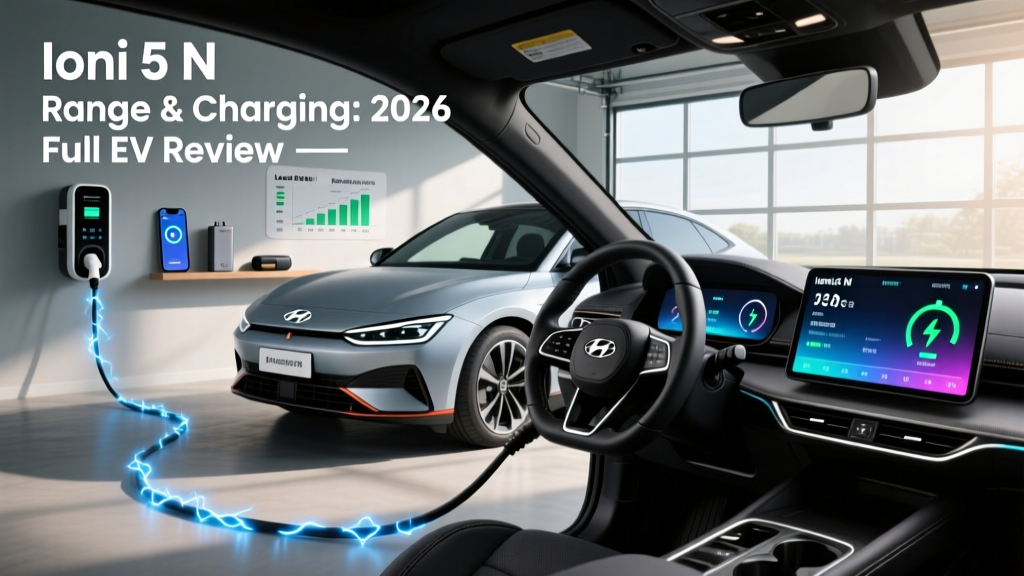
The Ioniq 5 N interior is where this EV separates itself from the standard Ioniq 5 lineup. Hyundai's N division has reworked nearly every touchpoint for performance driving without sacrificing daily usability.
N Sport Bucket Seats: The front seats are heavily bolstered N-branded sport buckets with integrated headrests, finished in a leather-suede combination. They feature N logos embossed on the seatbacks and offer excellent lateral support during aggressive cornering. Heated and ventilated front seats are standard. However, the aggressive bolsters make ingress and egress slightly more effort than the standard Ioniq 5's flatter seats — something to consider if you have mobility concerns.
N-Specific Steering Wheel and Controls: The leather-wrapped flat-bottom steering wheel includes dedicated N1 and N2 shortcut buttons (programmable for drive modes, regen settings, or N e-Shift profiles), a red N Grin Boost button for temporary power overboost, and paddle shifters that control the simulated 8-speed DCT gear changes in N e-Shift mode. The wheel is thick and grippy — clearly track-oriented.
Dual 12.3-Inch Displays: A 12.3-inch digital instrument cluster and a 12.3-inch infotainment touchscreen sit behind a single curved glass panel. The cluster includes N-specific readouts: battery temperature, G-force meter, lap timer, torque distribution, and N e-Shift gear indicator. The infotainment system runs Hyundai's latest software with wireless Apple CarPlay and Android Auto, Bluelink connected services, and over-the-air (OTA) update capability.
N Performance Pedals and Trim: Aluminum N-branded pedals, a metal dead pedal, and N-exclusive interior trim (dark chrome and Performance Blue accents) reinforce the motorsport theme. The headliner is finished in black suede, and N logos appear on the door scuff plates and center console.
Center Console and Storage: The floating center console (a signature Ioniq 5 design element) provides a covered storage bin, two USB-C ports (one data, one charge), a wireless phone charging pad, and cupholders. The flat floor architecture gives the cabin an airy, spacious feel despite the performance seat packaging.
Rear Seat and Cargo: The rear bench is a standard 60/40 split-folding design (not sport bucketed), with 39.4 inches of legroom — adequate for adults on shorter trips. Cargo space behind the rear seats is 27.2 cubic feet, expanding to 59.3 cubic feet with the seats folded. There is no front trunk (frunk) on the Ioniq 5 N — the space is consumed by the larger front drive motor and associated cooling hardware. This is a notable trade-off versus the standard Ioniq 5's 0.85 cu ft frunk (which was small to begin with).
Real-World Range: What 221 EPA Miles Actually Means
EPA Combined: 221 miles
Real-World Highway (70–75 mph, moderate climate): ~180–195 miles
Real-World City/Suburban (mixed stop-and-go): ~210–230 miles
Cold-Weather Highway (below 32°F / 0°C): ~145–165 miles
Track Use (aggressive driving): ~60–90 miles per full charge depending on pace
The Ioniq 5 N's EPA-rated range of 221 miles is the lowest in the Ioniq 5 family, and there's a clear physics explanation: 601–641 HP, dual motors, wider 275-section Pirelli P Zero tires, a sport-tuned suspension with stiffer bushings, and a curb weight of approximately 4,861 pounds. All of that adds rolling resistance, aerodynamic drag, and mass that the 84.0 kWh NMC battery must move.
In real-world highway driving at 70–75 mph, expect roughly 180–195 miles before needing to charge. EVs are inherently less efficient at sustained highway speeds because there's no regenerative braking to recapture energy — and the Ioniq 5 N's wider, stickier tires and less aero-optimized body (compared to the standard Ioniq 5) compound this. In city driving with frequent regenerative braking opportunities, you can match or even slightly exceed the EPA figure.
Cold weather hits all EVs hard, and the Ioniq 5 N is no exception. Below freezing, expect a 25–35% range reduction on highway trips, dropping usable range to roughly 145–165 miles. The Ioniq 5 N does include a battery heating system (preconditioning) that warms the pack for optimal charging and efficiency — activate it via the navigation system or Bluelink app before driving or arriving at a DC fast charger to minimize losses.
For track use, range becomes almost irrelevant to the EPA number. Aggressive lap driving can consume energy at 3–4× the normal rate, and Hyundai has designed the N's thermal management system to prioritize sustained power delivery over range preservation during track sessions. The battery cooling system has been significantly upgraded versus the standard Ioniq 5, with additional cooling capacity to prevent thermal derating during repeated hot laps.
Charging Speed: 800V Architecture Delivers Class-Leading DC Rates
| Charging Level | Power / Voltage | Charge Rate (mi/hr added) | Typical Time |
|---|---|---|---|
| Level 1 (120V household) | ~1.4 kW | ~4–5 mi/hr | ~50+ hours (0–100%) |
| Level 2 (240V home / public) | 10.9 kW (onboard max) | ~37 mi/hr | ~8.5 hours (0–100%) |
| DC Fast Charge (50 kW station) | 50 kW | ~130 mi/hr | ~1 hr 15 min (10–80%) |
| DC Fast Charge (150 kW station) | Up to 150 kW | ~350 mi/hr | ~30 min (10–80%) |
| DC Fast Charge (350 kW station) | Peak 238 kW | ~600 mi/hr (peak) | ~18 min (10–80%) |
The Ioniq 5 N shares Hyundai Motor Group's E-GMP 800-volt architecture, which remains one of the fastest-charging platforms available in any production EV. At a 350 kW-class DC fast charger (such as Electrify America's newest stations), the Ioniq 5 N can accept a peak charge rate of 238 kW, enabling a 10–80% charge in approximately 18 minutes when the battery is preconditioned.
However, real-world charging curves matter. The 238 kW figure is a peak, not a sustained rate. Like all EVs, the Ioniq 5 N's charge rate tapers as the battery fills — you'll see peak rates roughly between 10–50% state of charge (SoC), then a progressive taper through 80%, and a steep drop above 80%. Charging from 80–100% at a DC fast charger is painfully slow and wasteful of expensive public charging costs. For road trips, plan stops around the 10–80% window for maximum efficiency.
Battery preconditioning is critical. If you navigate to a DC fast charger using the built-in navigation system, the car will automatically begin warming the battery to its optimal charging temperature before you arrive. Without preconditioning — especially in cold weather — peak charge rates may be limited to 100–150 kW, extending your 10–80% time to 30–45 minutes. Always precondition.
For home charging, the Ioniq 5 N's 10.9 kW onboard charger is excellent. On a 48-amp Level 2 home charger (hardwired, 240V), you'll add roughly 37 miles of range per hour, meaning a full 0–100% charge takes about 8.5 hours — easily done overnight. A Level 2 home installation typically costs $800–$2,000 depending on panel capacity and wiring distance (source: licensed electrician estimates). If your home electrical panel is older (100-amp service), a panel upgrade to 200 amps may be required, adding $1,500–$3,000.
Performance: 641 HP, 3.25-Second 0–60, and Track-Ready Engineering
The Ioniq 5 N's performance credentials are its headline act. The dual-motor all-wheel-drive system produces 601 horsepower and 569 lb-ft of torque in standard N mode, with a temporary N Grin Boost function that unlocks 641 HP and 584 lb-ft for up to 10 seconds at a time (with a cooldown period between activations).
With launch control engaged and N Grin Boost active, Hyundai quotes a 0–60 mph time of 3.25 seconds — putting the Ioniq 5 N in the same acceleration bracket as a Porsche Taycan 4S or a Tesla Model Y Performance. Top speed is electronically limited to 161 mph, unusually high for an electric crossover, reflecting the car's track-day engineering.
But straight-line speed is only part of the story. The Ioniq 5 N features:
- N-tuned adaptive dampers with electronically controlled damping and three settings (Normal, Sport, N)
- Reinforced body structure with additional weld points and structural adhesives for improved torsional rigidity
- N-tuned electronic limited-slip differential (e-LSD) for torque vectoring across the rear axle
- N Brake Regeneration — a dedicated regen system designed to work seamlessly with the mechanical brakes during track driving, including a "N Regen" mode that maximizes regen braking to reduce mechanical brake wear on track
- 4-piston front brake calipers with 400mm front rotors — the largest ever fitted to a Hyundai production vehicle
- N Drift Optimizer — a torque-distribution mode that enables controlled rear-axle slip for drift driving (track use only)
- N e-Shift — software that simulates an 8-speed dual-clutch transmission with simulated gear shifts, torque interruptions, and even simulated "redline" vibrations through the seat and steering wheel. This is a polarizing feature: enthusiasts appreciate the engagement, while others prefer the seamless single-speed EV experience.
The N e-Shift system also includes N Active Sound+, which projects synthetic engine and exhaust sounds through interior and exterior speakers. Sound profiles include a simulated turbocharged 4-cylinder (inspired by Hyundai's N TCR race cars) and a futuristic EV "supersonic" theme. These can be turned off entirely for silent driving.
Pricing, Trims, and Federal Tax Credit Eligibility
The 2026 Hyundai Ioniq 5 N is offered in a single, well-equipped trim:
| Item | Amount |
|---|---|
| Base MSRP (incl. $1,375 destination) | $67,975 |
| Available Options (Performance Blue Matte paint, etc.) | +$1,000–$2,500 |
| As-Tested Price (typical) | $68,500–$70,500 |
| Federal Tax Credit (§30D) — Maximum | $7,500 |
| Effective Price After Max Credit | ~$60,475 |
The Ioniq 5 N's base MSRP of $67,975 places it firmly in the performance EV premium segment — directly competing with the Tesla Model Y Performance (~$54,990), the Ford Mustang Mach-E GT (~$62,975), and the BMW i4 M50 (~$69,700).
Federal Tax Credit (§30D) Eligibility: The Ioniq 5 N may qualify for up to $7,500 under the IRS §30D Clean Vehicle Credit, but eligibility is not automatic. As of 2026, the credit requires:
- MSRP Cap: The vehicle must have an MSRP at or below $80,000 for SUVs/trucks or $55,000 for sedans. The Ioniq 5 N is classified as an SUV by the IRS, so the $80,000 cap applies — it clears this threshold. (IRS §30D rules)
- Buyer Income Cap: Modified adjusted gross income (MAGI) must not exceed $300,000 (married filing jointly), $225,000 (head of household), or $150,000 (single filers).
- Battery Sourcing Requirements: The credit is split into two $3,750 halves — one for critical minerals sourcing and one for battery component manufacturing. Both must be met for the full $7,500. Sourcing requirements tighten annually. Hyundai has been working to localize battery supply chains (including the SK On joint venture plant in Georgia), but buyers should verify current-year sourcing compliance on the IRS eligible vehicle list at the time of purchase.
- Point-of-Sale Transfer: As of 2024, buyers can transfer the credit to the dealer at the point of sale, effectively reducing the purchase price by up to $7,500 at the dealership — rather than waiting to claim it on their tax return.
Always consult a tax professional and check the fueleconomy.gov tax credit database for the most current eligibility status before purchasing.
Driver Assistance, Safety, and Technology
The Ioniq 5 N includes Hyundai's SmartSense suite of driver-assistance features as standard equipment:
- Forward Collision-Avoidance Assist with pedestrian, cyclist, and junction-turning detection
- Highway Driving Assist 2 (HDA 2) — adaptive cruise control with lane centering and lane-change assist. This is a SAE Level 2 system, meaning the driver must remain fully engaged and hands-on (or hands-ready) at all times. It is not autonomous driving.
- Blind-Spot Collision-Avoidance Assist with rear cross-traffic alert
- Rear Occupant Alert
- Safe Exit Assist
- Surround View Monitor with 3D view and Remote Smart Parking Assist (the car can park itself in tight spaces while you stand outside via the key fob)
Hyundai's HDA 2 and all driver-assistance features on the Ioniq 5 N are SAE Level 2 — partial driving automation. The driver is responsible for steering, braking, and monitoring the road at all times. This is not "self-driving." Hands-off, eyes-off driving is not supported or legal in this vehicle.
The infotainment system supports Bluelink connected services (remote start, climate control, vehicle location, charging status, OTA updates), a Bose premium audio system (8 speakers, standard), and Digital Key 2 (use your smartphone as the key via NFC/UWB).
Pros and Cons: The Honest Assessment
✅ Pros
- Class-leading 800V charging (18 min 10–80%)
- 641 HP dual-motor AWD with genuine track capability
- N e-Shift adds engagement for driving enthusiasts
- Spacious interior with premium sport seats and materials
- Excellent 8-year/100,000-mi battery warranty
- Eligible for up to $7,500 federal tax credit (verify sourcing)
- OTA updates keep software current post-purchase
❌ Cons
- 221-mi EPA range is low for the price — highway range ~180–195 mi
- No front trunk (frunk) — cargo space limited to rear area
- $67,975 MSRP is steep for an Ioniq 5 variant
- Heavy at ~4,861 lbs — affects efficiency and tire wear
- N e-Shift synthetic shifts and sounds are polarizing (love/hate)
- Aggressive sport seats may not suit all body types
- Insurance premiums likely higher than standard Ioniq 5
Who Should Buy the Ioniq 5 N — And Who Shouldn't
🎯 Choose the Ioniq 5 N If:
- You want a daily-drivable EV that can genuinely perform at track days
- You prioritize driving engagement and performance over maximum range
- You have reliable home Level 2 charging and don't frequently road-trip beyond ~180 miles without stops
- You're cross-shopping a Tesla Model Y Performance or Mach-E GT but want something more distinctive and driver-focused
- You value Hyundai's 8-year/100,000-mile battery warranty for long-term peace of mind
🚫 Skip the Ioniq 5 N If:
- Range is your top priority — the standard Ioniq 5 Long Range AWD delivers 290 miles EPA for ~$20,000 less
- You frequently take 400+ mile road trips and want minimal charging stops
- You need maximum cargo versatility (the lack of a frunk and the 221-mi range limit utility)
- You prefer a smooth, quiet, single-speed EV experience without simulated gear shifts or engine sounds
Frequently Asked Questions
What is the real-world range of the Ioniq 5 N?
The EPA rates the Ioniq 5 N at 221 miles combined. In real-world highway driving at 70–75 mph, expect roughly 180–195 miles. City driving with regenerative braking can match or slightly exceed the EPA number (~210–230 miles). Cold weather (below freezing) reduces highway range to approximately 145–165 miles.
How fast does the Ioniq 5 N charge at home and on the road?
At home on a Level 2 (240V, 48A) charger, the Ioniq 5 N charges at up to 10.9 kW, adding ~37 miles of range per hour — a full charge takes about 8.5 hours overnight. On DC fast chargers, the 800V architecture accepts up to 238 kW peak, achieving a 10–80% charge in approximately 18 minutes at a 350 kW station (with battery preconditioning).
Does the Ioniq 5 N qualify for the $7,500 federal EV tax credit?
The Ioniq 5 N may qualify for up to $7,500 under IRS §30D, but eligibility depends on battery sourcing compliance (critical minerals and component manufacturing requirements), buyer income limits ($150K single / $300K joint), and the MSRP cap ($80K for SUVs — the Ioniq 5 N clears this). The credit can be transferred to the dealer at point of sale. Verify current-year eligibility on fueleconomy.gov and consult a tax professional.
Is the Ioniq 5 N worth buying versus the Tesla Model Y Performance?
It depends on priorities. The Model Y Performance offers more range (~303 mi EPA), access to the Supercharger network, and a lower starting price (~$54,990). The Ioniq 5 N offers faster peak DC charging (238 kW vs. ~250 kW peak but on a 400V architecture), a more engaging driving experience with N e-Shift and track modes, a more premium and distinctive interior, and Hyundai's superior warranty. If track capability and driving engagement matter most, the Ioniq 5 N wins. If range and value are paramount, the Model Y Performance is the stronger choice.
What is the battery warranty on the Ioniq 5 N?
Hyundai covers the Ioniq 5 N's high-voltage battery for 8 years or 100,000 miles (whichever comes first), with a capacity retention threshold of 70%. If the battery degrades below 70% of its original capacity within the warranty period, Hyundai will repair or replace it. The broader powertrain warranty is 10 years/100,000 miles, and bumper-to-bumper coverage is 5 years/60,000 miles.
Does the Ioniq 5 N have a frunk (front trunk)?
No. The Ioniq 5 N does not have a front trunk. The space under the front hood is occupied by the larger front drive motor, power electronics, and the enhanced cooling system required for sustained performance driving. All cargo must go in the rear cargo area (27.2 cu ft behind the rear seats, 59.3 cu ft with seats folded).