Quick Verdict: Is the Ioniq 5 Worth the Price?
The 2026 Hyundai Ioniq 5 remains one of the sharpest value propositions in the midsize electric crossover segment. Starting at $42,600 for the Standard Range SE and climbing to roughly $58,200 for the fully loaded Limited AWD, it undercuts rivals like the Ford Mustang Mach-E and Volkswagen ID.4 on base price while delivering class-leading 800-volt DC fast charging. Factor in the federal §30D tax credit — up to $7,500 if you meet income, MSRP, and battery-sourcing requirements — and the effective entry price drops into the mid-$30,000s. That's territory previously occupied only by compact EVs, not a 107-cubic-foot crossover with 320 miles of EPA range.
But the Hyundai Ioniq 5 cost story isn't just about sticker price. Real-world efficiency, insurance premiums, home charging investment, and long-term battery health all shape what you'll actually spend over five years. This guide breaks down every dollar.
2026 Ioniq 5 Pricing by Trim (MSRP & After Federal Credit)
Hyundai restructured the Ioniq 5 lineup for 2026, retaining the Standard Range / Long Range split and adding a refreshed N Line. Below is the current MSRP structure before destination charges ($1,495), dealer adjustments, or state incentives.
| Trim | Drivetrain | Base MSRP | Est. §30D Credit | Effective Price |
|---|---|---|---|---|
| SE Standard Range | RWD | $42,600 | Up to $7,500* | ~$35,100 |
| SEL Standard Range | RWD | $45,100 | Up to $7,500* | ~$37,600 |
| SE Long Range | RWD | $47,600 | Up to $7,500* | ~$40,100 |
| SEL Long Range | AWD | $51,200 | Up to $7,500* | ~$43,700 |
| Limited Long Range | AWD | $58,200 | Up to $7,500* | ~$50,700 |
| N Line | AWD | $54,500 | Up to $7,500* | ~$47,000 |
*Federal §30D credit eligibility depends on buyer income, vehicle MSRP caps, and critical-mineral/battery-component sourcing. Always verify on IRS.gov or consult a tax professional. Point-of-sale transfer is available through registered dealers.
- Buyer income cap: AGI ≤ $150,000 (single) / $300,000 (joint)
- MSRP cap: ≤ $80,000 for SUVs/trucks/vans — all Ioniq 5 trims qualify
- Battery sourcing: Critical minerals and battery components must meet phased domestic/FTEA content thresholds (tighter each year)
- Point-of-sale transfer: Credit can be applied at purchase through a registered dealer, reducing your out-of-pocket immediately
- One credit per VIN: Cannot be claimed if the same VIN previously received the credit
Range, Efficiency & Real-World Expectations
The Ioniq 5 offers two battery configurations. The Standard Range pairs a 58 kWh usable battery (LFP chemistry in 2026) with rear-wheel drive for 240 miles EPA. The Long Range uses a 77.4 kWh NMC pack — available in RWD or dual-motor AWD — delivering up to 320 miles EPA in the RWD configuration.
EPA 320 miles (Long Range RWD) — In mixed suburban/highway driving at 70°F, expect 280–305 miles. Sustained 75+ mph highway runs drop this to 250–270 miles. In cold weather (below 32°F), range can fall 20–30%, putting a realistic winter floor around 220–250 miles for the Long Range. The Standard Range (EPA 240 mi) realistically delivers 195–220 miles in moderate conditions.
| Configuration | Battery (kWh usable) | Chemistry | EPA Range | MPGe (combined) | kWh/100 mi |
|---|---|---|---|---|---|
| Standard Range RWD | 58 | LFP | 240 mi | 110 MPGe | 30 |
| Long Range RWD | 77.4 | NMC | 320 mi | 114 MPGe | 29 |
| Long Range AWD | 77.4 | NMC | 290 mi | 101 MPGe | 33 |
Source: fueleconomy.gov — verify specific trim/year for exact figures.
The Ioniq 5's efficiency is strong but not class-leading — the Tesla Model Y Long Range edges it at roughly 28 kWh/100 mi. However, Hyundai's 800-volt architecture compensates where it matters most: charging speed.
Charging Speed: DC Fast, Level 2 & Home Setup
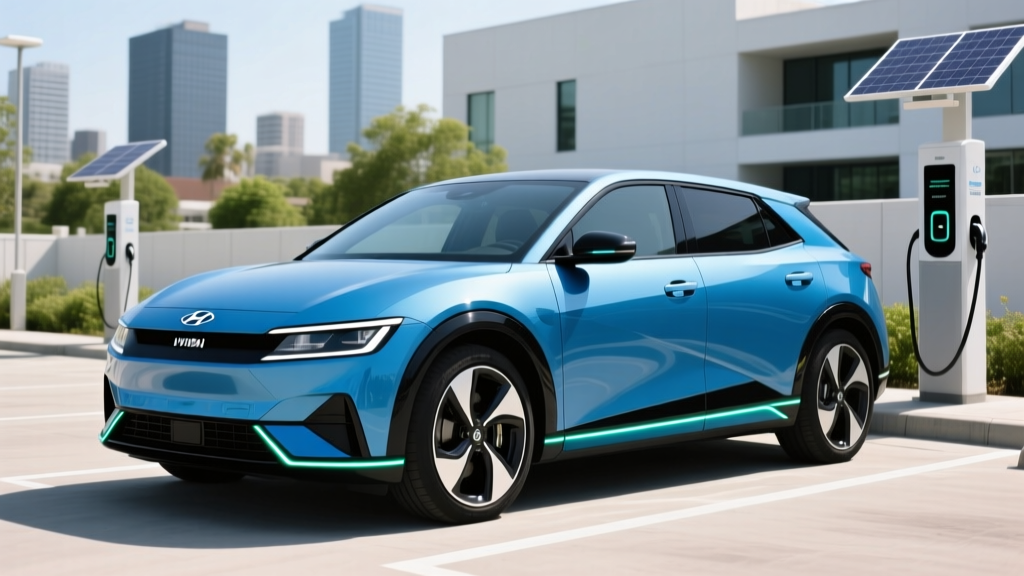
This is where the Ioniq 5 separates itself from nearly every rival under $60,000. The 800-volt E-GMP platform enables peak DC charging rates of 240 kW on a capable 350 kW station — translating to a 10–80% charge in approximately 18 minutes under ideal thermal conditions.
| Charging Level | Power | Time / Rate | Notes |
|---|---|---|---|
| Level 1 (120V outlet) | ~1.4 kW | ~3–4 mi/hr | Emergency/trickle only |
| Level 2 (240V, 48A) | 10.9 kW | ~34 mi/hr; full in ~7.5 hrs (LR) | Home/workplace standard |
| DC Fast (CCS/NACS*) | Up to 240 kW peak | 10–80% in ~18 min | Requires 350 kW station; tapers above 80% |
*Hyundai has adopted the NACS (Tesla-style) port for 2026 model-year vehicles sold in North America. CCS adapters are available for legacy stations.
Charging-curve reality: The 240 kW peak is sustained roughly from 10–55% State of Charge. Beyond that, the curve tapers — 55–80% averages closer to 150–170 kW. If you're road-tripping and only need 10–80%, plan for 18–20 minutes. Pushing past 80% adds significant time; most owners skip it unless the next charger is far away.
For home Level 2 charging, you'll need a 240V/60A circuit to deliver the full 10.9 kW (48A continuous). Installation costs typically range from $800–$2,500 depending on panel proximity, conduit length, and whether your electrical panel needs upgrading from 100A to 200A service. A quality Level 2 EVSE (ChargePoint Home Flex, Emporia Level 2, or Hyundai's own home charger) runs $400–$700.
Performance: 0–60, Horsepower & Drivetrain
The Ioniq 5 isn't a sports car, but it's no slouch. Here's the performance breakdown by configuration:
| Configuration | Horsepower | Torque (lb-ft) | 0–60 mph | Drivetrain |
|---|---|---|---|---|
| Standard Range RWD | 168 hp | 258 | 7.3 sec | Rear-wheel drive |
| Long Range RWD | 225 hp | 258 | 6.3 sec | Rear-wheel drive |
| Long Range AWD | 320 hp | 446 | 4.5 sec | Dual-motor AWD |
| N Line AWD | 320 hp | 446 | 4.5 sec | Dual-motor AWD (sport-tuned) |
The dual-motor AWD variants deliver genuinely quick acceleration that surprises passengers unfamiliar with EVs. The single-motor RWD models are perfectly adequate for commuting and highway merging — 6.3 seconds to 60 in the Long Range RWD is quicker than most gas-powered compact SUVs. Regenerative braking is adjustable via steering-wheel paddles, from coasting (Level 0) to near one-pedal driving (Level 3/i-PEDAL).
Towing capacity is rated at 1,650 lbs for AWD models — enough for a small utility trailer or a pair of dirt bikes, but not a camping trailer. RWD models are not rated for towing.
Interior, Cargo & Technology
The Ioniq 5's retro-futuristic interior remains one of its strongest selling points. The flat floor (thanks to the E-GMP skateboard) and sliding center console create a surprisingly airy cabin.
| Measurement | Value |
|---|---|
| Cargo (behind 2nd row) | 27.2 cu ft |
| Cargo (2nd row folded) | 59.3 cu ft |
| Front legroom | 41.7 in |
| Rear legroom | 39.4 in |
| Frunk (front trunk) | 0.85 cu ft (AWD) / 2.0 cu ft (RWD) |
Standout tech features:
- Dual 12.3-inch panoramic displays with wireless Apple CarPlay/Android Auto
- Hyundai Digital Key 2 (phone-as-key via NFC/UWB)
- Vehicle-to-Load (V2L) — power devices up to 3.6 kW from the vehicle (camping, job-site tools, emergency backup)
- Highway Driving Assist 2 (SAE Level 2) — adaptive cruise + lane centering with lane-change assist
- Remote Smart Parking Assist (on Limited/N Line trims)
- Heat pump standard on Long Range trims (improves cold-weather range)
- Preconditioning for battery — navigates to a fast charger and warms the pack for optimal charge speed
- No rear wiper (visibility issue in rain/snow — a longstanding complaint Hyundai has yet to fully address)
- Frunk is tiny, especially on AWD models (0.85 cu ft — barely fits a charging cable bag)
- Infotainment can feel layered with menus; physical climate controls would help
- Regen braking doesn't bring the car to a complete stop in Level 2 — you still need the brake pedal
- Insurance premiums run 15–25% higher than comparable gas crossovers (common for EVs, but worth budgeting)
Warranty & Long-Term Battery Outlook
Hyundai's warranty coverage is among the best in the industry:
| Coverage | Term |
|---|---|
| Basic (bumper-to-bumper) | 5 years / 60,000 miles |
| Powertrain | 10 years / 100,000 miles |
| EV Battery (capacity retention) | 10 years / 100,000 miles (≥70% SoH) |
| Corrosion perforation | 7 years / unlimited miles |
| Roadside assistance | 5 years / unlimited miles |
The battery warranty guarantees the high-voltage pack will retain at least 70% of its original capacity over 10 years or 100,000 miles. Based on fleet data from earlier Ioniq 5 model years and Hyundai-Kia's thermal management system (which actively cools and heats the pack), degradation has been modest — most owners report 3–6% loss over the first 50,000 miles. The LFP chemistry in the Standard Range model offers even longer cycle life and tolerates regular 100% charges, making it a strong pick for high-mileage commuters who charge daily at home.
Total Cost of Ownership: 5-Year Projection
Sticker price is only the beginning. Here's a realistic 5-year/60,000-mile cost comparison for a Long Range RWD Ioniq 5 versus a similarly equipped gas compact SUV (approximated):
| Category | Ioniq 5 LR RWD | Gas SUV (~28 MPG) |
|---|---|---|
| Purchase price (after credit) | ~$40,100 | ~$35,000 |
| Fuel / electricity (60k mi) | ~$3,600 (home L2, $0.13/kWh avg) | ~$7,500 ($3.50/gal avg) |
| Maintenance | ~$1,200 | ~$3,000 |
| Insurance (5 yr) | ~$9,500 | ~$7,500 |
| Estimated depreciation | ~$18,000 | ~$16,000 |
| 5-Year Total | ~$72,400 | ~$69,000 |
Assumes $7,500 federal credit applied. Without the credit, the Ioniq 5's 5-year cost rises to ~$79,900. State incentives (e.g., California CVRP, Colorado state credit) can narrow the gap further. Electricity and gas prices vary significantly by region — EIA.gov publishes state-level averages.
The Ioniq 5 breaks even with a gas SUV around year 4–5 if you claim the full federal credit and charge primarily at home. If you rely heavily on DC fast charging (at $0.35–$0.50/kWh), your fuel costs climb closer to the gas baseline.
Who Should Buy the Ioniq 5?
- Choose the Standard Range RWD if: You commute under 50 miles daily, charge at home every night, and want the lowest entry price (~$35,100 after credit). LFP chemistry handles daily 100% charges gracefully.
- Choose the Long Range RWD if: You take regular road trips (200+ miles), live in a region with sparse fast-charging infrastructure, or want maximum range without paying for AWD. This is the sweet-spot trim.
- Choose the Long Range AWD if: You deal with snow/ice regularly, need the 4.5-second 0–60 punch, or tow light loads. The ~30-mile range penalty is manageable with 290 EPA miles.
- Choose the N Line if: You want sport-tuned suspension and styling and are willing to trade some ride comfort for it.
- Look elsewhere if: You need three rows of seating (consider the Kia EV9), need 350+ miles of range (Tesla Model Y Long Range), or prioritize a massive frunk (Rivian R2 when available).
Pros & Cons at a Glance
- 800V architecture — 10–80% in ~18 min at 350 kW stations
- Spacious cabin with flat floor and generous rear legroom
- V2L capability (3.6 kW) for camping, tools, emergencies
- Strong warranty: 10yr/100k battery & powertrain
- All trims under $80K MSRP cap — federal credit eligible*
- Heat pump standard on Long Range
- Comfortable ride quality, low cabin noise
- Real-world highway range 15–20% below EPA sticker
- No rear wiper — visibility compromise
- Tiny frunk (especially AWD)
- Insurance costs above segment average
- Towing limited to 1,650 lbs (AWD only)
- Infotainment menu depth can frustrate
- Single-motor RWD acceleration merely adequate
Frequently Asked Questions
What is the real-world range of the 2026 Hyundai Ioniq 5?
The Long Range RWD is EPA-rated at 320 miles, but expect 280–305 miles in mixed driving, 250–270 on sustained highway trips, and 220–250 in freezing temperatures. The Standard Range (EPA 240 mi) realistically delivers 195–220 miles in moderate conditions.
How fast does the Ioniq 5 charge at home and on the road?
At home on a 240V Level 2 charger (10.9 kW), the Long Range gains about 34 miles per hour and fully charges in roughly 7.5 hours. On a 350 kW DC fast charger, it peaks at 240 kW and reaches 10–80% in approximately 18 minutes — one of the fastest in its class thanks to the 800-volt platform.
How much does the Ioniq 5 cost after the federal tax credit?
If you qualify for the full $7,500 §30D credit (meeting income, MSRP, and battery-sourcing requirements), the effective price ranges from approximately $35,100 (SE Standard Range) to $50,700 (Limited AWD). The credit can be transferred to the dealer at point of sale, reducing your upfront cost immediately.
Does the 2026 Ioniq 5 qualify for the $7,500 federal EV tax credit?
All Ioniq 5 trims fall under the $80,000 MSRP cap for SUVs. However, eligibility depends on your adjusted gross income (≤$150K single / ≤$300K joint), the battery's critical-mineral and component sourcing (thresholds tighten annually), and whether you've claimed a credit on this VIN before. Check IRS.gov's clean vehicle credit page for current rules or consult a tax professional.
Is the Ioniq 5 worth buying over the Tesla Model Y or Ford Mustang Mach-E?
It depends on your priorities. The Ioniq 5 charges faster than both (240 kW vs. ~250 kW for Model Y, ~150 kW for Mach-E), offers a more distinctive design, and has a superior warranty. The Model Y wins on Supercharger network access and cargo space. The Mach-E offers a sportier driving feel but slower charging. If fast road-trip charging and warranty coverage matter most, the Ioniq 5 is the strongest pick in this trio.
What's the biggest mistake Ioniq 5 buyers make?
Skipping the Level 2 home charger installation. Relying on a 120V Level 1 outlet adds only ~3–4 miles per hour — inadequate for the 77.4 kWh Long Range pack. Budget $800–$2,500 for a proper 240V/60A circuit installation; it transforms daily ownership and is essential for battery preconditioning before DC fast charging.