Walk up to any Tesla and the first thing you notice is the absence of a traditional grab handle. Tesla's door handle designs are as much a brand signature as they are an engineering choice — reducing drag, cutting mechanical complexity, and reinforcing the company's minimalist ethos. But if you've ever stood next to a Model 3 in a parking lot wondering how to actually get inside, you're not alone. The query how do Tesla door handles work is one of the most-searched ownership questions, and the answer varies significantly across the lineup.
This guide covers the mechanical and electronic operation of every current Tesla door handle system, then pairs that knowledge with the full spec profile — range, charging, pricing, and tax-credit eligibility — you need to evaluate each model as a purchase.
The Four Tesla Door Handle Systems Explained
Tesla uses three distinct exterior door handle architectures across its 2026 production vehicles, plus a unique rear-door mechanism on the Model X. Here is exactly how each one operates.
Model S: Auto-Presenting Flush Handles
The Model S pioneered Tesla's signature flush door handle. When the car detects an authenticated key fob or phone key approaching, the handle presents — a small motor extends the chrome accent outward, creating a grab point. Pull the handle and the door unlatches electronically. If the car doesn't detect a key, the handles remain fully flush with the body panel, contributing to the Model S's 0.208 drag coefficient — one of the lowest of any production sedan.
Manual override: If the 12V auxiliary battery is depleted, you can press the wider end of the handle firmly to create a small gap, then pull the hidden mechanical release cable behind it.
Model 3 & Model Y: Push-and-Pull Flush Handles
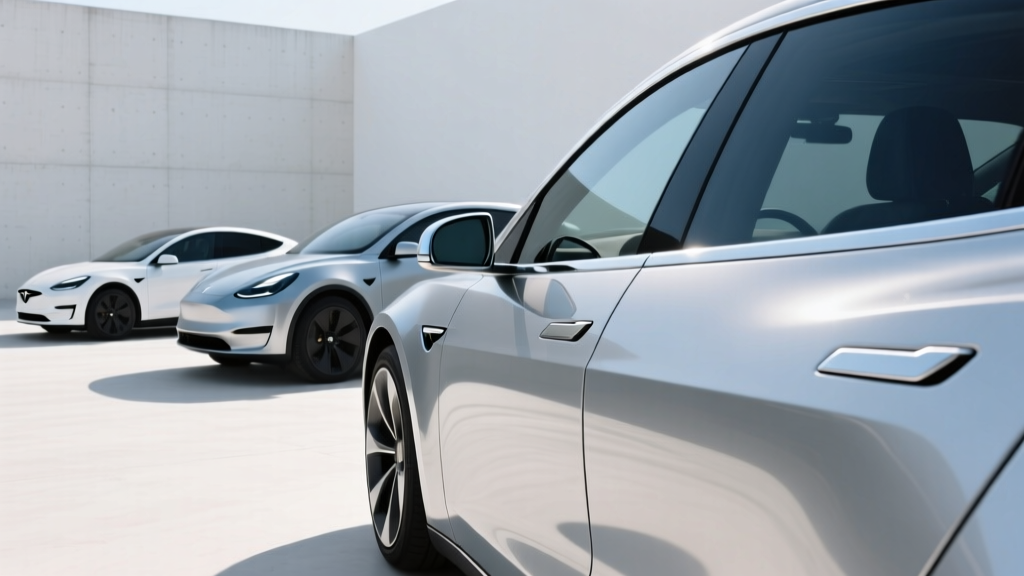
The Model 3 and Model Y use a simpler, more robust design. The exterior handle is a flush-mounted paddle. To open the door from outside, you push the wide end of the handle inward with your thumb, then pull the narrow end toward you with your fingers. It's a two-step motion that becomes instinctive after a day or two of ownership but reliably confuses first-time riders.
Interior handles: Inside, the front doors use a thumb-press electronic button atop the armrest (with a mechanical pull lever below for power-loss scenarios). The rear doors use a physical pull handle. On the refreshed Model 3 "Highland," Tesla added a small illuminated indicator strip to the exterior handle to improve visibility at night.
Model X: Front Auto-Presenting + Rear Falcon Wing
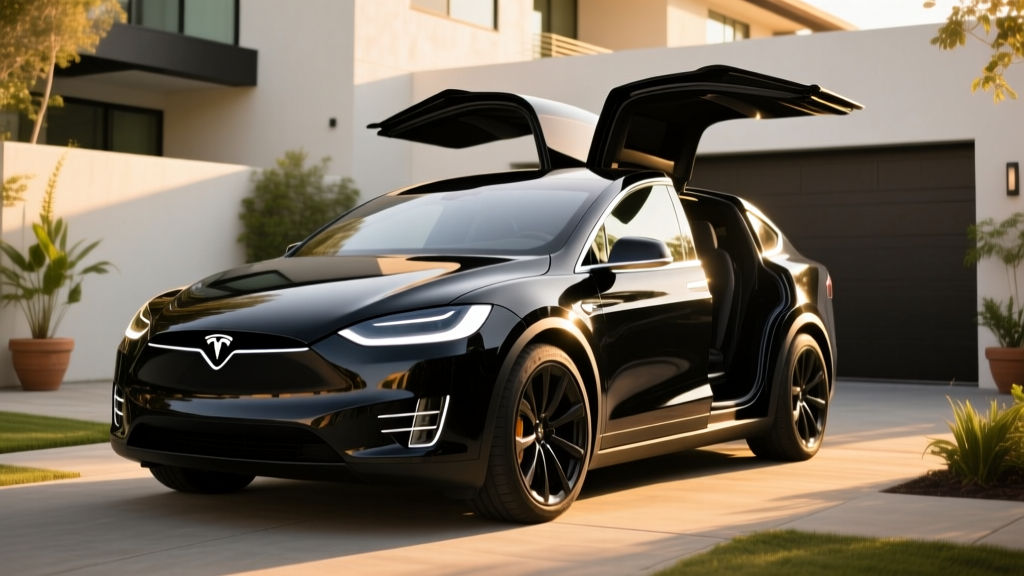
The Model X front doors operate identically to the Model S — auto-presenting flush handles with electronic latches. The rear Falcon Wing doors are where engineering gets ambitious. These double-hinged gullwing-style doors use ultrasonic sensors to detect overhead and side clearance, then articulate open in a two-stage motion. They require roughly 12 inches of lateral clearance (less than a conventional sliding minivan door) and can operate in tight parking spaces.
Real-world note: Falcon Wing doors are slower to open than conventional doors — expect 5-7 seconds for a full cycle. In heavy rain, the upper hinge can channel water onto the seat during the open cycle. Owners in snowy climates report occasional ice-related resistance on the secondary hinge, though Tesla's thermal preconditioning mitigates this when the car is plugged in.
- Model S: Wait for handle to present → pull handle toward you
- Model 3 / Model Y: Push wide end in → pull narrow end out
- Model X (front): Wait for handle to present → pull handle toward you
- Model X (rear): Press button on key/fob or use interior switch → doors articulate open automatically
2026 Tesla Lineup: Full Spec Comparison
Understanding the door mechanisms is step one. Step two is evaluating each vehicle on the metrics that matter for ownership. Below is a side-by-side comparison of the current 2026 Tesla lineup with verified EPA and manufacturer data.
| Spec | Model 3 RWD | Model 3 Long Range AWD | Model Y Long Range AWD | Model S Long Range | Model X Long Range |
|---|---|---|---|---|---|
| EPA Range | 363 mi | 346 mi | 320 mi | 402 mi | 335 mi |
| Battery (usable) | 60 kWh (LFP) | 79 kWh (NMC) | 79 kWh (NMC) | 100 kWh (NMC) | 100 kWh (NMC) |
| MPGe (combined) | 132 MPGe | 125 MPGe | 117 MPGe | 120 MPGe | 102 MPGe |
| kWh/100 mi | 25 | 27 | 29 | 28 | 33 |
| Max DC Fast Charge | 170 kW | 250 kW | 250 kW | 250 kW | 250 kW |
| 10-80% DCFC Time | ~25 min | ~18 min | ~20 min | ~22 min | ~24 min |
| Level 2 Home Rate | 7.6 kW (~30 mi/hr) | 11.5 kW (~44 mi/hr) | 11.5 kW (~44 mi/hr) | 11.5 kW (~44 mi/hr) | 11.5 kW (~44 mi/hr) |
| 0-60 mph | 5.8 sec | 4.2 sec | 4.8 sec | 3.1 sec | 3.8 sec |
| Horsepower | 271 hp | 440 hp | 384 hp | 670 hp | 670 hp |
| Drivetrain | RWD | Dual Motor AWD | Dual Motor AWD | Dual Motor AWD | Dual Motor AWD |
| Cargo (rear seats up) | 23 cu ft | 23 cu ft | 30 cu ft | 28 cu ft | 88 cu ft (seats folded) |
| Rear Legroom | 35.2 in | 35.2 in | 40.5 in | 35.4 in | 37.1 in |
| Base MSRP | $38,990 | $44,990 | $44,990 | $74,990 | $79,990 |
| Battery Warranty | 8 yr / 100,000 mi | 8 yr / 120,000 mi | 8 yr / 120,000 mi | 8 yr / 150,000 mi | 8 yr / 150,000 mi |
Sources: EPA fueleconomy.gov, Tesla.com spec sheets. Specs reflect 2026 model year. Pricing excludes destination fee.
Real-World Range vs. EPA Estimates
EPA range figures assume a mix of city and highway driving at moderate temperatures. Here's what to expect in real conditions:
- Model 3 Long Range (EPA 346 mi): Expect ~280-300 mi sustained highway at 75 mph; ~220-250 mi in sub-30°F winter conditions.
- Model Y Long Range (EPA 320 mi): Expect ~260-280 mi highway; ~200-230 mi in cold weather with cabin heat.
- Model S Long Range (EPA 402 mi): Expect ~330-350 mi highway; ~280-310 mi in cold weather. The larger 100 kWh pack provides a buffer that makes this the most road-trip-capable sedan in the lineup.
- Model 3 RWD (EPA 363 mi, LFP): The LFP battery tolerates 100% daily charging without accelerated degradation, so you can actually use all 363 miles regularly — a meaningful advantage over NMC packs where daily charging to 80% effectively yields ~290 mi.
Tesla's heat pump (standard on all 2026 models) significantly reduces cold-weather range loss compared to earlier resistive-heating systems. In our experience, preconditioning the cabin while plugged in recovers 15-25 miles of range in freezing weather — always worth doing before a winter commute.
Charging Speed: DC Fast Charge & Home Level 2
Charging speed is where trim selection matters enormously. The Model 3 RWD's LFP battery tops out at 170 kW on DC fast chargers, while all Long Range and Performance variants with NMC packs support up to 250 kW at V3/V4 Superchargers.
| Charging Level | Model 3 RWD (LFP) | Model 3/Y LR (NMC) | Model S/X (NMC) |
|---|---|---|---|
| Level 1 (120V, 12A) | ~1.4 kW / 4 mi/hr | ~1.4 kW / 3 mi/hr | ~1.4 kW / 3 mi/hr |
| Level 2 (240V, 48A) | 7.6 kW / 30 mi/hr | 11.5 kW / 44 mi/hr | 11.5 kW / 44 mi/hr |
| DC Fast Charge (peak) | 170 kW | 250 kW | 250 kW |
| 10-80% DCFC Time | ~25 min | ~18-20 min | ~22-24 min |
| Supercharger Network | Native NACS | Native NACS | Native NACS |
Charging curve reality: The 250 kW peak on NMC Teslas is sustained only between roughly 10-30% State of Charge. Above 50%, the curve tapers to ~100 kW, and above 80% it drops below 50 kW. This means a 10-80% session takes about 18-20 minutes, but 10-100% can take 40+ minutes. Plan road-trip stops around the 80% mark for optimal time efficiency.
All Teslas use the NACS (North American Charging Standard) connector natively. With Tesla opening the Supercharger network to other brands, V4 stalls now include a CCS adapter cable, but Tesla owners plug in directly — no adapter needed. For home Level 2 charging, Tesla's Wall Connector ($420) or the Universal Wall Connector with integrated NACS/CCS magic dock are the most reliable options. Budget $800-$2,000 for professional installation depending on panel proximity and local permitting.
Pricing, Trims & Federal Tax Credit Eligibility
| Model / Trim | Base MSRP | MSRP Cap Met? | Est. Credit | Effective Price* |
|---|---|---|---|---|
| Model 3 RWD | $38,990 | Yes (under $55K sedan cap) | Up to $7,500 | ~$31,490 |
| Model 3 Long Range AWD | $44,990 | Yes (under $55K sedan cap) | Up to $7,500 | ~$37,490 |
| Model 3 Performance | $52,990 | Yes (under $55K sedan cap) | Up to $7,500 | ~$45,490 |
| Model Y Long Range AWD | $44,990 | Yes (under $80K SUV cap) | Up to $7,500 | ~$37,490 |
| Model Y Performance | $48,990 | Yes (under $80K SUV cap) | Up to $7,500 | ~$41,490 |
| Model S Long Range | $74,990 | No (exceeds $55K sedan cap) | $0 | $74,990 |
| Model X Long Range | $79,990 | Yes (under $80K SUV cap) | Up to $7,500 | ~$72,490 |
*Effective price assumes full $7,500 §30D credit eligibility. Actual credit depends on battery sourcing, buyer income, and tax liability. Source: IRS §30D guidelines.
Critical eligibility rules for 2026:
- Income caps: Modified AGI must not exceed $300,000 (joint), $225,000 (head of household), or $150,000 (single).
- MSRP caps: $55,000 for sedans (Model 3); $80,000 for SUVs/trucks (Model Y, Model X).
- Battery sourcing: The full $7,500 requires meeting both critical-minerals (60% for 2026) and battery-component (100% for 2026) sourcing requirements. Tesla's Fremont and Austin-built vehicles have progressively increased domestic sourcing, but partial credit ($3,750) is possible if only one requirement is met. Always verify current sourcing status on the IRS eligible-vehicle list before purchase.
- Point-of-sale transfer: As of 2024, you can transfer the credit to the dealer at purchase, reducing your out-of-pocket cost immediately rather than waiting for tax filing.
Tech, Safety & Driver Assistance
Every 2026 Tesla ships with the same core software stack: a 15.4-inch center touchscreen (Model 3/Y) or 17-inch (Model S/X), over-the-air updates, native navigation with real-time Supercharger routing, and Tesla's Autopilot driver-assist suite.
Tesla Autopilot and Full Self-Driving (Supervised) are SAE Level 2 driver-assistance systems. They do not make the vehicle self-driving. The driver must maintain active supervision, keep hands on the wheel (or demonstrate attention via cabin camera), and be prepared to take over at any moment. Only Level 4 systems (e.g., Waymo robotaxis in designated service areas) operate without a human driver.
Notable tech features:
- Over-the-air updates that add features post-purchase (e.g., improved battery preconditioning, new UI elements)
- Sentry Mode dashcam recording with phone notifications
- Dog Mode and Camp Mode for climate control while parked
- Phone-as-key with passive entry (approach and the car unlocks — no fob button press needed)
- Model X: power-folding second-row seats with one-touch access to the third row
Notable drawbacks:
- No Apple CarPlay or Android Auto — Tesla's proprietary infotainment only
- Minimalist interior means nearly all controls (glove box, mirror adjustment, vent direction) live in the touchscreen
- Build quality variability remains a documented concern, though 2025-2026 Fremont and Austin output shows measurable improvement
- No physical instrument cluster — all driving info is on the center screen (Model 3/Y) or a small secondary display (Model S/X)
Who Should Buy Which Tesla?
- Choose Model 3 RWD if: You want the lowest entry price, primarily commute under 60 miles daily, have reliable home charging, and value being able to charge to 100% daily without battery degradation concerns (LFP advantage).
- Choose Model 3 Long Range if: You take regular road trips, live in a cold-weather state, or want dual-motor AWD for snow traction. The NMC pack charges faster at DCFC stations.
- Choose Model Y Long Range if: You need crossover cargo space (30 cu ft rear, 76 cu ft folded), frequently carry rear-seat passengers, or want the most tax-credit-eligible family EV in the lineup.
- Choose Model S if: You want the longest range in a luxury sedan (402 mi EPA), value the auto-presenting door handles and air suspension, and the $75K price point fits your budget regardless of tax-credit ineligibility.
- Choose Model X if: You need three-row seating (up to 7 passengers), want Falcon Wing doors for easy car-seat access, and can accommodate the premium price. Note: the MSRP sits just under the $80K SUV cap, so credit eligibility is possible but tight on options.
Pros and Cons Across the Tesla Lineup
- Class-leading Supercharger network access (20,000+ stalls in North America)
- Over-the-air updates continuously improve the vehicle
- Best-in-class efficiency (MPGe) in most segments
- LFP option on Model 3 allows daily 100% charging
- Strong resale value relative to most EV competitors
- Minimal maintenance (no oil, no transmission fluid, regenerative braking saves brake pads)
- No Apple CarPlay / Android Auto
- Touchscreen-dependent controls frustrate some drivers
- Insurance premiums 20-40% higher than comparable ICE vehicles
- Build quality, while improving, trails legacy luxury brands
- Model S/X exceed sedan MSRP cap — no federal tax credit for Model S
- FSD (Supervised) is a $8,000 add-on that remains Level 2 — not autonomous
Frequently Asked Questions
What is the real-world range of a Tesla?
Real-world range depends on trim, driving style, and climate. The Model 3 Long Range achieves roughly 280-300 miles at sustained highway speeds (70-75 mph) in mild weather, dropping to 220-250 miles in sub-freezing temperatures. The Model 3 RWD with LFP can deliver its full EPA 363 miles in daily use because Tesla recommends 100% charging for LFP chemistry — a practical advantage over NMC packs limited to 80% daily.
How fast does a Tesla charge at home and on the road?
At home on a 240V Level 2 charger, Long Range and Model S/X variants add roughly 44 miles of range per hour at 11.5 kW. The Model 3 RWD adds about 30 mi/hr at 7.6 kW. On DC fast chargers, NMC Teslas peak at 250 kW and complete a 10-80% charge in 18-24 minutes. The LFP Model 3 RWD peaks at 170 kW, taking about 25 minutes for the same session.
How much does a Tesla cost after tax credits?
The Model 3 RWD starts at $38,990 and can drop to approximately $31,490 with the full $7,500 federal §30D credit (subject to income caps, battery sourcing, and MSRP limits). The Model Y Long Range at $44,990 can reach ~$37,490 after credit. The Model S at $74,990 does not qualify because it exceeds the $55,000 sedan MSRP cap. Always verify current eligibility on the IRS clean vehicle credit page.
Do Tesla door handles work in freezing weather?
Yes, but with caveats. Ice can freeze flush handles to the body panel. Tesla recommends using the Tesla app to precondition the cabin (which warms the door areas) before entry. On the Model S/X, the auto-presenting motor is strong enough to break light ice. For Model 3/Y, a firm push on the wide end of the handle usually breaks the seal. Keeping the car plugged in and preconditioning eliminates most winter handle issues.
Is a Tesla worth buying vs. competitors like the Hyundai Ioniq 6 or Ford Mustang Mach-E?
Tesla's advantages remain the Supercharger network, software ecosystem, and efficiency. The Ioniq 6 offers comparable range (361 mi EPA) with 800V ultra-fast charging (10-80% in ~18 min at 350 kW) and CarPlay support. The Mach-E offers a more traditional interior with physical controls. If Supercharger access and software matter most, Tesla wins. If you prioritize interior quality, CarPlay, or 800V charging architecture, competitors deserve a serious look.
Does the Tesla Model Y qualify for the federal EV tax credit?
Yes — the Model Y qualifies under the $80,000 SUV MSRP cap. Eligibility for the full $7,500 depends on battery-component and critical-minerals sourcing (both requirements must be met for 2026), plus buyer income limits ($300K joint / $150K single). The credit can be transferred at point of sale to reduce your purchase price directly.