Tesla remains the most visible name in electric vehicles, but visibility doesn't always equal dependability. If you're searching for an honest answer to how reliable are Tesla vehicles in 2026, the response requires separating powertrain durability from build-quality quirks, software gremlins from structural longevity, and warranty coverage from real-world repair frequency. This profile examines the current Tesla lineup — Model 3, Model Y, Model S, and Model X — through the lens of reliability data, battery health, charging infrastructure, total cost of ownership, and the ownership realities that spec sheets don't capture.
Reliability by the Numbers: What the Data Shows
Tesla's reliability reputation is bifurcated. The electric powertrain — motors, inverter, and battery pack — consistently ranks among the most durable in the industry, with fewer moving parts than any internal-combustion alternative. However, build quality, interior trim, and software stability have historically dragged Tesla's overall scores down in consumer surveys.
According to Consumer Reports' 2025 Annual Auto Reliability Survey, Tesla's predicted reliability rating improved to an average score of 45 out of 100 across the lineup — up from the mid-30s in prior years — driven primarily by the refreshed Model 3 (Highland) and the Juniper-refresh Model Y reaching full production maturity. The Model S and Model X continue to score lower due to complex air suspension systems, power-folding mirrors, and panel-gap inconsistencies that persist even in 2026 production runs.
J.D. Power's 2025 U.S. Vehicle Dependability Study placed Tesla at 196 problems per 100 vehicles (PP100), roughly average for the industry but trailing brands like Lexus (133 PP100) and Porsche (162 PP100). The majority of Tesla complaints cluster around body hardware, paint quality, and wind noise — not drivetrain failure.
2026 Tesla Lineup: Core Specifications at a Glance
| Spec | Model 3 RWD | Model 3 Long Range AWD | Model Y Long Range AWD | Model S LR | Model X LR |
|---|---|---|---|---|---|
| EPA Range | 272 mi | 363 mi | 320 mi | 402 mi | 335 mi |
| Battery (usable) | ~57.5 kWh (LFP) | ~75 kWh (NMC) | ~75 kWh (NMC) | ~95 kWh (NMC) | ~95 kWh (NMC) |
| Peak DC Charge | 170 kW | 250 kW | 250 kW | 250 kW | 250 kW |
| 10–80% DCFC Time | ~30 min | ~25 min | ~25 min | ~27 min | ~30 min |
| Level 2 Home Rate | 11.5 kW (~44 mi/hr) | 11.5 kW (~44 mi/hr) | 11.5 kW (~44 mi/hr) | 11.5 kW (~44 mi/hr) | 11.5 kW (~44 mi/hr) |
| 0–60 mph | 5.8 sec | 4.2 sec | 4.8 sec | 3.1 sec | 3.8 sec |
| Horsepower | 271 hp | 346 hp | 384 hp | 670 hp | 670 hp |
| Drivetrain | RWD | Dual-Motor AWD | Dual-Motor AWD | Dual-Motor AWD | Dual-Motor AWD |
| Efficiency (MPGe) | 132 MPGe | 131 MPGe | 122 MPGe | 124 MPGe | 111 MPGe |
| kWh/100 mi | 25 | 26 | 28 | 27 | 30 |
| Cargo Volume | 23 cu ft (rear) | 23 cu ft (rear) | 30 cu ft (rear) / 72 cu ft (folded) | 28 cu ft (rear) | 88 cu ft (behind 2nd row) |
| Base MSRP | $38,990 | $44,990 | $47,990 | $79,990 | $84,990 |
Source: fueleconomy.gov and Tesla's 2026 official specification pages. Pricing reflects MSRP before destination fees and incentives.
Battery Longevity: The Reliability Factor That Matters Most
When EV buyers ask about reliability, the question underneath is almost always: how long will the battery last, and what will it cost to replace? Tesla's battery track record is among the strongest in the industry — but the answer depends on chemistry.
LFP vs. NMC: Two Battery Philosophies
| Attribute | LFP (Lithium Iron Phosphate) | NMC (Nickel Manganese Cobalt) |
|---|---|---|
| Used In | Model 3 RWD | Model 3 LR, Model Y, Model S, Model X |
| Energy Density | Lower (heavier pack for same range) | Higher (lighter, more range per kWh) |
| Cycle Life | 3,000–5,000+ cycles | 1,500–2,500 cycles |
| 100% SoC Charging | Recommended weekly for calibration | Limit to 80% daily; 100% for trips only |
| Cold-Weather Performance | Moderate range loss (~25–35%) | Better cold tolerance (~15–25% loss) |
| Degradation at 100k mi | ~5–8% capacity loss | ~8–12% capacity loss |
| Replacement Cost (est.) | $8,000–$12,000 | $12,000–$18,000 |
Tesla's 2025 Impact Report disclosed that Model 3 and Model Y battery packs retain approximately 85% of their original capacity at 200,000 miles — well within the 8-year/100,000-mile warranty threshold (RWD) or 8-year/120,000-mile threshold (Long Range and Performance). The warranty guarantees a minimum of 70% capacity retention during the coverage period.
Charging Infrastructure: Tesla's Reliability Advantage
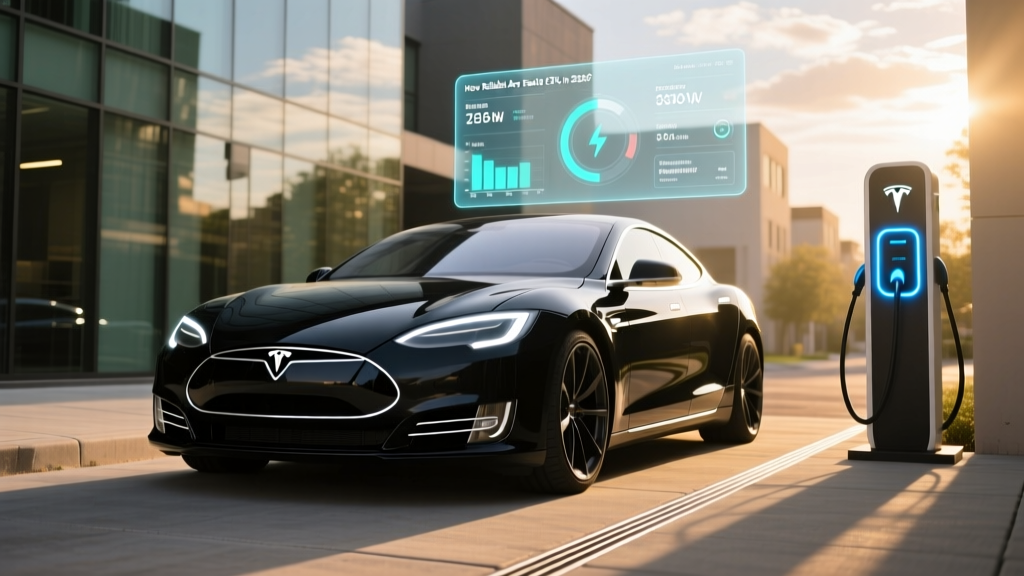
Perhaps the single strongest reliability argument for Tesla in 2026 is the Supercharger network. While competing networks (Electrify America, EVgo) have improved uptime, Tesla's Supercharger network consistently reports 99.5%+ station availability across its 6,500+ U.S. stations. Plug-and-charge functionality — no app activation, no RFID card — eliminates the most common failure point in public charging.
| Charging Level | Power (kW) | Speed (miles of range per hour) | Typical Use Case |
|---|---|---|---|
| Level 1 (120V outlet) | 1.4 kW | ~3–5 mi/hr | Overnight trickle; emergency backup |
| Level 2 (240V home) | 11.5 kW | ~44 mi/hr | Daily home charging; full overnight refill |
| DC Fast (V2 Supercharger) | 150 kW | ~300 mi/hr (peak) | Road-trip stops; 10–80% in ~35 min |
| DC Fast (V3 Supercharger) | 250 kW | ~500 mi/hr (peak) | Fastest Tesla option; 10–80% in ~25 min |
| DC Fast (V4 Supercharger) | 250+ kW | ~500+ mi/hr (peak) | Next-gen stations rolling out 2025–2026 |
Charging curve reality: Peak kW is not sustained kW. A Model 3 Long Range hitting a V3 Supercharger at 10% SoC will peak near 250 kW for the first 5–8 minutes, then taper progressively. By 60% SoC, the rate drops to roughly 100 kW; above 80%, it falls to 40–50 kW. This is why the 10–80% metric is the most honest measure of charging speed — and why Tesla's ~25-minute 10–80% time for Long Range models is competitive with the best in the segment.
For home charging, a NACS (North American Charging Standard) connector is native to all 2026 Teslas. With NACS now adopted by Ford, GM, Rivian, Hyundai, and most major automakers, Tesla owners benefit from a connector that has become the de facto U.S. standard — future-proofing resale value and parts availability.
Pricing, Tax Credits, and True Cost of Ownership
Tesla's pricing has stabilized after years of volatile cuts and increases. Here's the 2026 landscape, including the federal §30D tax credit — but with critical caveats.
| Model / Trim | Base MSRP | §30D Credit (if eligible) | Effective Price | MSRP Cap? | Income Cap? |
|---|---|---|---|---|---|
| Model 3 RWD | $38,990 | Up to $7,500 | ~$31,490 | Under $55k ✓ | $150k single / $300k joint |
| Model 3 LR AWD | $44,990 | Up to $7,500 | ~$37,490 | Under $55k ✓ | $150k single / $300k joint |
| Model Y LR AWD | $47,990 | Up to $7,500 | ~$40,490 | Under $80k (SUV) ✓ | $150k single / $300k joint |
| Model S LR | $79,990 | $0 | $79,990 | Over $55k sedan cap ✗ | N/A |
| Model X LR | $84,990 | Possible partial | Varies | Under $80k (SUV) — borderline | $150k single / $300k joint |
5-Year Total Cost of Ownership: Model 3 vs. Competitors
Tesla's TCO advantage comes from three factors: minimal scheduled maintenance (no oil changes, no spark plugs, minimal brake wear due to regenerative braking), low electricity cost per mile, and strong resale value. However, insurance premiums for Teslas run 15–30% higher than segment averages due to repair costs for aluminum body panels and sensor recalibration after collisions.
For a Model 3 Long Range driven 12,000 miles/year with home charging at $0.14/kWh:
- Annual electricity cost: ~$525 (at 26 kWh/100 mi)
- Annual maintenance: ~$150–$300 (cabin air filter, wiper fluid, tire rotation)
- Annual insurance: ~$2,200–$2,800 (varies significantly by state and driver profile)
- 5-year estimated TCO: ~$52,000–$58,000 (including purchase, energy, insurance, maintenance, depreciation)
Compare this to a similarly equipped BMW i4 eDrive40 (~$58,000–$64,000 5-year TCO) or Hyundai Ioniq 6 (~$48,000–$54,000 TCO). Tesla's advantage narrows when insurance costs are factored in, but the Supercharger network reliability and NACS standardization keep its road-trip usability ahead.
Tech, Driver Assistance, and Software Reliability
Tesla's software-first architecture means your car improves (or sometimes regresses) via over-the-air updates. The 2026 infotainment system runs on a Ryzen-based processor with responsive 15.4-inch touchscreen navigation, streaming media, and vehicle controls. The interface remains the most integrated in the industry — but also the most monopolistic: climate, glovebox, mirrors, and drive mode all route through the screen, with no physical redundancy.
Software reliability has improved but remains a mixed bag. OTA updates occasionally introduce new bugs — owners report intermittent issues with phantom braking on Autopilot, touchscreen latency after major updates, and Bluetooth connectivity drops. These are typically patched within weeks but can be frustrating. Tesla does not have a traditional dealership service network; repairs are handled through mobile service rangers or the limited number of service centers, which can mean 1–3 week waits for non-critical repairs in metro areas.
Build Quality and Physical Reliability Concerns
This is where Tesla's reliability story gets complicated. The Highland-refresh Model 3 (introduced for the 2024 model year and carried into 2026) addressed many prior complaints: panel gaps tightened significantly, acoustic glass reduced cabin noise, ventilated seats were added, and the turn-signal stalk was restored after the controversial yoke-only experiment. The Model Y Juniper refresh (2025–2026) brought similar improvements.
However, recurring build-quality concerns persist across the lineup:
- Panel gaps: Improved but still occasionally inconsistent, particularly on Model S/X
- Paint quality: Tesla's Fremont paint shop has improved, but thin paint and orange-peel texture remain more common than on legacy luxury brands
- Suspension: Model S/X air suspension is a known failure point outside warranty (replacement: $2,000–$3,500 per corner)
- Interior materials: Vegan leather is durable but the minimalist interior means fewer soft-touch surfaces and more hard plastics than competitors at similar price points
Warranty Coverage: What's Protected and What Isn't
| Coverage | Term | Details |
|---|---|---|
| Basic Vehicle | 4 years / 50,000 miles | Bumper-to-bumper (excluding wear items) |
| Battery & Drive Unit (RWD) | 8 years / 100,000 miles | 70% minimum capacity retention |
| Battery & Drive Unit (LR/Perf) | 8 years / 120,000 miles | 70% minimum capacity retention |
| Battery & Drive Unit (Model S/X) | 8 years / 150,000 miles | 70% minimum capacity retention |
Tesla's battery warranty is competitive with Hyundai's 10-year/100,000-mile coverage but trails Kia's 10-year/100,000-mile term. The critical detail: Tesla's warranty covers capacity degradation below 70%, not any measurable loss. Most owners will never hit that threshold under normal use — Tesla's own fleet data shows median degradation of approximately 8% at 150,000 miles for NMC packs and 5% for LFP packs.
Who Should Buy a Tesla in 2026?
- You road-trip regularly and want the most reliable, widespread DC fast-charging network
- You value OTA software updates that add features post-purchase
- You want NACS-native charging without adapters
- Minimizing scheduled maintenance is a priority
- You live in an area with a Tesla service center or mobile ranger coverage
- You want traditional dealership service with walk-in availability
- Physical buttons and redundant controls matter to you
- You need a luxury interior comparable to BMW, Mercedes, or Genesis at the Model S/X price point
- You want the longest possible battery warranty (Hyundai/Kia offer 10 years)
- You're uncomfortable with camera-only driver assistance (no lidar or radar backup)
Pros and Cons: The Honest Summary
- Industry-leading Supercharger network reliability (99.5%+ uptime)
- Excellent battery longevity — 85%+ retention at 200k miles
- Class-leading efficiency (kWh/100 mi) across the lineup
- NACS connector now the U.S. standard — future-proof
- OTA updates continuously add features
- Strong resale value relative to most EV competitors
- Low cost per mile for energy (home charging)
- Build quality still inconsistent vs. legacy luxury brands
- Insurance premiums 15–30% above segment average
- Service center wait times can stretch to weeks
- No physical buttons — all controls via touchscreen
- FSD (Supervised) expensive and still Level 2 only
- Model S/X air suspension costly out of warranty
- Phantom braking reports persist on Autopilot
Frequently Asked Questions
How reliable are Tesla batteries long-term?
Tesla's fleet data shows median battery degradation of approximately 8% at 150,000 miles for NMC packs and 5% for LFP packs. Complete battery failure is rare. The 8-year/100,000–150,000-mile warranty (depending on trim) covers capacity loss below 70%. Most owners will never need a battery replacement during the warranty period, and packs routinely exceed 200,000 miles with manageable degradation.
Do Teslas break down often compared to gas cars?
The electric powertrain (motors, inverter, battery) has far fewer failure points than a gas engine and transmission. Tesla owners report dramatically fewer "breakdowns" in the traditional sense. However, ancillary issues — 12V battery failures, touchscreen malfunctions, door handle mechanisms, and suspension components on Model S/X — occur at rates comparable to or slightly above industry average. You'll spend less time in a service bay but may deal with more software-related annoyances.
Is Tesla's service network reliable enough?
This is Tesla's weakest reliability link. Service centers are concentrated in major metro areas, and wait times for appointments can reach 2–4 weeks in high-demand markets. Mobile service rangers handle many repairs at your home or office, but body damage and high-voltage work require a service center. If you live in a rural area far from a Tesla service point, this is a legitimate concern that competitors with traditional dealership networks don't share.
Does the Tesla Model Y qualify for the $7,500 federal tax credit in 2026?
Eligibility for the §30D federal tax credit depends on three factors: (1) your income must be under $150,000 (single) or $300,000 (joint MAGI), (2) the Model Y's MSRP must be under the $80,000 SUV cap — which it is at $47,990 base — and (3) the battery must meet critical-mineral and component-sourcing requirements that tighten each year. As of early 2026, certain Model Y configurations qualify for the full $7,500, while others may qualify for a partial credit of $3,750 depending on battery sourcing. Verify your specific VIN's eligibility at fueleconomy.gov and consult a tax professional before purchase.
How does Tesla reliability compare to Hyundai, BMW, or Rivian?
For powertrain and battery reliability, Tesla matches or exceeds Hyundai Ioniq, BMW i4/iX, and Rivian. Where Hyundai and BMW pull ahead is in build quality consistency, physical control redundancy, and dealership service accessibility. Rivian matches Tesla's adventure-oriented capability but has a shorter reliability track record. For pure drivetrain confidence, Tesla remains a benchmark. For overall ownership polish, legacy luxury brands have closed the gap or surpassed it.
What is the real-world range of the most popular Tesla models?
For the Model 3 Long Range AWD (EPA 363 mi), expect approximately 310–325 miles on the highway in mild weather, 280–300 miles in mixed driving, and 250–280 miles in sub-freezing temperatures. The Model Y Long Range AWD (EPA 320 mi) delivers roughly 270–290 real-world highway miles in mild conditions. The LFP Model 3 RWD (EPA 272 mi) yields approximately 220–240 real-world highway miles, with cold-weather drops to 190–210 miles.
Sources: fueleconomy.gov (EPA range and efficiency data), irs.gov (§30D tax credit rules), Tesla 2025 Impact Report, Consumer Reports 2025 Auto Reliability Survey, J.D. Power 2025 Vehicle Dependability Study.