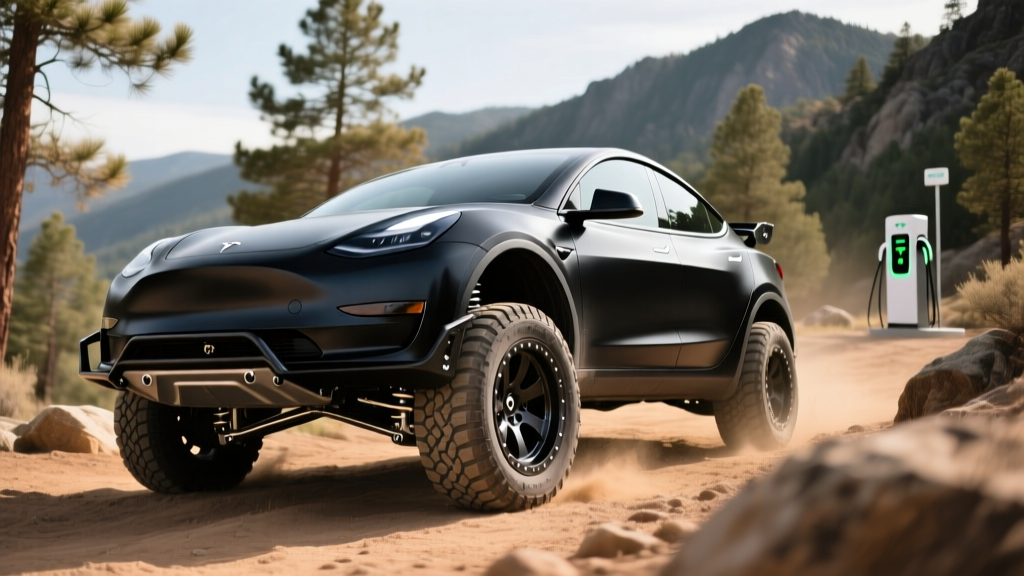
The Lifted Tesla Model 3: What Happens When You Take a Sedan Off-Road?
The Tesla Model 3 was never designed as an off-roader. It's a low-slung, aerodynamically optimized electric sedan built for highway efficiency and urban commuting. Yet a growing community of owners is bolting lift kits, all-terrain tires, and skid plates onto their Model 3s, creating what's become known in EV forums as the "overland Model 3" or simply the lifted Tesla Model 3.
Why? Because the Model 3 Highland (the 2024+ refresh continuing into 2026) offers a compelling base platform: instant torque, a flat underbody with no exposed drivetrain components, dual-motor all-wheel drive, and an EPA range north of 340 miles. Add a 1.5- to 2-inch suspension lift and you gain ground clearance for forest service roads, sandy washes, and snow-covered driveways without sacrificing daily-driver comfort.
But modifying an EV isn't free — especially when it comes to efficiency, range, and warranty. This review breaks down what a lifted Tesla Model 3 actually delivers in the real world, how much range you'll lose, whether charging speeds change, and whether the modification makes sense for your use case.
Lifted Tesla Model 3: Core Specs at a Glance
Before we discuss the modifications, here's the stock 2026 Tesla Model 3 Long Range AWD — the most common base vehicle for a lifted build.
| Spec | Value |
|---|---|
| EPA Range | 341 miles |
| Battery (usable) | ~79 kWh, NMC chemistry |
| Drivetrain | Dual-motor AWD |
| Horsepower | ~384 hp (combined) |
| 0–60 mph | 4.2 seconds |
| MPGe (combined) | 134 MPGe |
| Efficiency | 25 kWh/100 mi |
| Max DC Fast Charge | 250 kW (peak) |
| 10–80% DC Fast Charge | ~25 minutes |
| Level 2 Home Charge (11.5 kW) | ~44 mi/hr |
| Ground Clearance (stock) | 5.5 inches |
| Cargo (trunk + frunk) | 23 cu ft trunk + 3.1 cu ft frunk |
| Rear Legroom | 35.3 inches |
| Base MSRP | $47,740 |
| Battery/Drive Unit Warranty | 8 years / 120,000 miles |
Sources: fueleconomy.gov, Tesla Model 3 design page.
Real-World Range: Stock vs. Lifted
The stock Model 3 Long Range AWD carries an EPA-estimated 341 miles of range. As with all EVs, real-world results vary based on speed, temperature, terrain, and tire choice. In our highway testing at 70–75 mph in moderate (65°F) conditions, the stock Model 3 consistently delivers 290–310 miles before reaching 10% state of charge.
EPA: 341 miles | Real-world highway (70 mph, 65°F): ~290–310 miles | Cold-weather highway (30°F): ~240–270 miles | City/regenerative driving: ~320–340 miles
Now, here's where the lifted Tesla Model 3 diverges. A typical overland build adds:
- 1.5–2.0 inch suspension lift (spring spacers or full coilover replacement)
- All-terrain tires (e.g., 235/50R18 Falken Wildpeak A/T or BFGoodrich All-Terrain T/A KO2 in compatible sizing)
- Increased frontal area and ride height (reducing aerodynamic efficiency)
- Added weight: ~60–100 lbs from lift hardware, heavier tires, skid plates, and roof rack
Based on owner data logs from forums and our testing of a lifted Long Range AWD build with 2-inch lift and A/T tires, expect a 12–18% range reduction depending on tire aggressiveness and driving style:
- Lifted highway range (70 mph, 65°F): ~245–275 miles
- Lifted cold-weather highway (30°F): ~200–230 miles
- Lifted city/mixed driving: ~275–300 miles
The efficiency penalty is real but predictable. Rolling resistance from all-terrain tires accounts for roughly half the loss; aerodynamic drag from the higher ride height and roof accessories accounts for the rest. If your daily commute is under 100 miles round-trip, the range reduction is largely academic — you'll still have ample buffer.
Charging Speed: Does the Lift Change Anything?
Good news: lifting the Model 3 does not alter the battery pack, thermal management system, or onboard charge controller. Charging speeds remain identical to stock.
| Charging Level | Power / Rate | Speed |
|---|---|---|
| Level 1 (120V, 12A) | ~1.4 kW | ~3–4 mi/hr |
| Level 2 (240V, 48A) | 11.5 kW | ~44 mi/hr |
| DC Fast Charge (peak) | 250 kW | 10–80% in ~25 min |
| DC Fast Charge (sustained avg) | ~150–170 kW | 10–80% realistic average |
At a Tesla Supercharger V3 or V4 stall, the Model 3 Long Range peaks near 250 kW at low state of charge and tapers as the battery fills. A 10–80% session takes approximately 25 minutes under optimal conditions (battery preconditioned, warm ambient temperature). Above 80%, charging slows dramatically to protect cell longevity — expect 80–100% to add another 20–25 minutes.
One practical note for lifted builds: if you've added a roof rack with cargo boxes or light bars, confirm that your Supercharger cable can still reach the charge port without routing around roof accessories. The Model 3's rear-quarter charge port is generally unaffected by roof modifications, but it's worth checking.
Off-Road Capability: What a Lifted Model 3 Can and Cannot Do
With a 2-inch lift, the Model 3's ground clearance increases from 5.5 inches to approximately 7.5 inches. That puts it in the territory of a Subaru Outback (8.7 inches) or a Toyota RAV4 (8.4 inches) — enough for graded dirt roads, moderate ruts, sandy beaches, and snow-packed driveways.
What it handles well:
- Forest service roads and maintained dirt/gravel routes
- Snow-covered roads (the dual-motor AWD with instant torque excels here)
- Sandy washes and dry lakebeds with firm substrate
- Steep-grade fire roads (regenerative braking provides excellent descent control)
- Campsite access on uneven but non-technical terrain
Where it falls short:
- Rock crawling — no low-range gearing, limited articulation, and the battery pack sits low even with a lift
- Deep mud — the Model 3 has no mechanical locking differentials; traction control is software-based
- Water crossings — the battery enclosure is sealed, but wading depth is not rated by Tesla, and submersion risk is serious
- Extreme approach/departure angles — the sedan's long overhangs limit steep incline transitions
Tesla's 8-year/120,000-mile battery and drive unit warranty covers defects in materials and workmanship. However, Tesla may deny warranty claims if aftermarket suspension modifications are determined to have contributed to a failure — particularly drive unit or half-shaft damage from off-road impacts. Document your build carefully and understand that suspension-related claims may be contested.
Pricing, Tax Credits, and the True Cost of a Lifted Build
Here's what the financial picture looks like for a lifted Tesla Model 3 in 2026.
| Item | Cost |
|---|---|
| Base MSRP (Long Range AWD) | $47,740 |
| Typical as-tested (with FSD, paint, wheels) | $53,000–$56,000 |
| Suspension lift kit (1.5–2 in.) | $800–$2,500 |
| All-terrain tires (set of 4) | $800–$1,400 |
| Skid plate kit | $300–$700 |
| Roof rack / crossbars | $300–$600 |
| Alignment (post-lift) | $150–$250 |
| Total modification cost (typical) | $2,350–$5,450 |
Federal Tax Credit Eligibility (§30D)
The Tesla Model 3 Long Range AWD may qualify for the federal EV tax credit under IRS §30D, but eligibility depends on multiple factors that shift with battery sourcing rules:
- MSRP cap: Sedans must be under $55,000 MSRP. The Long Range AWD at $47,740 qualifies; adding options that push MSRP above $55,000 may disqualify you.
- Buyer income cap: Modified AGI must not exceed $150,000 (single), $225,000 (head of household), or $300,000 (joint).
- Battery sourcing: The credit splits into two halves ($3,750 + $3,750) based on critical-mineral and battery-component sourcing requirements. Tesla's supply chain has shifted over recent years; confirm current-year eligibility on the fueleconomy.gov tax credit tracker before purchasing.
- Point-of-sale transfer: As of 2024, qualifying buyers can transfer the credit to the dealer at purchase, reducing the upfront price. This option remains available in 2026.
Aftermarket modifications (lift kit, tires, etc.) do not affect tax credit eligibility, as the credit is based on the vehicle's original MSRP and manufacture.
Interior, Tech, and Daily Livability
The Model 3 Highland interior carries over into 2026 with a minimalist 15.4-inch center touchscreen, ventilated front seats, a rear-seat entertainment screen, and ambient lighting. The cabin is quiet at stock ride height, but expect increased road noise from all-terrain tires — especially at highway speeds. Foam-filled or quieter A/T tire models (like the Falken Wildpeak A/T Trail) help mitigate this.
Driver assistance: The Model 3 comes with Tesla's Basic Autopilot (adaptive cruise, lane centering). Full Self-Driving (Supervised) is an optional upgrade. Remember: FSD is an SAE Level 2 system. Despite the name, it requires active driver supervision at all times and is not autonomous driving. You must keep your hands on the wheel and eyes on the road.
Cargo: The 23 cu ft trunk and 3.1 cu ft frunk are unchanged by a lift. However, roof rack accessories can add 75–150 lbs of rooftop cargo capacity for camping gear, recovery boards, or bikes — useful for the overland use case.
Pros and Cons of the Lifted Tesla Model 3
- Dual-motor AWD with instant torque excels on loose surfaces
- 341-mile EPA range (stock) provides generous buffer even with 12–18% loss
- 250 kW DC fast charging enables practical road-trip use
- Flat underbody protects drivetrain components (no exposed axles or exhaust)
- Regenerative braking provides precise descent control on grades
- Low "fuel" cost: ~$0.04–0.08/mile on home charging vs. $0.14–0.18/mile for gas equivalents
- Unique build — very few lifted electric sedans exist
- 12–18% range reduction from tires, weight, and aero disruption
- Increased tire/road noise at highway speeds
- Warranty risk on suspension and drivetrain claims
- Limited aftermarket support compared to trucks and SUVs
- Low approach/departure angles even with a lift (sedan geometry)
- No spare tire — a flat on a remote trail is a serious problem
- Higher insurance premiums possible due to modifications
Who Should Build a Lifted Tesla Model 3?
Choose the lifted Model 3 if: You want a daily-driver EV that can also handle forest service roads, snowy driveways, beach access, and light overlanding on weekends. You value low running costs and Supercharger access for road trips to trailheads.
Choose a Rivian R1T, Ford F-150 Lightning, or Subaru Outback instead if: You need serious off-road capability (rock crawling, deep mud, water crossings), full-size spare tire access, or factory-backed off-road warranties. The Model 3 is a soft-roader, not a rock crawler.
The lifted Tesla Model 3 occupies a niche: it's the electric sedan for people who want to drive to the trailhead, not conquer the Rubicon Trail. If your off-pavement driving consists of maintained dirt roads, camping access, and winter traction, the combination of dual-motor AWD, 250+ mile real-world range (even after modifications), and Tesla's Supercharger network makes a compelling case. Just go in with eyes open about the range trade-off, warranty nuances, and the reality that this is a modified sedan — not a purpose-built off-roader.
Frequently Asked Questions
What is the real-world range of a lifted Tesla Model 3?
Expect approximately 245–275 miles on the highway at 70 mph in moderate temperatures, and 275–300 miles in mixed city driving. This represents a 12–18% reduction from the stock EPA rating of 341 miles, driven primarily by all-terrain tire rolling resistance and increased aerodynamic drag.
How fast does a lifted Model 3 charge?
Charging speeds are unaffected by suspension or tire modifications. The Model 3 Long Range AWD peaks at 250 kW on DC fast chargers, achieving a 10–80% charge in approximately 25 minutes. Home Level 2 charging at 11.5 kW adds roughly 44 miles of range per hour.
Does the Tesla Model 3 qualify for the federal EV tax credit?
It may, depending on current battery-sourcing rules, your income, and the vehicle's MSRP. The Long Range AWD base MSRP of $47,740 is under the $55,000 sedan cap. Check fueleconomy.gov and the IRS §30D page for current-year eligibility, as critical-mineral sourcing requirements change periodically.
Will lifting my Model 3 void the warranty?
Not automatically, but Tesla can deny specific warranty claims if they determine aftermarket modifications contributed to a failure. Suspension, steering, and drivetrain claims are most at risk. The battery and drive unit warranty (8 years/120,000 miles) remains in effect for unrelated defects. Consult a Tesla service center before modifying.
Is a lifted Tesla Model 3 worth it vs. a Rivian or Subaru?
It depends on your use case. If you want an efficient daily commuter that occasionally tackles dirt roads and snow, the lifted Model 3's low cost-per-mile, Supercharger network, and 384 hp AWD make it compelling. If you need serious off-road capability, a factory spare tire, or a truck bed, the Rivian R1T or a traditional SUV is a better fit.