Quick Answer: How Much to Charge an Electric Car?
Charging an electric car costs between $0.03 and $0.15 per mile depending on where and how you plug in. At the 2026 U.S. residential average of $0.165 per kWh, filling a 75 kWh battery (like a Tesla Model Y or Hyundai Ioniq 5) from empty to full at home costs roughly $12.38. Public DC fast charging typically runs $0.32–$0.48 per kWh, pushing a full charge to $24–$36. By comparison, fueling a 28 MPG gas car at $3.20/gallon costs about $0.114 per mile.
The Real Math: Cost Per Mile, kWh by kWh
The single most important concept for EV charging cost is understanding the difference between kW (power) and kWh (energy). A kilowatt-hour is a unit of energy — think of it as the EV equivalent of a gallon of gas. A kilowatt is the rate at which energy flows — like the flow rate of a gas pump nozzle. You pay for kWh consumed, not kW capacity.
To calculate your cost per mile, you need two numbers:
- Your electricity rate in $/kWh (check your utility bill)
- Your car's efficiency in kWh per 100 miles (listed on the EPA window sticker and at fueleconomy.gov)
The formula: (electricity rate per kWh) × (kWh per 100 miles) ÷ 100 = cost per mile
Cost-Per-Mile Examples for Popular 2026 EVs
| Vehicle | Efficiency (kWh/100 mi) | Home Cost/Mile ($0.165/kWh) | DCFC Cost/Mile ($0.40/kWh) | EPA Range |
|---|---|---|---|---|
| 2026 Tesla Model Y LR | 28 | $0.046 | $0.112 | 320 mi |
| 2026 Hyundai Ioniq 5 (RWD) | 30 | $0.050 | $0.120 | 303 mi |
| 2026 Chevrolet Equinox EV | 31 | $0.051 | $0.124 | 319 mi |
| 2026 Ford F-150 Lightning | 47 | $0.078 | $0.188 | 320 mi |
| 2026 BMW iX xDrive50 | 40 | $0.066 | $0.160 | 324 mi |
Source: EPA estimates via fueleconomy.gov. Real-world efficiency varies with speed, temperature, terrain, and climate control use. Expect 5–15% higher consumption on sustained highway driving above 70 MPH.
Home vs. Public Charging: What You'll Actually Pay
Where you charge determines your cost more than any other factor. Most EV owners do 80–90% of their charging at home, which is where the economics overwhelmingly favor EVs over gas vehicles.
Level 1: Standard 120V Outlet
Every EV ships with a cord that plugs into a standard household outlet. Level 1 delivers roughly 1.4 kW of power, adding about 3–5 miles of range per hour. It's slow, but for drivers who travel under 40 miles daily and can plug in overnight, it's effectively free to set up. Your cost is purely the electricity — at $0.165/kWh, a full overnight session adding 30 miles might cost $1.50–$2.50.
Level 2: 240V Home Charger
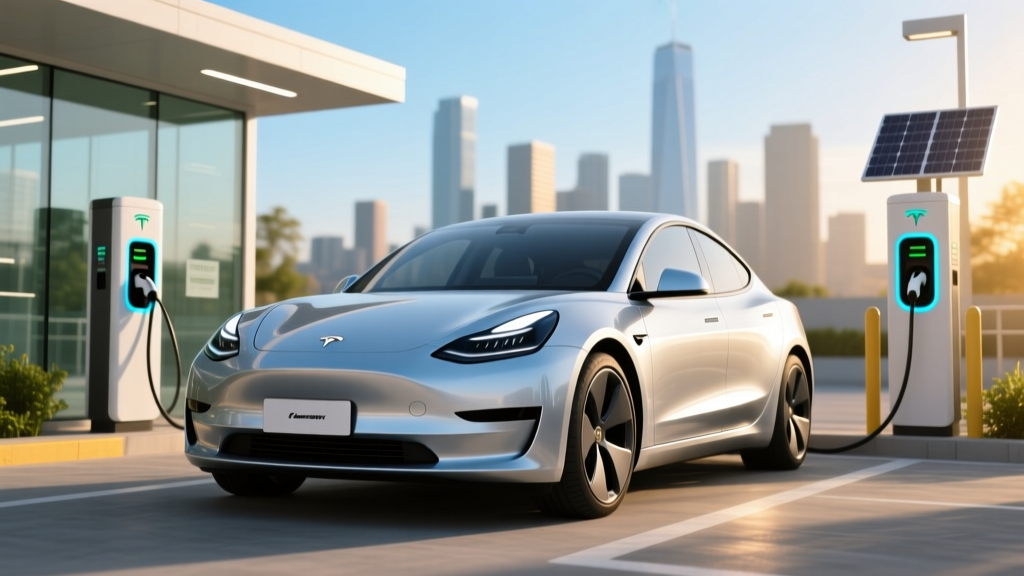
A Level 2 home charger operates at 7.2–11.5 kW (typically 32–48 amps on a 240V circuit), adding 25–44 miles of range per hour. This is the standard home-charging solution. Equipment costs $300–$700 for a quality smart charger (ChargePoint Home Flex, Emporia Level 2, or Tesla Wall Connector). Professional installation runs $500–$2,000 depending on whether your electrical panel needs an upgrade. A panel upgrade to 200A service can add $1,500–$3,000.
Your ongoing electricity cost remains your utility's $/kWh rate — the charger itself is just a conduit. With a time-of-use (TOU) plan, charging overnight when rates drop to $0.08–$0.12/kWh, a full charge for a 75 kWh battery costs $6–$9.
DC Fast Charging (Public)
DC fast chargers deliver 50–350 kW directly to the battery, enabling a 10–80% charge in 18–40 minutes depending on the vehicle and charger. This is essential for road trips but significantly more expensive for daily use.
| Charging Level | Power (kW) | Miles/Hour Added | Typical Cost/kWh | Full Charge Cost (75 kWh Battery) |
|---|---|---|---|---|
| Level 1 (120V) | 1.4 | 3–5 | $0.165 (residential) | $12.38 |
| Level 2 (240V home) | 7.2–11.5 | 25–44 | $0.08–$0.17 (TOU/standard) | $6.00–$12.75 |
| Level 2 (public/workplace) | 7.2–19.2 | 25–70 | $0.15–$0.30 or free | $11.25–$22.50 |
| DC Fast (50 kW) | 50 | ~150–180 | $0.30–$0.40 | $22.50–$30.00 |
| DC Fast (150–350 kW) | 150–350 | ~500–1,200* | $0.35–$0.48 | $26.25–$36.00 |
*Miles-per-hour figures assume peak sustained rate; actual charging slows above 80% SoC due to the charge curve taper. You will never sustain peak kW for a full session.
Major networks price differently. Electrify America and EVgo typically charge $0.36–$0.48/kWh for guest rates, with subscription plans reducing rates by 15–25%. Tesla Superchargers average $0.28–$0.36/kWh for Tesla owners and similar rates for NACS-equipped non-Tesla vehicles. In urban areas with high demand, some DC fast chargers implement peak pricing that can exceed $0.55/kWh.
EV Charging Cost vs. Gas: The 5-Year Picture
The per-mile savings of home charging are substantial, but a fair comparison requires looking at the full ownership picture. Here's a 5-year/75,000-mile breakdown comparing a 2026 Tesla Model Y Long Range (AWD, 320 mi EPA) against a comparably equipped 2026 Toyota RAV4 (AWD, 30 MPG combined).
| Cost Category | Tesla Model Y LR (EV) | Toyota RAV4 AWD (Gas) |
|---|---|---|
| Base MSRP | $44,990 | $33,500 |
| Est. Federal Tax Credit (§30D)* | –$3,750 to –$7,500 | $0 |
| Fuel/Energy (75,000 mi) | $3,450–$5,625** | $8,570 |
| Maintenance (5 yr) | $1,500–$2,200 | $3,800–$4,500 |
| Insurance (5 yr avg) | $10,500–$13,000 | $7,500–$9,500 |
| 5-Year Total (before resale) | $53,000–$62,000 | $53,000–$56,000 |
*§30D credit eligibility depends on MSRP caps ($55,000 SUVs), buyer AGI limits ($150K single / $300K joint), and battery critical-mineral sourcing requirements per current IRS rules. Credit amounts vary by model year and sourcing compliance — verify before purchase. Available as point-of-sale price reduction at participating dealers.
**EV energy cost assumes 85% home charging at $0.14/kWh avg and 15% DCFC at $0.40/kWh. Gas cost assumes $3.40/gal national average. Both vary significantly by region.
The key takeaway: EV fuel savings are real but not infinite. Over five years, you'll save $2,900–$5,100 on energy alone. Maintenance savings (no oil changes, fewer brake replacements due to regenerative braking) add another $1,500–$2,300. But higher insurance premiums (typically 20–40% above equivalent gas vehicles) eat into those gains. The EV wins on operating cost; the gas car wins on purchase price. Total cost of ownership converges around year 4–5 for most buyers.
What First-Time EV Buyers Should Know About Charging Costs
Before you buy, understand these real-world factors that affect what you'll actually spend:
Time-of-Use Plans Can Cut Your Bill in Half
Many utilities offer TOU rate plans where overnight electricity (typically 10 PM – 6 AM) costs 40–60% less than peak afternoon rates. If your utility offers $0.08/kWh off-peak, a full charge for a 75 kWh battery drops from $12.38 to $6.00. Most smart chargers let you schedule charging to these windows automatically. Check with your utility before purchasing a charger — some even offer rebates of $200–$500 for installing a smart Level 2 unit.
The Charge Curve Taper Means You Never Get Peak kW the Whole Time
When manufacturers advertise "250 kW DC fast charging," that's the peak rate — achieved only between roughly 10–40% State of Charge (SoC) at optimal battery temperature. Above 60%, the rate tapers significantly to protect battery health. A vehicle that peaks at 250 kW might average only 120–140 kW across a 10–80% session. This means your actual DCFC session costs more per mile than the peak rate implies, because you're paying for time at the charger as well as energy consumed.
Cold Weather Increases Energy Consumption by 20–35%
Battery chemistry is temperature-sensitive. In freezing conditions (below 32°F / 0°C), expect your efficiency to worsen by 20–35% due to cabin heating demands and reduced battery efficiency. A car rated at 28 kWh/100 mi in mild weather might consume 35–38 kWh/100 mi in January in Minnesota. This means your cost per mile rises proportionally during winter months. Vehicles with heat pumps (standard on most 2026 Hyundai, Kia, and Tesla models) mitigate this loss to 15–25%.
Not Everyone Has Home Charging Access
If you live in an apartment, condo, or street-parking situation without reliable access to a Level 2 charger, your EV charging costs will be substantially higher — potentially matching or exceeding gas car fuel costs if you rely entirely on DC fast charging at $0.40+/kWh. Before buying an EV, confirm your daily charging plan. Workplace charging (often free or subsidized) and public Level 2 chargers at grocery stores or gyms can bridge the gap, but they require schedule discipline.
Common EV Charging Cost Myths vs. Facts
| Myth | Fact |
|---|---|
| "Charging an EV is free." | Some workplaces and destinations offer free Level 2 charging, but most home and public charging costs money. Budget $40–$100/month for a typical commuter driving 1,000 miles. |
| "Public fast charging is cheaper than gas." | At $0.40–$0.48/kWh, DC fast charging a less-efficient EV like the F-150 Lightning ($0.19/mi) approaches the cost of fueling a 20 MPG gas truck at $3.40/gallon ($0.17/mi). Home charging is where savings live. |
| "EV batteries need frequent replacement." | Federal law mandates battery warranties of 8 years/100,000 miles. Real-world degradation data shows most NMC and LFP batteries retain 85–92% capacity at 100,000 miles. Full replacement costs $8,000–$18,000 but is rarely needed within the warranty period. |
| "You need a $2,000 electrical upgrade to charge at home." | Many homes with existing 240V dryer or oven circuits can add a Level 2 charger for $500–$1,200 total (equipment + install). A panel upgrade is only required if your service is maxed out — typically in older homes with 100A service. |
| "All EVs qualify for the $7,500 tax credit." | The §30D credit has MSRP caps ($55K cars, $80K SUVs/trucks), buyer income limits, and critical-mineral sourcing requirements that change annually. Many vehicles qualify for partial credits ($3,750) or none at all. Always verify on the IRS website before purchasing. |
Your Decision Framework: Is an EV Worth It for Your Budget?
Choose an EV if:
- You have reliable access to Level 2 charging at home or work (the single biggest cost predictor)
- Your daily commute is under 80 miles round-trip (eliminates DCFC dependency)
- Your utility offers a TOU plan with off-peak rates below $0.12/kWh
- You drive 10,000+ miles per year (higher mileage = faster payback on fuel savings)
- You qualify for the §30D federal credit or a state incentive (check IRS eligibility)
- You plan to keep the vehicle 4+ years to recoup the higher purchase price
Consider a Hybrid (HEV/PHEV) Instead if:
- You lack reliable home or workplace charging access
- You frequently drive 300+ miles in a single day through areas with sparse DCFC infrastructure
- Your budget is under $30,000 and you need a new vehicle (EV options below this price remain limited)
- You live in extreme cold (regularly below 0°F) where range loss exceeds 35% and charging speeds slow significantly
- You want to avoid the insurance premium increase (20–40% higher on average for EVs)
Stick with Gas for Now if:
- You drive under 5,000 miles per year (fuel savings won't offset the EV price premium)
- Your only parking option is street parking with no charging access within walking distance
- You need a specialized vehicle (heavy towing, commercial use) where EV options are still maturing
Frequently Asked Questions
How much does it cost to charge an EV at home per month?
For a typical driver covering 1,000 miles/month in an efficient EV (30 kWh/100 mi) with home charging at $0.14/kWh average, expect $42/month. With a TOU plan and overnight charging at $0.09/kWh, that drops to about $27/month. Compare this to $113/month for a 30 MPG gas car at $3.40/gallon.
Is it cheaper to charge an EV or fill up a gas car?
Home charging is almost always cheaper — typically 50–70% less per mile than gasoline. Public DC fast charging narrows the gap significantly, and in some cases (high electricity rates, low gas prices, inefficient EVs), DCFC can cost as much as or more than gas per mile. The economic advantage of an EV depends heavily on home charging access.
Does fast charging cost more than slow charging?
The electricity itself costs more per kWh at DC fast chargers ($0.32–$0.48 vs. $0.08–$0.17 at home). Additionally, frequent DC fast charging can accelerate battery degradation slightly over time, though modern thermal management systems have largely mitigated this concern. Reserve DCFC for road trips and use Level 2 for daily needs.
Do electric cars save you money in the long run?
Yes, but the payback period depends on your situation. With home charging, federal tax credit eligibility, and 12,000+ miles driven annually, most EV owners break even against a comparable gas car within 3–5 years. After that, annual savings of $800–$1,500 in fuel and maintenance accumulate. However, higher insurance costs and potentially steeper depreciation in some segments can extend the payback timeline.
What happens if I can't install a home charger?
You can still own an EV using public Level 2 chargers (often found at grocery stores, libraries, and workplaces) combined with occasional DC fast charging. However, your per-mile energy cost will likely rise to $0.10–$0.15/mile, reducing the cost advantage over gasoline. A plug-in hybrid (PHEV) with 30–40 miles of electric range plus a gas engine may be a better fit if home charging isn't possible — you'll charge at public Level 2 stations for short trips and use gas for longer drives.
Are there free EV charging stations?
Some employers, shopping centers, hotels, and municipalities offer complimentary Level 2 charging as an amenity. However, these are not guaranteed, often have time limits, and shouldn't form the basis of your charging strategy. Networks like ChargePoint and PlugShare let you filter for free stations in their apps. Availability has decreased as EV adoption has grown — what was free in 2022 often carries a fee by 2026.