The Quick Answer: How Long to Charge an Electric Vehicle
Charging time depends entirely on the charger type and your battery size. For a typical 75 kWh battery (like a Tesla Model Y or Hyundai Ioniq 5):
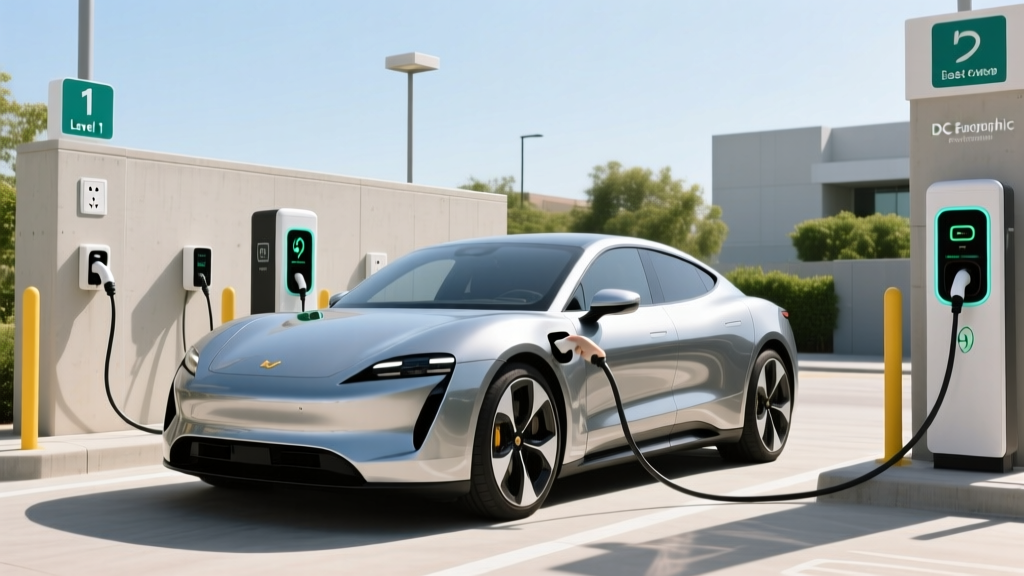
- Level 1 (120V household outlet): ~50–72 hours from empty to full — adds 3–5 miles of range per hour.
- Level 2 (240V home or public charger): ~7–10 hours from empty to full — adds 25–40 miles per hour. Most owners charge overnight.
- DC Fast Charging (150–350 kW public station): ~18–35 minutes from 10% to 80% — adds 150–300+ miles per hour at peak rate.
In daily ownership, you rarely charge from 0% to 100%. Most EV drivers plug in at home each night and wake up to a full battery, spending roughly 30 seconds connecting the cable — less time than a gas station stop.
Charging Speeds Explained: kW vs. kWh and the Three Levels
The single most common confusion among first-time EV buyers is mixing up kW (kilowatts) and kWh (kilowatt-hours). Here's the distinction:
- kWh = energy capacity. Your battery holds a certain number of kWh, like a gas tank holds gallons. A 2026 Tesla Model Y Long Range has an ~75 kWh usable battery; a Ford F-150 Lightning Extended Range has ~131 kWh.
- kW = power (charge rate). This is how fast energy flows into the battery, like the flow rate of a gas pump. A 10 kW Level 2 charger fills slower than a 250 kW DC fast charger.
To estimate charge time, divide battery capacity (kWh) by charge rate (kW). A 75 kWh battery on a 10 kW Level 2 charger takes roughly 7.5 hours from 0% to 100%. Simple math — but real-world charging involves a few more variables.
| Level | Voltage | Power (kW) | Miles of Range Added/Hour | 10–80% Time (75 kWh Battery) | Best For |
|---|---|---|---|---|---|
| Level 1 | 120V AC | 1.0–1.9 kW | 3–5 mi/hr | ~52 hours | PHEVs, low-mileage drivers, emergency top-ups |
| Level 2 (Home) | 240V AC | 7.2–11.5 kW | 25–40 mi/hr | ~7–9 hours | Daily overnight charging, primary ownership method |
| Level 2 (Public) | 208–240V AC | 6.6–19.2 kW | 22–65 mi/hr | ~4–9 hours | Workplace, shopping centers, apartments |
| DC Fast Charge | 400–800V DC | 50–350 kW | 150–300+ mi/hr (at peak) | ~18–35 min | Road trips, highway travel, quick top-ups |
The Charging Curve: Why Peak kW Is Not Sustained kW
Here's what automaker marketing materials don't emphasize: a "250 kW peak charge rate" applies only to a narrow portion of the battery's state of charge (SoC), typically between 10% and 40%. As the battery fills, the charge rate tapers to protect cell health.
Take the 2026 Hyundai Ioniq 5 (84 kWh battery, NMC chemistry) as a real example. On a 350 kW Electrify America station:
- 10–40% SoC: Peaks near 230–240 kW (blistering fast)
- 40–60% SoC: Drops to ~180 kW
- 60–80% SoC: Tapers to ~120–130 kW
- 80–100% SoC: Drops sharply below 50 kW (this is why you rarely charge past 80% on road trips)
The practical result: a 10–80% session takes about 18 minutes under ideal conditions, but charging from 80–100% can add another 30+ minutes. Road-trip strategy is to charge to 80% and go — making multiple short stops rather than one long one.
Preconditioning matters. Most modern EVs (Tesla, Hyundai/Kia, BMW, Rivian) can warm the battery before you arrive at a DC fast charger if you navigate to one in the car's system. A cold battery charges significantly slower — we've seen peak rates cut by 40–50% in winter without preconditioning. Always use the vehicle's built-in navigation to route to chargers.
Real-World Charging Times for Popular 2026 EVs
Here are actual charging profiles for some of the most-shopped EVs on the market, based on manufacturer specifications and EPA data at fueleconomy.gov:
| Vehicle | Battery (kWh) | Max DC Rate (kW) | 10–80% DC Time | Level 2 Rate (kW) | Level 2 Full Charge | EPA Range |
|---|---|---|---|---|---|---|
| Tesla Model Y Long Range | ~75 (NMC) | 250 | ~25 min | 11.5 | ~7 hrs | 320 mi |
| Hyundai Ioniq 5 SE | ~84 (NMC) | 240 (800V arch.) | ~18 min | 10.9 | ~8 hrs | 310 mi |
| Ford F-150 Lightning Ext. Range | ~131 (NMC) | 150 | ~41 min | 19.2 (optional) | ~7 hrs | 320 mi |
| Chevrolet Equinox EV 2LT | ~85 (NMC) | 150 | ~32 min | 11.5 | ~8 hrs | 319 mi |
| Tesla Model 3 RWD (LFP) | ~60 (LFP) | 170 | ~25 min | 11.5 | ~5.5 hrs | 272 mi |
| BMW i4 eDrive40 | ~81.5 (NMC) | 205 | ~28 min | 11.0 | ~8 hrs | 307 mi |
Real-world range caveat: EPA estimates assume a mix of city and highway driving at moderate temperatures. Expect 10–20% range reduction at sustained highway speeds (75+ mph) and 20–35% loss in sub-freezing winter conditions. A 310-mile EPA rating typically translates to ~250–270 miles in real-world highway driving and potentially ~200–220 miles in cold weather with cabin heating.
EV vs. Gas: Time and Cost Comparison in Daily Life
The most honest comparison isn't "how long does a full charge take vs. filling a gas tank" — because that's not how EV ownership works. The real comparison is total time and money spent on energy over a year.
| Metric | EV (Home Level 2 Charging) | Gas Car (28 MPG Combined) | Advantage |
|---|---|---|---|
| Weekly "refueling" time | ~30 seconds plugging in at home (done while sleeping) | ~8–10 min at gas station | EV (zero dedicated trips) |
| Annual fueling/charging cost | ~$540 (at $0.15/kWh national avg, 3.5 mi/kWh) | ~$1,500 (at $3.50/gal) | EV saves ~$960/year |
| Road trip refueling (500 mi) | ~35–45 min total (1–2 DC fast stops) | ~10–12 min total (1–2 gas stops) | Gas (faster on road trips) |
| Annual maintenance | ~$300–$400 (no oil, fewer brake replacements) | ~$800–$1,200 (oil, filters, brakes) | EV saves ~$500–$800/year |
The takeaway: EVs win decisively on daily convenience and cost if you have home charging. Gas cars retain an advantage on long road trips where refueling is faster and more universally available. For the ~95% of driving that's local or commuting, the EV is both cheaper and more convenient — you start every day "full."
What Charging Actually Costs: Home, Public, and DC Fast
Not all electrons are priced equally. Here's what you'll actually pay per kWh and per mile across charging scenarios:
| Charging Type | Typical Cost per kWh | Cost per Mile (at 3.5 mi/kWh) | Cost to Add 200 Miles |
|---|---|---|---|
| Home Level 2 (national avg electricity) | $0.12–$0.18 | $0.03–$0.05 | $6.85–$10.30 |
| Home with solar panels | $0.03–$0.07 (amortized) | $0.01–$0.02 | $1.70–$4.00 |
| Public Level 2 (ChargePoint, etc.) | $0.25–$0.49 | $0.07–$0.14 | $14.30–$28.00 |
| DC Fast Charge (Electrify America, EVgo) | $0.35–$0.55 | $0.10–$0.16 | $20.00–$31.40 |
| Tesla Supercharger (varies by location) | $0.25–$0.40 | $0.07–$0.11 | $14.30–$22.85 |
| Gasoline equivalent (28 MPG at $3.50/gal) | — | $0.125 | $25.00 |
Key insight: Home charging is where the economics work best — often one-third to one-quarter the cost of gasoline per mile. Exclusive reliance on DC fast charging erodes savings and can even exceed gasoline costs on a per-mile basis. This is why home charging access is the single most important factor in EV ownership satisfaction.
Home Charging Setup: What You Actually Need
Before buying an EV, confirm you can install a Level 2 charger. Here's the realistic cost and requirement breakdown:
| Component | Cost Range | Notes |
|---|---|---|
| Level 2 charger hardware (40–48A, hardwired or NEMA 14-50) | $350–$700 | Emporia, ChargePoint Home Flex, Wallbox Pulsar Plus, Tesla Wall Connector |
| Electrician labor (240V circuit, 50–60A breaker) | $500–$2,000 | Varies by run length from panel to garage/driveway |
| Permit and inspection | $50–$250 | Required in most jurisdictions; varies by municipality |
| Electrical panel upgrade (if needed, 100A → 200A) | $1,500–$3,500 | Needed if panel is at capacity; older homes more likely |
| Total (typical install, no panel upgrade) | $900–$2,500 | May qualify for up to $1,000 federal alternative fuel infrastructure credit (§30C) |
Apartment and condo dwellers: If you lack dedicated parking with electrical access, your options are public Level 2 chargers (workplace, grocery stores, gyms) and DC fast charging networks. This adds cost and time to ownership. Before buying, map your weekly routine and confirm you have reliable charging access within a 5-minute detour of your normal routes.
Common EV Charging Misconceptions, Corrected with Data
| Myth | Fact |
|---|---|
| "It takes all day to charge an EV." | On DC fast chargers, 10–80% takes 18–35 minutes. On home Level 2, it charges while you sleep (7–9 hours unattended). You never actively wait. |
| "EV batteries degrade quickly and need replacing." | Modern NMC and LFP batteries are warrantied for 8 years/100,000 miles at 70%+ capacity retention (federally mandated minimum). Real-world data from Tesla and Hyundai shows ~10–12% degradation at 100,000 miles — far less than early-generation EVs. Full battery replacement costs $8,000–$20,000 but is rarely needed within the vehicle's normal lifespan. |
| "You can't drive an EV in winter." | Cold reduces range by 20–35% due to battery chemistry and cabin heating demands. A 310-mile EV becomes ~210–250 miles in deep cold. Preconditioning, heat pumps (standard on most 2026 EVs), and seat heaters mitigate this. Norway, where EVs dominate new sales, averages below-freezing winters. |
| "The power grid can't handle EVs." | Most charging happens overnight during off-peak hours when grid capacity is underutilized. Utility time-of-use rates incentivize this. A single EV adds roughly the same load as a central AC unit. |
| "Charging stations are always broken." | Reliability varies by network. Tesla Superchargers consistently report 99%+ uptime. Non-Tesla networks (Electrify America, EVgo) have improved but still average ~90–93% uptime per J.D. Power studies. The NACS connector standard (now adopted by Ford, GM, Rivian, Hyundai, and others for 2025+ models) grants access to Tesla's reliable Supercharger network via adapter or native port. |
Federal Tax Credit and Ownership Economics
The federal EV tax credit under IRS §30D offers up to $7,500 for qualifying new EVs, but eligibility depends on several conditions that change frequently:
- MSRP caps: Vans, SUVs, and trucks must be under $80,000; sedans under $55,000.
- Buyer income caps: Modified AGI must not exceed $300,000 (joint), $225,000 (head of household), or $150,000 (single).
- Battery sourcing: Increasing percentages of critical minerals and battery components must be sourced from the U.S. or free-trade-agreement countries — this requirement tightens annually, and some previously qualifying models may lose eligibility.
- Point-of-sale transfer: As of 2024+, you can transfer the credit to the dealer at purchase for an immediate price reduction rather than waiting to claim it on your tax return.
- Used EV credit: Up to $4,000 (or 30% of sale price, whichever is lower) for qualifying used EVs under $25,000, with lower income caps ($150,000 joint / $75,000 single).
Always verify current eligibility on the IRS website and consult a tax professional — battery sourcing rules and qualifying model lists update regularly.
Decision Framework: Is an EV Right for Your Situation?
Choose a Battery EV (BEV) If:
- You have access to home Level 2 charging (garage, driveway, or employer-installed)
- Your daily driving is under 200 miles round-trip (covers ~95% of American commutes)
- You want the lowest per-mile fuel cost and minimal maintenance
- You take road trips fewer than 5–6 times per year (and can plan 20-min DC fast stops)
- You qualify for federal or state incentives that reduce the upfront price gap
Choose a Plug-In Hybrid (PHEV) If:
- You have home charging but regularly drive 300+ miles in a single day
- You want 25–45 miles of electric-only commuting with a gas engine for longer trips
- You live in an area with sparse DC fast-charging infrastructure
- You're not ready to fully commit to electric-only but want to reduce fuel consumption
Stick with a Gas or Traditional Hybrid (HEV) If:
- You have no access to home or workplace charging and rely entirely on street parking
- You regularly tow heavy loads over long distances (EV towing reduces range by 40–50%)
- Your budget is under $28,000 and used EV options in your area are limited
- You drive in extreme cold (-20°F or below) for extended periods with no garage access
Frequently Asked Questions
Can I charge an EV from a regular household outlet?
Yes, but slowly. A standard 120V outlet (Level 1) delivers roughly 1.0–1.4 kW, adding about 3–5 miles of range per hour of charging. For a plug-in hybrid with 30 miles of electric range, this is perfectly adequate overnight. For a full EV with a 75+ kWh battery, Level 1 is only practical as emergency backup or for very low daily mileage (under 30 miles/day).
Does fast charging damage the EV battery?
Frequent DC fast charging causes marginally more degradation than slow Level 2 charging, but modern thermal management systems have made this a minor concern. Tesla's own fleet data shows vehicles that Supercharged frequently had only ~2–3% more degradation at 100,000 miles compared to those that primarily used Level 2. For daily charging, Level 2 at home is ideal; DC fast charging for road trips is perfectly fine.
How long does it take to charge an EV at a Tesla Supercharger?
Tesla Superchargers (V3 at 250 kW and V4 at up to 350 kW) typically deliver a 10–80% charge in 18–30 minutes depending on the model and battery size. A Model 3 Long Range on a V3 Supercharger reaches 80% in about 25 minutes. With Tesla's navigation-based preconditioning, the battery arrives at optimal temperature for maximum charge speed.
What happens if I run out of charge on the road?
Running an EV battery to 0% is rare because vehicles provide extensive low-charge warnings, reduce power ("turtle mode"), and navigation systems proactively route you to chargers. If it happens, roadside assistance can tow the vehicle to the nearest charger. Some services now offer mobile DC charging vans. It's no different from running out of gas — except charging stations are increasingly mapped into your car's navigation.
Is it cheaper to charge at home or at public stations?
Home charging is dramatically cheaper. At the national average electricity rate of ~$0.15/kWh, you'll pay about $0.04 per mile. Public DC fast chargers at $0.40–$0.55/kWh cost $0.11–$0.16 per mile — closer to gasoline pricing. Maximizing home charging is the single biggest factor in achieving EV cost savings.
Do all EVs use the same charging connector?
As of 2026, the industry is consolidating around two standards. The NACS (North American Charging Standard), originally developed by Tesla, is now adopted by Ford, GM, Rivian, Hyundai, Kia, BMW, and others. The CCS1 connector is still found on many existing vehicles and public chargers. CHAdeMO is effectively legacy (Nissan Leaf). Most new EVs either ship with NACS or include a CCS-to-NACS adapter for Supercharger access.