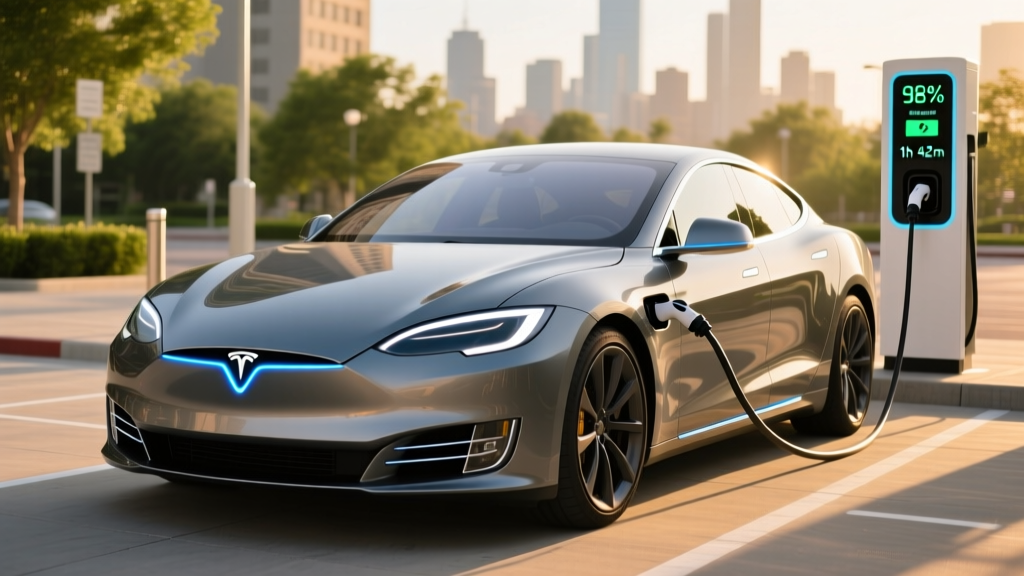
When shoppers ask how long does a full charge Tesla last, they're usually asking two different questions: how many miles the battery will deliver on a single charge, and how many years the battery pack will survive before needing replacement. The answer depends heavily on which 2026 Tesla model you drive, how you drive it, and what the thermometer reads outside.
This guide breaks down the real-world range, battery chemistry, charging speeds, and ownership economics for Tesla's current 2026 lineup — the refreshed Model 3 ("Highland") and the updated Model Y ("Juniper") — so you can plan your commute, road trips, and budget with actual numbers instead of marketing promises.
Real-World Range: What the EPA Sticker Doesn't Tell You
The EPA publishes laboratory-derived range estimates that assume a mix of city and highway driving at moderate temperatures. In practice, your mileage will vary — sometimes significantly.
EPA estimated range: 363 miles
Real-world expectation: ~290–310 mi highway (75 mph), ~250–270 mi in freezing weather, ~330+ mi mixed city driving at moderate temps.
2026 Tesla Model Y Long Range AWD
EPA estimated range: 320 miles
Real-world expectation: ~260–280 mi highway (75 mph), ~220–240 mi in freezing weather, ~290+ mi mixed city driving.
Several factors compress range below the EPA sticker:
- Highway speed: Aerodynamic drag increases with the square of velocity. Sustained 75–80 mph driving typically yields 15–20% less range than the EPA combined figure.
- Cold weather: Below freezing, expect 20–30% range loss. The battery must heat itself, cabin heating draws 2–5 kW continuously, and regenerative braking is limited until the pack warms up. Tesla's heat pump (standard on all 2026 models) helps, but physics still wins in deep cold.
- Terrain and payload: Mountain passes and fully loaded cabins with roof boxes will shave 10–15% off range.
- Wheel size: On the Model 3, upgrading from 18-inch to 19-inch wheels costs roughly 10–15 EPA miles. Same pattern on the Model Y with 19-inch vs. 20-inch options.
Source: EPA Fuel Economy — 2026 Tesla Model 3
Battery Chemistry: LFP vs. NMC in Tesla's 2026 Lineup
Tesla uses two distinct lithium-ion chemistries depending on trim, and this choice affects how you should charge, how the battery degrades, and how the car performs in cold weather.
| Attribute | LFP (Lithium Iron Phosphate) | NMC (Nickel Manganese Cobalt) |
|---|---|---|
| Found in | Model 3 RWD, Model Y RWD (Standard Range) | Model 3 LR/Performance, Model Y LR/Performance |
| Usable capacity | ~57.5 kWh | ~75 kWh (Model 3), ~78 kWh (Model Y) |
| Energy density | Lower — heavier pack for same range | Higher — more range per kg |
| Cycle life | 3,000+ cycles to 80% SoH | 1,500–2,000 cycles to 80% SoH |
| Recommended daily SoC | 100% (charge to full daily) | 80% (charge to 100% only before trips) |
| Cold-weather performance | Weaker — more range loss below freezing | Better — retains more capacity in cold |
| Cost | Lower — enables cheaper trims | Higher — premium trims |
Why this matters: If you charge at home every night and want a lower purchase price, the LFP-equipped RWD trims are ideal — Tesla explicitly recommends charging LFP packs to 100% regularly to maintain cell balancing. If you need maximum range for road trips or live in a cold climate, the NMC Long Range models deliver more miles and better winter performance, but you should keep daily charge at 80% to minimize degradation.
Charging Speeds: DC Fast, Level 2, and Level 1
Understanding charging speed requires separating kW (power — how fast energy flows into the battery) from kWh (energy — how much the battery holds). A 250 kW charger delivers energy roughly 5× faster than a 48 kW unit, but only if the car can accept that rate and the battery is preconditioned.
| Spec | Model 3 Long Range AWD | Model Y Long Range AWD |
|---|---|---|
| Max DC fast-charge rate | 250 kW (peak) | 250 kW (peak) |
| 10–80% DC fast charge | ~25 minutes | ~27 minutes |
| Sustained DC rate (10–50%) | ~200–230 kW | ~190–220 kW |
| Level 2 home charging (max) | 11.5 kW (48A) | 11.5 kW (48A) |
| Miles added per hour (L2) | ~44 mi/hr | ~40 mi/hr |
| Level 1 (120V outlet) | ~1.2 kW / ~4 mi/hr | ~1.2 kW / ~3.5 mi/hr |
| Charge port (North America) | NACS (native) | NACS (native) |
The charge-curve reality: Tesla's 250 kW peak only holds between roughly 10–30% state of charge. Above 50%, the rate tapers significantly — by 80%, you're pulling closer to 60–80 kW. This is why the 10–80% time is the meaningful metric, not the peak number. Charging from 80–100% on DC fast charging is painfully slow and should be avoided on road trips unless absolutely necessary.
Preconditioning is critical: When you navigate to a Supercharger in the Tesla navigation system, the car automatically warms the battery to optimal charging temperature. Arriving at a Supercharger without preconditioning (e.g., you drove there using a third-party app) can add 5–10 minutes to your session in cool weather.
Performance, Efficiency, and Practicality
Tesla's 2026 lineup spans daily-driver comfort to genuine sports-sedan acceleration. Here are the key specs:
| Spec | Model 3 RWD | Model 3 LR AWD | Model 3 Perf. | Model Y LR AWD | Model Y Perf. |
|---|---|---|---|---|---|
| 0–60 mph | 5.8 sec | 4.2 sec | 2.9 sec | 4.8 sec | 3.5 sec |
| Horsepower | 271 hp | 384 hp | 510 hp | 384 hp | 456 hp |
| Drivetrain | RWD | Dual-motor AWD | Dual-motor AWD | Dual-motor AWD | Dual-motor AWD |
| EPA range | 272 mi | 363 mi | 315 mi | 320 mi | 285 mi |
| MPGe (combined) | 132 MPGe | 131 MPGe | 119 MPGe | 117 MPGe | 111 MPGe |
| kWh/100 mi | 25 | 26 | 28 | 29 | 30 |
| Cargo (rear seats up) | 23 cu ft | 23 cu ft | 23 cu ft | 30 cu ft | 30 cu ft |
| Cargo (seats folded) | 65 cu ft | 65 cu ft | 65 cu ft | 72 cu ft | 72 cu ft |
| Rear legroom | 35.3 in | 35.3 in | 35.3 in | 41.0 in | 41.0 in |
| Towing capacity | — | — | — | 3,500 lbs | 3,500 lbs |
Efficiency note: Tesla remains among the most energy-efficient EV makers. The Model 3 Long Range achieves 131 MPGe combined, meaning it uses about 26 kWh per 100 miles — roughly $3.50–$4.50 per 100 miles on residential electricity at the U.S. average rate of $0.16/kWh. Compare that to a 30 MPG gas car at $3.50/gallon: $11.67 per 100 miles. That's a 70% fuel-cost advantage before considering maintenance savings.
Pricing, Trims, and Federal Tax Credit Eligibility
Tesla's pricing has stabilized after several years of volatility. Below are 2026 MSRP figures before any incentives, followed by a breakdown of federal tax credit eligibility under IRS §30D rules.
| Model / Trim | Base MSRP | Federal §30D Credit | Effective Price (est.) |
|---|---|---|---|
| Model 3 RWD | $38,990 | Up to $7,500* | ~$31,490 |
| Model 3 Long Range AWD | $45,240 | Up to $7,500* | ~$37,740 |
| Model 3 Performance | $52,990 | Up to $7,500* | ~$45,490 |
| Model Y RWD | $44,990 | Up to $7,500* | ~$37,490 |
| Model Y Long Range AWD | $48,240 | Up to $7,500* | ~$40,740 |
| Model Y Performance | $52,490 | Up to $7,500* | ~$44,990 |
*Federal tax credit subject to eligibility requirements. As of 2026, the §30D Clean Vehicle Credit provides up to $7,500 for qualifying new EVs. Eligibility depends on:
- Buyer income caps: Modified AGI ≤ $150,000 (single), ≤ $300,000 (married filing jointly), ≤ $225,000 (head of household).
- MSRP caps: ≤ $55,000 for sedans (Model 3 qualifies across all trims); ≤ $80,000 for SUVs/trucks (Model Y qualifies across all trims).
- Battery sourcing: A percentage of critical minerals and battery components must be sourced from the U.S. or free-trade-agreement partners. Tesla's North American battery supply chain has generally met these thresholds for 2026, but percentages are adjusted annually — verify at fueleconomy.gov before purchasing.
- Point-of-sale transfer: Since 2024, you can transfer the credit to the dealer at purchase, reducing your out-of-pocket cost immediately rather than waiting for tax filing.
For authoritative, up-to-date eligibility details, consult the IRS Clean Vehicle Credits page or speak with a tax professional. State and local incentives vary by jurisdiction — check your state energy office or DSIRE database for additional rebates.
Technology, Driver Assistance, and Drawbacks
Standout Tech Features
- 15.4-inch center touchscreen with Tesla's proprietary OS — responsive, feature-rich, and updated regularly via over-the-air (OTA) software pushes.
- Autopilot (standard): Includes Traffic-Aware Cruise Control and Autosteer (lane centering). This is SAE Level 2 driver assistance — you must keep your hands on the wheel and eyes on the road at all times.
- Full Self-Driving (Supervised): Optional $8,000 add-on (or $99/month subscription in 2026). Adds Navigate on Autopilot, Auto Lane Change, Autopark, and Smart Summon. Despite the name, FSD is still SAE Level 2 — the driver is fully responsible for monitoring and intervention.
- Sentry Mode: Uses external cameras to record and alert you of threats near the parked vehicle. Draws ~200–300W while active, so expect ~1–2% SoC drain per day.
- Supercharger network: Over 6,000 stalls in North America. Tesla's proprietary NACS connector is now the industry standard, with Ford, GM, Rivian, and others gaining access via adapters.
Tesla Autopilot and FSD (Supervised) are SAE Level 2 systems. The driver must remain fully engaged, monitor the road, and be ready to take over instantly. These are NOT self-driving systems. Level 4 (no driver required) is currently only available in limited robotaxi services like Waymo in select metro areas.
Notable Drawbacks
- No traditional instrument cluster: All information is on the center screen, which requires glancing right. Some drivers find this distracting; others adapt quickly.
- Firm ride quality: The Highland and Juniper refreshes improved ride comfort, but both models still transmit more road imperfections than competitors like the Hyundai Ioniq 6 or BMW i4.
- No Apple CarPlay or Android Auto: Tesla uses its own infotainment exclusively. If you rely on CarPlay for navigation or music, this is a dealbreaker.
- Turn signal stalks removed (Model 3 Highland): Turn signals are now buttons on the steering wheel. Many owners report an adjustment period and frustration during roundabouts.
- Insurance costs: Tesla insurance premiums run 15–30% higher than comparable gas vehicles in most states due to repair costs and parts pricing. Always get a quote before purchasing.
Pros and Cons at a Glance
- Class-leading energy efficiency (25–30 kWh/100 mi)
- Access to the Supercharger network — the most reliable DC fast-charging infrastructure in North America
- Strong resale value relative to most EV competitors
- OTA updates continuously add features
- LFP option enables worry-free 100% daily charging on RWD trims
- Spacious frunk + rear cargo (Model Y: 30 cu ft rear, 72 cu ft folded)
- No Apple CarPlay/Android Auto
- FSD is expensive and still Level 2 (not autonomous)
- Higher insurance premiums than segment average
- Steering-wheel turn-signal buttons (Model 3) polarize owners
- Model Y rear visibility is limited due to sloping roofline
- Cold-weather range loss is significant on LFP trims
Battery Longevity and Warranty
How long does a Tesla battery last in terms of years and degradation? Tesla's warranty provides a strong baseline:
- Model 3 RWD (LFP): 8 years / 100,000 miles, whichever comes first, with minimum 70% battery capacity retention.
- Model 3 Long Range & Performance (NMC): 8 years / 120,000 miles, minimum 70% retention.
- Model Y Long Range & Performance (NMC): 8 years / 120,000 miles, minimum 70% retention.
Real-world degradation data: Aggregated owner data from TeslaFi and community fleet reports shows that NMC Tesla packs typically lose ~5–7% capacity in the first 30,000 miles, then degrade at a slower linear rate of ~1% per 15,000–20,000 miles thereafter. At 100,000 miles, most packs retain 88–92% of original capacity. LFP packs show similar long-term retention but may appear to lose more in early cycles due to cell-balancing characteristics.
Out-of-warranty replacement cost: If the battery fails after the warranty period, a replacement pack runs approximately $12,000–$16,000 including labor (based on 2025–2026 service-center quotes). However, complete pack failures are rare — most degradation is gradual and stays well above the 70% threshold within the warranty window.
Who Should Buy a 2026 Tesla?
Choose the Model 3 Long Range AWD if: You take regular road trips, live in a four-season climate, and want the best range-to-price ratio in Tesla's sedan lineup (363 mi EPA, ~$37,700 after credit).
Choose the Model Y Long Range AWD if: You need SUV cargo space (30 cu ft), have a family needing generous rear legroom (41 in), want AWD traction, or plan to tow up to 3,500 lbs.
Look at competitors (Hyundai Ioniq 5, Kia EV6, Ford Mustang Mach-E) if: You want Apple CarPlay, prefer a traditional instrument cluster, need 800V ultra-fast charging (Ioniq 5/EV6: 10–80% in ~18 min), or want a more cushioned ride.
Frequently Asked Questions
What is the real-world range of a 2026 Tesla?
Expect roughly 80–85% of the EPA sticker on highway road trips at 75 mph, and 65–75% in sub-freezing temperatures. The Model 3 Long Range AWD (363 mi EPA) delivers approximately 290–310 miles on a warm-weather highway drive and 250–270 miles in freezing conditions.
How fast does a Tesla charge at home and on the road?
On a Level 2 home charger (11.5 kW / 48A), the Model 3 Long Range adds about 44 miles of range per hour, or roughly 8–9 hours for a full 10–100% charge. On a Tesla Supercharger (250 kW peak), a 10–80% session takes approximately 25 minutes for the Model 3 and 27 minutes for the Model Y.
How much does a 2026 Tesla cost after tax credits?
If you qualify for the full $7,500 federal §30D credit (income and battery-sourcing requirements met), the Model 3 RWD starts around $31,490 and the Model Y Long Range AWD comes in around $40,740. The credit can be transferred at point of sale, reducing your upfront payment.
Does a 2026 Tesla qualify for the federal EV tax credit?
As of 2026, both the Model 3 and Model Y are eligible for up to $7,500 under IRS §30D, provided the buyer meets income caps ($150K single / $300K joint), the vehicle MSRP is within limits ($55K sedans / $80K SUVs), and battery critical-mineral and component sourcing thresholds are met. Verify current eligibility at fueleconomy.gov before purchasing, as sourcing rules tighten annually.
Is a Tesla worth buying vs. competitors in 2026?
Tesla's advantages are efficiency, the Supercharger network, strong software, and LFP battery longevity on RWD trims. Competitors like the Hyundai Ioniq 5 offer faster 800V charging (~18 min 10–80%), Apple CarPlay, and a more compliant ride. The best choice depends on whether Supercharger access and software integration outweigh the desire for faster peak charging and third-party infotainment.
How long does a Tesla battery last before replacement?
Tesla warranties the battery for 8 years / 100,000–120,000 miles (depending on trim) with a minimum 70% capacity retention guarantee. Real-world data shows most Tesla packs retain 88–92% capacity at 100,000 miles. Complete replacements are uncommon; most owners will sell or trade the vehicle before the battery reaches end-of-life.