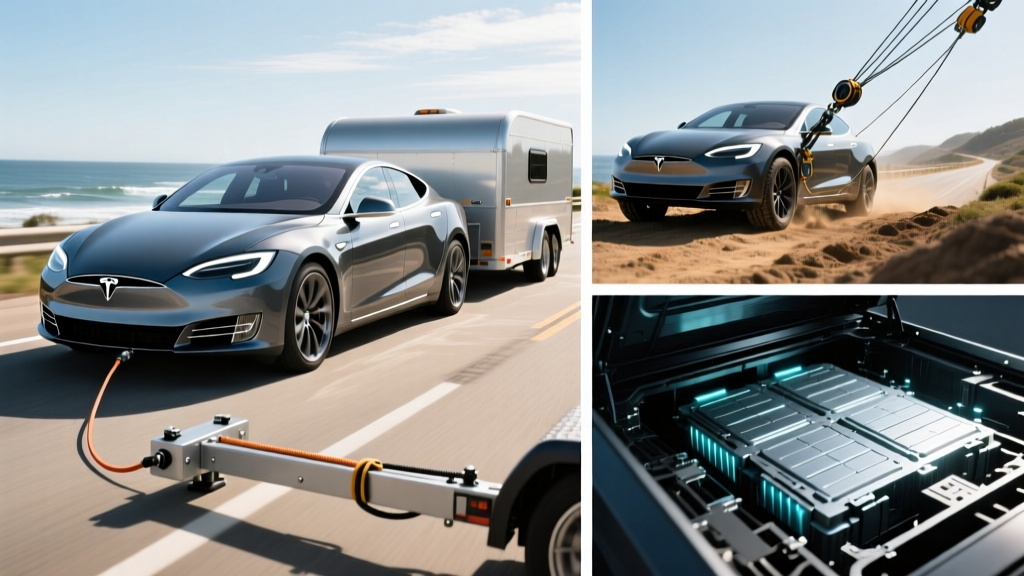
If you've ever searched "how do you tow a Tesla" at 2 a.m. on the side of an interstate, you already know the answer isn't as simple as dropping a gas car into neutral and hooking up a strap. Teslas — like all electric vehicles with permanent-magnet motors — require specific procedures before they're moved with wheels on the ground. Get it wrong, and you risk generating back-current through the drivetrain that can destroy power electronics or the motor itself.
This guide covers every legitimate towing scenario for the current 2026 Tesla lineup: emergency roadside recovery, flat-towing behind an RV (spoiler: don't), trailer transport, and using Tesla's own tow-capable models to pull boats and campers. We'll also touch on what makes each 2026 model unique in terms of specs, range, and capability — because understanding your specific vehicle matters when you're coordinating a tow.
The Golden Rule: Never Flat-Tow a Tesla
Flat-towing (also called dinghy towing or four-down towing) means pulling a vehicle with all four wheels on the road. This is common in the RV community for gas cars with a neutral gear. Teslas cannot be flat-towed under any circumstances.
Here's the physics: Tesla's permanent-magnet synchronous motors don't have a traditional mechanical neutral. Even in the car's software "Neutral" state, spinning the wheels turns the motor rotor inside its stator, generating electricity. With nowhere for that energy to go safely, it feeds back into the power electronics and battery system, potentially causing:
- Irreversible damage to the drive inverter
- Battery overcharge or thermal events
- Voided powertrain warranty (Tesla's warranty explicitly excludes damage from improper towing)
Approved Method 1: Flatbed Trailer or Wheel-Lift (Drive Wheels Up)
The only Tesla-approved methods for moving a disabled vehicle are:
- Flatbed truck/trailer — all four wheels off the ground. This is the preferred and safest method.
- Wheel-lift tow truck with dollies — the drive wheels are lifted off the ground, and the non-drive wheels sit on rolling dollies. Only acceptable for short distances at low speed.
Activating Tow Mode (Transport Mode)
Before any tow, you must activate the vehicle's Transport Mode (sometimes called Tow Mode) to keep the parking brake released and the vehicle in a state where it can be winched onto a flatbed without the motors resisting. Here's how to do it on 2026 models:
- Ensure the vehicle is powered on (press the brake pedal).
- On the touchscreen, go to Controls > Service > Towing.
- Press and hold the Transport Mode button until the indicator confirms activation.
- The vehicle will remain in this state even if powered off, until you deactivate it.
If the touchscreen is dead or the 12V auxiliary battery has failed, Tesla Roadside Assistance can remotely unlock the vehicle and release the parking brake. Call 1-877-79-TESLA or use the Tesla app's roadside feature. Roadside assistance is included for the duration of the battery warranty (8 years) and up to the warranty mileage limit.
Approved Method 2: Using Tesla's Tow Mode for Trailer Hitch Recovery
If you own a Model Y or Model X with a factory tow hitch and need to pull a trailer, Tesla's software includes a Trailer Mode that adjusts stability control, regenerative braking, and autopilot behavior for the added load. This is different from Transport Mode and is activated under Controls > Service > Trailer Mode when a hitch is detected.
2026 Tesla Towing Capacity by Model
| Model | Max Tow Capacity | Hitch Availability | Notes |
|---|---|---|---|
| Model 3 (2026) | Not rated for towing (US) | Not available from factory | European Model 3 is rated to 2,000 lbs; US version is not |
| Model Y (2026) | 3,500 lbs | Factory optional ($1,000) | AWD Long Range & Performance only |
| Model S (2026) | Not rated for towing | Not available | Sedan — no hitch option |
| Model X (2026) | 5,000 lbs | Factory standard | Class III hitch, integrated wiring |
Real-world range impact when towing: Expect a 30–50% reduction in range when towing near max capacity. A Model Y Long Range AWD with an EPA-rated 320 miles of range may realistically deliver 160–220 miles with a 3,000-lb camper in tow, depending on terrain, speed, and wind. Plan charging stops accordingly.
Step-by-Step: How to Tow a Disabled Tesla Safely
If your Tesla is disabled (dead battery, flat tire, collision damage), follow this exact sequence:
Step 1: Assess Power State
Is the touchscreen responsive? Can the car power on? If yes, proceed to activate Transport Mode. If no, you'll need to access the 12V jump-start points (located under the front bumper tow eye cover on most models) to temporarily power the vehicle's electronics, or call Tesla Roadside.
Step 2: Install the Tow Eye
Every Tesla ships with a tow eye (a threaded metal loop) stored in the trunk or frunk. Remove the small cover on the front bumper (press the upper-right area to pop it out), then thread the tow eye in counter-clockwise (it's reverse-threaded). This is the only approved attachment point for winching onto a flatbed.
Step 3: Activate Transport Mode
As described above, navigate to Controls > Service > Towing and hold the Transport Mode button. The car will display a confirmation and the parking brake will release.
Step 4: Winch or Load Onto Flatbed
Using the tow eye, winch the vehicle onto a flatbed. Ensure all four wheels are fully on the bed and secured with straps. Never attach tow straps to suspension components, bumpers, or the vehicle's frame rails.
Step 5: If Using a Wheel-Lift Truck
For AWD models (Dual Motor), all wheels are drive wheels. A wheel-lift is not acceptable unless all four wheels are on dollies or the vehicle is fully on a flatbed. For RWD-only Model 3 variants, the front wheels can roll on dollies while the rear (drive) wheels are lifted — but only for short distances under 35 mph.
2026 Tesla Model Lineup: Quick Spec Reference
If you're evaluating which Tesla suits your towing or transport needs, here's the current 2026 lineup at a glance:
| Spec | Model 3 LR AWD | Model Y LR AWD | Model S LR | Model X LR |
|---|---|---|---|---|
| EPA Range | 341 mi | 320 mi | 402 mi | 335 mi |
| Battery (usable) | ~75 kWh (NMC) | ~75 kWh (NMC) | ~95 kWh (NMC) | ~95 kWh (NMC) |
| Max DC Charge | 250 kW | 250 kW | 250 kW | 250 kW |
| 10–80% DC Time | ~25 min | ~27 min | ~30 min | ~32 min |
| Level 2 Home Rate | 11.5 kW (~44 mi/hr) | 11.5 kW (~44 mi/hr) | 11.5 kW (~37 mi/hr) | 11.5 kW (~34 mi/hr) |
| 0–60 mph | 4.2 sec | 4.8 sec | 3.1 sec | 3.8 sec |
| Horsepower | 346 hp | 384 hp | 670 hp | 670 hp |
| Drivetrain | Dual Motor AWD | Dual Motor AWD | Dual Motor AWD | Dual Motor AWD |
| Efficiency | 132 MPGe / 25 kWh/100mi | 122 MPGe / 28 kWh/100mi | 124 MPGe / 28 kWh/100mi | 109 MPGe / 32 kWh/100mi |
| Cargo (rear seats up) | 23 cu ft | 30 cu ft | 28 cu ft | 37 cu ft (+ falcon doors) |
| Base MSRP | $47,740 | $48,990 | $79,990 | $84,990 |
| Battery Warranty | 8 yr / 120,000 mi | 8 yr / 120,000 mi | 8 yr / 150,000 mi | 8 yr / 150,000 mi |
Sources: EPA fueleconomy.gov, Tesla.com specifications. Prices and specs reflect 2026 model year as of publication. Verify current pricing at Tesla.com.
Federal Tax Credit & Pricing: What You'll Actually Pay
Under the IRS §30D Clean Vehicle Credit, Tesla models may qualify for up to $7,500 in federal tax credits, but eligibility depends on three factors that change frequently:
- MSRP cap: Vans, SUVs (Model Y, Model X) must be under $80,000 MSRP; sedans (Model 3, Model S) must be under $55,000. The Model S and some Model X configurations exceed these caps and do not qualify.
- Buyer income cap: Modified AGI must not exceed $150,000 (single), $225,000 (head of household), or $300,000 (married filing jointly).
- Battery sourcing: A percentage of critical minerals and battery components must be sourced from the US or free-trade-agreement countries. Tesla's shifting supply chain means eligibility can change month to month — always verify on the IRS qualified vehicles list before purchase.
As of 2026, the credit can be transferred to the dealer at point of sale, effectively reducing your purchase price at delivery rather than waiting for tax filing. Confirm eligibility with your tax professional and the IRS Clean Vehicle Credit page.
Standout Tech & Notable Drawbacks
- Supercharger network — the most reliable DC fast-charging network in North America, now with NACS as the industry standard
- Over-the-air updates continuously improve features, efficiency, and even range
- Autopilot (standard) is one of the best Level 2 driver-assist systems for highway use — but requires full driver attention
- Integrated trailer sway control (Model Y/X with tow package)
- Low center of gravity from underfloor battery = stable towing dynamics
- No flat-tow capability — RV owners must use a trailer to bring a Tesla along
- Towing cuts range by 30–50%, making long-distance trailer hauling impractical without careful planning
- No physical instrument cluster — all info on center screen, which some drivers find distracting
- FSD (Supervised) remains Level 2 — not self-driving despite the name
- Model 3 has no US tow rating; Model Y's 3,500-lb limit is below many gas competitors
- Insurance premiums tend to be higher than comparable ICE vehicles
Who Is Each Tesla Model Best For?
Model 3 Long Range: Best for commuters and couples who prioritize efficiency and driving dynamics over cargo space. Not suitable for towing. Excellent for daily driving with 341 miles of EPA range and the lowest cost per mile in the lineup.
Model Y Long Range AWD: The family workhorse. 30 cu ft of cargo, optional 3,500-lb tow hitch, and enough range for road trips. Best-selling Tesla for a reason — it does most things well, though towing range is limited.
Model S Long Range: For those who want luxury-sedan performance with 402 miles of range. Not a towing vehicle. Competes with the Lucid Air and BMW i7 on range, but the aging interior design shows its age versus newer rivals.
Model X Long Range: The only Tesla that's a serious tow vehicle at 5,000 lbs. Falcon-wing doors are practical in tight parking, and the 3-row seating fits families. Trade-off: higher price, lower efficiency, and panel-gap quality concerns persist.
Emergency Roadside: What to Tell the Tow Operator
When you call for a tow (Tesla Roadside or a third-party service), communicate these points clearly:
- "This is an electric vehicle. It must go on a flatbed." Repeat this if needed — many operators default to wheel-lift for sedans.
- Specify whether your model is AWD (Dual Motor) or RWD — this affects whether a wheel-lift with dollies is even an option.
- Confirm Transport Mode is activated, or request that the operator call Tesla Roadside to remotely release the parking brake.
- Point out the tow eye location (front bumper, behind the small removable cover).
- Remind the operator: never tow with wheels on the ground, even in Neutral.
Tesla Roadside Assistance is available 24/7 at 1-877-79-TESLA or through the Tesla app. Coverage is included for 8 years or the battery warranty mileage limit, whichever comes first. For flat tires, Tesla can dispatch a mobile technician or arrange a tow to the nearest Service Center.
Frequently Asked Questions
Can I flat-tow a Tesla behind my RV?
No. No Tesla model supports flat-towing (four wheels down). The permanent-magnet motors generate electricity when the wheels spin, which can destroy the drive inverter and battery. If you want to bring a Tesla on an RV trip, you'll need a car-hauler trailer that keeps all four wheels off the ground.
What happens if my Tesla is towed incorrectly?
Incorrect towing (wheels on ground, no Transport Mode) can generate back-current through the motor and inverter, causing thousands of dollars in damage. Tesla's battery and drive unit warranty explicitly excludes damage from improper towing. You'll be liable for the repair, which could involve replacing the drive unit ($5,000–$12,000 depending on model).
Does Tesla Roadside Assistance cover towing?
Yes, for the duration of the battery warranty (8 years / 100,000–150,000 miles depending on model). Coverage includes towing to the nearest Tesla Service Center or Supercharger if the battery is depleted. Beyond warranty, you'll need your own roadside plan (AAA, insurance rider, etc.).
Can I use a car dolly to tow my Tesla?
Only if the drive wheels are fully off the ground. For RWD models, the front wheels can sit on a dolly while rear wheels are lifted. For all AWD/Dual Motor Teslas, all four wheels are drive wheels, so a dolly is not acceptable — you need a full flatbed.
How far can a Tesla be towed on a flatbed?
Any distance. On a flatbed with all four wheels off the ground and Transport Mode activated, there is no distance or speed restriction. The vehicle is essentially cargo at that point.
Will towing a trailer void my Tesla warranty?
No, as long as you stay within the rated tow capacity (3,500 lbs for Model Y, 5,000 lbs for Model X) and use the factory hitch. However, any drivetrain or battery damage caused by exceeding the tow rating or using an aftermarket hitch will not be covered.
Does the Tesla Model 3 have a tow hitch option?
Not in the United States. The European-market Model 3 offers a 2,000-lb tow rating, but Tesla has not certified the US version for towing. Aftermarket hitches exist but using one will void related warranty coverage and is not recommended.
What's the real-world range when towing a trailer with a Model Y?
With a 3,000-lb trailer at highway speeds, expect 160–220 miles from the Model Y Long Range AWD's EPA-rated 320 miles. Cold weather, headwinds, and hilly terrain push consumption toward the lower end. Plan charging stops every 90–120 minutes at 70 mph and use Tesla's built-in trip planner or ABRP with trailer weight input.
Always verify towing procedures in your specific vehicle's Owner's Manual (available in the Tesla app under Manuals). Procedures can vary by model year and software version. When in doubt, call Tesla Roadside Assistance before authorizing any tow.