Quick Verdict: The Lucid Air in 2026
The Lucid Air remains the efficiency benchmark among luxury electric sedans. With EPA range figures that no competitor touches and a powertrain that sips electrons at a class-leading rate, it's the EV for buyers who prioritize distance per kWh above all else. But beyond the headline range number, there are practical ownership questions — from rearward visibility and camera systems to real-world charging behavior and federal tax credit eligibility — that deserve a hard look before signing a $70,000+ purchase order.
This review covers every trim in the 2026 Lucid Air lineup, with specific attention to the rear view and visibility systems buyers frequently search for, alongside the complete spec breakdown you need to make an informed decision.
Lucid Air Rear View and Visibility Systems
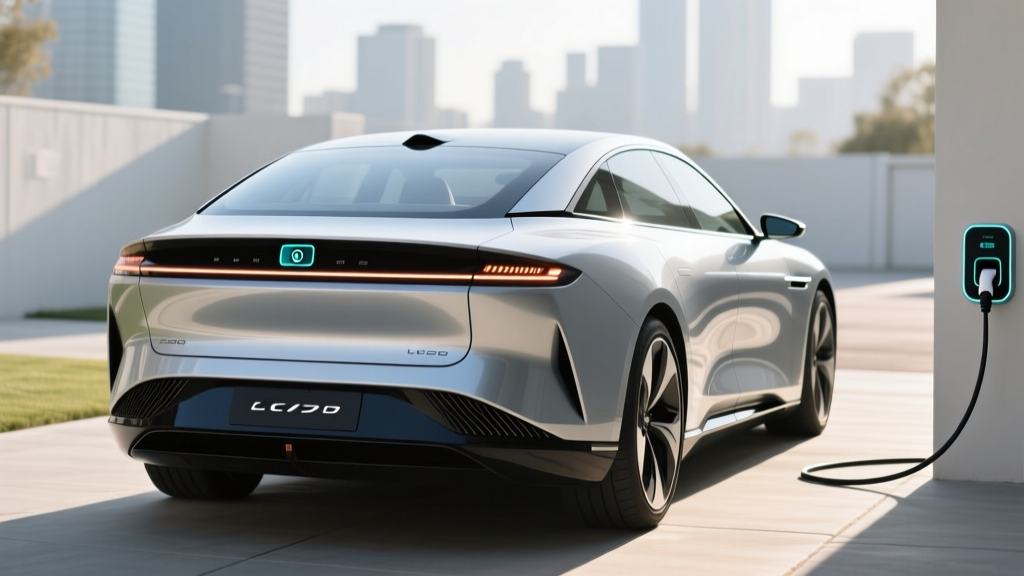
Searches for "Lucid Air rear view" typically center on two things: the sedan's actual rearward visibility from the driver's seat, and the camera-based systems Lucid provides to compensate for its design limitations.
The Air's sleek, teardrop silhouette creates a relatively high rear deck and narrow rear glass. From the driver's seat, the over-the-shoulder view is restricted — thick C-pillars and the sloping roofline compress your direct sightline. This is the trade-off for a drag coefficient of just 0.20 Cd, one of the lowest of any production sedan.
To address this, Lucid equips every Air with a high-resolution digital rear view camera system. The feed displays on the upper portion of the 34-inch curved glass cockpit display, giving you a wider, unobstructed field of view than a traditional mirror could provide. The camera activates automatically in reverse and can be toggled on during forward driving. Surround-view cameras (bird's-eye perspective) are standard across all trims, aiding in tight parking situations where the Air's 195.9-inch length demands attention.
For buyers prioritizing visibility, the digital rear view is effective — the resolution is sharp, latency is minimal, and the wide-angle lens captures lanes adjacent to you. However, in heavy rain or direct low-angle sunlight, the camera lens can degrade in clarity, something no digital system fully eliminates. A quick wipe of the rear-mounted camera (located near the trunk lip) resolves this.
Range, Battery, and Efficiency
The Air Pure RWD achieves an EPA-estimated 419 miles on its 88 kWh usable battery. In real-world highway driving at 70-75 mph, expect approximately 350-380 miles in mild weather. In freezing temperatures (below 32°F), plan for 280-320 miles of usable range due to battery chemistry limitations and cabin heating demands.
The Grand Touring AWD, with its 112 kWh usable pack, holds an EPA rating of 512 miles — the highest of any production EV sold in the US. Real-world highway figures settle around 420-460 miles in moderate conditions.
| Trim | Battery (usable kWh) | Chemistry | EPA Range | MPGe (combined) | kWh/100 mi |
|---|---|---|---|---|---|
| Pure RWD | 88 kWh | NMC | 419 mi | 140 MPGe | 24 kWh |
| Touring AWD | 92 kWh | NMC | 425 mi | 131 MPGe | 26 kWh |
| Grand Touring AWD | 112 kWh | NMC | 512 mi | 131 MPGe | 26 kWh |
| Sapphire (AWD) | 118 kWh | NMC | 427 mi | 109 MPGe | 31 kWh |
Lucid's efficiency advantage comes from its proprietary miniaturized drive units, which pack high output into compact housings with reduced parasitic losses. The Pure RWD's 24 kWh per 100 miles is exceptional for a vehicle weighing over 4,400 pounds — for context, the Tesla Model S Long Return sits around 28 kWh/100 mi, and the Mercedes EQS 450+ at roughly 30 kWh/100 mi, per fueleconomy.gov.
All Air trims use nickel-manganese-cobalt (NMC) lithium-ion cells. NMC offers higher energy density than LFP (lithium iron phosphate), which is why Lucid can pack over 112 kWh into a sedan platform. The trade-off: NMC cells are more sensitive to sustained high-state-of-charge storage. Lucid recommends daily charging to 80-90% and reserving 100% charges for road trips.
Charging Speed: DC Fast Charge and Home Level 2
| Charging Level | Max Rate | Delivery | Notes |
|---|---|---|---|
| Level 1 (120V) | ~1.4 kW | ~4-5 mi/hr | Emergency/trickle only |
| Level 2 (240V, 48A) | 11.5 kW | ~38-42 mi/hr | Home overnight standard |
| Level 2 (240V, 80A) | 19.2 kW | ~65-70 mi/hr | Requires Lucid Connected Home station or equivalent 80A EVSE |
| DC Fast Charge | 300 kW peak | 10-80% in ~20 min (Grand Touring) | Wunderbox 900V architecture; taper above 80% |
The Air's 900-volt electrical architecture (Lucid calls it the Wunderbox) is the key to its DC fast-charging capability. At a 350 kW-capable Electrify America or Ionity station, the Grand Touring can accept up to 300 kW peak, pulling the battery from 10% to 80% in approximately 20 minutes. The Pure and Touring, with slightly smaller packs, achieve similar 10-80% times of roughly 22-25 minutes.
A critical real-world note: peak kW is not sustained kW. The Air will hold its highest charge rate between roughly 10-40% state of charge, then progressively taper. From 60-80%, you'll see rates drop to 100-130 kW. This is normal lithium-ion charge-curve behavior and applies to every EV on the market. Plan your road-trip stops around the 10-80% window for the fastest throughput.
For home charging, the Air's onboard charger supports up to 19.2 kW (80 amps) on Level 2 — among the highest in the industry. This means a full overnight replenishment is realistic even for the 112 kWh Grand Touring pack. However, achieving 19.2 kW requires a hardwired 100-amp circuit and a compatible EVSE. Most homes will need an electrical panel evaluation; a 200-amp main panel is typically the minimum. Budget $1,200-$3,000 for professional Level 2 installation depending on your panel capacity and run distance (consult a licensed electrician for a site-specific quote).
The Air uses the NACS (North American Charging Standard) connector as of the 2025 model year, giving native access to Tesla's Supercharger network — a significant practical advantage for road-trip charging access.
Performance and Driving Dynamics
| Trim | Drivetrain | Horsepower | 0-60 mph | Top Speed |
|---|---|---|---|---|
| Pure RWD | Rear-wheel drive | 430 hp | 5.0 sec | 145 mph |
| Touring AWD | Dual-motor AWD | 620 hp | 3.4 sec | 145 mph |
| Grand Touring AWD | Dual-motor AWD | 819 hp | 3.0 sec | 168 mph |
| Sapphire | Tri-motor AWD | 1,234 hp | 1.89 sec | 205 mph |
Even the base Pure RWD delivers 430 horsepower — enough for effortless highway merging and passing. The dual-motor Touring and Grand Touring add all-weather traction and serious acceleration, while the tri-motor Sapphire exists in hypercar territory with a sub-2-second 0-60 time.
Ride quality is a highlight. The Air uses a multi-link front and rear suspension with available adaptive dampers (standard on Grand Touring and Sapphire). The result is a sedan that absorbs highway imperfections with composure while remaining genuinely engaging on back roads. Steering is precise, if slightly light in the default drive mode.
Regenerative braking offers two modes: a strong setting that enables near one-pedal driving in city traffic, and a coasting mode that mimics a conventional automatic transmission. The transition between regen and friction braking is well-blended — no abrupt grab at low speeds.
Interior, Cargo, and Technology
The Air's cabin is minimalist in execution but generous in space. The flat floor (a benefit of the dedicated EV platform) creates excellent rear legroom — 37.4 inches in the rear seat, competitive with the Mercedes S-Class. Front legroom measures 41.9 inches.
Cargo volume is 16.2 cubic feet in the trunk, supplemented by a 4.0 cu ft frunk (front trunk). The trunk opening is relatively narrow due to the aerodynamic bodywork, which can make loading bulky items like large suitcases more challenging than in an SUV. For families who regularly haul strollers or cargo-box loads, this is a practical limitation versus a Tesla Model X or Rivian R1S.
The 34-inch curved glass cockpit dominates the dashboard, running Lucid's proprietary infotainment OS. It supports wireless Apple CarPlay and Android Auto, over-the-air updates, and a built-in navigation system with real-time charging station routing. The UI is responsive, though some buyers report a learning curve with the multi-layered menu structure. Physical buttons are limited — climate and volume controls use a mix of touchscreen and a small rotary knob.
Driver Assistance (ADAS)
Lucid's DreamDrive Pro system is an SAE Level 2 driver-assistance suite. It combines adaptive cruise control, lane centering, and automatic lane changes on compatible highways. The driver must keep hands on the wheel and eyes on the road at all times. This is not autonomous or "self-driving" technology. Level 4 driverless capability (like Waymo's robotaxi service) is not available in any consumer vehicle sold today.
DreamDrive Pro uses a sensor suite of cameras, radar, and LiDAR (on Grand Touring and Sapphire trims). In practice, highway lane-centering is smooth and confidence-inspiring, though the system can be conservative in heavy cut-in traffic. Automatic emergency braking, blind-spot monitoring, and rear cross-traffic alert are standard across all trims.
Pricing, Tax Credits, and Ownership Costs
| Trim | Base MSRP | Federal §30D Credit Eligible? | Effective Price (if eligible) |
|---|---|---|---|
| Pure RWD | $69,900 | Potentially up to $7,500 (sedan MSRP cap: $55,000 — exceeds cap) | $69,900 (not eligible for new-vehicle credit) |
| Touring AWD | $87,400 | No — exceeds $55,000 sedan MSRP cap | $87,400 |
| Grand Touring AWD | $125,600 | No — exceeds $55,000 sedan MSRP cap | $125,600 |
| Sapphire | $249,000 | No — exceeds $55,000 sedan MSRP cap | $249,000 |
A critical point for Lucid Air buyers: under IRS §30D rules, new passenger sedans are capped at a $55,000 MSRP to qualify for the federal EV tax credit (SUVs, vans, and trucks have an $80,000 cap). Because every Air trim starts above $55,000, no new Lucid Air qualifies for the $7,500 federal purchase credit. This is a significant factor versus competitors like the Tesla Model S (which also exceeds the cap) but different from electric SUVs like the Rivian R1S or Cadillac Lyriq that may still qualify depending on trim and battery sourcing.
Additional §30D requirements — buyer income caps ($150,000 single / $300,000 joint AGI), critical mineral sourcing, and battery component manufacturing rules — further restrict eligibility for all EVs. Always verify current-year rules at IRS.gov and consult a tax professional before relying on credit projections.
Warranty Coverage
Lucid provides a 4-year/50,000-mile limited vehicle warranty and an 8-year/100,000-mile battery and drive unit warranty. The battery warranty guarantees the pack will retain at least 70% of its original capacity over that period. This is competitive with Tesla's 8-year/120,000-mile battery warranty on the Model S, though some luxury EV competitors (Mercedes, BMW) offer similar or slightly longer coverage terms.
Who Should Buy the Lucid Air?
Choose the Lucid Air if:
- Maximum range per charge is your top EV priority — the Grand Touring's 512-mile EPA rating is unmatched
- You value sedan driving dynamics, low center of gravity, and a quiet, composed highway ride
- You have reliable home Level 2 charging access and want to minimize public charging dependence
- You regularly drive long-distance routes (300+ miles) and want to reduce or eliminate en-route charging stops
Look elsewhere if:
- You need SUV-level cargo versatility (hatchback opening, roof rack, 3-row seating)
- You're counting on the federal tax credit to bring the purchase price down — the Air's MSRP exceeds the sedan cap
- Rearward visibility is a primary concern and you prefer direct over-the-shoulder sightlines over camera reliance
- Your budget is below $65,000 — consider the Tesla Model 3, Hyundai Ioniq 6, or Chevrolet Equinox EV instead
Lucid Air vs. Key Competitors
| Spec | Lucid Air Pure RWD | Tesla Model S LR | Mercedes EQS 450+ |
|---|---|---|---|
| EPA Range | 419 mi | 402 mi | 390 mi |
| Battery (usable) | 88 kWh | ~95 kWh | 108 kWh |
| Efficiency (kWh/100mi) | 24 | 28 | 30 |
| Peak DC Charge | 300 kW | 250 kW | 200 kW |
| 0-60 mph | 5.0 sec | 3.1 sec | 5.9 sec |
| Base MSRP | $69,900 | $74,990 | $104,400 |
| §30D Credit Eligible | No (sedan cap) | No (sedan cap) | No (sedan cap) |
The Air Pure undercuts the Model S on price and range while delivering superior efficiency. The Model S counters with a more mature Supercharger network experience (though the Air's NACS connector now grants Supercharger access), faster acceleration in dual-motor trims, and a more established service infrastructure. The EQS offers a more traditional luxury interior with richer materials but trails significantly on efficiency and charging speed. See IIHS for the latest crash-test ratings across these competitors.
Pros
- Class-leading EPA range (up to 512 mi)
- Best-in-class efficiency (24 kWh/100 mi on Pure RWD)
- 300 kW peak DC fast charging with 900V architecture
- NACS connector for native Tesla Supercharger access
- Spacious rear seat with flat floor
- Refined ride quality with adaptive damper availability
Cons
- No federal §30D tax credit eligibility (sedan MSRP cap)
- Rear visibility relies heavily on camera systems
- Trunk opening is narrow for a vehicle this size
- Limited service center footprint vs. Tesla or legacy luxury brands
- Infotainment learning curve; limited physical controls
- High starting price with limited incentive offset
Frequently Asked Questions
What is the real-world range of the Lucid Air?
The EPA rates the Air Pure RWD at 419 miles and the Grand Touring at 512 miles. In real-world highway driving at 70-75 mph, expect 350-380 miles from the Pure and 420-460 miles from the Grand Touring in mild weather. Cold weather (below freezing) reduces range by roughly 25-30% — plan for 280-320 miles (Pure) or 350-380 miles (Grand Touring) in winter conditions. Preconditioning the battery before departure mitigates some cold-weather loss.
How fast does the Lucid Air charge?
On a DC fast charger, the Air peaks at 300 kW and charges from 10-80% in approximately 20 minutes (Grand Touring) or 22-25 minutes (Pure/Touring). At home on Level 2 (240V), the onboard charger accepts up to 19.2 kW (80A), adding roughly 65-70 miles of range per hour — enough to fully replenish any Air trim overnight. On a standard 48A Level 2 circuit (11.5 kW), expect 38-42 miles per hour of charging.
Does the Lucid Air qualify for the federal EV tax credit?
No. Under current IRS §30D rules, new sedans must have an MSRP at or below $55,000 to qualify. Every Lucid Air trim starts above that threshold. The $7,500 credit is unavailable for new Air purchases regardless of buyer income or battery sourcing. Used Air models may qualify for the separate used-EV credit (up to $4,000, subject to income limits and a $25,000 sale-price cap) — check IRS.gov used vehicle credit rules for details.
Is the Lucid Air worth buying vs. a Tesla Model S?
If range and efficiency are your top priorities, the Air is the stronger choice — it delivers more miles per kWh and a lower starting price in the Pure RWD trim. The Model S wins on acceleration (Plaid trim), established service infrastructure, and software maturity. Both now share NACS connector access to Superchargers. Test-drive both before deciding; the Air's ride quality and cabin spaciousness often sway luxury sedan buyers who prioritize comfort over track performance.
How does the rear view camera system work?
The Air's digital rear view camera feeds a live, wide-angle video stream to the upper section of the 34-inch glass cockpit display. It activates automatically in reverse and can be manually enabled during forward driving for improved rearward awareness. The system supplements (but does not replace) the physical rearview mirror and side mirrors. Surround-view cameras provide a bird's-eye perspective for parking maneuvers.
What is the battery warranty on the Lucid Air?
Lucid covers the battery and drive unit for 8 years or 100,000 miles, whichever comes first. The warranty guarantees the battery will retain at least 70% of its original usable capacity during the coverage period. The general vehicle limited warranty covers 4 years or 50,000 miles.