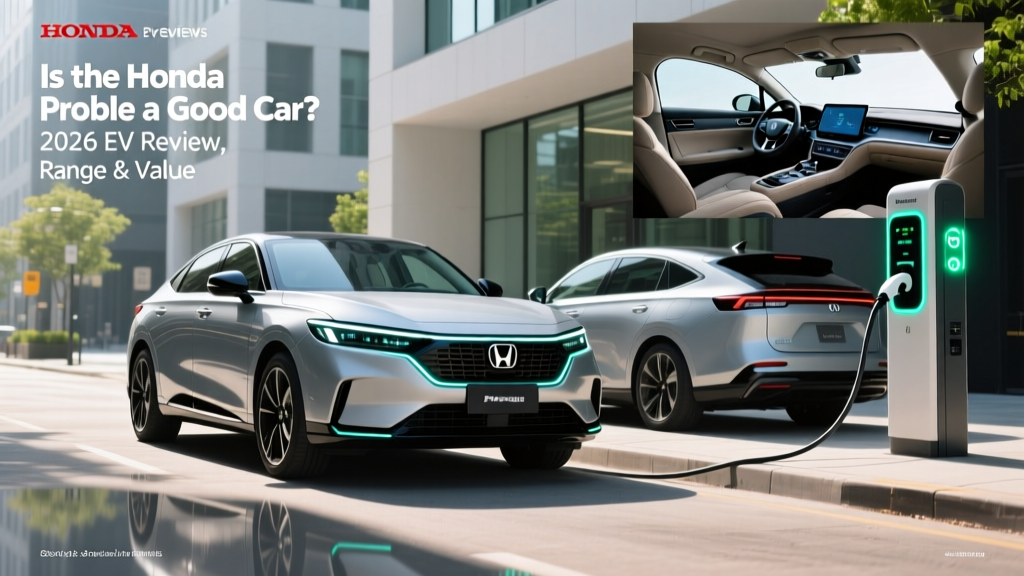
The Honda Prologue arrived as the brand's first mass-market battery-electric vehicle, built on General Motors' Ultium platform in partnership with GM. For 2026, it remains Honda's flagship EV offering — a midsize two-row SUV aimed squarely at families transitioning from the CR-V or Passport. But with the EV market now packed with competitors like the Hyundai Ioniq 5, Tesla Model Y, and Ford Mustang Mach-E, buyers are asking a fair question: is the Honda Prologue a good car for the money, or is it merely a rebadged Chevy Blazer EV with a Honda badge?
After analyzing EPA data, real-world driving impressions, charging performance, and total cost of ownership, here's our comprehensive verdict on the 2026 Honda Prologue.
2026 Honda Prologue: Core Specifications at a Glance
| Spec | EX (FWD) | Touring (AWD) |
|---|---|---|
| EPA Range | 308 miles | 281 miles |
| Battery (usable) | 85 kWh, NMC lithium-ion | 85 kWh, NMC lithium-ion |
| Horsepower / Torque | 212 hp / 236 lb-ft | 288 hp / 333 lb-ft |
| 0-60 mph | ~7.7 sec | ~6.2 sec |
| Drivetrain | Single motor, FWD | Dual motor, AWD |
| Max DC Fast Charge | 150 kW | 150 kW |
| 10-80% DC Charge Time | ~35 min | ~35 min |
| Level 2 Home Charge Rate | 11.5 kW (~32 mi/hr) | 11.5 kW (~32 mi/hr) |
| EPA Efficiency (combined) | 99 MPGe (34 kWh/100mi) | 90 MPGe (37 kWh/100mi) |
| Cargo (rear seats up / folded) | 25.2 / 57.7 cu ft | 25.2 / 57.7 cu ft |
| Rear Legroom | 39.8 in | 39.8 in |
| Base MSRP | $47,400 | $57,900 |
| Battery/Powertrain Warranty | 8 years / 100,000 miles | |
Real-World Range: What to Actually Expect
EPA Estimate: 308 miles (EX FWD) / 281 miles (Touring AWD)
Real-World Expectation: Expect 250–275 miles on mixed highway driving in moderate temperatures. In sustained 70+ mph highway use, the Prologue's boxy SUV profile and 4,600-lb curb weight push consumption higher — plan for roughly 235–255 miles of usable range before needing to charge.
Cold Weather Impact: In temperatures below 32°F, NMC batteries lose 15–25% of range. Without a standard heat pump on all trims, winter range can dip to 210–240 miles for the FWD model. Preconditioning the battery while plugged in helps mitigate this loss.
The Prologue's 85 kWh usable battery pack uses NMC (nickel manganese cobalt) chemistry, which offers strong energy density but is more temperature-sensitive than LFP alternatives found in some Tesla and Ford models. According to fueleconomy.gov, the FWD EX achieves 99 MPGe combined — respectable for a midsize SUV, but notably behind the Hyundai Ioniq 5's 114 MPGe and the Tesla Model Y's 122 MPGe.
For daily commuting under 60 miles round-trip, the Prologue's real-world range is more than adequate, requiring only every-other-day home charging. Road trippers should budget charging stops every 200–220 miles to stay in the battery's optimal 20–80% state-of-charge window.
Charging Performance: DC Fast, Level 2, and Home Setup
| Charging Level | Power (kW) | Speed (miles of range per hour) | Notes |
|---|---|---|---|
| Level 1 (120V household) | ~1.4 kW | ~3–4 mi/hr | Emergency/trickle only; full charge in 60+ hours |
| Level 2 (240V home/public) | 11.5 kW | ~32 mi/hr | Full 0–100% in ~8.5 hours; ideal overnight charging |
| DC Fast Charge (peak) | 150 kW | — | 10–80% in ~35 min; tapers significantly above 80% |
The Prologue's 150 kW peak DC fast-charging capability is its most debated specification. While competitors like the Hyundai Ioniq 5 and Kia EV6 can peak at 240 kW (on 800V architecture) and the Tesla Model Y at 250 kW, the Prologue's Ultium-based system maxes out at 150 kW on 400V architecture.
What this means in practice: at a 150 kW Electrify America or EVgo station, you'll see peak speeds only between roughly 10–40% state of charge. The charge curve tapers to ~100 kW by 60% and drops further above 80%. A 10–80% session takes approximately 35 minutes — adequate for a rest-stop break, but noticeably slower than the Ioniq 5's ~18-minute 10–80% time.
For home charging, the 11.5 kW onboard charger is competitive. On a 48-amp Level 2 circuit (requiring a 60-amp breaker), you'll add roughly 32 miles of range per hour — meaning an overnight session from 20% to full takes about 8–9 hours. Honda provides a dual-voltage portable charging cord with the vehicle, though most buyers will want a dedicated wall-mounted Level 2 unit. Budget $500–$1,200 for a quality Level 2 charger and $800–$2,000 for professional installation by a licensed electrician, depending on your panel capacity.
The Prologue uses the CCS1 connector for DC fast charging, which remains widely supported across Electrify America, EVgo, and ChargePoint networks. Honda has confirmed future NACS adapter availability for Tesla Supercharger access, though availability and pricing vary by model year.
Driving Dynamics and Performance
The Prologue's driving experience reflects its GM Ultium underpinnings — competent and comfortable rather than sporty. The single-motor FWD EX produces 212 horsepower and 236 lb-ft of torque, delivering a 0–60 mph time of approximately 7.7 seconds. That's adequate for merging and passing, but it won't win any stoplight sprints against the dual-motor Model Y or Ioniq 5.
Step up to the Touring AWD with its dual-motor setup, and you get 288 horsepower and 333 lb-ft, dropping the 0–60 time to roughly 6.2 seconds. The all-wheel-drive system provides confident traction in rain and light snow, and the additional torque makes highway overtaking noticeably easier.
Ride quality is a genuine strength. The Prologue's suspension tuning prioritizes comfort, absorbing highway expansion joints and urban potholes with a compliance that feels more premium than its platform-mate, the Chevy Blazer EV. Steering is light and low-effort — ideal for parking and city driving, if somewhat numb at highway speeds. Regenerative braking offers multiple levels selectable via steering-wheel paddles, though one-pedal driving doesn't bring the SUV to a complete stop without brake pedal input, which some EV veterans find frustrating.
Interior, Technology, and Practicality
The Prologue's cabin is where Honda's influence is most visible. An 11.3-inch touchscreen running Google Built-in (with native Google Maps, Google Assistant, and Play Store apps) anchors the dash. Wireless Apple CarPlay and Android Auto are standard on all trims. The digital instrument cluster measures 11 inches on EX and Touring trims.
Build quality is solid, with soft-touch materials on the dash and door uppers, though hard plastics appear on the lower door panels and center console — typical for this price segment. The front seats are comfortable for long drives, and rear-seat space is generous: 39.8 inches of rear legroom outpaces the Model Y and matches the Ioniq 5.
Cargo volume measures 25.2 cubic feet behind the second row and 57.7 cubic feet with the rear seats folded. There is no front trunk (frunk), a notable omission given that competitors like the Ioniq 5, Mach-E, and Model Y all offer one. The absence of a frunk costs you roughly 2–3 cubic feet of secure, weatherproof storage.
On the driver-assistance front, the Honda Sensing suite includes adaptive cruise control with low-speed follow, lane-keeping assist, traffic sign recognition, and automatic emergency braking. This is a solid SAE Level 2 driver-assist system — not self-driving. The driver must maintain steering wheel contact and visual attention at all times. It performs competently on divided highways but doesn't offer hands-free capability like GM's Super Cruise or Ford's BlueCruise, which are available on competing platforms.
Pricing, Trims, and Federal Tax Credit Eligibility
| Trim | Drivetrain | MSRP | Est. After §30D Credit* |
|---|---|---|---|
| EX | FWD | $47,400 | ~$39,900 |
| EX-L | FWD or AWD | $50,400–$52,400 | ~$42,900–$44,900 |
| Touring | AWD | $57,900 | ~$50,400 |
*Federal tax credit estimates assume full eligibility. Actual credit depends on individual tax liability and sourcing compliance.
The Prologue's pricing places it firmly in the mainstream midsize EV SUV segment. The $47,400 base EX undercuts the Touring-trim competitors but aligns closely with well-equipped Ioniq 5 and Model Y offerings.
- MSRP Cap: SUVs must have an MSRP ≤ $80,000 — all Prologue trims qualify.
- Buyer Income Cap: AGI must not exceed $150,000 (single), $225,000 (head of household), or $300,000 (joint).
- Battery Sourcing: Critical minerals and battery components must meet escalating domestic-content thresholds. As a GM-platform vehicle assembled in Mexico, the Prologue's credit eligibility depends on current-year sourcing compliance. Verify on IRS.gov's qualified vehicle list before purchasing.
- Point-of-Sale Transfer: Eligible buyers can transfer the credit to the dealer at purchase, reducing the sale price directly rather than waiting for a tax refund.
- Tax Liability: The credit is non-refundable — it can only reduce your federal tax liability to zero, not generate a refund beyond that.
Credit rules change frequently. Consult a tax professional and check the IRS qualified vehicles page for the latest eligibility.
How the Prologue Stacks Up Against Key Competitors
| Spec | Honda Prologue EX (FWD) | Hyundai Ioniq 5 SE (RWD LR) | Tesla Model Y (LR RWD) | Ford Mach-E (Select RWD) |
|---|---|---|---|---|
| EPA Range | 308 mi | 361 mi | 320 mi | 250 mi |
| Battery | 85 kWh NMC | 84 kWh NMC | ~75 kWh NMC | 75.7 kWh NMC |
| Peak DC Charge | 150 kW | 240 kW | 250 kW | 150 kW |
| 10–80% Time | ~35 min | ~18 min | ~25 min | ~38 min |
| 0–60 mph | 7.7 sec | 7.0 sec | 6.5 sec | 6.3 sec |
| MPGe (combined) | 99 | 114 | 122 | 101 |
| Cargo (rear up) | 25.2 cu ft | 27.2 cu ft | 30.2 cu ft | 29.7 cu ft |
| Base MSRP | $47,400 | $46,700 | $44,990 | $42,995 |
The competitive comparison reveals the Prologue's positioning challenge. The Ioniq 5 offers more range, dramatically faster charging, and a lower starting price. The Model Y leads in efficiency and cargo space while undercutting the Prologue on price. The Mach-E matches the Prologue's charging speed but offers more cargo room at a lower MSRP.
Where the Prologue wins is ride comfort, cabin quietness, and Honda brand loyalty — particularly among buyers who value dealer service familiarity and Honda's long-term reliability reputation. If you're coming from a CR-V or Pilot and want to stay within the Honda ecosystem, the Prologue delivers a comfortable, competent transition to electric.
Pros, Cons, and Our Verdict
- Comfortable, compliant ride quality
- Spacious rear seat (39.8" legroom)
- Google Built-in infotainment works well
- Competitive 308-mile EPA range (FWD)
- Honda dealer network for service
- 8-year/100,000-mile battery warranty
- Honda Sensing safety suite standard
- 150 kW peak DC charging is slow vs. 800V rivals
- No front trunk (frunk)
- Lower efficiency (99 MPGe) than key competitors
- No hands-free driving assist (only lane-centering ACC)
- Higher base price than Ioniq 5, Model Y, Mach-E
- One-pedal driving doesn't hold at full stop
- AWD range drops to 281 miles
The Prologue is a good EV, not a great one. It excels as a comfortable, practical daily driver for Honda-loyal families who prioritize ride quality and dealer familiarity over spec-sheet dominance. If you charge primarily at home, drive under 250 miles daily, and value cabin comfort over 0–60 times, the Prologue serves well.
However, if fast DC charging for road trips, maximum efficiency, or cutting-edge tech are priorities, the Hyundai Ioniq 5 and Tesla Model Y offer more capability for less money. The Prologue's 150 kW charging ceiling and 99 MPGe efficiency are its most significant competitive gaps in 2026.
Choose the Prologue if: You want a comfortable, quiet family SUV from a brand you trust, you charge at home nightly, and road-trip charging speed is secondary.
Look elsewhere if: You road-trip frequently (Ioniq 5's 240 kW charging saves real time), you want maximum cargo space (Model Y), or you're budget-conscious (Mach-E).
Frequently Asked Questions
What is the real-world range of the Honda Prologue?
The EPA rates the FWD Prologue EX at 308 miles and the AWD Touring at 281 miles. In real-world mixed driving at moderate temperatures, expect 250–275 miles (FWD) or 230–255 miles (AWD). Highway-heavy driving at 75+ mph and cold weather below freezing will reduce range by 15–25%.
How fast does the Honda Prologue charge?
On a DC fast charger, the Prologue peaks at 150 kW and charges from 10–80% in approximately 35 minutes. At home on a Level 2 (240V, 48-amp) charger, it adds about 32 miles of range per hour, reaching a full charge in roughly 8.5 hours. Level 1 (120V) charging is extremely slow at 3–4 miles per hour and is only practical for emergencies or low-mileage days.
Does the Honda Prologue qualify for the federal EV tax credit?
The Prologue's MSRP falls under the $80,000 SUV cap, and buyer income limits apply ($150K single / $300K joint). However, battery sourcing and critical-mineral requirements under IRS §30D determine the actual credit amount, which can range from $3,750 to $7,500 depending on current-year compliance. Because the Prologue is assembled in Mexico on a GM platform, eligibility can shift as sourcing rules tighten. Always verify on the fueleconomy.gov tax credit page and consult a tax professional before purchasing.
Is the Honda Prologue worth buying over the Hyundai Ioniq 5 or Tesla Model Y?
It depends on your priorities. The Ioniq 5 offers more range (361 mi), much faster charging (240 kW peak, ~18 min 10–80%), and a lower starting price — making it the spec-sheet winner. The Model Y leads in efficiency (122 MPGe), cargo space (30.2 cu ft), and Supercharger network access. The Prologue wins on ride comfort, cabin quietness, and Honda brand familiarity. If comfort and dealer trust outweigh charging speed and efficiency, the Prologue is worth considering. If you road-trip often or want the best value per mile, the Ioniq 5 and Model Y are stronger picks.
Does the Prologue have a frunk (front trunk)?
No. The Prologue does not include a front trunk, which is a notable omission in this segment. Competitors like the Ioniq 5 (0.85 cu ft), Model Y (4.1 cu ft), and Mach-E (4.7 cu ft) all offer frunk storage for charging cables, groceries, or secure small items.
What is the battery warranty on the Honda Prologue?
Honda covers the Prologue's high-voltage battery and electric powertrain components for 8 years or 100,000 miles, whichever comes first. This warranty covers defects and excessive capacity loss (typically defined as dropping below 70% state of health). This matches the industry-standard EV battery warranty and aligns with competitors like Hyundai (10yr/100K) and Tesla (8yr/120K).