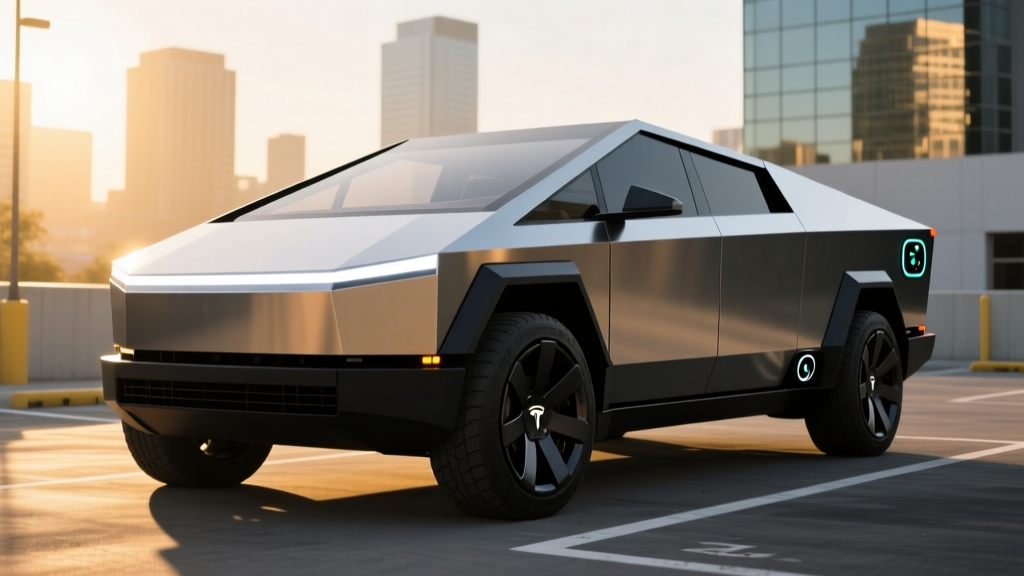
The Tesla Cybertruck defies conventional pickup proportions. Its angular stainless-steel exoskeleton and vault-like bed create a footprint that's simultaneously compact for a full-size truck and massive in curb weight. For buyers researching Tesla Cybertruck dimensions — whether to confirm garage fitment, bed utility, or towing practicality — the numbers tell a story of engineering trade-offs that directly affect daily usability.
This review covers every critical dimension alongside the powertrain specs, charging behavior, and ownership economics that determine whether the Cybertruck fits your life, not just your driveway.
Exterior Dimensions and Garage Fitment
At 231.7 inches long, 79.8 inches wide (excluding mirrors), and 70.5 inches tall, the Cybertruck sits between mid-size and full-size pickups in overall length but pushes full-size width. The wheelbase measures 143.5 inches.
| Measurement | Cybertruck AWD | Cybertruck Cyberbeast | Ford F-150 Lightning (Ref) |
|---|---|---|---|
| Overall Length | 231.7 in | 231.7 in | 232.7 in |
| Overall Width (no mirrors) | 79.8 in | 79.8 in | 79.9 in |
| Overall Width (mirrors out) | 95.0 in | 95.0 in | 96.8 in |
| Overall Height | 70.5 in | 70.5 in | 78.3 in |
| Wheelbase | 143.5 in | 143.5 in | 145.5 in |
| Ground Clearance (max) | 16.0 in | 16.0 in | 8.9 in |
| Curb Weight | 6,603 lbs | 6,843 lbs | 6,171 lbs |
| Approach Angle | 35° | 35° | 24.4° |
| Departure Angle | 34° | 34° | 23.6° |
The Cybertruck is roughly one inch shorter and nearly eight inches lower than the F-150 Lightning, which helps with garage door clearance. Most standard 7-foot-tall garage doors accommodate the Cybertruck's 70.5-inch roof height with room to spare. However, the 95-inch mirror-out width demands careful positioning in narrow single-car garages.
Ground clearance is a standout: the adaptive air suspension provides up to 16 inches (in Extract mode), surpassing most off-road-oriented trucks and making the Cybertruck genuinely capable on rough terrain. Approach and departure angles of 35° and 34° respectively rival purpose-built off-roaders.
Bed, Cargo, and Interior Dimensions
The Cybertruck's 6-foot composite bed (officially 72.0 inches long, 43.0 inches wide between wheel wells) is shorter than a traditional 6.5-foot truck bed. Total bed volume is rated at 54.9 cubic feet with the tonneau closed. The powered stainless-steel tonneau — which Tesla calls the "sail" — retracts automatically and supports up to 300 lbs of distributed load on top.
| Dimension | Cybertruck |
|---|---|
| Bed Length | 72.0 in |
| Bed Width (between wells) | 43.0 in |
| Bed Volume (tonneau closed) | 54.9 cu ft |
| Front Trunk (Frunk) | 7.1 cu ft |
| Gear Locker (under-bed) | 5.3 cu ft |
| Front Headroom | 40.3 in |
| Rear Headroom | 38.4 in |
| Front Legroom | 41.0 in |
| Rear Legroom | 38.2 in |
| Seating Capacity | 5 (2+3) |
Interior space is adequate but not class-leading. Rear legroom at 38.2 inches falls short of the F-150 Lightning's 43.6 inches, and the rear bench sits relatively upright. Three adults across the back is tight. The 7.1-cubic-foot frunk handles charging cables and groceries, while the lockable 5.3-cubic-foot gear locker beneath the bed floor adds secure, weatherproof storage.
A notable dimension constraint: the 43-inch width between wheel wells means standard 4×8-foot plywood sheets cannot lie flat — they must ride on top of the wheel wells or angle in. For contractors who rely on flat-floor sheet goods transport, this is a functional limitation.
Range, Battery, and Efficiency
The Cybertruck AWD carries a roughly 123-kWh (usable) NMC (nickel manganese cobalt) battery pack and achieves an EPA-estimated 340 miles of range. The tri-motor Cyberbeast variant drops to 320 miles EPA due to the additional front motor's weight and drag.
EPA Sticker: 340 mi (AWD) / 320 mi (Cyberbeast)
Highway (70-75 mph): Expect ~260–285 mi in moderate temps
City/Mixed: ~300–320 mi with regen braking
Cold Weather (below 30°F): ~220–260 mi depending on cabin heat use and preconditioning
Towing (5,000-lb trailer): ~150–180 mi
The Cybertruck's 6,600+ lb curb weight and slab-sided aerodynamics (drag coefficient ~0.38 Cd) punish highway efficiency. Cold weather compounds the loss — the stainless steel body has no inherent insulation advantage, and heating a large cabin draws significant energy.
Efficiency lands at approximately 58 MPGe combined (AWD), or about 58 kWh per 100 miles — among the least efficient EVs on the market. For context, a Rivian R1T achieves roughly 70 MPGe combined. If electricity costs $0.15/kWh at home, expect to spend about $8.70 per 100 miles driven; on DC fast chargers averaging $0.40/kWh, that jumps to roughly $23.20 per 100 miles.
| Spec | AWD | Cyberbeast |
|---|---|---|
| Battery (usable) | ~123 kWh (NMC) | ~123 kWh (NMC) |
| EPA Range | 340 mi | 320 mi |
| MPGe (combined) | 58 MPGe | 56 MPGe |
| kWh/100 mi | 58 | 60 |
| Motors | Dual (AWD) | Tri (AWD) |
| Horsepower | 600 hp | 845 hp |
| 0–60 mph | 3.9 sec | 2.6 sec |
| Top Speed | 112 mph | 130 mph |
| Max Towing | 11,000 lbs | 11,000 lbs |
| Payload | 2,500 lbs | 2,500 lbs |
Charging Speed and Infrastructure
The Cybertruck supports an 800-volt architecture and can accept up to 350 kW at a V4 Tesla Supercharger. In controlled testing, a 10–80% charge completes in approximately 20–24 minutes, though sustained peak rates taper significantly above 60% state of charge (SoC).
| Level | Power / Rate | Time / Miles Added |
|---|---|---|
| Level 1 (120V, 12A) | ~1.4 kW | ~3 mi/hr — not practical for daily use |
| Level 2 (240V, 48A) | 11.5 kW | ~29 mi/hr; full charge in ~11 hours |
| DC Fast (V4 Supercharger) | Up to 350 kW peak | 10–80% in ~20–24 min; adds ~150 mi in 10 min at peak |
| DC Fast (non-Tesla 350 kW) | Up to 250 kW (with adapter) | 10–80% in ~28–32 min |
At home on a 48-amp Level 2 circuit (requiring a 60-amp breaker), you'll recover roughly 29 miles of range per hour. A full overnight charge from 10% to 100% takes about 11 hours — plan accordingly. The Cybertruck ships with a NACS (North American Charging Standard) port natively, granting full access to Tesla's Supercharger network without adapters. For Electrify America or other CCS networks, Tesla's CCS adapter (sold separately) is required, though charge rates may cap lower than V4 Supercharger speeds.
Preconditioning the battery before arriving at a Supercharger — triggered automatically when you navigate to a charger in the Tesla app — is essential for achieving peak charge rates, especially in cold weather. Skipping preconditioning can add 10+ minutes to a fast-charge session.
Pricing, Tax Credits, and Ownership Cost
The Cybertruck lineup starts at $79,990 for the dual-motor AWD, climbs to $99,990 for the tri-motor Cyberbeast, and tops out with the limited Foundation Series packages (no longer available for new orders as of late 2025). All trims exceed the IRS §30D MSRP cap of $80,000 for pickup trucks.
| Trim | Base MSRP | §30D Federal Credit | Effective Price |
|---|---|---|---|
| AWD | $79,990 | $0 (exceeds $80K truck cap by destination fees) | $79,990 + dest. |
| Cyberbeast | $99,990 | $0 (exceeds cap) | $99,990 + dest. |
Important tax credit caveat: Under current IRS §30D rules, new clean pickup trucks must have an MSRP at or below $80,000 to qualify for the federal credit. The Cybertruck AWD's $79,990 base price is technically under the cap, but destination and delivery charges (typically $1,995–$3,495) push the effective MSRP above $80,000 in most configurations, disqualifying it. The Cyberbeast is well above the threshold. Buyers should verify final eligibility with a tax professional before purchase.
Income caps also apply: modified adjusted gross income (MAGI) must not exceed $150,000 (single), $225,000 (head of household), or $300,000 (joint filers). Battery critical-mineral and North American assembly sourcing requirements add further complexity — consult the latest fueleconomy.gov listings for current eligibility.
Purchase: $79,990 | Insurance (avg): ~$3,200/yr | Electricity (home + DCFC mix): ~$1,900/yr
Maintenance: ~$400/yr | Depreciation (est. 50% over 5 yr): ~$40,000
Estimated 5-year total: ~$141,000 (before any state/local incentives)
Technology, Driver Assistance, and Drawbacks
The Cybertruck runs Tesla's latest infotainment on an 18.5-inch front touchscreen and a 9.4-inch rear display. The interface handles media, navigation, climate, vehicle settings, and a built-in dashcam/sentry-mode system. There are no physical buttons — wipers, glovebox, and mirror adjustments all route through the screen or steering-wheel controls.
Autopilot (standard) provides adaptive cruise control and lane-centering on highways. Full Self-Driving (Supervised), a $8,000 add-on or $99/month subscription, extends to city-street navigation, traffic-light recognition, and automatic parking. Both systems are SAE Level 2 — the driver must remain attentive with hands on the steering wheel at all times.
Autopilot and FSD (Supervised) are driver-assistance systems, not self-driving. The driver is fully responsible for vehicle operation, must monitor the road continuously, and must be prepared to take over instantly. Tesla's "Supervised" branding reflects this requirement. No consumer Tesla vehicle offers Level 3 or higher autonomy.
Notable drawbacks worth flagging:
- Visibility: The angular A-pillars and lack of a rear windshield (replaced by a camera feed) create significant blind spots. The camera-based rearview mirror takes adjustment.
- Ride quality: Despite adaptive air suspension, the 6,600+ lb curb weight and stiff stainless-steel body transmit road imperfections more than unibody trucks. Rear-seat passengers notice this most.
- Panel gaps and build quality: Early-production Cybertrucks drew widespread criticism for uneven panel gaps and trim issues. Tesla has improved consistency through 2025–2026 production, but inspect any delivery carefully.
- Bed limitations: The 43-inch width between wheel wells, 2,500-lb payload (low for the class), and composite bed liner (no spray-in option) limit work-truck utility.
- No Apple CarPlay or Android Auto: Tesla's closed ecosystem means no smartphone mirroring — a dealbreaker for some.
Warranty Coverage
| Component | Coverage |
|---|---|
| Basic Vehicle | 4 years / 50,000 miles |
| Battery & Drive Unit | 8 years / 120,000 miles (min 70% retention) |
| Restraint System | 5 years / 60,000 miles |
| Corrosion (body) | 12 years / unlimited miles (perforation only) |
The 8-year/120,000-mile battery warranty guarantees at least 70% capacity retention. Tesla's NMC chemistry typically degrades 10–15% over the first 100,000 miles based on fleet data from Model S/X, though the Cybertruck's heavier cycling demands (more kWh consumed per mile) could accelerate wear if frequently DC-fast-charged to 100%. Best practice: charge to 80–90% daily and reserve 100% for road trips.
For detailed safety ratings, check NHTSA's Cybertruck page and IIHS for crash-test results as they become available.
Who Should Buy the Cybertruck?
- You want a statement vehicle with genuine off-road capability (16" clearance, 35° approach)
- You need 11,000-lb towing capacity with electric torque delivery
- You have home Level 2 charging and primarily drive under 250 miles/day
- You value Supercharger network access for road trips
- Acceleration thrills (2.6-sec Cyberbeast) matter more than efficiency
- You need a flat 4×8 bed floor for work (Rivian R1T or F-150 Lightning are better)
- Efficiency and low operating costs are priorities (R1T and Lightning outperform)
- Rear-seat comfort for adults is essential (Lightning's back seat is far roomier)
- You want the $7,500 federal tax credit (the Cybertruck effectively doesn't qualify)
- Build-quality consistency is a top concern
Frequently Asked Questions
What is the real-world range of the Tesla Cybertruck?
The EPA rates the AWD at 340 miles and the Cyberbeast at 320 miles. In real-world highway driving at 70–75 mph, expect 260–285 miles. Cold weather (below 30°F) can drop range to 220–260 miles. Towing a 5,000-lb trailer cuts range roughly in half, to 150–180 miles.
How fast does the Cybertruck charge at home and on the road?
At home on a 48-amp Level 2 charger (240V), the Cybertruck adds about 29 miles per hour and fully charges in roughly 11 hours. On a Tesla V4 Supercharger, it peaks at 350 kW and charges from 10–80% in approximately 20–24 minutes. Non-Tesla DC fast chargers with the CCS adapter may peak around 250 kW.
Does the Cybertruck qualify for the federal EV tax credit?
Effectively, no. While the AWD's $79,990 base MSRP is technically under the $80,000 truck cap, destination fees push most configurations above the threshold. The Cyberbeast at $99,990 is well above. Additionally, buyer income caps ($150K single / $300K joint) and battery-sourcing requirements apply. Consult a tax professional and check IRS §30D guidance for your specific situation.
Is the Cybertruck worth buying vs. the Rivian R1T or F-150 Lightning?
The Cybertruck wins on Supercharger access, off-road ground clearance (16 inches), and acceleration (2.6 sec Cyberbeast). The Rivian R1T offers a more usable bed (including the Gear Tunnel), better efficiency (~70 MPGe), more rear-seat room, and qualifies for the $7,500 federal credit. The F-150 Lightning provides a traditional truck experience with a full-size bed, more rear legroom, and available Pro Power Onboard. If work utility and efficiency matter, the R1T or Lightning are stronger choices. If you want the Tesla ecosystem and head-turning design, the Cybertruck is unique.
What are the biggest pros and cons?
Pros: Supercharger network, 11,000-lb towing, 16-inch ground clearance, tri-motor performance, stainless-steel body durability, NACS native charging, over-the-air updates.
Cons: Poor efficiency (58 MPGe), no federal tax credit, limited bed width (43" between wells), tight rear seat, no rear windshield, camera-dependent visibility, high insurance costs, no CarPlay/Android Auto.
Will the Cybertruck fit in my garage?
At 70.5 inches tall, it clears most standard 7-foot garage doors. At 231.7 inches long (19.3 feet), you'll need a garage at least 20 feet deep. Width at 95 inches (mirrors out) requires a single-car garage at least 10 feet wide for comfortable entry. Measure your space before ordering.