Quick Answer: Is There a Honda EV Civic?
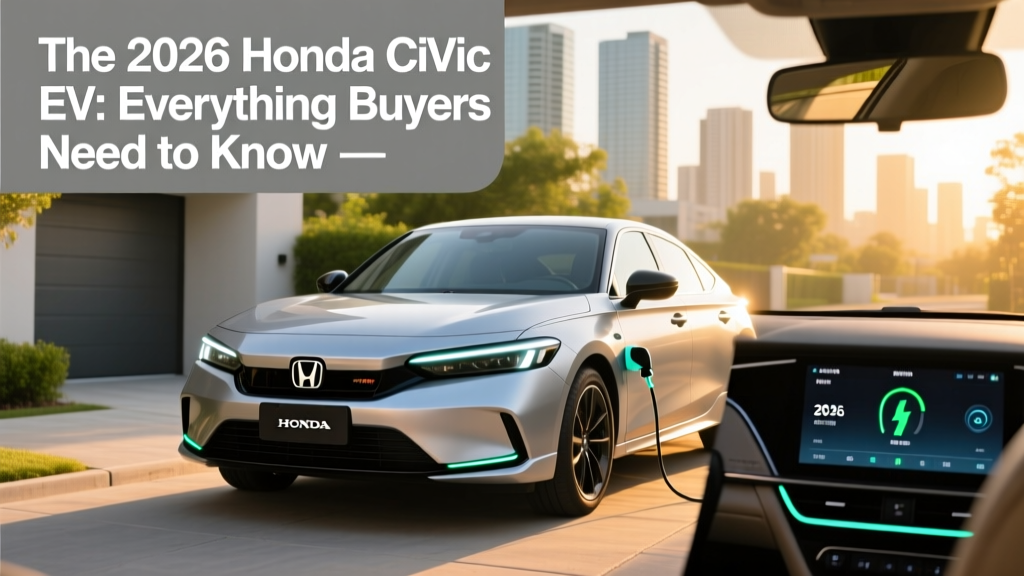
As of early 2026, Honda has not released a dedicated battery-electric Civic in the United States. The closest equivalent is the Honda e:Ny1 (an electric compact SUV based on the HR-V platform) available in Europe, and the upcoming Honda 0 Series sedans slated for 2026–2027. US buyers seeking an electrified Civic currently choose between the Civic Hybrid (49 MPG combined) or cross-shop against competitors like the Hyundai Ioniq 6 or Tesla Model 3. If Honda brings a Civic EV stateside, expect ~250–300 miles of EPA range, a ~68 kWh battery, and a starting MSRP near $35,000–$40,000.
The Current State of Honda's Electric Lineup
Honda's EV strategy has been deliberate rather than aggressive. The Prologue, a midsize SUV built on GM's Ultium platform, launched for the 2024 model year and remains Honda's only battery-electric vehicle (BEV) sold in the US. The compact Honda e was never offered stateside and has been discontinued globally.
For the Civic nameplate specifically, Honda offers the Civic Hybrid — a conventional hybrid (HEV) that pairs a 2.0L Atkinson-cycle engine with a two-motor system producing 200 hp and delivering an EPA-estimated 49 MPG combined (50 city / 47 highway) per fueleconomy.gov. This is not a plug-in vehicle and has no electric-only range.
Honda's next-generation EVs will ride the company's proprietary e:Architecture, debuting with the Honda 0 Series. The first models — the Saloon sedan and Space-Hub minivan concept — are expected for the 2027 model year. A compact sedan in the Civic segment could follow, but Honda has not confirmed an "EV Civic" by name for the US market.
Civic Hybrid vs. Competitor EVs: The Numbers
If you're searching for an "EV Civic," you're likely weighing whether to buy a Civic Hybrid or look at a full battery-electric sedan from another brand. Here's how the math works:
| Spec | Honda Civic Hybrid (Sport Touring) | Tesla Model 3 (Long Range) | Hyundai Ioniq 6 (SEL) |
|---|---|---|---|
| Powertrain | 2.0L HEV (no plug) | BEV (dual motor AWD) | BEV (RWD) |
| EPA Range / MPG | 49 MPG combined | 363 mi (EPA) | 361 mi (EPA) |
| Battery / Fuel | ~1.1 kWh (non-plug) | 75 kWh usable (NMC) | 77.4 kWh usable (NMC) |
| 0–60 mph | ~7.2 sec | 4.2 sec | 6.1 sec |
| Peak DC Charge | N/A | 250 kW | 233 kW |
| 10–80% Charge Time | N/A | ~25 min | ~18 min |
| Base MSRP | $31,450 | $42,380 | $38,650 |
| Federal Tax Credit (§30D) | Not eligible (HEV) | Up to $7,500* | Up to $7,500* |
* §30D credit eligibility depends on buyer income, MSRP caps, and battery-critical-mineral sourcing requirements per IRS rules. Always verify current-year eligibility with a tax professional.
Real Costs: Civic Hybrid vs. Going Full Electric
The purchase price is only the start. Here's a 5-year ownership comparison assuming 15,000 miles per year, a national average gas price of $3.40/gallon, and residential electricity at $0.16/kWh.
| Cost Category | Civic Hybrid | Tesla Model 3 LR | Ioniq 6 SEL |
|---|---|---|---|
| Purchase (MSRP) | $31,450 | $42,380 | $38,650 |
| Tax Credit Applied | $0 | –$7,500 | –$7,500 |
| Effective Purchase | $31,450 | $34,880 | $31,150 |
| Fuel / Electricity (5 yr) | $5,200 | $4,800 | $4,600 |
| Maintenance (5 yr) | $2,800 | $1,500 | $1,600 |
| Insurance (5 yr est.) | $7,500 | $9,800 | $8,400 |
| Total 5-Year | $46,950 | $50,980 | $45,750 |
Key takeaway: The Civic Hybrid's lower purchase price keeps its 5-year total competitive. The Ioniq 6 closes the gap with the tax credit and lower fueling costs, but higher insurance premiums on EVs partially offset savings. Your local electricity rate and driving distance shift these numbers significantly — home charging at $0.10/kWh makes EVs cheaper; relying on public DC fast charging at $0.35–$0.48/kWh makes them more expensive than the hybrid.
What a First-Time EV Buyer Should Know
If you're considering stepping past the Civic Hybrid into a full BEV, these realities matter more than marketing claims:
Home Charging Is the Deciding Factor
Over 80% of EV charging happens at home. A Level 2 home charger (240V, 7–11 kW) adds roughly 30–44 miles of range per hour and costs $800–$2,500 installed, depending on whether your electrical panel needs an upgrade. If you live in an apartment without charging access or lack a garage, public charging becomes your primary source — and that costs 2–4× more per mile than home charging.
Real-World Range Is Not the EPA Sticker
EPA range figures assume mixed driving at moderate temperatures. Expect 10–15% range loss at sustained highway speeds (75+ mph) and 20–35% loss in freezing weather (below 32°F) due to cabin heating and battery chemistry limitations. A 360-mile EPA-rated EV may deliver 240–270 real miles on a cold winter road trip.
Charging Speeds Taper Above 80%
Peak DC fast-charge rates (e.g., 250 kW) apply only at low state of charge. Charging slows dramatically above 80% SoC to protect the battery. A "25-minute 10–80% charge" may require 45+ minutes to reach 100%. Plan road trips around 80% charges, not full fills.
| Myth | Fact |
|---|---|
| "Honda sells an electric Civic in the US" | Not as of 2026. The Civic Hybrid is an HEV; the Prologue is Honda's only US BEV. |
| "EVs cost less to own than any hybrid" | Depends on electricity cost, insurance, and annual mileage. Hybrids can win for apartment dwellers. |
| "The battery will need replacing" | Modern NMC and LFP batteries retain 85–90% capacity after 150,000 miles. Honda's EV battery warranty covers 8 years/100,000 miles minimum. |
| "EVs are zero-emission" | Tailpipe-emission-free, yes. Upstream emissions depend on your grid's energy mix. |
Decision Framework: Which Electrified Civic Path Is Right for You?
Choose the Civic Hybrid if:
- You lack reliable home or workplace Level 2 charging access
- Your budget is under $35,000 before incentives
- You take frequent long road trips through areas with sparse DC fast-charging infrastructure
- You live in a region with extreme cold (sub-zero winters) where BEV range loss is significant
- You want the lowest-risk entry into electrified driving with no charging behavior change
Choose a Competitor EV (Model 3, Ioniq 6, etc.) if:
- You have a garage or dedicated parking with Level 2 charging access
- You qualify for the full §30D federal tax credit (income under $150K single / $300K joint, vehicle MSRP under $55K sedan cap)
- Your daily commute is under 100 miles round-trip (covers most US drivers)
- You want the lowest per-mile fueling cost and minimal maintenance (no oil changes, fewer brake replacements due to regenerative braking)
- You're willing to pay a higher upfront price for lower operating costs over 5–10 years
Wait for a Honda Civic EV if:
- You want a Honda-badged BEV specifically and can wait until 2027–2028
- You want Honda's dealer network for service and warranty support on an EV
- You're loyal to the Civic's driving dynamics and interior layout
The Bottom Line
Searching for an "EV Civic" in 2026 means making a choice Honda hasn't yet made for you. The Civic Hybrid delivers outstanding efficiency (49 MPG) at an accessible price with zero lifestyle changes. Full battery-electric sedans from Tesla, Hyundai, and others offer longer electric range, faster performance, and lower operating costs — but require home charging access and a higher effective budget when insurance is factored in.
Honda's 0 Series EVs will eventually fill this gap, likely starting with a larger sedan before a compact Civic-class EV arrives. Until then, the data says: buy the Civic Hybrid if charging access is uncertain, or cross-shop the Ioniq 6 and Model 3 if you're ready for a full BEV and qualify for the tax credit.
Will Honda release an electric Civic?
Honda has not confirmed a Civic-branded EV for the US market. The Honda 0 Series sedan (expected 2027) may fill a similar segment, and a compact EV could follow by 2028–2029.
Is the Civic Hybrid a plug-in?
No. The 2026 Civic Hybrid is a conventional hybrid (HEV). It cannot be plugged in and has no electric-only driving range. It recovers energy through regenerative braking and the gasoline engine.
How much would a Honda EV Civic cost?
Based on Honda's pricing strategy and competitor benchmarks, a future Civic-class EV would likely start between $35,000 and $40,000 MSRP, potentially qualifying for the §30D federal tax credit of up to $7,500.
Does the Civic Hybrid qualify for any tax credits?
No. The §30D federal clean vehicle credit applies only to plug-in vehicles (BEVs and PHEVs) meeting battery-sourcing requirements. Conventional hybrids like the Civic Hybrid are not eligible.
What's the most fuel-efficient Civic I can buy?
The 2026 Civic Hybrid Sport Touring at 49 MPG combined is the most efficient Civic available. It saves approximately $600–$800 per year in fuel costs compared to the standard 1.5T Civic (33 MPG combined) at 15,000 miles/year.