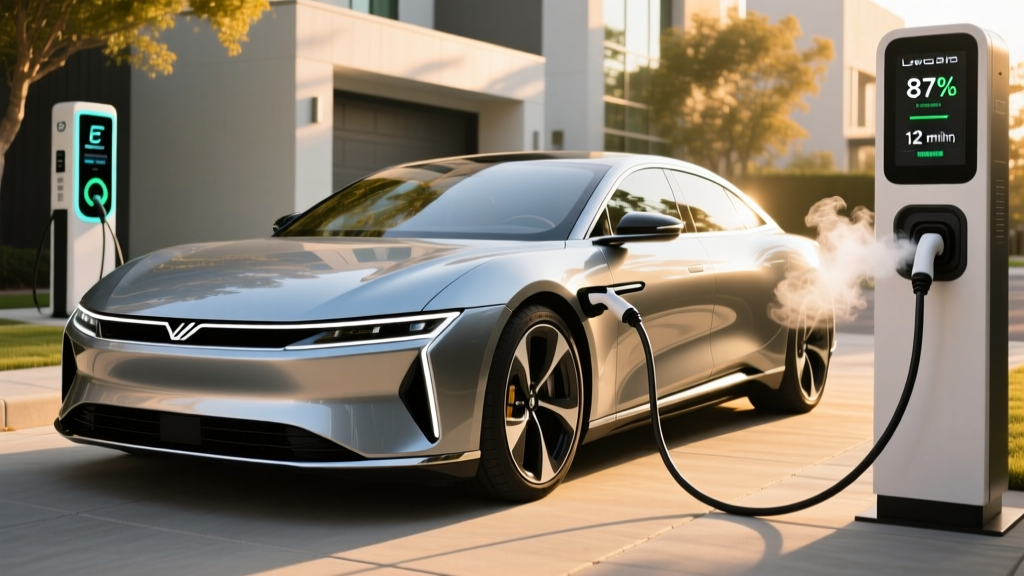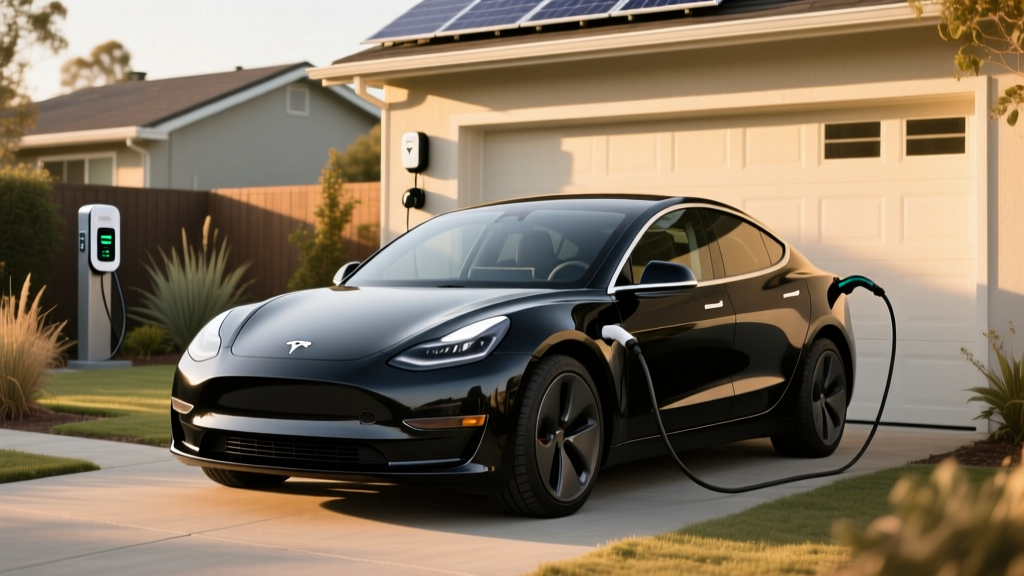
If you're researching a home Tesla setup — meaning a Tesla you'll charge primarily at your house — the 2026 Model 3 remains the benchmark most buyers measure everything else against. After living with the refreshed "Highland" Model 3 Long Range AWD for several months, including cold-weather driving and multiple road trips, here's the data-driven breakdown of what ownership actually looks like when your daily routine revolves around plugging in at home.
Real-World Range vs. EPA Sticker
EPA Estimated Range: 341 miles (Long Range AWD) | 272 miles (RWD)
What to actually expect: In mixed suburban/highway driving at 65-75 mph and moderate temperatures (50-75°F), plan on 290-315 miles from the Long Range AWD. On a pure 75-mph highway run, expect 270-290 miles. In freezing weather (below 32°F), range drops 15-25%, meaning a realistic winter highway range of roughly 220-250 miles. The heat pump helps, but physics wins in deep cold.
2026 Tesla Model 3 Core Specifications
| Specification | RWD | Long Range AWD | Performance |
|---|---|---|---|
| EPA Range | 272 mi | 341 mi | 315 mi |
| Battery (usable) | ~60 kWh (LFP) | ~82 kWh (NMC) | ~82 kWh (NMC) |
| Drivetrain | Rear-Wheel Drive | Dual-Motor AWD | Dual-Motor AWD |
| Horsepower | 271 hp | 346 hp | 510 hp |
| 0-60 mph | 5.8 sec | 4.2 sec | 2.9 sec |
| MPGe (combined) | 132 MPGe | 131 MPGe | 119 MPGe |
| kWh/100 mi | 25 | 26 | 28 |
| Max DC Fast Charge | 170 kW | 250 kW | 250 kW |
| 10-80% DCFC Time | ~25 min | ~18 min | ~18 min |
| Level 2 (11.5 kW AC) | ~30 mi/hr | ~44 mi/hr | ~44 mi/hr |
| Cargo Volume | 23 cu ft (rear trunk) + 3.1 cu ft (frunk) | ||
| Rear Legroom | 35.2 in | ||
| Base MSRP (2026) | $38,990 | $45,740 | $52,990 |
| Battery Warranty | 8 years / 120,000 miles (Long Range & Performance) / 100,000 mi (RWD) | ||
Source: fueleconomy.gov and Tesla Model 3 specs.
Charging at Home: What a Home Tesla Setup Actually Requires
The biggest ownership advantage of any EV is waking up to a full "tank" every morning — but only if your home charging is properly configured. Here's what a home Tesla charging setup looks like in practice:
| Charging Level | Power | Speed (Long Range AWD) | Daily Practicality |
|---|---|---|---|
| Level 1 (120V outlet) | ~1.4 kW | ~4-5 mi/hr | Emergency only; ~50 mi overnight |
| Level 2 (240V, 32A) | 7.7 kW | ~30 mi/hr | Adequate for most daily commutes |
| Level 2 (240V, 48A — Tesla Wall Connector) | 11.5 kW | ~44 mi/hr | Ideal; full charge in ~7-8 hours |
| DC Fast Charge (Supercharger V3/V4) | Up to 250 kW | ~170 mi in 15 min | Road trips; not for daily use |
The kW vs kWh distinction matters here: Your home Wall Connector delivers up to 11.5 kW (power/flow rate) into an 82 kWh (energy/tank size) battery. Think of kW as how fast the hose fills the tank, and kWh as the tank's total capacity.
Home Installation Cost Breakdown
| Item | Typical Cost Range |
|---|---|
| Tesla Wall Connector (hardwired) | $425-$475 |
| Electrician: 240V/60A circuit run (50 ft avg) | $800-$2,500 |
| Panel upgrade (if needed, 100A→200A) | $1,500-$3,500 |
| Permit & inspection | $100-$400 |
| Total (no panel upgrade) | $1,325-$3,375 |
| Total (with panel upgrade) | $2,825-$6,875 |
Most homes with a 200-amp panel and a garage or carport within 50 feet of the panel will land in the $1,500-$2,500 range. Always get a quote from a licensed electrician — older homes with 100-amp panels may require an upgrade that doubles or triples the cost. Some utilities offer rebates of $250-$1,000 for Level 2 installations; check with your local provider.
Charging Curve Reality
On a V3 or V4 Supercharger, the Long Range AWD peaks at 250 kW, but only between roughly 10-30% State of Charge (SoC). The charge curve tapers progressively: by 60% SoC you're seeing ~120 kW, and above 80% it drops below 50 kW. This is why Tesla (and every other manufacturer) quotes 10-80% times rather than 0-100%. Charging from 80-100% on DCFC can take as long as 10-80%. For daily home charging, this taper doesn't matter — you plug in overnight and wake up full.
Efficiency and Running Costs
The Model 3 Long Range AWD achieves 131 MPGe combined, translating to 26 kWh per 100 miles, according to the EPA. That makes it one of the most efficient EVs in its class. At the U.S. average residential electricity rate of ~$0.17/kWh (early 2026), fueling costs roughly $4.42 per 100 miles. Compare that to a 30-MPG gas car at $3.30/gallon: $11.00 per 100 miles. The home-charging advantage is substantial.
On public DC fast chargers, costs vary wildly — Tesla Superchargers average $0.28-$0.38/kWh depending on location and time of day, making road-trip fueling closer to $7-$10 per 100 miles. Still cheaper than gas, but the home-charging discount is where the real savings live.
Performance and Driving Impressions
The Long Range AWD's dual-motor setup produces 346 hp and delivers a 4.2-second 0-60 mph time. Instant torque means real-world acceleration feels even quicker than the number suggests — merging onto highways and passing on two-lanes is effortless. The Highland refresh improved ride quality noticeably: the suspension absorbs road imperfections better than the pre-2024 model, and cabin noise is significantly reduced thanks to acoustic glass and additional insulation.
Regenerative braking remains strong and predictable. Tesla removed the adjustable regen setting several years ago, but the single calibration is well-tuned for one-pedal driving in most scenarios. You'll still use the brake pedal for complete stops and low-speed maneuvering.
Autopilot and FSD (Supervised)
SAE Automation Level: Tesla Autopilot and FSD (Supervised) are Level 2 driver-assistance systems. The driver must remain fully engaged — eyes on the road, hands available to steer — at all times. These are NOT self-driving systems. Level 4 (genuine driverless operation) currently exists only in geofenced robotaxi services like Waymo in select cities.
Standard Autopilot (included) handles lane-centering and adaptive cruise competently on highways. FSD (Supervised), which costs $8,000 upfront or $99/month as of 2026, adds city-street navigation, traffic-light recognition, and more assertive lane changes. It's impressive in well-mapped suburban areas but still requires constant vigilance — unexpected construction zones, faded lane markings, and complex intersections demand immediate driver takeover. For most buyers, standard Autopilot is sufficient; FSD is an enthusiast add-on, not a necessity.
Pricing, Trims, and Federal Tax Credit Eligibility
| Trim | Base MSRP | As-Tested (typical options) | §30D Credit Eligible? | Effective Price (if eligible) |
|---|---|---|---|---|
| RWD | $38,990 | $40,490 (w/ paint + wheels) | Yes (subject to rules) | ~$32,990 |
| Long Range AWD | $45,740 | $48,240 (w/ paint + FSD) | Yes (subject to rules) | ~$40,740 |
| Performance | $52,990 | $55,490 | Yes (subject to rules) | ~$47,990 |
Federal Tax Credit: §30D Eligibility Checklist
The Model 3 qualifies for up to $7,500 under IRS §30D, but eligibility depends on several conditions that change periodically:
- MSRP Cap: Vehicle base price must be ≤$55,000 (sedans). All 2026 Model 3 trims qualify.
- Buyer Income Cap: Modified AGI ≤$150,000 (single), $225,000 (head of household), $300,000 (joint). Exceed these and you're ineligible.
- Battery Sourcing: Critical minerals and battery components must meet escalating domestic/free-trade-partner thresholds. Tesla sources LFP cells from CATL (China) for the RWD model, which may affect credit qualification — verify current-year status on the IRS clean vehicle credit page before purchasing.
- Point-of-Sale Transfer: As of 2024+, you can transfer the credit to the dealer at purchase, reducing the purchase price by $7,500 at the point of sale rather than waiting for a tax refund.
- Tax Liability: If claiming on your tax return (not point-of-sale), you must owe at least $7,500 in federal income tax to capture the full credit.
Important: Battery-sourcing rules tighten annually. Always confirm current eligibility on irs.gov before committing to a purchase. State incentives (California, Colorado, New York, and others) may stack on top — consult your state's energy office or a tax professional for specifics.
Interior, Tech, and Practicality
The Model 3's minimalist interior centers on a 15.4-inch touchscreen that controls virtually every function — climate, mirrors, glovebox, and drive settings. The Highland refresh added ventilated front seats, ambient lighting, rear-seat ventilation controls via an 8-inch screen, and improved materials. Build quality has improved meaningfully since early production years.
Cargo: 23 cubic feet in the rear trunk (including under-floor storage) plus a 3.1-cubic-foot frunk. That's competitive with compact sedans but less than a Model Y or crossover alternatives. A set of four carry-on bags fits easily; a week's groceries for a family of four requires some Tetris.
Passenger space: Front headroom (40.3 in) and legroom (42.7 in) are generous. Rear legroom at 35.2 inches is adequate for adults under 6 feet but tight for taller passengers on long trips. The sloping roofline cuts rear headroom to 37.8 inches — taller riders may notice.
Notable tech: Over-the-air updates continue to add features post-purchase (recent additions include improved Sentry Mode visualization and enhanced trip planning). The Tesla app provides remote preconditioning, charge monitoring, and location tracking. No Apple CarPlay or Android Auto — Tesla's native infotainment is the only option, which is either a pro or con depending on your preference.
Pros and Cons
Pros
- Best-in-class efficiency (131 MPGe, 26 kWh/100 mi)
- Access to Tesla Supercharger network — the most reliable DC fast-charging network in North America
- Strong real-world range (290-315 mi mixed driving for Long Range AWD)
- Excellent home charging speed at 11.5 kW (~44 mi/hr)
- Low running costs (~$4.42/100 mi on home electricity)
- Continuous OTA updates improve the car over time
- High resale value relative to most EV competitors
Cons
- No Apple CarPlay / Android Auto
- Rear seat space is tight for tall adults
- Everything through the touchscreen takes attention (no physical buttons for climate, mirrors)
- RWD model uses LFP battery from China — tax credit sourcing eligibility may shift
- Insurance premiums run 15-30% higher than comparable gas sedans
- Minimalist interior isn't for everyone; some miss physical controls
- Repair costs and wait times for body/paint damage can be high
Who Should Buy a Home Tesla Model 3?
Choose the Model 3 Long Range AWD if: You have home Level 2 charging (or can install it), commute 30-80 miles daily, want a sedan with genuine road-trip capability on the Supercharger network, and value efficiency and tech integration over cargo space.
Choose the RWD if: Your commute is under 40 miles round-trip, you live in a mild climate, you want the lowest entry price, and you primarily charge at home. The LFP battery tolerates daily 100% charging better than NMC.
Choose the Performance if: Track days and sub-3-second acceleration matter to you, and you accept the ~25-mile range penalty and stiffer ride.
Look elsewhere if: You need maximum rear-seat and cargo space (consider the Model Y or Hyundai Ioniq 5), you want CarPlay integration, or you lack access to reliable home or workplace charging.
Frequently Asked Questions
What is the real-world range of the 2026 Tesla Model 3?
The EPA rates the Long Range AWD at 341 miles. In real-world mixed driving at moderate temperatures, expect 290-315 miles. Highway-only driving at 75 mph drops that to 270-290 miles, and freezing temperatures can reduce range by 15-25%.
How fast does the Model 3 charge at home and on the road?
At home on a Tesla Wall Connector (11.5 kW / 48A), the Long Range AWD adds roughly 44 miles of range per hour — a full overnight charge from 20% to 100% takes about 7-8 hours. On a V3/V4 Supercharger, it peaks at 250 kW and charges 10-80% in approximately 18 minutes, though the curve tapers significantly above 60% SoC.
Does the 2026 Model 3 qualify for the $7,500 federal tax credit?
All trims fall under the $55,000 MSRP sedan cap and can qualify — but buyer income limits ($150K single / $300K joint) and battery-sourcing requirements apply. The RWD model's LFP cells are sourced from CATL (China), which may affect critical-mineral qualification under tightening 2026 rules. Always verify current eligibility at irs.gov before purchasing. The credit can be transferred at the point of sale, reducing your purchase price immediately.
Is the Model 3 worth buying vs. the Hyundai Ioniq 6 or BMW i4?
The Model 3 wins on Supercharger network access, efficiency, and software integration. The Ioniq 6 offers more rear-seat space and 800V ultra-fast charging (~18 min 10-80% on 350 kW chargers), plus CarPlay. The BMW i4 provides a more traditional luxury interior and physical controls but at a higher price point (~$52K base) and shorter range. If Supercharger reliability and OTA updates matter most, the Model 3 is the strongest pick.
What are the biggest drawbacks of owning a Model 3 at home?
Insurance costs 15-30% more than equivalent gas sedans. The touchscreen-only interface for mirrors and climate can be distracting. Rear-seat space is tight for tall adults. And if you ever need body repair after a collision, Tesla-certified body shops can have multi-week wait times and higher costs than conventional shops.
How long will the Model 3 battery last?
Tesla warranties the Long Range/Performance battery for 8 years or 120,000 miles (whichever comes first), guaranteeing at least 70% capacity retention. Real-world data from high-mileage owners suggests NMC packs lose roughly 10-12% capacity over the first 100,000 miles, with degradation slowing significantly after the initial break-in period. The RWD's LFP battery typically shows even slower degradation and can be charged to 100% daily without accelerated wear.