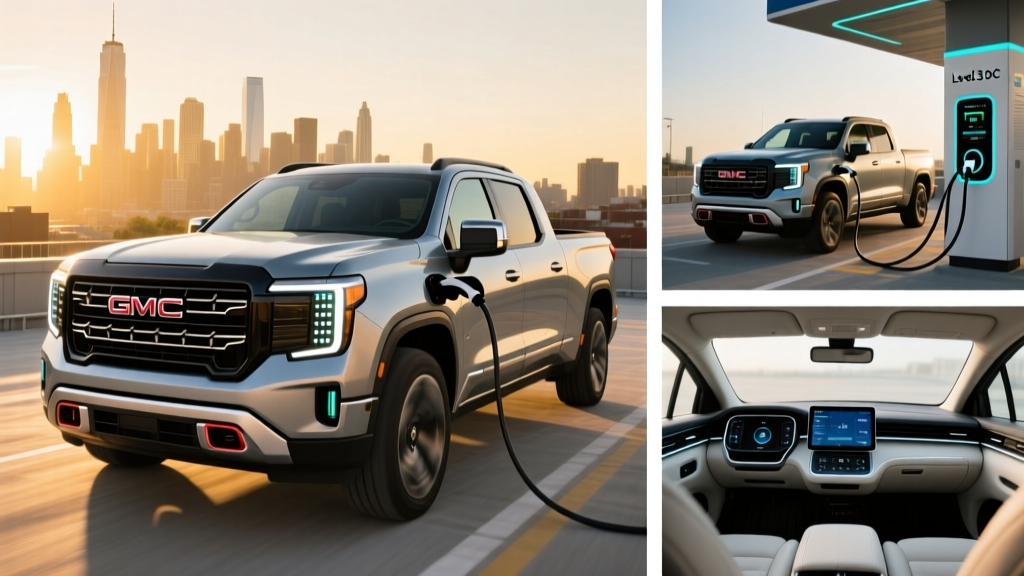
The 2026 GMC Sierra EV Elevation sits in a peculiar spot in the electric truck market. It's the entry point into GMC's full-size electric pickup lineup — a vehicle that shares its Ultium platform bones with the Chevrolet Silverado EV and Cadillac Escalade IQ, but wears premium GMC styling and targets buyers who want crew-cab space, serious range, and a badge that feels a step above Chevy without crossing into luxury-truck territory. With an EPA-estimated range approaching 390 miles and DC fast-charging capability up to 350 kW, the Elevation trim is GMC's bid to make the electric truck practical for daily driving and road trips alike. But does the real-world experience match the spec sheet?
Range and Efficiency: The 390-Mile Promise vs. Reality
Real-World Expectation: ~310–340 miles highway driving at 70+ mph; ~270–300 miles in freezing temperatures with cabin heat; ~360–380 miles mixed city/suburban driving with regen braking
The Sierra EV Elevation is available with two battery configurations for 2026. The standard-range pack delivers an EPA-estimated 290 miles, while the Max Range option — a massive 106.9 kWh usable NMC (nickel manganese cobalt) lithium-ion battery — pushes the figure to 390 miles in the 2WD configuration. Choose e4WD (dual-motor all-wheel drive) and the Max Range EPA estimate drops slightly to approximately 375 miles due to the added weight and drivetrain losses of the front motor.
In real-world highway testing at sustained speeds of 70–75 mph, large electric pickups typically lose 12–18% versus their EPA combined estimate. The Sierra EV's aerodynamic profile is improved over its gas counterpart, but it's still a full-size truck pushing a large frontal area. Expect roughly 310 to 340 miles on a full charge during warm-weather highway cruising. In cold weather (below 32°F), battery chemistry limitations and cabin heating demands can reduce range by 20–30%, bringing the effective range down to approximately 270–300 miles on the Max Range pack.
Efficiency lands around 70 MPGe combined (approximately 48 kWh/100 miles) for the Max Range 2WD model, according to fueleconomy.gov. That's competitive with the Ford F-150 Lightning Extended Range (66 MPGe combined) and slightly behind the Rivian R1T Dual-Motor Max Pack (73 MPGe combined), though the Sierra EV carries a larger battery to compensate.
Battery, Charging, and the 350 kW Advantage
| Charging Level | Max Power | Speed / Rate | Notes |
|---|---|---|---|
| Level 1 (120V) | ~1.4 kW | ~3–4 miles/hour | Emergency/trickle only |
| Level 2 (240V, 48A) | 11.5 kW | ~27–30 miles/hour | Full charge in ~10 hours |
| Level 2 (240V, 80A) | 19.2 kW | ~45–50 miles/hour | Requires compatible hardwired EVSE |
| DC Fast Charge | 350 kW peak | 10–80% in ~25 min | On 800V-capable stations |
The Sierra EV's Ultium platform supports up to 350 kW peak DC fast charging on compatible 800V infrastructure — a significant advantage over the Ford F-150 Lightning's 150 kW peak. At a 350 kW station (such as newer Electrify America or EVgo stalls), the Sierra EV can add approximately 100 miles of range in about 10 minutes and reach 80% state of charge from 10% in roughly 25 minutes.
However, charging-curve reality matters. The 350 kW figure is a peak, not a sustained rate. The Sierra EV, like all EVs, tapers charge speed significantly above 80% SoC to protect battery longevity. Expect the average charge rate during a 10–80% session to be closer to 180–220 kW, which still translates to excellent real-world road-trip charging performance. On 150 kW CCS stations (still the majority of public DC infrastructure), the truck will charge at the station's maximum, reaching 10–80% in approximately 40–45 minutes.
For home charging, the Sierra EV comes with a dual-level charge cord (120V/240V) and supports up to 19.2 kW on Level 2 when paired with a compatible hardwired home charger on an 80-amp circuit. Most buyers will install a 48-amp Level 2 wallbox on a 60-amp circuit, delivering 11.5 kW — enough to fully replenish the Max Range battery overnight in roughly 10 hours. A 200-amp electrical panel is typically sufficient, though older homes may require a panel upgrade ($1,500–$3,000) to support continuous 80-amp service.
The Sierra EV uses the NACS (North American Charging Standard) connector natively for 2026, giving it direct access to Tesla's Supercharger network — the most reliable and widespread DC fast-charging network in the U.S. — without an adapter. This is a meaningful practical advantage over CCS-only vehicles, which now require adapters for Supercharger access.
Performance and Drivetrain
| Specification | Elevation 2WD | Elevation e4WD |
|---|---|---|
| Horsepower | 510 hp | 655 hp |
| Torque | 615 lb-ft | 785 lb-ft |
| 0–60 mph | ~5.9 sec | ~4.5 sec |
| Drivetrain | Rear-Wheel Drive (single motor) | Dual-Motor AWD |
| Max Towing | 10,200 lbs | 10,200 lbs |
| Payload | ~1,450 lbs | ~1,350 lbs |
The Elevation trim offers substantial power even in its base rear-wheel-drive form: 510 horsepower and 615 lb-ft of torque, good for a 0–60 mph time around 5.9 seconds. That's brisk for a full-size pickup and more than adequate for highway merging and passing. The e4WD dual-motor variant bumps output to 655 hp and 785 lb-ft, dropping the 0–60 time to approximately 4.5 seconds — sports-sedan acceleration in a 9,000-pound truck.
Towing capacity maxes out at 10,200 pounds across both drivetrains when properly equipped. That's competitive with the F-150 Lightning (10,000 lbs) and trails the Rivian R1T's 11,000-lb rating. Note that towing any substantial trailer will cut range dramatically — expect a 40–55% reduction at highway speeds with a loaded enclosed trailer, bringing effective range to roughly 175–210 miles on the Max Range pack. This is a physics reality for all electric trucks, not unique to the Sierra EV.
Ride quality benefits from the Ultium platform's independent rear suspension (a departure from the solid rear axle on the gas Sierra). The result is noticeably better on-road comfort and composure, though it sacrifices some of the heavy-duty articulation that off-road-focused buyers might want. The Elevation trim does not include the adaptive air suspension found on the higher Denali trim; you get conventional coil springs with passive dampers.
Interior, Cargo, and Technology
The Sierra EV is exclusively a crew cab with a 5-foot-3-inch bed — there's no regular cab or extended cab option. Interior space is generous: rear-seat legroom measures approximately 43.4 inches, and the flat floor (no transmission tunnel hump) makes the middle rear seat genuinely usable for adults. Front headroom and legroom are excellent, and the seating position is commanding.
The centerpiece of the Elevation's tech suite is an 11.4-inch diagonal infotainment touchscreen running Google Built-In (Google Maps, Google Assistant, and Play Store apps native to the vehicle). A 11.0-inch digital instrument cluster sits behind the steering wheel. Wireless Apple CarPlay and Android Auto are standard. The Elevation also includes a head-up display — a feature often reserved for higher trims in competitors.
Cargo versatility is a highlight. The eTrunk (front trunk) offers approximately 10.7 cubic feet of lockable, weather-sealed storage — large enough for charging cables, groceries, or a weekend bag. The rear bed includes GMC's MultiPro Tailgate (six-position tailgate) and a midgate that can fold down to extend the effective bed length to approximately 9 feet with the tailgate closed, or nearly 11 feet with the tailgate open. This is a practical advantage for hauling lumber, kayaks, or ladders.
Driver-assistance technology includes GM's Super Cruise on compatible mapped highways — a hands-off (but eyes-on) Level 2 system. It's important to understand that Super Cruise is an SAE Level 2 system, meaning the driver must remain attentive and ready to take over at all times. It is not autonomous driving. Super Cruise coverage has expanded significantly for 2026, with over 750,000 miles of compatible roads in the U.S. and Canada. The Elevation trim includes a 3-year Super Cruise subscription; after that, it requires a paid plan (currently ~$25/month).
Pricing, Trims, and Federal Tax Credit Eligibility
| Trim / Config | Base MSRP | Est. After §30D Credit | Notes |
|---|---|---|---|
| Elevation 2WD Standard Range | $58,000 | $50,500* | 290-mi EPA range |
| Elevation 2WD Max Range | $68,500 | $61,000* | 390-mi EPA range |
| Elevation e4WD Max Range | $72,500 | $65,000* | 375-mi EPA range, dual motor |
*Estimated prices after the maximum $7,500 federal tax credit. Actual credit amount and eligibility depend on buyer income, battery sourcing, and point-of-sale transfer rules under IRS §30D. See IRS.gov clean vehicle credits for current requirements.
The 2026 Sierra EV Elevation starts at $58,000 for the 2WD Standard Range model, including destination charge. The high-volume configuration — Elevation 2WD Max Range — lists at $68,500. Adding e4AWD pushes the price to $72,500. All figures fall under the IRS §30D MSRP cap of $80,000 for trucks, which is a critical threshold for tax credit eligibility.
To qualify for the full $7,500 federal clean vehicle credit, buyers must meet several requirements:
- Income caps: Modified AGI must not exceed $150,000 (single), $225,000 (head of household), or $300,000 (joint filers)
- MSRP cap: Vehicle MSRP must be ≤ $80,000 for trucks (all Sierra EV Elevation trims qualify)
- Battery sourcing: Critical minerals and battery components must meet phased-in percentages from U.S. or FTA-partner countries — GM has been working to localize Ultium battery production at U.S. plants, but exact credit amounts ($3,750 for minerals, $3,750 for components) vary by build date
- Point-of-sale transfer: Buyers can elect to transfer the credit to the dealer at purchase, reducing the upfront price rather than claiming it on their tax return
The partial-credit situation is worth noting. If the Sierra EV's battery components or critical minerals don't fully meet 2026 sourcing thresholds, the credit may be $3,750 instead of $7,500. Always confirm the exact credit amount for your specific VIN with the dealer before purchase, and consult a tax professional for personal eligibility.
Warranty and Long-Term Ownership
GMC backs the Sierra EV with a comprehensive warranty package:
- Battery & Powertrain: 8 years / 100,000 miles (whichever comes first), covering the Ultium battery pack and electric drive units against defects and excessive capacity loss (typically defined as falling below 60–70% of original capacity)
- Bumper-to-Bumper: 3 years / 36,000 miles
- Corrosion: 6 years / 100,000 miles
- Roadside Assistance: 5 years / 60,000 miles
The 8-year/100,000-mile battery warranty is standard across the EV truck segment (matching Ford, Rivian, and Tesla). GM's Ultium platform uses NMC chemistry, which offers higher energy density than LFP (lithium iron phosphate) but is generally considered slightly more susceptible to long-term calendar degradation if regularly stored at 100% SoC. Best practice for NMC batteries: charge to 80–90% for daily use and reserve 100% charges for road trips. GM's battery management system includes active thermal management and a buffer that protects the cells from full 0–100% cycling.
Insurance costs for the Sierra EV Elevation are notably higher than for a comparable gas Sierra 1500 — expect premiums 25–40% higher depending on your profile, location, and coverage level. This is common across the EV truck segment due to higher repair costs, expensive battery components, and limited collision-repair networks trained on high-voltage systems.
Sierra EV Elevation vs. the Competition
| Spec | 2026 GMC Sierra EV Elevation (Max Range) | 2026 Ford F-150 Lightning Ext. Range | 2026 Rivian R1T Dual-Motor Max |
|---|---|---|---|
| EPA Range | 390 mi | 320 mi | 410 mi |
| Battery (usable) | 106.9 kWh NMC | ~131 kWh NMC | ~149 kWh NMC |
| DC Fast Charge Peak | 350 kW | 150 kW | 220 kW |
| 0–60 mph (AWD) | ~4.5 sec | ~4.5 sec | ~4.5 sec |
| Max Towing | 10,200 lbs | 10,000 lbs | 11,000 lbs |
| Bed Length | 5'3" (midgate extends) | 5'6" | 4'6" (with gear tunnel) |
| Starting MSRP | $58,000 | $59,995 | $79,900 |
| NACS Native | Yes | Adapter required | Yes (2025+) |
The Sierra EV Elevation's strongest competitive advantages are its range-per-dollar ratio, native NACS/Supercharger access, and 350 kW charging speed. The F-150 Lightning remains the more traditional-feeling truck (body-on-frame, familiar styling, slightly larger bed), but its 150 kW charging peak is a significant road-trip drawback — adding 15–20 minutes to typical fast-charge stops compared to the Sierra EV.
The Rivian R1T Max Pack offers even more range (410 miles EPA) and superior off-road capability, but starts at roughly $80,000 — pushing it above the §30D MSRP cap for many configurations and placing it in a different price bracket entirely. For buyers who prioritize value and daily-driver comfort over off-road prowess, the Sierra EV Elevation makes a compelling case.
Pros
- 390-mile Max Range EPA estimate — class-leading for the price
- 350 kW DC fast charging with NACS native Supercharger access
- Midgate extends effective bed length to ~9–11 feet
- Generous rear-seat legroom and flat floor
- Super Cruise hands-off highway driving (3-year subscription included)
- Competitive starting price under §30D MSRP cap
Cons
- 5'3" bed is shorter than traditional full-size pickups
- e4WD Max Range pushes close to MSRP cap with options
- Insurance premiums significantly higher than gas Sierra
- No adaptive air suspension on Elevation trim (Denali only)
- Towing range loss is severe (40–55% with loaded trailer)
- Real-world highway range falls notably short of 390-mile sticker
Who Should Buy the Sierra EV Elevation?
Choose the Sierra EV Elevation if: You want maximum electric range in a full-size truck under $70,000, you have home Level 2 charging access, you value Supercharger network compatibility, and your typical driving is commuting, road trips, and light-to-moderate towing.
Look elsewhere if: You need a long bed for work (consider F-150 Lightning), you regularly tow heavy trailers long distances (range becomes a major pain point for all EV trucks), you want serious off-road capability (Rivian R1T), or you don't have reliable home charging access.
The Sierra EV Elevation is best suited for suburban and exurban homeowners with garage or driveway charging who want a daily-driver truck with the option for weekend road trips. Its range and charging speed make it one of the most road-trip-capable electric trucks available, and the midgate system provides surprising cargo flexibility despite the short bed. It's less ideal as a dedicated work truck for contractors who need a full-length bed or who tow heavy loads daily over long distances.
Frequently Asked Questions
What is the real-world range of the GMC Sierra EV Elevation?
The EPA rates the Max Range 2WD model at 390 miles combined. In real-world highway driving at 70–75 mph in warm weather, expect approximately 310–340 miles. In cold weather (below freezing), range can drop to 270–300 miles due to battery chemistry limitations and cabin heating energy demands.
How fast does the Sierra EV charge at home and on the road?
On a 48-amp Level 2 home charger (11.5 kW), a full charge takes about 10 hours — easily done overnight. On a compatible 350 kW DC fast charger, the Sierra EV reaches 10–80% in approximately 25 minutes. On a 150 kW station, expect 40–45 minutes for the same 10–80% session.
Does the Sierra EV Elevation qualify for the $7,500 federal tax credit?
It can, but eligibility depends on the buyer's income (must be under $150K single / $300K joint), the vehicle's battery sourcing compliance with §30D critical-mineral and component rules, and the MSRP staying under $80,000 (all Elevation trims qualify). The credit may be $3,750 or $7,500 depending on battery sourcing for your specific build. Confirm with your dealer and a tax professional before purchasing.
Is the Sierra EV Elevation worth buying over the F-150 Lightning or Rivian R1T?
The Sierra EV Elevation wins on range-per-dollar and charging speed. The F-150 Lightning offers a more traditional truck layout and slightly larger bed but charges significantly slower (150 kW vs. 350 kW). The Rivian R1T is more capable off-road and offers more range in its Max Pack form, but starts at roughly $80,000. For most suburban truck buyers prioritizing range and road-trip charging convenience, the Sierra EV Elevation is the strongest value proposition in 2026.
Can the Sierra EV use Tesla Superchargers?
Yes. The 2026 Sierra EV comes with a native NACS charge port, meaning it can plug directly into Tesla Superchargers without any adapter. This gives access to the largest and most reliable DC fast-charging network in North America.
How long will the Sierra EV battery last?
GM warranties the Ultium battery for 8 years or 100,000 miles against defects and excessive degradation. Based on current NMC battery data from the broader EV fleet, most owners can expect 85–92% capacity retention at 100,000 miles with normal use patterns (avoiding frequent 100% charges and DC fast charging exclusively). Full battery replacement costs, if needed out of warranty, are estimated at $15,000–$25,000 depending on pack size — though this figure is expected to decline as battery costs continue to fall.