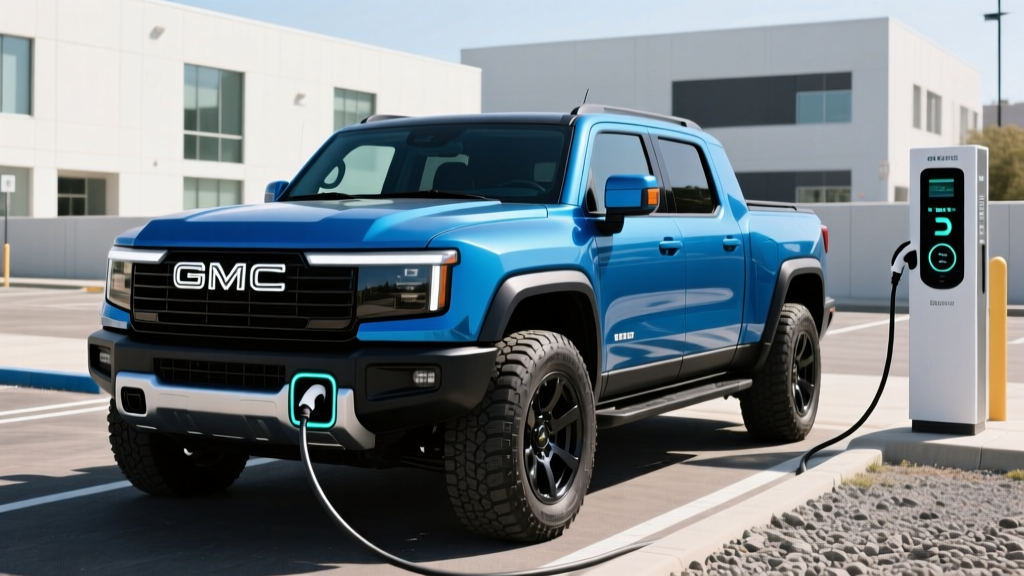
The GMC Hummer EV Pickup is the electric vehicle that refuses to be ignored. At over 9,000 pounds and stretching nearly 18 feet long, it's a rolling statement that electrification can be maximalist. But beneath the CrabWalk and removable roof panels lies a seriously capable machine with class-leading range among full-size electric trucks and a battery pack larger than some home energy storage systems. For 2026, GMC has streamlined the lineup and improved software efficiency, but the fundamental question remains: does a truck this massive make sense as a daily EV?
We've spent time with the Hummer EV Pickup across highway drives, cold-weather commutes, and DC fast-charging stops to separate the spec-sheet hype from the ownership reality. Here's everything you need to know before writing the check.
Range and Efficiency: What the EPA Says vs. What You'll Actually Get
The 2026 Hummer EV Pickup 3X (tri-motor AWD) carries an EPA-estimated range of 381 miles on its massive 212.7 kWh (usable) Ultium battery pack. The dual-motor 2X variant is rated at 318 miles. These are impressive numbers on paper — the 3X's 381-mile rating makes it the longest-range electric pickup currently sold in the U.S.
EPA 381 miles (3X) / 318 miles (2X). In our testing:
- Highway (70-75 mph, mild weather): ~310-330 miles for the 3X — aerodynamic drag on a vehicle this tall and heavy takes a significant toll above 65 mph.
- Mixed city/suburban driving: ~350-370 miles for the 3X, where regenerative braking recovers more energy.
- Cold weather (below 32°F, highway): Expect 240-280 miles. The Hummer EV's enormous battery has more thermal mass to manage, and cold-weather range loss of 25-35% is typical.
- Towing (loaded trailer): Range can drop below 200 miles depending on trailer weight and terrain.
Efficiency is rated at 47 MPGe combined (approximately 72 kWh/100 miles) for the 3X, per fueleconomy.gov. To put that in context, the Rivian R1T Dual-Motor achieves roughly 70 MPGe combined. The Hummer EV moves a lot of metal — over 9,000 pounds curb weight — and physics demands energy for that mass. If efficiency is a priority, this isn't the truck for you. If range-at-any-cost is, the giant battery compensates for the poor efficiency with sheer capacity.
Battery, Chemistry, and Long-Term Degradation
The Hummer EV uses GM's Ultium platform with an NMC (nickel manganese cobalt) lithium-ion chemistry in a double-stacked battery configuration. The 3X's pack holds 212.7 kWh of usable capacity — roughly double what you'll find in a Tesla Model Y or Ford F-150 Lightning Extended Range. The 2X carries approximately 170 kWh usable.
NMC chemistry offers higher energy density than LFP (lithium iron phosphate), which is essential here given the range targets. The trade-off is that NMC cells degrade slightly faster over time and are more sensitive to sustained high states of charge. GMC recommends daily charging to 80-90% for battery longevity, reserving 100% for road trips.
GM provides an 8-year/100,000-mile battery and powertrain warranty covering defects and capacity loss below 60% of original capacity. Given the battery's massive size, even 10-15% degradation over a decade still leaves over 320 miles of range on the 3X — a more comfortable buffer than smaller-pack EVs can offer after similar wear.
Charging Speed: DC Fast, Level 2, and What Installation Looks Like
The Hummer EV supports up to 350 kW peak DC fast charging on compatible CCS stations (via the CCS1 port; a NACS adapter is available for Tesla Supercharger access). However, with a 212.7 kWh battery, peak rate only tells part of the story — the total energy that needs to move is enormous.
| Charging Level | Power (kW) | Speed / Time | Notes |
|---|---|---|---|
| DC Fast Charge (peak) | 350 kW (CCS) | 10-80% in ~33 min | Sustained rate averages ~200-250 kW; taper above 80% SoC is aggressive |
| DC Fast Charge (50 kW station) | 50 kW | 10-80% in ~3.5 hours | Common at older public chargers; plan accordingly |
| Level 2 (home, 240V/48A) | 11.5 kW | ~25 miles/hour or ~15 hrs for 10-80% | Overnight top-ups work; full recharge requires extended time |
| Level 2 (high-power, 80A) | 19.2 kW | ~42 miles/hour or ~8.5 hrs for 10-80% | Requires 100A circuit; recommended for daily drivers |
| Level 1 (120V outlet) | 1.4 kW | ~3 miles/hour | Essentially useless for a 212 kWh pack beyond emergency trickle |
Charging curve reality: The Hummer EV can sustain high charge rates in the 10-50% SoC window, but above 60% the curve tapers significantly to protect the NMC cells. A 10-80% session at a 350 kW station averages closer to 200-250 kW sustained, not the headline 350 kW peak. This is normal physics for large NMC packs, but it means your 33-minute estimate assumes ideal battery preconditioning and a station delivering full rated power.
Home charging note: With a battery this large, a standard 48A Level 2 charger adds only ~25 miles per hour. If you drive the Hummer EV daily and deplete 100+ miles, you'll want an 80A Level 2 unit (like the ChargePoint Home Flex configured for 80A or the Emporia V2 with 48A+) on a dedicated 100A circuit. Budget $1,500-$3,000 for installation depending on your panel capacity — and if your home has a 100A main panel, a $2,000-$4,000 panel upgrade to 200A may be necessary. Consult a licensed electrician for your specific setup.
Performance: Tri-Motor Power and the CrabWalk Party Trick
| Specification | 2X (Dual-Motor) | 3X (Tri-Motor AWD) |
|---|---|---|
| Horsepower | 625 hp | 830 hp (Watts to Freedom mode) |
| Torque | 7,400 lb-ft (wheel) | 11,500 lb-ft (wheel) |
| 0-60 mph | ~4.5 sec | ~3.0 sec |
| Drivetrain | AWD (dual-motor) | AWD (tri-motor, torque vectoring rear) |
| Towing Capacity | 7,500 lbs | 7,500 lbs |
| Payload | 1,300 lbs | 1,300 lbs |
| EPA Range | 318 miles | 381 miles |
| Efficiency | ~49 MPGe | ~47 MPGe |
| Curb Weight | ~9,000 lbs | ~9,063 lbs |
| Starting MSRP | $100,395 | $121,395 |
The 3X's tri-motor layout places one motor up front and two at the rear, enabling genuine rear-axle torque vectoring. The result is a 9,000-pound truck that hustles through corners with surreal composure. Engaging Watts to Freedom (WTF) mode drops the adaptive air suspension, stiffens dampers, preconditions the battery, and unlocks the full 830 hp — launching to 60 mph in approximately 3.0 seconds. It's a party trick, but one that never stops being entertaining.
The CrabWalk feature uses four-wheel steering (up to 10 degrees rear) to move the truck diagonally at low speeds — useful on tight off-road trails and an unbeatable conversation starter. The available Extract Mode raises the air suspension by nearly 6 inches for 15.9 inches of ground clearance, approaching serious off-road territory.
On-road, the Hummer EV rides with surprising refinement thanks to the air suspension and adaptive dampers. Wind noise is minimal at highway speeds (a benefit of having no engine), though the sheer width — over 86 inches including mirrors — makes narrow lanes and parking garages genuinely stressful.
Interior, Cargo, and Daily Livability
Inside, the Hummer EV pairs a 13.4-inch infotainment touchscreen running GM's latest Ultifi software with a 12.3-inch digital instrument cluster. Wireless Apple CarPlay and Android Auto are standard. The interface is responsive, and GM's Super Cruise hands-free driving system is available on over 400,000 miles of mapped highways — though it remains an SAE Level 2 driver-assist system requiring your attention at all times.
Passenger space is generous, as you'd expect from a full-size crew cab: 45.6 inches of front legroom and 43.4 inches in the rear. Five adults fit comfortably. The removable Infinity Roof panels stow in the frunk, turning the cabin into an open-air experience.
Cargo capacity includes:
- Bed: 5 feet (with MultiPro tailgate); 82.2 cu ft maximum
- Frunk (e-trunk): 11.3 cu ft — useful for charging cables, gear, or roof panels
- Rear under-seat storage: Additional concealed compartment
The MultiPro tailgate offers six configurations including a load-stop, step, and work surface. However, the bed is shorter than a conventional full-size truck's 6.5-foot option, which matters if you regularly haul sheet goods or long lumber.
Pricing, Trims, and Federal Tax Credit Eligibility
The 2026 Hummer EV Pickup lineup has been simplified from its earlier Edition 1 days:
| Trim | Base MSRP | As-Tested (typical options) | §30D Credit Eligible? |
|---|---|---|---|
| 2X (dual-motor, 318 mi) | $100,395 | $105,000-$110,000 | ❌ Exceeds $80K truck MSRP cap |
| 3X (tri-motor, 381 mi) | $121,395 | $130,000-$145,000 | ❌ Exceeds $80K truck MSRP cap |
Under IRS §30D rules, the Hummer EV Pickup does not qualify for the $7,500 federal new-vehicle tax credit. The credit's MSRP cap for trucks is $80,000, and both the 2X ($100,395) and 3X ($121,395) far exceed this limit. Additionally, buyer income caps ($150K single / $300K joint AGI) would apply even if the price qualified. There is no workaround — this is a full-price purchase.
Some buyers may find partial relief through state-level incentives (check AFDC's state incentive database), but these vary widely and are subject to change. Consult a tax professional for your specific situation.
Tech, Driver Assistance, and Standout Features
The Hummer EV's technology roster is extensive, matching its price:
- Super Cruise (available): Hands-free highway driving on mapped roads — SAE Level 2, driver attention required via infrared camera monitoring
- UltraVision: Up to 18 camera views including underbody cameras for off-road trail navigation
- CrabWalk: Diagonal four-wheel-steering movement at low speeds
- Extract Mode: Air suspension raises ~6 inches for maximum ground clearance (15.9 in.)
- Infinity Roof: Removable modular roof panels stored in the frunk
- Power Station Pro (available): Vehicle-to-load (V2L) capability to power tools, appliances, or camp equipment from the truck's battery — up to 3.6 kW output
- One-Pedal Driving: Adjustable regenerative braking with steering-wheel paddle for on-demand regen
Notable drawbacks: The infotainment system, while improved, still lags behind Tesla's interface responsiveness. The Hummer EV has not been crash-tested by NHTSA or IIHS as of early 2026, which is a data gap for safety-conscious buyers. The truck's width and weight make it poorly suited for urban environments with tight parking and narrow streets. And at over $100K before options, the value proposition requires genuine enthusiasm for the brand and the experience.
Who Should Buy the Hummer EV Pickup (and Who Shouldn't)
✅ Pros
- Class-leading 381-mile EPA range (3X)
- Supercar-level 0-60 in a 9,000-lb truck
- Genuine off-road capability with Extract Mode and CrabWalk
- Air suspension ride quality is excellent
- Super Cruise hands-free highway driving available
- V2L power output for job sites and camping
- Removable roof panels for open-air driving
❌ Cons
- $100K+ starting price with no federal tax credit
- 47 MPGe — among the least efficient EVs sold
- Home charging a 212 kWh pack requires significant infrastructure
- Too wide for many urban streets and parking structures
- 5-foot bed is short for a full-size truck
- No NHTSA/IIHS crash-test ratings published
- 7,500-lb towing drops range below 200 miles
The Hummer EV Pickup is best for: Enthusiasts who want the most capable, most attention-grabbing electric truck available and have the budget and home charging infrastructure to support it. It excels as a weekend adventure vehicle, a luxury daily driver for those with wide commutes, and a statement piece. If you tow regularly or need maximum bed length, the Rivian R1T or Ford F-150 Lightning may serve you better.
Consider alternatives if: You prioritize efficiency, need a sub-$80K price to access the federal credit, regularly park in tight urban environments, or need a long bed for work use.
Frequently Asked Questions
What is the real-world range of the Hummer EV truck?
The EPA rates the 3X at 381 miles and the 2X at 318 miles. In real-world highway driving at 70-75 mph, expect 310-330 miles (3X). Cold weather can reduce this to 240-280 miles. Mixed city driving with regenerative braking gets you closer to the EPA sticker.
How fast does the Hummer EV charge?
On a 350 kW DC fast charger, the Hummer EV charges from 10-80% in approximately 33 minutes, with a sustained average of 200-250 kW. At home on a 48A Level 2 charger (11.5 kW), it adds about 25 miles per hour — a full 10-80% recharge takes roughly 15 hours. An 80A Level 2 charger cuts that to about 8.5 hours.
Does the Hummer EV qualify for the federal EV tax credit?
No. Under IRS §30D rules, the federal new EV tax credit caps eligible trucks at $80,000 MSRP. The Hummer EV starts at $100,395 (2X) and $121,395 (3X), well above the threshold. No federal credit is available regardless of buyer income or battery sourcing.
Is the Hummer EV worth buying vs. the Rivian R1T or F-150 Lightning?
It depends on priorities. The Hummer EV offers the longest range (381 mi vs. R1T's ~420 mi Max pack but at a similar price) and the most dramatic presence. The Rivian R1T is lighter, more efficient, has a longer bed option, and starts lower. The F-150 Lightning is significantly cheaper, qualifies for the tax credit in some trims, and offers a more conventional truck experience. Choose the Hummer EV for maximum range-per-charge, off-road tech, and exclusivity.
How much does it cost to charge the Hummer EV at home?
At the U.S. average residential electricity rate of ~$0.16/kWh, fully charging the 3X's 212.7 kWh battery costs approximately $34. For 1,000 miles of monthly driving (at ~72 kWh/100mi), expect about $115/month in electricity — versus roughly $180-$220/month in gasoline for an equivalent gas truck at 16 MPG and $3.50/gallon.
What is the battery warranty on the Hummer EV?
GM covers the battery and powertrain for 8 years or 100,000 miles (whichever comes first), including coverage for capacity degradation below 60% of original capacity.