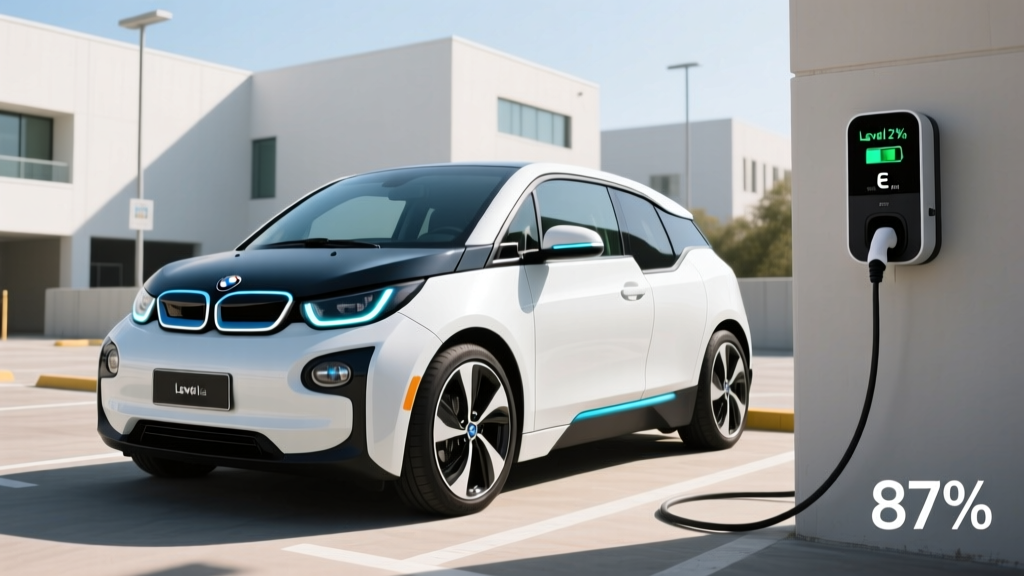
The BMW i3 hatchback remains one of the most distinctive electric vehicles ever produced — a carbon-fiber-reinforced plastic (CFRP) city car built around sustainability and urban efficiency. BMW ceased U.S. sales of the i3 after the 2021 model year, but its strong presence on the used-EV market means thousands of buyers are evaluating it right now. With its 42.2 kWh battery, lightweight construction, and premium interior, the i3 occupies a niche no current EV fully replicates: a purpose-built electric urban commuter with genuine BMW engineering DNA.
This guide covers every number that matters — EPA range, real-world expectations, charging speeds across all levels, efficiency, and whether the used-EV federal tax credit can bring the price down to $4,000 or less.
BMW i3 Hatchback at a Glance: Key Specs
| Specification | BMW i3 (120 Ah / 42.2 kWh) |
|---|---|
| EPA Range (BEV) | 153 miles |
| Battery (Usable) | 42.2 kWh, NMC lithium-ion |
| MPGe (Combined) | 113 MPGe |
| Energy Consumption | 30 kWh / 100 mi |
| Motor Output | 170 hp / 184 lb-ft torque |
| Drivetrain | Rear-wheel drive (single motor) |
| 0–60 mph | |
| Top Speed | 93 mph (electronically limited) |
| Max DC Fast Charge | 50 kW (CCS Combo 1) |
| 10–80% DC Charge Time | ~42 minutes |
| Level 2 Charge Rate | 7.4 kW (~25 mi/hr) |
| Cargo Volume | 15.1 cu ft (rear seats up) |
| Battery Warranty (Original) | 8 yr / 100,000 mi |
| Original Base MSRP (2021) | $44,450 |
Sources: EPA / fueleconomy.gov, BMW USA historical spec sheets.
Real-World Range: What the 153-Mile EPA Estimate Actually Means
Real-World Expectation: 120–140 miles highway; 145–160 miles city
Cold Weather (below 32°F): 95–115 miles (25–35% reduction typical for NMC cells without a heat pump)
The i3's EPA rating of 153 miles was competitive for a city-focused EV when the 120 Ah battery launched. In practice, the i3 excels in stop-and-go traffic where regenerative braking recovers energy aggressively — BMW's one-pedal driving mode is among the strongest in any EV, often bringing the car to a complete stop without touching the brake pedal.
Highway driving tells a different story. The i3's tall, narrow body creates more aerodynamic drag than a sleek sedan, and the 155-section tires (chosen for ultra-low rolling resistance) prioritize efficiency over grip. At 70 mph on a flat interstate in moderate temperatures, expect roughly 120–135 miles before the battery buffer warning engages. In winter conditions without preconditioning, range can drop to around 100 miles — the i3 uses resistive cabin heating rather than a heat pump, which draws significant energy from the pack.
Preconditioning matters: The i3 allows scheduled departure preconditioning via the BMW Connected app. Warming the cabin and battery while plugged in preserves range and improves charge acceptance on cold mornings. Owners who precondition consistently report 10–15% better winter range versus those who don't.
Charging Speed: DC Fast, Level 2, and Level 1 Breakdown
| Charging Level | Power / Rate | Miles Added per Hour | Notes |
|---|---|---|---|
| Level 1 (120V household) | ~1.4 kW | ~4–5 mi/hr | Emergency/top-up only; 30+ hr for full charge |
| Level 2 (240V home/public) | 7.4 kW | ~25 mi/hr | Full charge in ~6 hours; ideal daily solution |
| DC Fast Charge (CCS) | 50 kW peak | ~150 mi/hr (peak) | 10–80% in ~42 min; tapers sharply above 80% |
The i3's 50 kW DC fast-charging ceiling is its most significant limitation for road-trip use. While modern EVs from Hyundai, Kia, and Tesla accept 150–350 kW on DC fast chargers, the i3 peaks at 50 kW and sustains that rate only up to roughly 50% state of charge. Above 60%, the charge curve tapers progressively — from 50 kW down to roughly 20 kW by 80%, and single-digit kW above 90%.
This means a 10–80% session takes approximately 42 minutes at a properly functioning CCS station. For a car with 153 miles of range, that's a meaningful stop on any trip beyond the daily commute. The i3 was designed as an urban vehicle first, and its charging profile reflects that philosophy.
Level 2 home charging is where the i3 shines for daily ownership. A 7.4 kW onboard charger replenishes the 42.2 kWh pack in roughly six hours — plug in at 10 PM and you'll wake up to a full battery every morning. Installation of a 240V Level 2 home charger (such as a ChargePoint Home Flex or BMW Wall Connect) typically costs $800–$2,000 including a licensed electrician, depending on panel proximity and permit fees. The i3 uses a standard J1772 connector for AC charging and CCS Combo 1 for DC — both widely compatible at public stations.
Performance, Efficiency, and Driving Dynamics
The i3's rear-mounted electric motor produces 170 horsepower and 184 lb-ft of instant torque, channeled through the rear wheels. The 0–60 mph sprint takes approximately 6.9 seconds — brisk enough for confident highway merging and genuinely quick off the line in city traffic. The instant torque delivery makes the i3 feel faster than the numbers suggest, particularly from 0–30 mph.
What truly distinguishes the i3 is its construction. The passenger cell ("Life Module") is made from carbon-fiber-reinforced plastic, while the aluminum drive module houses the battery, motor, and suspension. This results in a curb weight of roughly 2,900 pounds — exceptionally light for any EV. For comparison, a Chevrolet Bolt EV weighs over 3,500 pounds with a similar battery capacity. The low weight translates to sharp handling, minimal brake wear (regenerative braking handles most deceleration), and the strong efficiency figure of 113 MPGe combined (30 kWh per 100 miles), per the EPA.
The trade-off is a firm ride quality — the narrow, tall tires and lightweight construction transmit more road imperfections than heavier, more insulated EVs. The i3 also has a tight turning radius of 32.3 feet, making it outstanding for urban parking and narrow streets.
Pricing, Tax Credits, and the Used-EV Opportunity
Since BMW discontinued the i3 for the U.S. market after 2021, all purchases are now on the used market. This is where the financial case becomes compelling — specifically because of the §25E Used Clean Vehicle Credit.
| Cost Factor | Amount |
|---|---|
| Typical Used Price (2019–2021, 120 Ah) | $18,000–$26,000 |
| §25E Used EV Tax Credit (30% of sale price, max $4,000) | Up to $4,000 |
| Effective Price After Credit | $14,000–$22,000 |
| IRS Income Cap (Modified AGI) | $75K single / $112,500 HOH / $150K joint |
| Vehicle Price Cap | $25,000 or less |
| Dealer Requirement | Must be purchased from a licensed dealer |
The §25E credit — separate from the §30D new-vehicle credit — allows qualifying buyers to claim 30% of the sale price, up to $4,000, on a used EV purchased from a dealer. The i3's used-market pricing often falls at or near the $25,000 vehicle price cap, making it one of the best vehicles to maximize this credit. A $22,000 i3 purchase yields a $4,000 credit (capped at 30% = $6,600, but the $4,000 maximum applies). A $15,000 i3 yields $4,000 (30% of $15,000 = $4,500, capped at $4,000).
Eligibility requirements (per IRS §25E):
- Buyer modified AGI must not exceed $75,000 (single), $112,500 (head of household), or $150,000 (married filing jointly)
- Vehicle sale price must be $25,000 or less
- Vehicle must be at least 2 model years old (all i3s qualify)
- Must be purchased from a licensed dealer (private-party sales do not qualify)
- Vehicle must have a battery capacity of at least 7 kWh (the i3's 42.2 kWh easily qualifies)
- The credit is non-refundable — it can reduce your tax liability to zero but won't generate a refund beyond that
Always consult a tax professional to confirm eligibility. Rules are current as of 2025–2026 and subject to legislative change.
Interior, Cargo, Technology, and Daily Livability
The i3's interior was radical at launch and still feels futuristic. BMW used renewable and recycled materials extensively — dashboard trim made from eucalyptus wood, door panels from kenaf plant fiber, and seat fabrics from recycled PET bottles. The result is an airy, minimalist cabin that ages well and avoids the typical automotive plastics.
Space and dimensions:
- Cargo volume: 15.1 cu ft behind rear seats (comparable to a subcompact hatchback)
- Cargo volume (rear seats folded): 34.8 cu ft
- Rear legroom: 31.9 inches — tight for adults on longer trips
- Front headroom: 39.6 inches — generous thanks to the tall roofline
- Seating: 4 passengers only (no middle rear seat)
The rear-hinged "coach doors" (suicide doors) require the front door to be open before the rear door can open — a quirk that's manageable in parking lots but awkward in tight spaces. There is no frunk; the front compartment houses electronics and the charge port.
Tech and infotainment: The final model years (2019–2021) feature BMW's iDrive 6.0 with a 10.25-inch touchscreen, Apple CarPlay (wired), navigation, and real-time traffic. The instrument cluster is a compact digital display showing speed, range, and energy flow. Available driver-assistance features include Active Driving Assistant (forward collision warning, automatic emergency braking, lane departure warning) and adaptive cruise control — all Level 1/Level 2 assists that require full driver attention at all times.
Notable drawbacks:
- No Apple CarPlay in models before 2018 (and never wireless)
- Resistive cabin heater — significant range drain in winter
- Rear coach doors are impractical in tight parking spaces
- Only seats 4 passengers
- 50 kW DC charging is slow by 2026 standards
- Spare tire not included — BMW provides a tire-repair kit
Pros and Cons: The Honest Assessment
Pros
- Ultra-efficient: 113 MPGe, one of the highest of any EV sold
- Extremely lightweight (2,900 lbs) — minimal brake and tire wear
- Strong regenerative braking enables true one-pedal driving
- Carbon-fiber construction is corrosion-resistant and structurally rigid
- Excellent city maneuverability (32.3 ft turning radius)
- Premium, sustainable interior materials
- Maximizes the §25E used-EV credit ($4,000 potential savings)
- Low cost of ownership: electricity + minimal maintenance
Cons
- 153-mile EPA range limits road-trip utility
- 50 kW DC fast charging is slow vs. modern 150–350 kW EVs
- Resistive heating causes significant winter range loss (25–35%)
- Rear coach doors are impractical in tight spaces
- Only 4 seats — no 5-passenger option
- Discontinued — no new-vehicle warranty or dealer support network for new purchases
- High insurance costs relative to vehicle value in some markets
Battery Longevity, Warranty, and Replacement Considerations
The i3's 42.2 kWh battery uses Samsung SDI NMC (nickel-manganese-cobalt) cells arranged in 8 modules. BMW's original battery warranty covers 8 years or 100,000 miles against capacity loss below 70% of original capacity. For a 2019 model, that warranty extends through 2027; for a 2021, through 2029.
Real-world degradation data from high-mileage i3 owners shows the 120 Ah battery holds up well — most report 90–95% state of health (SoH) at 60,000–80,000 miles when following moderate charging habits (avoiding repeated 100% charges and DC fast-charging daily). BMW's battery thermal management system is passive (air-cooled), which is adequate for the i3's modest charge rates but means the battery runs warmer in hot climates. Owners in Arizona and Texas report slightly higher degradation rates — closer to 85–88% SoH at 80,000 miles.
Battery replacement cost (out of warranty): approximately $10,000–$14,000 including labor for a refurbished pack from BMW, though third-party options are emerging at lower prices. Individual module replacement (if only 1–2 of the 8 modules degrade disproportionately) can cost $1,500–$3,000 per module — a more affordable repair that independent EV shops increasingly offer.
Before purchasing a used i3, request a battery health report from the dealer or use an OBD-II reader with the BMW-specific app "BMW ENET" or "Carly" to check SoH independently. A healthy used i3 should show 85%+ SoH; below 80% indicates significant range reduction and potential near-term service needs.
Who Should Buy the BMW i3 Hatchback?
Choose the BMW i3 if:
- Your daily commute is under 80 miles round-trip
- You have reliable Level 2 home charging
- You primarily drive in urban or suburban environments
- You value premium build quality and unique design
- You want to maximize the $4,000 used-EV tax credit
- You appreciate low running costs and minimal maintenance
Look elsewhere if:
- You regularly drive more than 120 miles in a single day
- You need 5-passenger seating or substantial cargo space
- You take frequent road trips and need fast DC charging
- You live in an extremely cold climate without garage parking
- You want the latest infotainment and driver-assistance tech
The i3 is an outstanding second car, commuter vehicle, or urban runabout. It is not a primary family vehicle or a road-trip EV. Buyers who understand and accept that scope will find one of the most efficient, well-built, and distinctive electric cars ever made — at a used-market price that, after the §25E credit, can dip below $15,000.
Frequently Asked Questions
What is the real-world range of the BMW i3 hatchback?
The EPA rates the 120 Ah (42.2 kWh) BMW i3 at 153 miles combined. In real-world driving, expect 145–160 miles in city conditions with regenerative braking, 120–135 miles on the highway at 70 mph, and as low as 95–115 miles in freezing temperatures without preconditioning. The resistive heater draws significant power in winter.
How fast does the BMW i3 charge?
On DC fast charging (CCS), the i3 peaks at 50 kW and charges from 10–80% in approximately 42 minutes. On a Level 2 home charger (240V, 7.4 kW), a full charge takes about 6 hours, adding roughly 25 miles of range per hour. Level 1 (120V) charging adds only 4–5 miles per hour and is suitable only for overnight top-ups.
How much does a used BMW i3 cost after tax credits?
Used 2019–2021 i3 hatchbacks (120 Ah models) typically sell for $18,000–$26,000 from dealers. The §25E used-EV credit provides up to $4,000 (30% of sale price, capped) for qualifying buyers who meet IRS income limits ($75K single / $150K joint) and purchase from a licensed dealer at or below $25,000. Effective prices after credit range from $14,000–$22,000.
Does the BMW i3 qualify for the federal EV tax credit?
The i3 does not qualify for the §30D new-vehicle credit because it is discontinued and only available used. However, it does qualify for the §25E Used Clean Vehicle Credit — up to $4,000 — if purchased from a dealer for $25,000 or less, and the buyer meets IRS income caps. Confirm eligibility at irs.gov or with a tax professional before purchasing.
Is the BMW i3 worth buying vs. competitors like the Chevy Bolt or Nissan Leaf?
The i3 trades range and practicality for efficiency, build quality, and driving refinement. The Chevrolet Bolt EV offers 259 miles of EPA range and 5-passenger seating but weighs 600+ pounds more and feels less premium. The Nissan Leaf Plus provides 212 miles of range but uses CHAdeMO (a declining connector standard) and passive battery cooling. If range is your priority, the Bolt wins. If urban driving quality, efficiency, and the used-EV credit maximization matter most, the i3 is hard to beat at its post-credit price point.
What are the biggest maintenance concerns with a used BMW i3?
The i3 requires minimal routine maintenance — no oil changes, no transmission fluid, minimal brake wear (thanks to aggressive regen). Key items to monitor include: 12V auxiliary battery health (a common failure point in all EVs), cabin air filter replacement (~$50–$80 annually), brake fluid flush every 2 years, and tire replacement (the 155/70 R19 tires are a specialty size and cost $180–$250 each). The electric motor and powertrain are largely maintenance-free.
Does the BMW i3 have a range extender?
Yes — some i3 models were sold with a Range Extender (REx), a 647cc two-cylinder gasoline engine that acts as a generator to maintain battery charge once the pack depletes to approximately 6%. The REx adds roughly 70–80 miles of range but reduces the battery capacity slightly (the REx models have a marginally smaller usable battery to accommodate the fuel tank). The REx is useful for occasional longer trips but adds weight, complexity, and maintenance (oil changes, fuel system). Most 2019–2021 U.S. models are pure BEV; REx versions are more common in earlier model years and European markets.