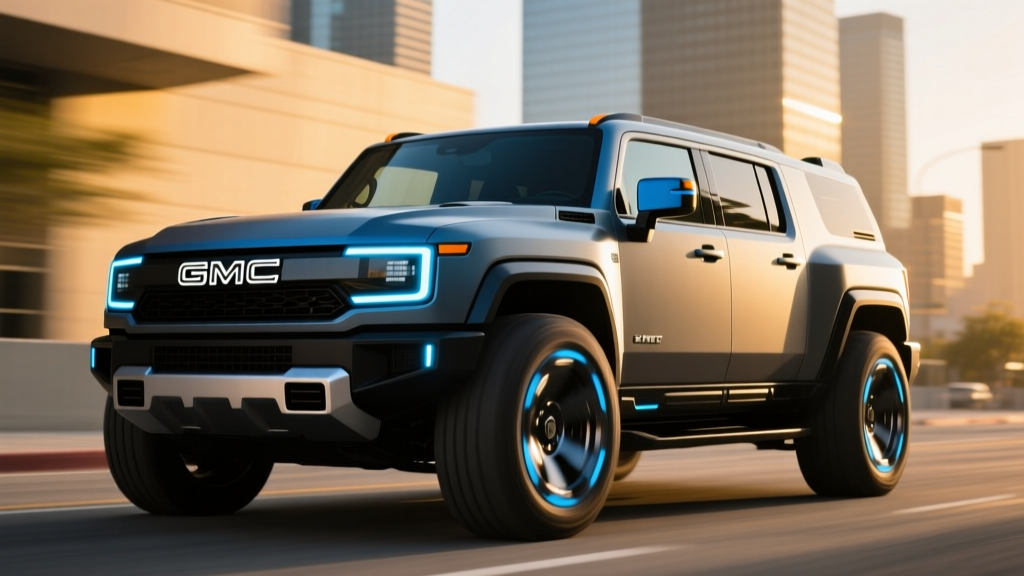
The GMC Hummer EV is less a vehicle and more a rolling statement. At over 9,000 pounds, with up to 1,000 horsepower and a battery pack larger than some home energy storage systems, it defies conventional EV logic. Yet it exists, it's on sale, and buyers are lining up. This review breaks down the real numbers behind the Hummer EV's headline-grabbing horsepower — and whether that power translates into a practical daily driver or remains an expensive garage trophy.
Hummer EV Horsepower and Powertrain Breakdown
The Hummer EV's horsepower output depends entirely on which trim and drive mode you select. GMC offers two distinct powertrain configurations across the Pickup and SUV body styles:
| Trim / Configuration | Horsepower | Torque (lb-ft) | 0-60 mph | Drivetrain |
|---|---|---|---|---|
| 2X (Dual-Motor) | 625 hp | 7,400 lb-ft* | ~4.0 sec | AWD (e4WD) |
| 3X (Tri-Motor) | 830 hp | 11,500 lb-ft* | ~3.0 sec | AWD (e4WD) |
| 3X with Watts to Freedom | 1,000 hp | 12,000 lb-ft* | ~3.0 sec | AWD (e4WD) |
*Wheel torque figures as published by GMC; these are multiplied through gearing and differ from motor-output torque.
The tri-motor 3X configuration is where the Hummer EV earns its supercar-rivaling Hummer EV hp claims. The Watts to Freedom (WTF) drive mode is essentially a launch-control sequence: the vehicle lowers its air suspension, haptics pulse through the seat, and all three motors deliver maximum output. In testing, the 3X Pickup hits 60 mph in roughly 3.0 seconds — remarkable for a vehicle that weighs as much as two Honda Civics stacked on top of each other.
The dual-motor 2X is no slouch at 625 hp and a sub-4-second 0-60, but it also carries a significantly smaller (though still massive) battery, which affects both range and charging behavior. Most buyers cross-shopping large electric trucks will find the 2X more than adequate for real-world passing and merging.
Range, Battery, and Real-World Efficiency
The Hummer EV's battery is one of the largest ever put into a production passenger vehicle. GMC uses an Ultium-platform double-stacked module design with NMC (nickel manganese cobalt) chemistry — chosen for energy density over the cycle-life advantages of LFP.
| Spec | 2X (Standard/Large Pack) | 3X (Tri-Motor) |
|---|---|---|
| Battery Capacity (usable) | ~170 kWh (2X) / ~212 kWh (2X w/ Large Pack) | ~212 kWh |
| Chemistry | NMC (Ultium) | NMC (Ultium) |
| EPA Range (Pickup) | 292 mi (Std) / 381 mi (Large) | 329 mi |
| EPA Range (SUV) | 281 mi (Std) / 314 mi (Large) | 314 mi |
| Efficiency (Pickup) | ~47 MPGe / 72 kWh/100mi | ~52 MPGe / 65 kWh/100mi |
The EPA sticker on the 3X Pickup says 329 miles. In practice, expect 250–280 miles at sustained highway speeds (70–80 mph), where aerodynamic drag on a 9,000-lb brick-shaped truck dominates energy consumption. In cold weather (below 30°F), range can drop an additional 15–25%, putting realistic winter highway range closer to 200–230 miles. City driving with regenerative braking recovers more energy, so urban commuters may see numbers closer to the EPA estimate. Source: fueleconomy.gov.
Efficiency is, predictably, the Hummer EV's weakest metric. At roughly 65–72 kWh per 100 miles, it consumes about twice the energy per mile of a Tesla Model Y or Ford F-150 Lightning. This matters for charging cost and time, not just range. A full 0–100% charge on the 212 kWh pack at the national average residential electricity rate of ~$0.17/kWh costs roughly $36, compared to about $12–$15 for a midsize EV.
Charging Speed: DC Fast and Home Level 2
The Hummer EV supports 800-volt architecture, enabling DC fast-charge rates up to 350 kW on compatible chargers — but only on the 3X tri-motor trims. The 2X tops out at a lower rate. Here's what the numbers look like in practice:
| Charging Level | Power / Rate | Time / Range Added |
|---|---|---|
| Level 1 (120V, 12A) | ~1.4 kW | ~3–4 miles per hour |
| Level 2 (240V, 48A) | 11.5 kW | ~24–28 miles per hour |
| Level 2 (240V, 80A) | 19.2 kW | ~40–46 miles per hour |
| DC Fast Charge (3X, peak) | 350 kW | 10–80% in ~34 minutes |
| DC Fast Charge (2X, peak) | ~200 kW | 10–80% in ~45 minutes |
A critical nuance: the Hummer EV's massive battery means that even at a peak 350 kW, you're filling a 212 kWh tank. The charge curve tapers significantly above 80% state of charge (SoC), so a 10–80% session takes roughly 34 minutes on the 3X at a 350 kW station. On more common 150 kW chargers, expect 10–80% in closer to 55–65 minutes.
For home charging, the onboard 19.2 kW AC charger (available on higher trims) is almost a necessity rather than a luxury. At 11.5 kW (48A), refilling the 212 kWh pack from 10% takes roughly 18 hours — fine for overnight top-ups but not for same-day turnaround. At 19.2 kW (80A), that drops to about 11 hours. Plan on a dedicated 100-amp circuit for the 80A EVSE, and budget for a panel upgrade if your home has a 100-amp main panel.
Pricing, Trims, and Federal Tax Credit Eligibility
The Hummer EV is positioned as GMC's halo vehicle, and pricing reflects that. Here is the current trim breakdown for the 2026 model year:
| Trim | Body Style | MSRP (est.) |
|---|---|---|
| 2X | Pickup | ~$99,995 |
| 2X | SUV | ~$106,495 |
| 3X | Pickup | ~$107,095 |
| 3X | SUV | ~$112,595 |
| 3X with Extreme Off-Road Package | Pickup/SUV | $120,000–$140,000+ |
Under current IRS rules, the Hummer EV Pickup qualifies for the full $7,500 federal tax credit (MSRP cap for trucks/vans/SUVs is $80,000 — but the Hummer EV Pickup is classified as a truck, and the cap applies; however, the Hummer's MSRP exceeds $80,000). Important: The §30D MSRP cap for pickups is $80,000, which means no Hummer EV trim qualifies for the federal purchase credit because all trims exceed this threshold. Buyers should verify current rules at irs.gov and consult a tax professional. State-level incentives may still apply — check your local DMV or energy office.
As-tested pricing on a well-equipped 3X Pickup with the Extreme Off-Road package (underbody armor, 37-inch tires, adaptive air ride, CrabWalk four-wheel steering) can push past $140,000 after destination and options. This puts the Hummer EV in direct price competition with the Rivian R1T Quad-Motor and the Lucid Gravity Touring, both of which offer very different value propositions.
Cargo, Passenger Space, and Daily Practicality
The Hummer EV Pickup offers a 5-foot bed with approximately 37.7 cubic feet of cargo volume, plus a front trunk (frunk) with roughly 11.3 cubic feet of lockable storage — one of the largest frunks in any production EV. The SUV variant trades the bed for an enclosed cargo area with about 81.8 cubic feet behind the front seats when the second row is folded.
| Dimension | Pickup | SUV |
|---|---|---|
| Front Legroom | 45.6 in | 45.6 in |
| Rear Legroom | 38.9 in | 38.9 in |
| Bed / Cargo Volume | 37.7 cu ft (bed) | 81.8 cu ft (max cargo) |
| Frunk | 11.3 cu ft | N/A (SUV) |
| Towing Capacity | 7,500 lbs | 7,500 lbs |
| Curb Weight | ~9,063 lbs | ~9,000+ lbs |
Towing is rated at 7,500 pounds, respectable for an electric truck but below the F-150 Lightning's 10,000-lb max. Expect towing range to drop by 40–50%, meaning a 3X Pickup pulling a 5,000-lb trailer will see real-world range fall to roughly 150–180 miles before needing a charge.
Daily practicality is a mixed bag. The Hummer EV is 86.7 inches wide (over 7 feet) before mirrors, making it a tight fit in standard parking spaces and older garage structures. Ground clearance in Terrain mode reaches 15.9 inches with the air suspension, and the available CrabWalk diagonal-steering mode is genuinely useful on tight trails — less so navigating a Costco parking lot.
Technology, Driver Assists, and Standout Features
The Hummer EV runs GM's latest Ultifi software platform with a 13.4-inch center touchscreen and a 12.3-inch driver display. Google Built-in handles navigation, voice assistant, and app integration. The 18-camera UltraVision system (including underbody cameras) is invaluable for off-road obstacle spotting and tight maneuvering.
Driver assistance comes via GM's Super Cruise on compatible mapped highways — a hands-off, eyes-on Level 2 system with driver monitoring via infrared camera. Super Cruise coverage has expanded significantly through 2026, now covering over 750,000 miles of compatible roads in North America.
Super Cruise is a Level 2 driver-assist system. You must remain attentive, keep your eyes on the road, and be prepared to take over at any moment. It is not self-driving. The vehicle will issue escalating warnings and eventually slow to a stop if driver attention is not detected.
Standout features include:
- CrabWalk: Rear wheels steer up to 10° in the same direction as the fronts, allowing diagonal movement at low speeds — genuinely useful for off-camber trail sections.
- Extract Mode: Air suspension raises the vehicle 149 mm (~5.9 in) above standard ride height for extreme obstacle clearance.
- Adaptive Air Ride: Lowers for highway efficiency, raises for off-road, and includes a load-leveling function for towing.
- One-Pedal Driving: Aggressive regen allows near-complete stops without touching the brake pedal.
Notable drawbacks: the infotainment system can lag under heavy load (multiple camera views + navigation simultaneously), and the sheer vehicle width makes the surround-view camera essential rather than optional in urban settings. Wind noise at highway speeds is more pronounced than in the Rivian R1T or F-150 Lightning due to the removable roof panel seals and upright windshield.
How the Hummer EV Compares to Key Rivals
| Spec | GMC Hummer EV 3X Pickup | Rivian R1T Quad-Motor | Ford F-150 Lightning Platinum |
|---|---|---|---|
| Horsepower | 830–1,000 hp | 1,025 hp | 580 hp |
| EPA Range | 329 mi | 352 mi (Max Pack) | 300 mi |
| 0-60 mph | ~3.0 sec | ~2.5 sec | ~3.8 sec |
| Towing | 7,500 lbs | 11,000 lbs | 10,000 lbs |
| Max DC Charge | 350 kW | 220 kW | 150 kW |
| Starting MSRP | ~$107,095 | ~$89,900 | ~$98,874 |
| Federal Credit | Not eligible (MSRP cap) | Not eligible (MSRP cap) | Eligible (select trims/battery sourcing) |
The Rivian R1T Quad-Motor matches or exceeds the Hummer's horsepower in a package that's 2,000 pounds lighter, with better towing and comparable range. The F-150 Lightning is far more practical for daily use and towing, though it lacks the Hummer's off-road theater. The Hummer EV's unique value proposition is its combination of extreme off-road capability, novelty, and sheer presence — it's a vehicle you buy for what it is, not what it does most efficiently.
Pros
- Up to 1,000 hp with sub-3-second 0-60
- 350 kW DC fast charging (3X)
- CrabWalk and Extract Mode are genuinely useful off-road
- Massive 212 kWh battery provides strong range buffer
- Super Cruise hands-off highway driving
- One of the largest frunks in any EV
Cons
- Extreme width (86.7 in) limits parking/garage fit
- Efficiency of 65–72 kWh/100mi drives high charging costs
- No federal tax credit (MSRP exceeds §30D cap)
- Real-world highway/cold-weather range well below EPA
- Towing capacity trails F-150 Lightning and R1T
- $100,000+ entry price; as-tested can exceed $140,000
Who Should Buy the Hummer EV?
Buy the Hummer EV if: You want a conversation-starting, off-road-capable electric truck with supercar acceleration and don't mind paying a significant premium for novelty and presence. You have a garage that fits a 7-foot-wide vehicle, access to a Level 2 charger (ideally 80A/19.2 kW), and your daily driving is within 200 miles round-trip.
Skip the Hummer EV if: You need maximum towing capacity (F-150 Lightning or R1T), you're budget-conscious about charging costs, you need the federal tax credit to justify the purchase, or you regularly navigate tight urban streets and parking structures. The Rivian R1T delivers comparable performance in a more manageable, efficient package.
Warranty and Battery Coverage
GMC backs the Hummer EV with a competitive warranty package:
- Battery/Powertrain: 8 years / 100,000 miles (whichever comes first)
- Battery Capacity Retention: Warranty covers degradation below 70% of original capacity during the warranty period
- Bumper-to-Bumper: 3 years / 36,000 miles
- Corrosion: 6 years / 100,000 miles
The 70% retention threshold is standard for the industry. Given the NMC chemistry and the thermal management system's active cooling, early degradation data from 2023–2024 model-year owners suggests the 212 kWh packs are holding up well, with most reporting less than 5% loss after 20,000 miles. However, long-term data (100,000+ miles) on the Ultium platform is still limited.
Frequently Asked Questions
What is the real-world range of the GMC Hummer EV?
The EPA rates the 3X Pickup at 329 miles. Real-world highway driving at 70–80 mph yields approximately 250–280 miles. In cold weather (below 30°F), expect 200–230 miles. City driving with regenerative braking can approach the EPA figure.
How fast does the Hummer EV charge at home and on the road?
On a 350 kW DC fast charger, the 3X charges from 10–80% in roughly 34 minutes. At home on a 240V/80A Level 2 charger (19.2 kW), a full charge takes about 11 hours. On a standard 48A Level 2 (11.5 kW), plan for ~18 hours.
Does the GMC Hummer EV qualify for the $7,500 federal tax credit?
No. Under current IRS §30D rules, the Hummer EV's MSRP exceeds the $80,000 cap for pickup trucks, making all trims ineligible for the federal clean vehicle purchase credit. Always verify current eligibility at irs.gov.
Is the Hummer EV worth it vs. the Rivian R1T?
If your priority is off-road capability, presence, and the unique CrabWalk feature, the Hummer EV has no equal. If you want better towing (11,000 lbs), a lighter and more efficient platform, and a lower starting price, the Rivian R1T Quad-Motor is the more rational performance truck.
How much horsepower does the Hummer EV actually have?
The dual-motor 2X produces 625 hp. The tri-motor 3X produces 830 hp, rising to 1,000 hp in Watts to Freedom launch mode. These are peak output figures available under specific drive-mode conditions.
Can the Hummer EV fit in a standard garage?
It depends on your garage. The Hummer EV is 217 inches long and 86.7 inches wide (without mirrors). A standard single-car garage (typically 12 feet wide) will be an extremely tight fit. A two-car garage is strongly recommended. Check your garage door opening height as well — the Hummer stands 81.1 inches tall at standard ride height.