Quick Answer: Is the Kia Niro EV Interior Worth It in 2026?
The 2026 Kia Niro EV pairs a practical, tech-forward cabin with a 64.8 kWh battery delivering an EPA-estimated 239 miles of range. The interior offers 19.1 cu ft of cargo space behind the rear seats (53.0 cu ft folded), dual 10.25-inch displays, and standard heated front seats. Starting around $39,600 before incentives, it costs roughly $10,000 more upfront than the Niro Hybrid, but saves an estimated $4,500–$6,000 in fuel and maintenance over five years for drivers covering 12,000 miles annually. It's best suited to buyers with reliable Level 2 home charging and mostly suburban or city commutes under 80 miles round-trip.
Kia Niro EV Interior: Cabin Quality, Space, and Tech
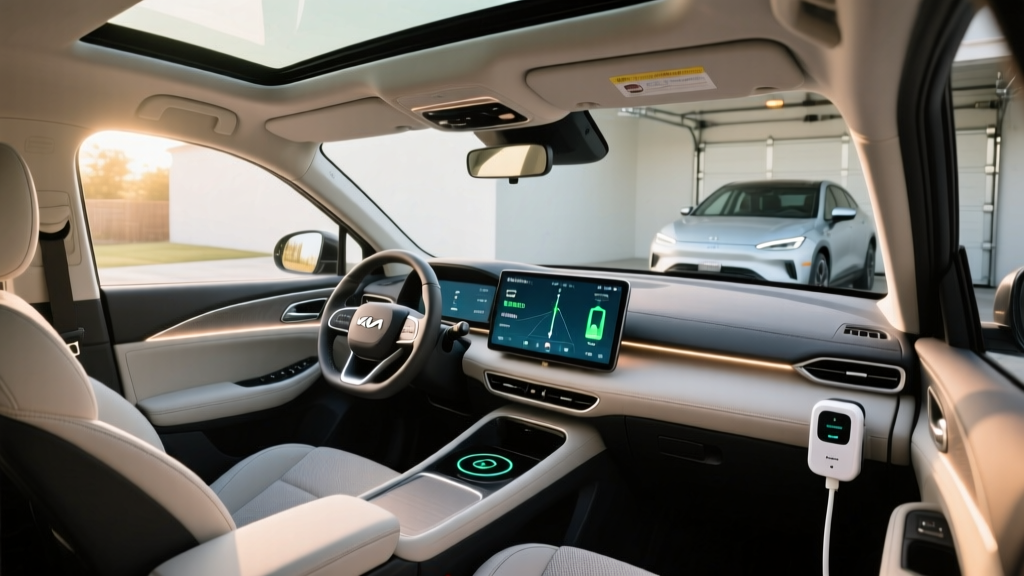
The Niro EV's interior is where this crossover earns its keep against rivals like the Chevrolet Bolt EUV and Hyundai Kona Electric. Kia uses a mix of soft-touch materials on the upper dash and door panels, with harder plastics lower down — typical for the sub-$45,000 segment but a step below what you'd find in the Ioniq 5 or Tesla Model Y.
The centerpiece is a curved display panel housing a 10.25-inch digital instrument cluster and a 10.25-inch infotainment touchscreen running Kia's latest Connect system with wireless Apple CarPlay and Android Auto. Physical climate controls remain below the screen — a practical choice that avoids the menu-diving frustration common in touch-only HVAC systems.
Front headroom measures 40.5 inches and rear legroom sits at 37.6 inches, making the back seat genuinely usable for adults on longer trips. The flat floor (thanks to the skateboard-style battery pack) improves middle-seat comfort compared to the Niro Hybrid's transmission tunnel.
Cargo and Practicality
Behind the rear seats, you get 19.1 cu ft — enough for a week's groceries or two carry-on bags per passenger. Fold the 60/40 split rear seat and capacity expands to 53.0 cu ft. The Niro EV does not offer a front trunk (frunk); the space under the hood houses the charge port electronics and inverter. A power liftgate is standard on EX and above.
Range, Efficiency, and Real-World Expectations
The Niro EV uses a 64.8 kWh usable battery pack (NMC chemistry) powering a front-mounted permanent-magnet synchronous motor producing 201 horsepower and 188 lb-ft of torque. The EPA rates it at 239 miles of combined range with a 113 MPGe combined efficiency rating, per fueleconomy.gov.
EPA vs. Real-World Range: What to Actually Expect
EPA sticker: 239 miles
Real-world highway (70 mph, 75°F): ~200–215 miles
Cold weather (30°F, city/highway mix): ~165–185 miles
Hot weather with A/C (95°F): ~210–225 miles
The Niro EV lacks a heat pump in US-market trims (available in some global markets), which means resistive cabin heating draws significant power in winter. Budget-conscious buyers in northern climates should plan for 25–30% range loss from December through February.
Charging Speeds: Home and DC Fast Charging
Charging capability is where the Niro EV shows its age relative to newer 800V platforms. The peak DC fast-charge rate is approximately 85 kW on a CCS1 connector — adequate for daily use but noticeably slower than the Hyundai Ioniq 5 (240 kW peak) or Tesla Model Y (250 kW peak).
| Charging Level | Power (kW) | Connector | Time / Rate |
|---|---|---|---|
| Level 1 (120V household) | ~1.4 kW | J1772 | ~3–4 miles per hour |
| Level 2 (240V home/public) | ~11 kW | J1772 | 0–100% in ~6.5 hours |
| DC Fast Charge | Peak 85 kW | CCS1 | 10–80% in ~43 minutes |
The charge curve tapers noticeably past 60% state of charge (SoC), dropping to roughly 50–60 kW for the 60–80% segment. On a road trip, plan your DC fast stops around the 20–70% SoC window where the Niro EV sustains its best rate. Expect roughly 150–170 miles added in a 30-minute session at a 150 kW+ station.
For home charging, a Level 2 wallbox (like a ChargePoint Home Flex or Emporia V2) on a 48-amp circuit will fully replenish the battery overnight. Installation typically costs $600–$1,800 depending on your panel capacity and conduit run — budget toward the higher end if your electrical panel needs a 200-amp upgrade.
Niro EV vs. Niro Hybrid: Cost and Ownership Breakdown
Many Niro shoppers cross-shop the EV and Hybrid trims. Here's how the numbers stack up over a 5-year/60,000-mile ownership horizon.
| Cost Category | Niro EV | Niro Hybrid |
|---|---|---|
| Base MSRP | $39,600 | $29,600 |
| Federal tax credit (§30D) | Up to $7,500* | $0 (not a PHEV/BEV) |
| Effective purchase price | ~$32,100 | $29,600 |
| Fuel/energy (60k mi) | ~$2,700 (home L2 @ $0.14/kWh) | ~$6,300 (50 MPG @ $3.50/gal) |
| Maintenance (5 yr) | ~$900 | ~$2,400 |
| Insurance (avg) | ~$7,800 | ~$6,900 |
| 5-Year Total | ~$43,500 | ~$45,200 |
*Federal §30D credit eligibility depends on buyer income (≤$150k single / $300k joint), vehicle MSRP caps ($80k SUVs), and battery critical-mineral sourcing requirements. Verify current rules at irs.gov. The credit may be transferred to the dealer at point of sale as a purchase-price reduction.
The EV pulls ahead on operating costs — electricity at national average rates is roughly one-third the per-mile cost of gasoline, and the Niro EV eliminates oil changes, transmission fluid, and exhaust-system maintenance. Insurance runs 10–15% higher for the EV due to repair-cost differentials on battery-adjacent components.
Common Misconceptions About the Niro EV
| Myth | Fact |
|---|---|
| "The battery will need replacing in 5 years" | Kia warranties the battery for 10 years/100,000 miles with a 70% capacity retention threshold. Real-world NMC degradation typically stays above 85% at 100k miles. |
| "I can charge it anywhere — any outlet works" | Level 1 (120V) adds only 3–4 miles per hour — useless as a primary strategy for daily driving. A dedicated Level 2 circuit is strongly recommended. |
| "It charges as fast as a Tesla" | At 85 kW peak, the Niro EV charges at roughly one-third the rate of a Model Y on a Supercharger. Plan longer DC stops on road trips. |
| "The federal credit is guaranteed" | §30D eligibility requires meeting income caps, MSRP limits, and battery-sourcing rules that change annually. Confirm before purchasing. |
Real-World Ownership: What First-Time EV Buyers Should Know
If you're transitioning from a gas vehicle, the Niro EV demands a shift in refueling habits. Here's what matters most:
- Home charging is the foundation. Over 85% of EV charging happens at home. If you live in an apartment without charging access or lack a garage/driveway, the Niro EV becomes significantly less convenient — public Level 2 charging adds 25–35 miles per hour and requires planning.
- Cold weather cuts range hard. Without a heat pump, the Niro EV relies on resistive heating that can consume 2–4 kW continuously. In sub-freezing climates, expect 25–30% range reduction and plan accordingly.
- Road trips require planning. The 85 kW DC fast-charge rate and 239-mile range mean stops every 150–170 highway miles. Use apps like PlugShare or A Better Routeplanner to map CCS-compatible stations along your route.
- Maintenance is minimal but not zero. Cabin air filters, tire rotations, brake fluid checks, and wiper blades remain. Regenerative braking dramatically extends pad life — many EV owners reach 80,000+ miles on original brake pads.
- Tire wear increases. The instant torque and heavier curb weight (~3,800 lbs) accelerate tire wear by 15–25% compared to the Niro Hybrid. Budget for replacement tires around 35,000–45,000 miles.
Decision Framework: Should You Buy the Niro EV?
Choose the Niro EV If:
- You have Level 2 home charging (or can install it)
- Your daily commute is under 80 miles round-trip
- You want zero tailpipe emissions and lower per-mile fuel costs
- You qualify for the full or partial §30D federal tax credit
- You primarily drive in moderate climates or accept winter range loss
Choose the Niro Hybrid Instead If:
- You lack reliable home or workplace charging access
- You regularly drive 300+ miles between stops (rural areas, frequent road trips)
- You live in an extreme cold-weather region and can't tolerate range variability
- Your budget is firm at $30,000 and you don't qualify for the EV tax credit
Consider the Hyundai Kona Electric or Chevrolet Bolt EUV If:
- You want faster DC charging (Kona Electric: ~100 kW+; newer platforms even faster)
- You need slightly more cargo volume or a more modern 800V architecture
2026 Kia Niro EV Key Specifications
| Specification | 2026 Kia Niro EV (Wind/EX) |
|---|---|
| EPA Range | 239 miles |
| Battery (usable) | 64.8 kWh, NMC |
| Motor Output | 201 hp / 188 lb-ft |
| 0–60 mph | ~7.2 seconds |
| DC Fast Charge Peak | 85 kW (CCS1) |
| 10–80% DC Charge | ~43 minutes |
| Level 2 Charge Rate | 11 kW (J1772) |
| Efficiency | 113 MPGe combined |
| Cargo Volume | 19.1 / 53.0 cu ft |
| Base MSRP | ~$39,600 |
| Battery Warranty | 10 yr / 100,000 mi (70% retention) |
| Bumper-to-Bumper | 5 yr / 60,000 mi |
Frequently Asked Questions
Does the 2026 Kia Niro EV qualify for the $7,500 federal tax credit?
It may. The §30D credit requires the buyer to meet income thresholds (≤$150,000 single / $300,000 joint AGI), the vehicle MSRP must not exceed $80,000 for SUVs, and the battery must satisfy critical-mineral and battery-component sourcing requirements set by the IRS. These sourcing rules tighten annually. Check the latest eligibility at fueleconomy.gov's tax credit tracker and consult a tax professional before relying on the credit.
How does the Niro EV interior compare to the Niro Hybrid interior?
The dashboard layout, screen sizes, and seat materials are nearly identical between the EV and Hybrid. The main difference: the EV has a rotary shift dial instead of a traditional gear lever, freeing up center-console storage. The EV also has a flat rear floor (no driveshaft tunnel), improving middle-seat legroom and comfort. Cargo volume is similar, though the Hybrid's smaller battery allows slightly more under-floor storage in the rear.
Can I road-trip the Niro EV cross-country?
Yes, but it requires patience. The 85 kW peak DC charge rate and 239-mile EPA range mean you'll stop every 150–170 highway miles for roughly 35–45 minutes. A 2,500-mile cross-country trip takes approximately 6–8 hours longer than in a gas car. Use Electrify America, EVgo, or ChargePoint DC stations along major interstates — CCS1 connector coverage is strong on I-5, I-10, I-40, I-70, and I-80 corridors.
What does Level 2 home charger installation cost for the Niro EV?
A typical Level 2 wallbox installation (48-amp, hardwired) costs $600–$1,800 total: $350–$700 for the charger unit, $250–$800 for electrician labor and materials, and $50–$200 for permits. If your home's electrical panel needs a 200-amp service upgrade, add $1,500–$3,500. Get quotes from at least two licensed electricians and confirm they pull required permits — unpermitted work can void home insurance coverage.
Is the Niro EV's battery reliable long-term?
Kia backs the battery with a 10-year/100,000-mile warranty guaranteeing at least 70% capacity retention. Independent fleet data on similar NMC packs shows typical degradation of 10–15% over the first 100,000 miles. To maximize longevity, avoid frequent DC fast charging above 90% SoC, try to keep daily SoC between 20–80%, and use scheduled departure preconditioning when plugged in to reduce thermal stress.