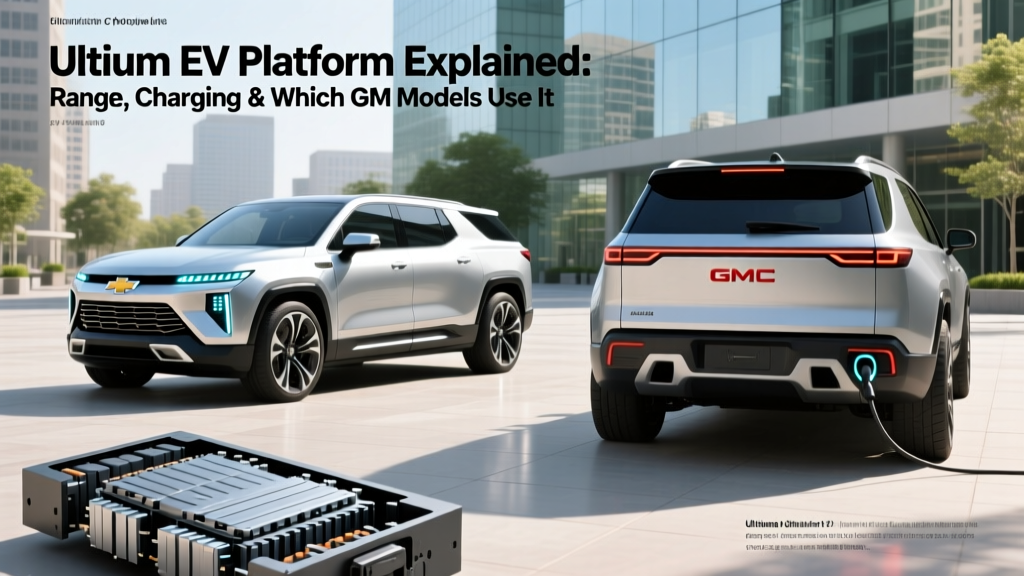
Quick Answer: Ultium is General Motors' modular EV battery and motor architecture introduced in 2022, now powering vehicles from the Chevrolet Equinox EV to the GMC Hummer EV. Ultium EVs use NMC (nickel-manganese-cobalt) pouch cells with usable capacities from 85 kWh to 200+ kWh, delivering EPA ranges between 250 and 440 miles depending on the model. Most Ultium vehicles support DC fast charging at 190–350 kW peak, with 10–80% charge times of 20–30 minutes. Pricing starts around $33,000 (Equinox EV) and exceeds $100,000 (Hummer EV). Federal §30D tax credit eligibility varies by model, MSRP cap, buyer income, and battery-sourcing rules — always verify on IRS.gov before purchasing.
What Is the Ultium EV Platform?
Ultium is not a single vehicle — it is a shared skateboard-style architecture encompassing battery packs, electric drive units (motors), and power electronics that GM deploys across Chevrolet, Buick, Cadillac, and GMC. The platform launched with the GMC Hummer EV in late 2022 and the Cadillac Lyriq in 2023, and by the 2025–2026 model years it underpins a wide range: affordable crossovers, luxury SUVs, full-size trucks, and performance vehicles.
The key engineering choices behind Ultium:
- Pouch-format NMC cells supplied primarily by Ultium Cells LLC (a GM–LG Energy Solution joint venture), with some prismatic cell sourcing as production scaled.
- Modular pack design — battery modules can be stacked in layers (single-layer for standard range, double-layer for extended range) to tune capacity from ~85 kWh usable to over 200 kWh usable.
- Wireless Battery Management System (wBMS) — reduces wiring harness weight and allows over-the-air calibration updates to individual cell groups.
- 800V architecture on select models (Hummer EV, Silverado EV) enabling 350 kW peak DC charging; 400V on others (Lyriq, Equinox EV, Blazer EV).
The name "Ultium" refers specifically to the battery chemistry and packaging — not the infotainment, chassis, or body. Two Ultium vehicles can share battery modules yet drive very differently depending on motor configuration, weight, and aerodynamics.
Which GM Models Use Ultium in 2025–2026?
Here is the current Ultium lineup with the specifications that matter most to buyers. All range figures are EPA estimates; real-world results depend on speed, temperature, and terrain.
| Model | Battery (usable kWh) | EPA Range | Peak DC kW | 10–80% Time | 0–60 mph | Base MSRP |
|---|---|---|---|---|---|---|
| Chevrolet Equinox EV 2LT (FWD) | 85 kWh (NMC) | 319 mi | 150 kW | ~32 min | 7.8 sec | $33,600 |
| Chevrolet Blazer EV RS (AWD) | 102 kWh (NMC) | 279 mi | 190 kW | ~28 min | 5.5 sec | $50,600 |
| Cadillac Lyriq (RWD) | 102 kWh (NMC) | 314 mi | 190 kW | ~27 min | 6.0 sec | $58,595 |
| Cadillac Optiq (AWD) | 85 kWh (NMC) | 300 mi (est.) | 150 kW | ~30 min | 5.7 sec | $53,000 (est.) |
| GMC Sierra EV Denali (AWD) | 200 kWh (NMC) | 440 mi | 350 kW | ~22 min | 4.3 sec | $99,495 |
| Chevrolet Silverado EV RST (AWD) | 200 kWh (NMC) | 440 mi | 350 kW | ~22 min | 4.5 sec | $87,300 |
| GMC Hummer EV Pickup 3X | 212 kWh (NMC) | 314 mi | 350 kW | ~24 min | 3.0 sec | $104,500 |
Real-World Range Reality: EPA estimates assume a mix of city and highway driving at moderate speeds. In sustained 75-mph highway testing, expect Ultium EVs to deliver roughly 80–88% of their EPA sticker. A Lyriq rated at 314 miles typically achieves 255–275 miles on a flat interstate at 70–75 mph. In freezing temperatures (below 32°F), range can drop an additional 15–25% without preconditioning. The 200 kWh trucks (Sierra EV, Silverado EV) lose more absolute miles to cold because their massive packs take longer to heat-soak — always precondition before DC fast charging in winter.
Charging the Ultium Platform: Home and DC Fast
Understanding charging speed requires distinguishing kW (power — how fast energy flows) from kWh (energy — how much the battery holds). A 190 kW charger doesn't deliver 190 kW for the entire session; it peaks early and tapers as the battery fills.
| Level | Power | Miles Added per Hour | Use Case |
|---|---|---|---|
| Level 1 (120V outlet) | 1.4 kW | 3–4 mi/hr | Overnight trickle; emergency top-ups |
| Level 2 (240V, 48A) | 11.5 kW | 28–34 mi/hr | Daily home charging; full overnight refill |
| DC Fast (400V models) | 150–190 kW peak | ~200 mi in 20 min | Road-trip stops (Lyriq, Equinox, Blazer) |
| DC Fast (800V models) | 350 kW peak | ~200 mi in 12 min | Road-trip stops (Sierra, Silverado, Hummer) |
At home, a Level 2 wall connector on a 60-amp circuit (delivering 48 amps continuous) adds roughly 30 miles of range per hour of charging. An Equinox EV owner driving 40 miles daily can fully replenish in under two hours overnight. A Sierra EV Denali with its 200 kWh pack needs closer to 18–20 hours on Level 2 from empty — but since most owners charge daily and rarely drain the pack, this is rarely a practical issue.
Charging-curve reality for road trips: A Blazer EV hitting a 190 kW Electrify America stall will peak near 190 kW at around 15–20% state of charge, sustain roughly 150–170 kW through 50%, then taper to 80–100 kW by 70%, and drop below 50 kW past 85%. The advertised "10–80% in 28 minutes" assumes a preconditioned battery and a cooperative charger. Always precondition via the vehicle's navigation-routed charging feature to warm the pack before arrival.
Ultium vehicles use the CCS1 connector for DC fast charging as of the 2025 model year. GM has announced a transition to the NACS (Tesla-style) port starting with 2026 model-year vehicles, and current CCS-equipped GM EVs can use Tesla Superchargers with a GM-approved CCS-to-NACS adapter. Verify adapter compatibility with your specific model year before relying on Supercharger access.
Ultium EV vs. Gas Vehicle: Real Ownership Costs
The purchase price of an EV is only one input. Total cost of ownership factors in fuel, maintenance, insurance, depreciation, and incentives. Here is a five-year comparison between a Chevrolet Equinox EV 2LT and a comparably equipped gasoline compact SUV (e.g., Honda CR-V AWD, ~$34,000 MSRP).
| Cost Factor (5 years / 75,000 mi) | Equinox EV 2LT | Gas Compact SUV (AWD) |
|---|---|---|
| Purchase Price (MSRP) | $33,600 | $34,000 |
| Federal Tax Credit (§30D, if eligible) | –$3,750 to –$7,500 | $0 |
| Fuel / Electricity | $2,800 (home charging at $0.14/kWh) | $7,200 (28 MPG avg at $3.40/gal) |
| Maintenance (oil, filters, brakes) | $1,200 | $3,800 |
| Insurance (average) | $8,500 | $7,100 |
| Estimated Depreciation | $14,000 | $12,500 |
| Total 5-Year Cost | $24,350 – $28,100 | $35,500 |
Key takeaways from this comparison:
- Energy savings are substantial — roughly $4,400 over five years when charging primarily at home. Public DC fast charging at $0.40–$0.55/kWh narrows this gap significantly.
- Maintenance savings come from eliminating oil changes, transmission fluid, spark plugs, and reducing brake wear via regenerative braking.
- Insurance costs more for EVs — typically 15–25% higher premiums due to repair costs and parts pricing. Get quotes before purchasing.
- Depreciation on EVs has been steeper than on gas vehicles in 2023–2025, though the gap is narrowing as the used-EV market stabilizes.
- Tax credit eligibility is not guaranteed. Under current §30D rules, the credit ranges from $3,750 to $7,500 depending on critical-mineral and battery-component sourcing, and is subject to buyer income caps ($150K single / $300K joint) and MSRP caps ($55K for cars, $80K for SUVs/trucks). The credit can be transferred to the dealer as a point-of-sale discount. Always confirm eligibility at IRS.gov and with your tax professional.
Battery Longevity and Warranty: What Ultium Owners Should Expect
GM covers Ultium battery packs with an 8-year / 100,000-mile warranty (10 years / 150,000 miles in California Air Resources Board states) against defects and excessive capacity loss. The warranty threshold is typically 70% retained capacity — if the pack drops below 70% of its original kWh within the warranty period, GM will repair or replace it.
Real-world degradation data for Ultium is still accumulating given the platform's 2022 launch, but based on NMC pouch-cell behavior in comparable EVs:
- Year 1–2: 2–4% capacity loss (initial formation settling)
- Year 3–5: 1–2% per year (gradual linear decline)
- Year 8–10 projection: 80–88% retained capacity under normal use
To maximize Ultium battery life:
- Keep daily charging between 20–80% state of charge; charge to 100% only before road trips.
- Minimize repeated DC fast charging — Level 2 home charging produces less thermal stress.
- Use preconditioning in cold weather before charging and before departure.
- Avoid letting the vehicle sit at 100% or below 10% for extended periods (days or weeks).
Out-of-warranty Ultium battery replacement costs are not yet widely published since few packs have aged out, but industry estimates for large NMC packs range from $12,000 to $22,000 depending on capacity, with the 200 kWh truck packs at the upper end.
Common Ultium EV Misconceptions — Fact-Checked
| Myth | Fact |
|---|---|
| "Ultium is a single car you can buy." | Ultium is the platform name. You buy a specific GM model (Equinox EV, Lyriq, Sierra EV, etc.) built on Ultium. |
| "All Ultium EVs charge at 350 kW." | Only 800V models (Sierra EV, Silverado EV, Hummer EV) peak at 350 kW. The 400V models (Equinox, Blazer, Lyriq) peak at 150–190 kW. |
| "I'll get the full $7,500 tax credit on any Ultium EV." | Credit amount depends on critical-mineral sourcing and battery-component requirements, plus your income and the vehicle MSRP cap. Some models may qualify for only $3,750 or none at all in a given year. Check IRS guidance. |
| "Ultium batteries use LFP chemistry." | As of 2025–2026, Ultium uses NMC (nickel-manganese-cobalt) pouch cells. GM has discussed LFP for future lower-cost variants, but current production is NMC. |
| "Supercharging works natively on my GM EV." | Current Ultium vehicles have CCS1 ports. You need a GM-approved CCS-to-NACS adapter to use Tesla Superchargers. Native NACS ports are expected starting with 2026 model-year vehicles. |
| "The EPA range is what I'll actually get." | EPA range is a standardized estimate. Sustained highway driving at 75 mph yields ~80–88% of EPA. Freezing temperatures can reduce range by an additional 15–25%. |
Decision Framework: Which Ultium EV Fits Your Situation?
Choose the Chevrolet Equinox EV if: You want the lowest entry price (~$33,600), drive under 60 miles daily, have home Level 2 charging, and prioritize value over performance. It's the most accessible Ultium vehicle and a strong commuter.
Choose the Cadillac Lyriq if: You want a luxury crossover with strong highway refinement, 314 miles of EPA range, and a premium interior — and you're willing to pay ~$58,600 before incentives. Ideal for buyers cross-shopping the BMW iX, Genesis Electrified GV70, or Tesla Model X.
Choose the Chevrolet Blazer EV if: You want a sportier midsize crossover with more power (up to 557 hp in SS trim) and don't mind slightly lower range (279 mi in AWD RS) for the performance trade-off.
Choose the GMC Sierra EV or Chevrolet Silverado EV if: You need truck utility — towing (up to 10,000 lbs on Silverado), a bed, ProPilot-style hands-free driving (Super Cruise available), and 440 miles of range — and your budget supports $87,000–$100,000. These are the longest-range Ultium vehicles thanks to their massive 200 kWh packs.
Choose the GMC Hummer EV if: You want extreme performance (1,000+ hp, 0–60 in ~3 seconds), off-road capability (Extract Mode, adaptive air suspension), and exclusivity — and you accept the $100,000+ price and heavy weight (over 9,000 lbs). It's a halo vehicle, not a rational commuter.
Wait or look elsewhere if: You lack access to any form of home or workplace charging. Public-only charging with a 200 kWh truck pack is expensive ($30–$50 per session at DC rates) and time-consuming. Consider a PHEV like the Chevrolet Volt's successors or a Toyota RAV4 Prime instead until your charging situation improves.
Frequently Asked Questions
Is Ultium the same as GM's older Bolt EV battery?
No. The Chevrolet Bolt EV and Bolt EUV used a different NMC cell format (cylindrical/prismatic from LG Chem) with a 65 kWh pack and CCS charging limited to ~55 kW. Ultium is a ground-up redesign with pouch cells, modular packs, higher energy density, and much faster DC charging.
Can I charge an Ultium EV at Tesla Superchargers?
Yes, but with an adapter. Current Ultium vehicles use the CCS1 connector. GM offers or approves CCS-to-NACS adapters that allow access to Tesla's Supercharger network. Verify adapter availability for your specific model and model year. Native NACS ports are expected on GM EVs starting with 2026 models.
What is the cheapest Ultium EV available?
The Chevrolet Equinox EV 2LT starts at approximately $33,600 for the 2025 model year, making it one of the most affordable Ultium-based vehicles and one of the lowest-priced EVs with over 300 miles of EPA range.
Does the Ultium battery use LFP or NMC chemistry?
All current Ultium production vehicles use NMC (nickel-manganese-cobalt) pouch cells. GM has signaled potential LFP adoption for future entry-level models to reduce cost, but as of 2025–2026, every Ultium EV on sale has an NMC pack. NMC offers higher energy density than LFP but is more sensitive to sustained high states of charge — keep daily charging at 80% or below.
How reliable are Ultium EVs so far?
Early Ultium vehicles (2022–2023 Hummer EV, 2023 Lyriq) experienced some software-related recalls and build-quality issues typical of first-year production. GM issued OTA updates and service campaigns to address most concerns. The Equinox EV and Blazer EV, entering production later, have benefited from these refinements. Check NHTSA.gov for the latest recall status on any specific model year before purchasing.
What happens if my Ultium battery degrades past the warranty threshold?
GM's battery warranty covers capacity loss below 70% of original within 8 years / 100,000 miles (10 years / 150,000 miles in CARB states). If your pack falls below this threshold, GM will repair or replace modules — not necessarily the entire pack, since Ultium's modular design allows individual module replacement, potentially reducing out-of-warranty costs compared to monolithic packs.
Sources: EPA range and efficiency data from fueleconomy.gov; federal tax credit rules from IRS.gov §30D; safety and recall data from NHTSA.gov; manufacturer specifications from GM press materials. Pricing and credit eligibility reflect 2025 model-year data and are subject to change. Consult a tax professional for credit eligibility.