Quick Verdict: The Best-Selling EV Earns Its Spot—With Caveats
The 2026 Tesla Model Y (Juniper refresh) remains the default electric crossover for American buyers who want a proven charging network, strong efficiency, and top-tier crash-test scores. EPA range peaks at 320 miles on the Long Range AWD trim, DC fast charging hits 250 kW, and the starting MSRP of $44,990 positions it squarely against the Hyundai Ioniq 5, Ford Mustang Mach-E, and Kia EV6. But viral videos of a crashed Tesla Model Y—often highlighting repair costs, battery-pack vulnerability, or Autopilot-related incidents—deserve a data-driven unpacking before you sign the paperwork.
This review covers the 2026 Model Y's real-world range, charging behavior, safety record, total cost, and whether it still deserves its sales crown.
Range, Battery, and Efficiency: The Numbers That Matter
| Trim | Drivetrain | Battery (usable kWh) | Chemistry | EPA Range | MPGe (combined) | kWh/100 mi |
|---|---|---|---|---|---|---|
| Standard Range RWD | Rear-Wheel Drive | 60 kWh | LFP | 277 mi | 123 MPGe | 27 |
| Long Range AWD | Dual-Motor AWD | 75 kWh | NMC | 320 mi | 117 MPGe | 29 |
| Performance AWD | Dual-Motor AWD | 75 kWh | NMC | 293 mi | 111 MPGe | 30 |
The EPA 320-mile sticker on the Long Range AWD assumes mixed driving at moderate temperatures. In sustained 75-mph highway testing, expect ~265–280 miles before hitting a charger. In sub-freezing winter conditions (20°F or below), plan for 220–250 miles of usable range due to cabin heating load and reduced battery availability, even with Tesla's heat pump. The Standard Range RWD's LFP pack handles cold slightly worse at the chemistry level but allows routine 100% charging, partially offsetting the smaller pack size.
Tesla's efficiency remains class-leading. The Model Y Long Range's 29 kWh/100 mi beats the Ioniq 5 AWD (~33 kWh/100 mi) and Mach-E Extended Range AWD (~34 kWh/100 mi), meaning cheaper per-mile fueling on any given electricity rate.
Charging Speed: Supercharger Network Still the Gold Standard
Charging is where Tesla ownership separates itself from the pack—less because of peak kW and more because of the Supercharger network's reliability and density.
| Charging Level | Connector | Peak Power | Speed / Time |
|---|---|---|---|
| Level 1 (120V household) | NACS | 1.4 kW | ~3–4 mi/hr |
| Level 2 (240V home / public) | NACS | 11.5 kW (48A) | ~44 mi/hr |
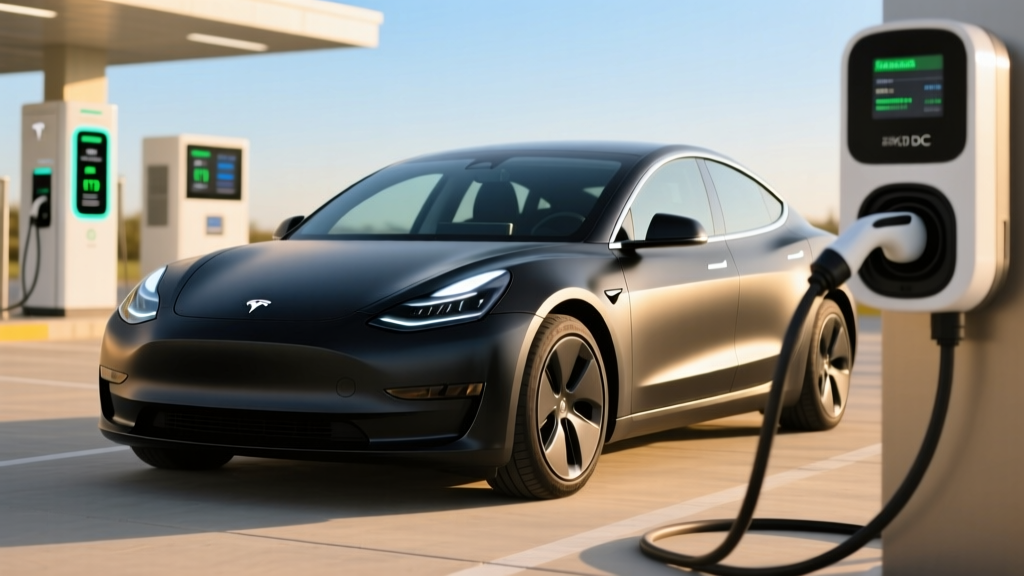
| DC Fast Charge | NACS (native) | 250 kW (V3 Supercharger) | 10–80% in ~25 min |
Charging-curve reality: The 250-kW peak only sustains from roughly 5% to 30% State of Charge. Above 50%, the rate tapers to ~100 kW, and above 80% it drops below 40 kW. Plan your road-trip stops around 10–80% for the fastest throughput—charging from 80–100% adds 25+ minutes for only ~60 miles of range.
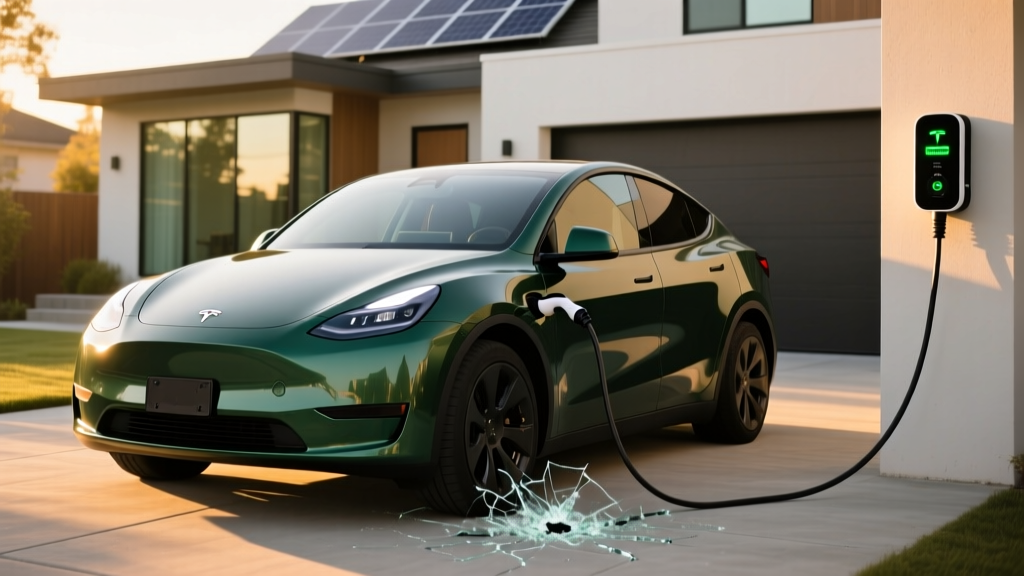
Home Level 2 charging requires a NACS Wall Connector ($420) on a 60-amp circuit. Expect a licensed electrician to charge $800–$2,200 for installation depending on panel proximity and local permitting. A 200-amp panel upgrade, if needed, adds $1,500–$3,000.
Safety Record: What Crashed-Tesla Data Actually Shows
Every few months, a viral crashed Tesla video circulates—often showing severe body damage, fire-department response, or Autopilot-related collisions. Context matters. Let's look at the data rather than headlines.
The 2026 Model Y carries a 5-Star Overall NHTSA Rating across frontal, side, and rollover crash tests, consistent with prior model years. The IIHS has historically named the Model Y a Top Safety Pick+ when equipped with acceptable headlights. The rigid battery-pack skateboard contributes to an extremely low rollover risk and strong side-impact intrusion resistance.
- NHTSA 5-Star Rating: Frontal crash ★★★★★, Side crash ★★★★★, Rollover risk 9.3%.
- Fire incidence: NTSB data indicates EV battery fires occur at roughly 25 per 100,000 vehicles vs. ~1,530 per 100,000 for ICE vehicles. However, EV battery fires burn hotter, longer, and require specialized suppression—making them more newsworthy per incident.
- Repair cost: A crashed Tesla with battery-pack damage frequently results in a total loss because Tesla does not offer pack-section repairs to independent shops. Minor-impact repairs (fender, bumper) are routine; structural or pack-involving collisions are where costs spiral.
- ADAS incidents: NHTSA's Standing General Order data shows Tesla Autopilot/FSD involved in a disproportionate share of reported Level 2 collisions—partly because Tesla reports more thoroughly than competitors, and partly due to the system's wide deployment scale. Autopilot is SAE Level 2: the driver is legally and physically responsible at all times.
Tesla's standard active safety suite (Automatic Emergency Braking, Blind-Spot Monitoring, Lane-Departure Avoidance) performs well in controlled testing. The optional FSD (Supervised) package, at $8,000 or $99/month, does not change the SAE Level 2 classification despite its "Full Self-Driving" branding.
Performance & Driving Impressions
| Trim | Horsepower | 0–60 mph | Top Speed | Drivetrain |
|---|---|---|---|---|
| Standard Range RWD | 295 hp | 6.5 sec | 135 mph | RWD |
| Long Range AWD | 384 hp | 4.8 sec | 135 mph | Dual-Motor AWD |
| Performance AWD | 456 hp | 3.5 sec | 155 mph | Dual-Motor AWD |
The Juniper refresh brought acoustic glass, retuned adaptive dampers, and a ventilated-seat option that close the refinement gap with the Ioniq 5 and EV6. The Long Range AWD is the sweet spot: 4.8-second 0–60 is more than adequate for merging, and the ride quality no longer feels like a penalty for choosing efficiency. The Performance trim's 3.5-second sprint is thrilling but costs 27 miles of EPA range and a stiffer ride.
Interior, Cargo, and Tech
The minimalist cabin centers on a 15.4-inch touchscreen running Tesla's proprietary OS. Rear passengers get a 8-inch screen for climate and entertainment. Build quality on the 2026 Juniper has measurably improved—panel gaps are tighter and the new ambient lighting strips replace the prior austerity.
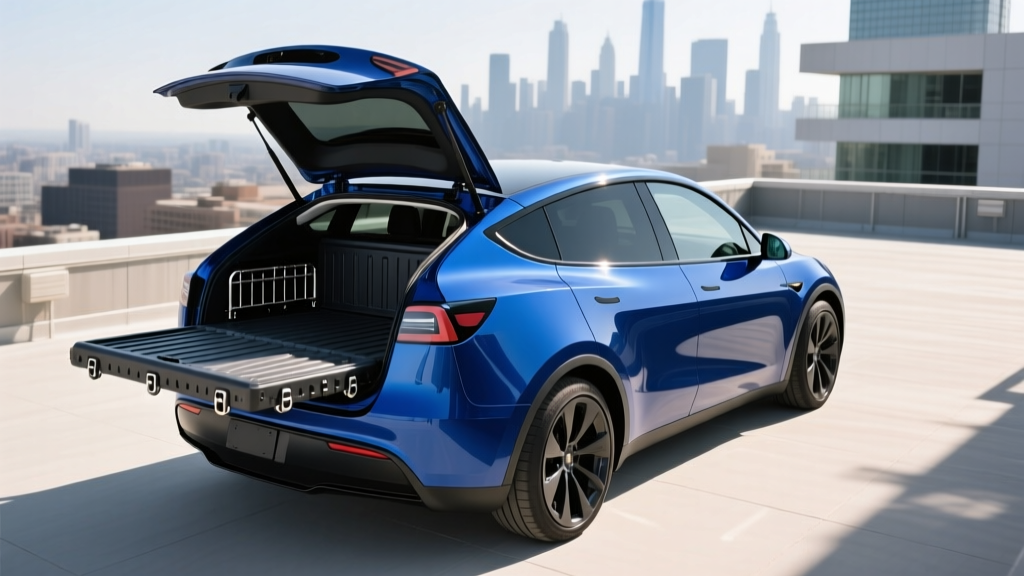
- Cargo (behind 2nd row): 30.2 cu ft
- Cargo (seats folded): 72.1 cu ft
- Front trunk (frunk): 4.1 cu ft
- Rear legroom: 40.5 inches
- Towing capacity: 3,500 lbs (AWD trims)
The Model Y's cargo volume still beats the Ioniq 5 (27.2 / 59.3 cu ft) and Mach-E (29.7 / 59.7 cu ft), making it the pragmatic family hauler. The available third-row seat is best reserved for small children on short trips—legroom is 26.5 inches.
Pricing, Trims, and Federal Tax Credit Eligibility
| Trim | Base MSRP | As-Tested (typical) | §30D Credit Eligible? | Effective Price (if eligible) |
|---|---|---|---|---|
| Standard Range RWD | $44,990 | $46,490 | Yes — up to $7,500 | ~$37,490–$38,990 |
| Long Range AWD | $48,990 | $51,990 | Yes — up to $7,500 | ~$41,490–$44,490 |
| Performance AWD | $53,990 | $56,490 | Yes — up to $7,500 | ~$46,490–$48,990 |
Federal tax credit rules (IRS §30D): The $7,500 credit is available as a point-of-sale transfer through a registered dealer. Eligibility requires:
- Buyer AGI ≤ $150,000 (single) / $300,000 (joint)
- Vehicle MSRP ≤ $80,000 (SUVs/crossovers)
- Battery critical-mineral and component sourcing thresholds (updated annually)
- Vehicle final assembly in North America (Model Y: Fremont, CA & Austin, TX)
All three 2026 Model Y trims currently meet the MSRP cap and assembly requirements. Battery-sourcing rules tighten annually—verify current-year compliance on the IRS qualified-vehicles list before purchase.
Pros, Cons, and Who Should Buy
- Class-leading efficiency (27–30 kWh/100 mi)
- Supercharger network reliability
- Top cargo volume in the segment (72.1 cu ft)
- 5-Star NHTSA safety across all tests
- OTA software updates add features over time
- LFP option (Standard Range) allows routine 100% charging
- Repair costs high when battery pack is involved in a crash
- No Apple CarPlay / Android Auto
- FSD ($8,000) is still SAE Level 2—not autonomous
- Insurance premiums 15–30% above segment average
- Minimalist interior not for everyone (no physical stalks on 2026)
- Third-row seat is impractical for adults
- Choose the Standard Range RWD if you commute under 60 miles/day, charge at home, and want the lowest entry price (~$38k after credit).
- Choose the Long Range AWD if you take regular road trips, live in a cold-weather state, or need AWD traction. This is the default recommendation.
- Choose the Performance if you prioritize acceleration over range and don't mind a firmer ride.
- Consider the Ioniq 5 or EV6 if you want physical controls, 800V architecture for faster 10–80% charging (~18 min on 350-kW chargers), or CarPlay integration.
Warranty & Long-Term Ownership
- Basic Vehicle: 4 years / 50,000 miles
- Battery & Drive Unit (Standard Range, LFP): 8 years / 100,000 miles, ≥70% capacity retention
- Battery & Drive Unit (Long Range / Performance, NMC): 8 years / 120,000 miles, ≥70% capacity retention
Tesla's battery warranty threshold of 70% is industry-standard, matching Hyundai/Kia's terms. Real-world degradation data from fueleconomy.gov owner reports and Tesla's own impact data show typical NMC packs retaining ~88–92% capacity at 100,000 miles. LFP packs degrade slower in calendar aging but are more sensitive to extreme cold when charging.
Frequently Asked Questions
What is the real-world range of the 2026 Tesla Model Y?
The Long Range AWD's EPA rating is 320 miles. In real-world highway driving at 75 mph, expect 265–280 miles. In winter (below 20°F), plan for 220–250 miles. The Standard Range RWD delivers ~230 miles highway and ~190 miles in deep cold.
How fast does the Model Y charge at home and on the road?
At home on a 240V / 48A Level 2 Wall Connector (11.5 kW), you gain ~44 miles per hour—a full overnight charge. On a V3 Supercharger (250 kW DC), 10–80% takes about 25 minutes. The charging curve tapers significantly above 50% SoC.
How much does the 2026 Model Y cost after the federal tax credit?
The Standard Range RWD starts at $44,990 and drops to roughly $37,490–$38,990 after the $7,500 §30D credit, assuming you meet income and sourcing requirements. The Long Range AWD falls to ~$41,490–$44,490. Always verify eligibility on the IRS qualified-vehicles list before purchase.
Does the Model Y qualify for the federal EV tax credit?
Yes, all 2026 Model Y trims currently qualify for up to $7,500 under §30D. Requirements include buyer AGI limits ($150k single / $300k joint), MSRP under $80,000, North American assembly, and battery critical-mineral/component sourcing thresholds that tighten each year. The credit can be transferred at point of sale as a purchase-price reduction.
Is the Model Y worth buying vs. the Ioniq 5, Mach-E, or EV6?
The Model Y wins on cargo space, efficiency (kWh/100 mi), and Supercharger access. The Ioniq 5 and EV6 charge faster on 350-kW hardware (~18 min 10–80%) and offer CarPlay. The Mach-E provides a more traditional interior layout. If reliable public charging is your top priority, Tesla's network advantage remains significant.
What happens if a Tesla Model Y is in a serious crash—can the battery be repaired?
Minor collision repairs (panels, glass, suspension) are routine at Tesla-authorized body shops. However, when a crashed Tesla sustains structural or battery-enclosure damage, the vehicle is frequently declared a total loss. Tesla does not sell battery modules to independent shops, and full pack replacement costs $12,000–$20,000 out of warranty. This dynamic drives higher insurance premiums compared to some competitors.
Is Tesla Autopilot or FSD actually self-driving?
No. Both Autopilot and FSD (Supervised) are SAE Level 2 driver-assistance systems. The driver must remain attentive, hands on or near the wheel, and legally responsible for all vehicle operation. True self-driving (Level 4) is currently only available via Waymo robotaxi services in select metro areas.