The Short Answer: Tesla Has Never Made a Gasoline Car
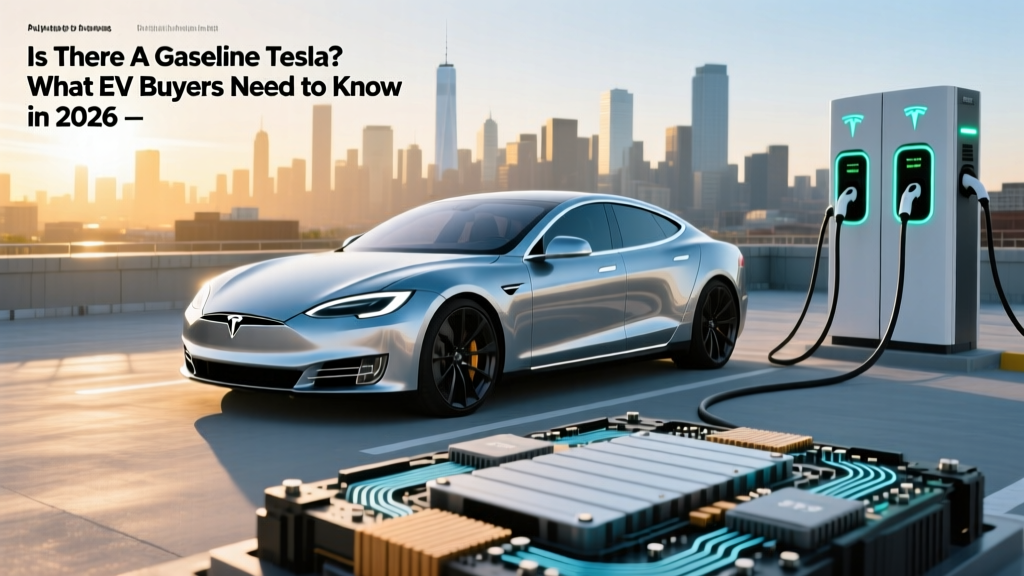
If you've been searching for a "gasoline Tesla," you're not alone—this phrase draws consistent interest from shoppers who admire Tesla's technology, Supercharger network, and minimalist design but aren't ready to commit to a fully electric drivetrain. The reality is straightforward: Tesla has never produced a gasoline, hybrid, or plug-in hybrid vehicle. Every model Tesla has ever sold—the Roadster, Model S, Model X, Model 3, Model Y, and Cybertruck—is a battery-electric vehicle (BEV) with zero tailpipe emissions and no internal combustion engine of any kind.
This isn't a future plan that might change. Tesla's corporate identity, manufacturing infrastructure, and software stack are built entirely around battery-electric propulsion. CEO Elon Musk has repeatedly stated that Tesla will not produce hybrids, calling them a "silly" compromise. So if a gasoline Tesla is a dealbreaker for your next purchase, you'll need to look elsewhere—or reconsider whether a Tesla BEV might actually work for your lifestyle.
Why People Search for a Gasoline Tesla (and What They Really Want)
The search intent behind "gasoline Tesla" typically falls into a few categories:
- Range-anxious buyers who want Tesla's tech and Supercharger access but fear being stranded without a gas backup.
- Apartment dwellers or street parkers who can't install home charging and worry about relying solely on public infrastructure.
- Road-trip enthusiasts who drive into rural areas where DC fast chargers are sparse.
- First-time EV shoppers who assume Tesla might offer a hybrid variant like Toyota, Ford, or Hyundai do.
These are legitimate concerns. The good news is that the 2026 EV landscape offers solutions for each scenario—whether that means choosing a Tesla BEV with realistic expectations or picking a competitor that does offer a plug-in hybrid with similar tech appeal.
Tesla's 2026 Lineup: All-Electric, By the Numbers
Since there's no gasoline Tesla to review, here's a detailed look at what Tesla actually sells in 2026. These are the vehicles you'd be choosing from if you decide to go fully electric with the brand.
| Model | EPA Range | Battery (kWh) | Chemistry | 0-60 mph | Drivetrain | Base MSRP |
|---|---|---|---|---|---|---|
| Model 3 RWD | 272 mi | ~60 kWh (usable) | LFP | 5.8 sec | RWD | $38,990 |
| Model 3 Long Range AWD | 341 mi | ~79 kWh (usable) | NMC | 4.2 sec | Dual-Motor AWD | $42,490 |
| Model Y Long Range AWD | 308 mi | ~79 kWh (usable) | NMC | 4.8 sec | Dual-Motor AWD | $44,990 |
| Model S Long Range | 402 mi | ~100 kWh (usable) | NMC | 3.1 sec | Dual-Motor AWD | $74,990 |
| Model X Long Range | 335 mi | ~100 kWh (usable) | NMC | 3.8 sec | Dual-Motor AWD | $79,990 |
| Cybertruck AWD | 340 mi | ~123 kWh (usable) | NMC | 4.1 sec | Dual-Motor AWD | $79,990 |
Source: fueleconomy.gov and Tesla's official specifications. Range figures are EPA estimates; real-world results vary.
EPA estimates assume a mix of city and highway driving at moderate temperatures. In real-world use:
- Highway driving at 75+ mph: Expect 10-15% less than EPA (e.g., Model 3 LR's 341 mi drops to ~290-305 mi).
- Cold weather (below 32°F): Range can drop 20-30% due to battery chemistry and cabin heating demands. A 341-mile Model 3 LR might deliver 240-270 miles in freezing conditions.
- City/regenerative driving: You may match or slightly exceed EPA estimates thanks to regen braking recapturing energy.
Tesla's navigation system accounts for elevation, temperature, and traffic when estimating range—making it one of the more accurate in-dash range predictors in the industry.
Charging Speed: DC Fast, Level 2, and the Supercharger Advantage
One reason buyers are drawn to Tesla—even while wishing for a gas option—is the Supercharger network. As of 2026, Tesla operates over 6,500 Supercharger stations in North America, and the network is now open to non-Tesla EVs via the NACS connector standard.
| Charging Level | Power (kW) | Speed (miles of range per hour) | Typical Use Case |
|---|---|---|---|
| Level 1 (120V household) | ~1.4 kW | 3-5 mi/hr | Emergency/overnight trickle |
| Level 2 (240V home wall connector) | 11.5 kW | 30-44 mi/hr | Daily home charging |
| DC Fast (V3 Supercharger) | Up to 250 kW | ~1,000 mi/hr (peak) | Road trips, 10-80% in ~25-30 min |
| DC Fast (V4 Supercharger) | Up to 350 kW (model-dependent) | Varies | Newer stations; Cybertruck capable of higher sustained rates |
Charging curve reality: Tesla's peak 250 kW rate on V3 Superchargers is sustained only between roughly 10-30% state of charge. The rate tapers progressively—dropping to ~100 kW by 60% and ~40 kW by 80%. A typical 10-80% session on a Model 3 Long Range takes about 25-30 minutes. This is competitive with the best CCS-based EVs but not class-leading; Hyundai's Ioniq 5 and Kia's EV6, with 800V architectures, can hit 10-80% in roughly 18 minutes at compatible 350 kW chargers.
Home charging: Tesla's Wall Connector delivers up to 11.5 kW on a 60-amp circuit (48 amps continuous), adding roughly 30-44 miles of range per hour of charging. For most owners, an overnight charge from 20% to 80% takes 5-7 hours—more than sufficient for daily driving needs. Installation costs typically range from $500 to $2,000 depending on your electrical panel's capacity and the distance from panel to charger location.
Tesla's Efficiency: MPGe and kWh per 100 Miles
Tesla vehicles consistently rank among the most energy-efficient EVs on the market, measured in MPGe (miles per gallon equivalent) or kWh per 100 miles. Here's how the 2026 lineup stacks up per EPA data:
- Model 3 RWD: 132 MPGe combined / 25 kWh/100mi
- Model 3 Long Range AWD: 125 MPGe combined / 27 kWh/100mi
- Model Y Long Range AWD: 117 MPGe combined / 29 kWh/100mi
- Model S Long Range: 120 MPGe combined / 28 kWh/100mi
What this means for your wallet: At the U.S. average residential electricity rate of ~$0.17/kWh (as of early 2026), charging a Model 3 Long Range at home costs roughly $4.59 per 100 miles. Compare that to a 30 MPG gasoline sedan at $3.50/gallon: $11.67 per 100 miles. The EV saves about $7 per 100 miles driven, or roughly $1,050 per year at 15,000 miles annually.
Performance and Drivetrain: What You Gain Without Gas
One area where Tesla's all-electric approach pays dividends is instant torque delivery. Without a transmission to shift or an engine to rev into its power band, Tesla models deliver maximum torque from zero RPM. The result:
- Model 3 RWD: 283 HP, 0-60 in 5.8 seconds—quicker than most gasoline sport sedans in its price class.
- Model 3 Long Range AWD: 346 HP combined, 0-60 in 4.2 seconds.
- Model S Plaid: 1,020 HP, 0-60 in 1.99 seconds—one of the fastest production cars ever built, gasoline or electric.
- Cybertruck AWD: 600 HP, 0-60 in 4.1 seconds, 11,000-lb towing capacity.
All Tesla models feature a low center of gravity thanks to the under-floor battery pack, which improves handling dynamics compared to most gasoline vehicles with a front-heavy engine layout. Dual-motor AWD models provide traction control that responds in milliseconds—faster than any mechanical AWD system.
Pricing, Tax Credits, and Total Cost of Ownership
Tesla's pricing has shifted frequently in recent years, but as of early 2026, here's where the lineup stands—and how the federal tax credit factors in.
| Model | Base MSRP | §30D Credit Eligibility | Effective Price (with credit) |
|---|---|---|---|
| Model 3 RWD | $38,990 | Eligible for up to $7,500 (LFP battery sourced from CATL; critical mineral & assembly rules met for qualifying buyers) | ~$31,490 |
| Model 3 Long Range AWD | $42,490 | Eligible for up to $7,500 (subject to sourcing & income caps) | ~$34,990 |
| Model Y Long Range AWD | $44,990 | Eligible for up to $7,500 | ~$37,490 |
| Model S Long Range | $74,990 | Not eligible — exceeds $55,000 sedan MSRP cap | $74,990 |
| Model X Long Range | $79,990 | Eligible for up to $7,500 (SUV cap is $80,000) | ~$72,490 |
The federal EV tax credit of up to $7,500 is not automatic. Per IRS guidelines, you must meet all of the following:
- Income caps: Modified AGI ≤ $150,000 (single), $225,000 (head of household), $300,000 (married filing jointly).
- MSRP caps: ≤ $55,000 for sedans; ≤ $80,000 for SUVs, vans, and trucks.
- Battery sourcing: A percentage of critical minerals must be sourced from the U.S. or free-trade-agreement partners, and battery components must be manufactured or assembled in North America (thresholds increase annually through 2029).
- Point-of-sale transfer: As of 2024, buyers can transfer the credit to the dealer for an immediate price reduction at purchase, rather than waiting to claim it on their tax return.
Eligibility can change as supply chains shift. Always verify current status on fueleconomy.gov before purchasing.
5-Year Cost Snapshot (Model 3 Long Range vs. comparable gas sedan): Over 5 years and 75,000 miles, a Model 3 LR owner might spend roughly $3,750 on home electricity, versus $8,750 on gasoline for a 30 MPG sedan. Factor in the lack of oil changes, transmission fluid, spark plugs, and reduced brake wear (thanks to regenerative braking), and total maintenance savings can add another $2,000-$3,000. However, EV insurance premiums tend to run 15-25% higher than comparable gasoline vehicles—budget accordingly.
Tech, Driver Assistance, and What Sets Tesla Apart
Tesla's technology stack is a primary reason buyers seek the brand—even those unsure about going fully electric. Key features across the 2026 lineup include:
- 15.4-inch central touchscreen (Model 3/Y) running Tesla's proprietary OS with over-the-air updates, streaming, and gaming.
- Autopilot (standard): SAE Level 2 driver assistance with adaptive cruise control, lane centering, and automatic emergency braking.
- Full Self-Driving (Supervised): An optional $8,000 upgrade (or $99/month subscription) that adds automated lane changes, traffic light/stop sign recognition, and city street navigation. This remains SAE Level 2—you must keep your hands on the wheel and eyes on the road at all times.
- Sentry Mode: 360-degree camera recording when parked, with motion-triggered alerts.
- Phone-as-key: Bluetooth-based entry with no fob required.
- Over-the-air updates: Tesla regularly pushes performance, range, and feature improvements wirelessly—something no gasoline vehicle can match.
Tesla's Autopilot and FSD (Supervised) are SAE Level 2 driver-assistance systems. They do not make the vehicle self-driving. The driver is legally and practically responsible for all vehicle operation at all times. Only Level 4 services like Waymo's robotaxi operate without a human driver, and those are available only in limited geofenced areas. Do not disengage from driving while using any Tesla assist feature.
Cargo, Passenger Space, and Practicality
For buyers considering whether a Tesla can replace their gasoline daily driver, cargo and passenger dimensions matter:
- Model 3: 23 cu ft trunk (including rear subtrunk), 42.3 inches front legroom, 35.2 inches rear legroom. Adequate for a family of four on a road trip, but the sedan trunk opening limits bulky items.
- Model Y: 34 cu ft behind the second row (76 cu ft with seats folded), available third row for small children. 41.8 inches front legroom, 41.6 inches rear legroom. This crossover form factor is why the Model Y is the best-selling EV in the U.S.
- Cybertruck: 6-foot bed with 3,400+ lb payload capacity and 11,000-lb towing. The most utilitarian Tesla, aimed squarely at truck buyers.
- Model X: Up to 91 cu ft cargo space with seats folded, falcon-wing rear doors for tight-space access, optional 6- or 7-seat configurations.
All Tesla models include a front trunk (frunk) for additional storage—a packaging advantage EVs have over gasoline vehicles since there's no engine block.
Battery Warranty and Longevity
Tesla's battery and drive unit warranty provides strong coverage:
- Model 3 RWD (LFP): 8 years / 100,000 miles, whichever comes first, with retention of at least 70% of original capacity.
- Model 3 Long Range / Model Y / Model S / Model X: 8 years / 120,000 miles (Model S/X: 150,000 miles), minimum 70% capacity retention.
Real-world degradation data from Tesla's fleet shows that most NMC batteries retain roughly 85-90% of original capacity after 100,000 miles. LFP batteries (Model 3 RWD) tend to show slightly more initial degradation but have a longer overall cycle life and can be charged to 100% daily without harm—unlike NMC packs, which Tesla recommends charging to 80% for daily use.
Out-of-warranty battery replacement costs range from approximately $5,000 to $16,000 depending on the model and pack size, though full replacements remain rare within the first 200,000 miles based on fleet data.
If You Want Tesla Tech but Need Gas: Alternatives to Consider
If you've read this far and still feel a gasoline or hybrid powertrain is essential, several competitors offer compelling alternatives that blend EV-like tech with gas flexibility:
- Toyota RAV4 Plug-In Hybrid (RAV4 Prime): 42 miles of electric-only range, 302 HP, 38 MPG combined on gas. No range anxiety, strong reliability, and available AWD. ~$44,000 MSRP.
- Hyundai Tucson PHEV: 33 miles electric-only, 261 HP, 35 MPG combined. Modern interior, strong warranty. ~$38,000 MSRP.
- Ford Escape PHEV: 37 miles electric-only, 210 HP, 40 MPG combined. Practical crossover with solid efficiency. ~$36,000 MSRP.
- BMW iX xDrive50 (BEV, but luxury alternative): If it's the premium feel you want, the iX offers 324 miles of range, 516 HP, and a luxury cabin. ~$87,000 MSRP.
None of these offer Tesla's Supercharger network access or OTA update frequency, but they eliminate range anxiety while providing meaningful electric-only commuting range.
Pros and Cons: Going All-Electric with Tesla
Pros
- Best-in-class Supercharger network with 6,500+ stations
- Industry-leading efficiency (kWh/100mi)
- Over-the-air updates improve the car after purchase
- Instant torque and strong performance across the lineup
- Low operating costs (electricity vs. gasoline, minimal maintenance)
- Strong resale value relative to most EV competitors
- Eligible for up to $7,500 federal tax credit on qualifying models
Cons
- No gasoline or hybrid option—BEV only
- Cold-weather range loss of 20-30% in freezing conditions
- Insurance premiums typically 15-25% higher than gas equivalents
- Repair costs can be high after collisions (aluminum body, integrated battery)
- Minimalist interior not to everyone's taste (no instrument cluster, no physical buttons)
- FSD (Supervised) is expensive and still requires full driver attention
- Model S/X priced out of the federal tax credit
Who Should Buy a Tesla (and Who Shouldn't)
Choose a Tesla BEV if:
- You can install a Level 2 home charger (garage or driveway with 240V access).
- Your daily commute is under 200 miles round-trip.
- You value OTA updates, minimal maintenance, and the Supercharger network.
- You're ready to plan road trips around charging stops (typically 20-30 minutes every 2-3 hours).
Choose a PHEV or HEV alternative if:
- You live in an apartment or park on the street with no reliable charging access.
- You frequently drive into rural areas with sparse charging infrastructure.
- You regularly tow heavy loads over long distances (EV range drops significantly under tow).
- You want the flexibility of gas stations for spontaneous long-distance travel without planning.
Frequently Asked Questions
Has Tesla ever made a gasoline or hybrid car?
No. Since its founding in 2003, Tesla has produced only battery-electric vehicles. The company has no announced plans for a hybrid or gasoline model, and CEO Elon Musk has publicly dismissed hybrids as unnecessary.
What is the real-world range of a Tesla Model 3 Long Range?
The EPA rates it at 341 miles. In real-world highway driving at 75 mph, expect roughly 290-305 miles. In freezing winter conditions, plan for 240-270 miles. The in-dash navigation system provides accurate range predictions that account for route elevation, speed, and temperature.
How fast does a Tesla charge at home and on the road?
At home on a Level 2 Tesla Wall Connector (11.5 kW), you'll add roughly 30-44 miles of range per hour—a full overnight session easily replenishes daily driving. On a V3 Supercharger (250 kW DC fast charging), a 10-80% session takes approximately 25-30 minutes, though charging speed tapers significantly above 80% state of charge.
Does the Tesla Model 3 qualify for the $7,500 federal tax credit?
The Model 3 RWD and Long Range AWD can qualify for up to $7,500 under IRS §30D, provided the buyer meets income caps (≤$150K single / ≤$300K joint), the vehicle MSRP is within limits (≤$55K for sedans), and battery sourcing requirements are met. The credit can be applied at the point of sale. Always verify current eligibility on fueleconomy.gov and consult a tax professional.
Is a Tesla worth buying versus a gasoline car in 2026?
Financially, a Tesla can save $1,000-$1,500 annually on fuel and maintenance versus a comparable gasoline sedan, and the federal tax credit can reduce the purchase price by up to $7,500. However, insurance costs are higher, and you need reliable home charging access. If your lifestyle supports daily charging and planned road-trip stops, the total cost of ownership strongly favors the Tesla. If you need go-anywhere flexibility without planning, a PHEV may be a better fit.
Can I charge a non-Tesla EV at a Supercharger?
Yes. As of 2026, Tesla has opened a significant portion of its Supercharger network to non-Tesla EVs equipped with the NACS connector (or using a Tesla-approved adapter). Vehicles from Ford, GM, Rivian, and others now use NACS natively. Non-Tesla vehicles without NACS may use a Magic Dock adapter at select stations.