Quick Verdict: Does the Mach-E Deliver Where It Counts?
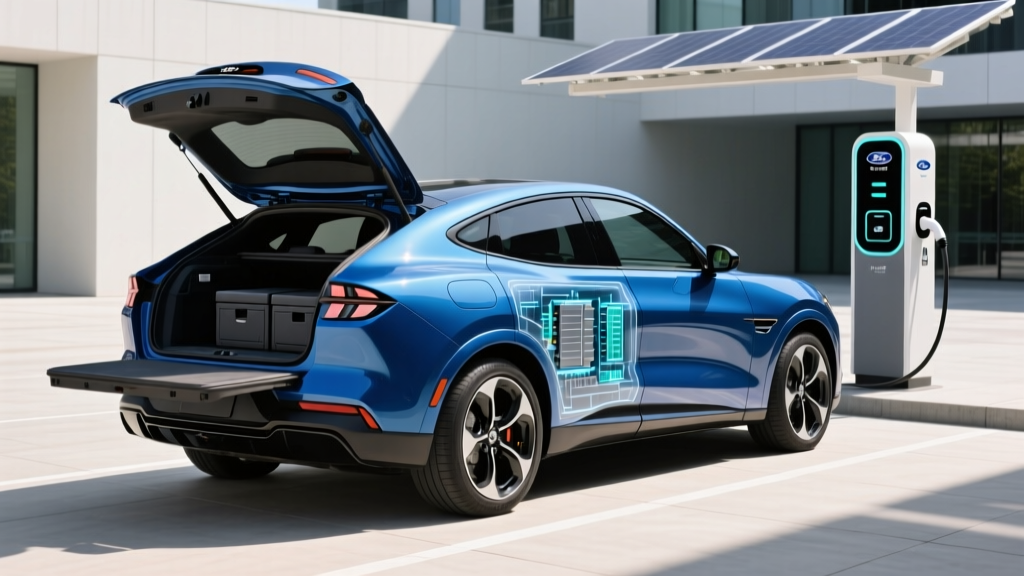
The 2026 Ford Mustang Mach-E remains one of the most compelling electric crossovers on the market, blending sharp handling, strong charging speeds, and a usable interior. But for family buyers, the first question is often practical: how much Mustang Mach-E trunk space do you actually get? The answer is 29.7 cubic feet behind the rear seats, expanding to 59.7 cubic feet with the 60/40 split folded — competitive with the Hyundai Ioniq 5 and slightly behind the Tesla Model Y's 30.2 cubic feet (rear seats up). Add the front trunk (frunk) at 4.7 cubic feet with a drain plug, and the Mach-E proves it can handle real-world cargo duty.
This review covers every number that matters — EPA range, real-world expectations, charging curves, battery chemistry, pricing after the federal tax credit, and the tech that makes daily ownership easier or more frustrating.
Mustang Mach-E Trunk Space & Cargo Dimensions
Ford designed the Mach-E on the dedicated GE2 EV platform, which frees up interior volume by eliminating a transmission tunnel and exhaust routing. The result is a cargo area that's wide, flat-floored, and practical.
| Measurement | Dimension |
|---|---|
| Cargo volume (rear seats up) | 29.7 cu ft |
| Cargo volume (rear seats folded) | 59.7 cu ft |
| Front trunk (frunk) | 4.7 cu ft (drainable, lockable) |
| Total max cargo | 64.4 cu ft |
| Rear legroom | 38.9 inches |
| Front legroom | 43.3 inches |
| Rear headroom | 38.2 inches |
| Cargo floor width (between wheel wells) | ~41.5 inches |
| Under-floor rear storage | Small compartment for charging cables |
The frunk is one of the Mach-E's standout utility features. At 4.7 cubic feet with a built-in drain plug, it doubles as a cooler for tailgating or a sealed bin for muddy gear. The power liftgate is standard on all trims, and the load floor sits low for easy loading of heavy items like dog crates or strollers.
Real-world cargo note: The sloping roofline — a design nod to the Mustang coupe heritage — does cut into vertical space for tall items. A full-size bicycle requires the front wheel removed, even with seats folded. If maximum vertical cargo room is a priority, the boxier Hyundai Ioniq 5 (27.2 cu ft rear-up but significantly taller load area) or the Tesla Model Y may serve better for oversized loads.
EPA Range, Battery & Real-World Expectations
The 2026 Mach-E lineup offers three battery configurations. Ford uses NMC (nickel manganese cobalt) chemistry across the lineup, prioritizing energy density for the extended-range packs.
| Trim / Battery | Usable kWh | Drivetrain | EPA Range | MPGe (Combined) |
|---|---|---|---|---|
| Select (Standard Range) | 70.0 kWh | RWD | 250 mi | 103 MPGe |
| Premium (Extended Range) | 91.0 kWh | RWD | 320 mi | 101 MPGe |
| Premium (Extended Range) | 91.0 kWh | AWD (eAWD) | 290 mi | 94 MPGe |
| GT (Extended Range) | 91.0 kWh | AWD (eAWD) | 280 mi | 87 MPGe |
| Rally (Extended Range) | 91.0 kWh | AWD (eAWD) | 265 mi | 84 MPGe |
EPA estimates assume mixed driving at moderate temperatures. In our experience and consistent with third-party highway testing, expect the Extended Range RWD to deliver approximately 270–285 miles at sustained 70 mph highway speeds in fair weather. In cold weather (below 30°F), range drops 20–30%, putting a 320-mile EPA rating closer to 225–255 miles on a winter road trip. The eAWD models lose an additional 10–15 miles vs. RWD due to the second motor's parasitic drag and added weight. Preconditioning the battery before departure (via FordPass scheduled departure) mitigates cold-weather losses by warming the pack while still plugged in.
Efficiency for the Extended Range RWD lands at approximately 33 kWh per 100 miles, which is average for the class. The Hyundai Ioniq 5 RWD achieves roughly 30 kWh/100 mi, while the heavier Tesla Model Y Long Range sits around 28 kWh/100 mi — giving Tesla a slight efficiency edge. Ford's heat pump, standard on 2026 models, helps preserve range in cold climates compared to resistive heating alone.
Charging Speed: DC Fast & Home Level 2
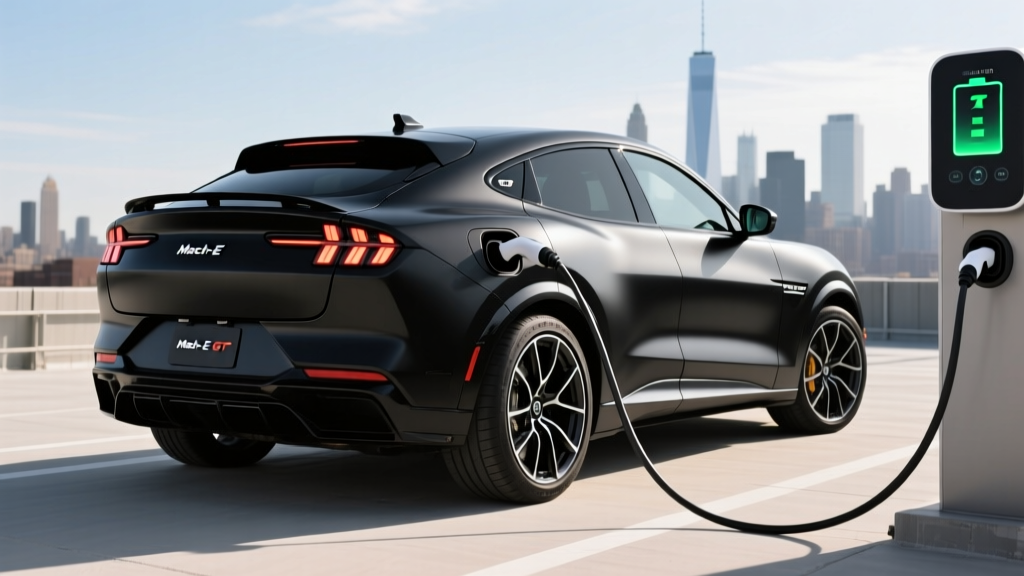
The Mach-E uses the NACS (North American Charging Standard) connector as of the 2025 model year, giving it native access to the Tesla Supercharger network — one of the strongest charging ecosystems available. This is a significant practical advantage over CCS-only vehicles in 2026.
| Charging Level | Power / Rate | Time / Notes |
|---|---|---|
| Level 1 (120V household) | ~1.2 kW | ~3–4 miles of range per hour |
| Level 2 (240V home, 32A) | 7.7 kW (single-phase onboard) | ~25 miles/hr; 10–100% in ~12 hours (ER) |
| Level 2 (240V, 48A capable) | 10.5 kW (requires Ford Connected Charge Station) | ~34 miles/hr; 10–100% in ~9 hours (ER) |
| DC Fast Charge (Standard Range) | Peak 150 kW | 10–80% in ~36 minutes |
| DC Fast Charge (Extended Range) | Peak 150 kW | 10–80% in ~36 minutes |
Charging curve reality: The Mach-E peaks at 150 kW but does not sustain that rate. The curve holds above 100 kW through roughly 50% State of Charge (SoC), then tapers progressively. From 80–100%, charging slows dramatically to protect the NMC cells — expect an additional 25–30 minutes for that final 20%. For road trips, plan stops around the 10–80% window to minimize time at the charger.
Compared to competitors, the Mach-E's 150 kW peak is modest. The Hyundai Ioniq 5 with its 800V architecture can peak at 240 kW and hit 10–80% in approximately 18 minutes. The Tesla Model Y peaks around 250 kW on V3 Superchargers. If DC fast-charge speed is your top priority, the Mach-E trails the segment leaders here.
For home charging, Ford's optional Connected Charge Station (48A, hardwired, NACS connector) is the recommended setup for Extended Range owners. Budget $500–$800 for the unit plus $800–$2,000 for professional installation by a licensed electrician, depending on whether your panel needs a 240V/60A circuit run. A panel upgrade to 200A service, if needed, adds $1,500–$3,000.
Performance & Driving Dynamics
| Trim | Horsepower | Torque (lb-ft) | 0–60 mph | Drivetrain |
|---|---|---|---|---|
| Select (SR RWD) | 266 hp | 317 | 6.3 sec | RWD |
| Premium (ER RWD) | 290 hp | 317 | 5.8 sec | RWD |
| Premium (ER eAWD) | 346 hp | 428 | 4.8 sec | Dual-motor AWD |
| GT (ER eAWD) | 480 hp | 634 | 3.5 sec | Dual-motor AWD |
| Rally (ER eAWD) | 480 hp | 700 | 3.4 sec | Dual-motor AWD |
The Mach-E's chassis tuning is where Ford earns its Mustang badge. Steering is precise, body roll is well-controlled, and the low center of gravity (battery pack under the floor) gives it genuinely engaging handling for a two-row crossover. The GT and Rally trims deliver supercar-rivaling acceleration — the GT's 3.5-second 0–60 time matches a Porsche 911 Carrera from a decade ago.
The eAWD system uses independent front and rear motors with no mechanical linkage. Torque vectoring is managed electronically, and the system can disconnect the front motor during light-load cruising to improve efficiency. Regenerative braking offers two modes: a mild setting that mimics conventional brake feel, and a stronger one-pedal mode that can bring the car to a full stop without touching the brake pedal.
Pricing, Trims & Federal Tax Credit Eligibility
| Trim | Base MSRP | Est. As-Tested (Popular Options) |
|---|---|---|
| Select (SR RWD) | $38,990 | $40,500 |
| Premium (ER RWD) | $45,490 | $48,000 |
| Premium (ER eAWD) | $48,490 | $51,500 |
| GT (ER eAWD) | $57,990 | $61,000 |
| Rally (ER eAWD) | $61,990 | $63,500 |
All trims fall under the IRS §30D MSRP cap of $80,000 for SUVs/crossovers, making them potentially eligible for the federal EV tax credit. However, qualifying for the full $7,500 credit depends on several factors that change with IRS guidance on battery component and critical mineral sourcing.
- MSRP cap: Vehicle must be ≤ $80,000 (all Mach-E trims qualify)
- Buyer income cap: AGI ≤ $150,000 (single) / $300,000 (married filing jointly) / $225,000 (head of household)
- Battery sourcing: Must meet critical mineral and battery component requirements per current IRS guidance — these thresholds increase annually and may affect eligibility
- Point-of-sale transfer: Eligible buyers can transfer the credit to the dealer at purchase, reducing the purchase price directly rather than waiting for a tax refund
- Final assembly: Must be in North America (Mach-E is built in Cuautitlán, Mexico — qualifying under USMCA)
Always verify current eligibility at IRS.gov and consult a tax professional before purchase. Credit amounts and sourcing rules are subject to change.
If the full $7,500 credit applies, the Select trim effectively starts around $31,490 — exceptional value for a 250-mile electric crossover. The Premium ER RWD drops to approximately $37,990 after credit, undercutting the Tesla Model Y Long Range on price while offering comparable range.
Technology, Safety & Driver Assistance
The 2026 Mach-E features Ford's latest SYNC 4A infotainment on a 15.5-inch vertically oriented touchscreen (13.2-inch on Select). Wireless Apple CarPlay and Android Auto are standard. The system supports over-the-air (OTA) updates, which Ford has used to add features like improved route planning and battery preconditioning for DC charging after launch.
Ford BlueCruise is available on Premium and standard on GT/Rally trims. BlueCruise is an SAE Level 2 hands-free driver-assistance system — meaning it handles steering, acceleration, and braking on pre-mapped divided highways (over 130,000 miles of qualified roads in the US and Canada as of 2026). The driver must remain attentive; an infrared camera monitors eye gaze and will issue escalating warnings if attention lapses, eventually bringing the vehicle to a controlled stop.
BlueCruise is NOT self-driving. It does not handle city streets, construction zones, or unmapped roads. The driver is legally responsible for the vehicle at all times. Do not confuse Level 2 hands-free assist with Level 4 autonomous driving (which only Waymo-style robotaxis currently offer in limited geofenced areas).
Standard safety technology includes Ford Co-Pilot360 2.0: automatic emergency braking with pedestrian detection, blind-spot monitoring, rear cross-traffic alert, lane-keeping assist, and evasive steering assist. The Mach-E earned an IIHS Top Safety Pick+ rating and a 5-star overall rating from NHTSA.
Notable tech drawbacks: The Mach-E has no rear wiper (a common complaint in rainy climates), and the absence of physical HVAC buttons means climate adjustments require tapping the screen — frustrating for some drivers. The digital instrument cluster is compact (10.2 inches) compared to competitors with full-width displays.
Warranty & Long-Term Ownership
| Coverage | Term |
|---|---|
| Basic (bumper-to-bumper) | 3 years / 36,000 miles |
| Powertrain | 5 years / 60,000 miles |
| EV Battery & Components | 8 years / 100,000 miles |
| Battery capacity retention | ≥70% of original capacity during warranty period |
| Corrosion (perforation) | 5 years / unlimited miles |
| Roadside assistance | 5 years / 60,000 miles |
The 8-year/100,000-mile battery warranty is industry-standard, matching most competitors. Ford guarantees the battery will retain at least 70% of its original usable capacity during the warranty period. Real-world NMC degradation data from early 2021–2022 Mach-E owners suggests approximately 5–8% capacity loss at 60,000 miles, well within the warranty threshold. Best practices for longevity: avoid routinely charging to 100% (set daily limit to 80–90%), use DC fast charging sparingly, and precondition the battery in extreme temperatures.
Ford's BlueCruise subscription is included for the first 3 months (or 90-day trial, depending on trim), after which it costs approximately $75/month or $800/year. Some buyers view this as a negative — paying a subscription for functionality bundled into the purchase price of the hardware.
Pros, Cons & Who Should Buy the Mach-E
Pros
- Competitive 29.7 cu ft trunk + 4.7 cu ft drainable frunk
- Engaging handling; GT delivers 3.5-sec 0–60
- Native NACS connector = direct Supercharger access
- 320-mile EPA range on ER RWD (class-leading for the price)
- BlueCruise hands-free on 130,000+ miles of highway
- All trims under $80K MSRP cap for tax credit
- Strong IIHS/NHTSA safety ratings
Cons
- 150 kW DC peak lags Ioniq 5 (240 kW) and Model Y (250 kW)
- No rear wiper
- Sloping roofline limits tall-item cargo height
- BlueCruise requires paid subscription after trial
- No physical HVAC buttons
- eAWD range penalty of ~30 miles vs. RWD
- Made in Mexico (may matter to some buyers)
Who the Mach-E Suits Best
- Daily commuters: The Select SR RWD at ~$31,500 after tax credit is a strong value for a 250-mile commuter with low running costs.
- Small families: 29.7 cu ft cargo + frunk handles strollers, groceries, and weekend trips. Rear legroom of 38.9 inches fits car seats and adult passengers comfortably.
- Enthusiast drivers: The GT and Rally deliver genuine performance-car acceleration with daily-driver practicality.
- Road trippers (with planning): NACS access to Superchargers makes cross-country travel viable, though 36-minute 10–80% stops are longer than Ioniq 5's ~18 minutes.
Consider alternatives if: You need maximum cargo height (look at Ioniq 5 or Kia EV9), fastest DC charging (Ioniq 5), or third-row seating (Kia EV9).
Frequently Asked Questions
What is the real-world range of the Mustang Mach-E?
The Extended Range RWD has an EPA rating of 320 miles. In real-world highway driving at 70 mph, expect approximately 270–285 miles in moderate temperatures. In cold weather below 30°F, expect 225–255 miles. The eAWD versions lose roughly 10–15 miles vs. their RWD counterparts.
How fast does the Mustang Mach-E charge?
On DC fast charging, the Mach-E peaks at 150 kW and charges from 10–80% in approximately 36 minutes. At home on a Level 2 (240V/48A) Ford Connected Charge Station, it adds about 34 miles of range per hour, fully charging the Extended Range battery in roughly 9 hours.
Does the Mustang Mach-E qualify for the federal EV tax credit?
All 2026 Mach-E trims fall under the $80,000 MSRP cap. Buyer income must not exceed $150,000 (single) or $300,000 (married filing jointly). Battery sourcing requirements under IRS §30D must also be met — verify current eligibility at IRS.gov before purchasing. The credit can be transferred at point of sale to reduce the purchase price directly.
How much trunk space does the Mustang Mach-E have?
The Mach-E offers 29.7 cubic feet behind the rear seats, 59.7 cubic feet with seats folded, and an additional 4.7 cubic feet in the front trunk (frunk). Total maximum cargo is 64.4 cubic feet.
Is the Mustang Mach-E worth buying vs. the Tesla Model Y or Ioniq 5?
The Mach-E competes well on driving dynamics, interior build quality, and range-per-dollar. It trails the Ioniq 5 on DC charging speed (150 kW vs. 240 kW) and the Model Y on cargo volume and efficiency. Choose the Mach-E if you value engaging handling, native Supercharger access without an adapter, and Ford's dealer/service network. Choose the Ioniq 5 for faster charging and a boxier cargo area, or the Model Y for maximum efficiency and Supercharger network maturity.
What is the battery warranty on the Mustang Mach-E?
Ford covers the EV battery and specific electric components for 8 years or 100,000 miles, whichever comes first. The battery must retain at least 70% of its original capacity during that period for a warranty claim to apply.