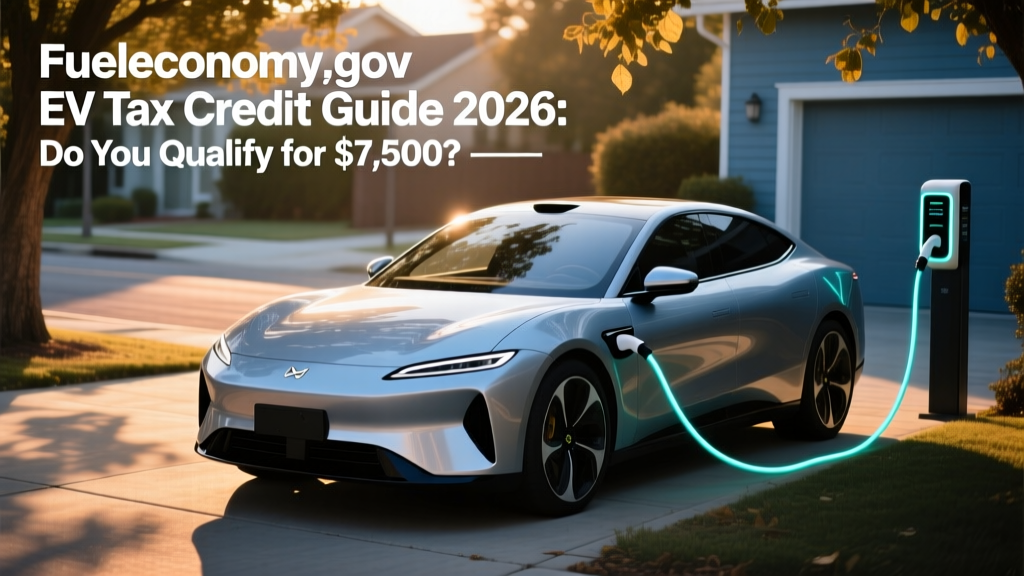
The Real Question: Does the Fueleconomy.gov EV Tax Credit Apply to You?
If you've searched "fueleconomy gov ev tax credit" in 2026, you're likely trying to figure out whether the vehicle you want actually qualifies for up to $7,500 in federal tax relief. The answer is more nuanced than a simple yes or no. The IRS §30D Clean Vehicle Credit — the official name behind the figures you see on fueleconomy.gov — comes with a stack of eligibility requirements that change based on your income, the vehicle's MSRP, and where its battery materials come from.
This guide breaks down exactly what the credit requires in 2026, how to verify eligibility, and what your true 5-year ownership cost looks like once you factor in charging, insurance, maintenance, and depreciation — not just the sticker-price savings.
Federal §30D Tax Credit: The 2026 Eligibility Checklist
The federal EV tax credit is split into two components, each worth up to $3,750, for a combined maximum of $7,500. You must satisfy each component independently. Here is what the IRS requires for a new clean vehicle placed in service in 2026:
- Buyer Income Caps (Modified AGI): $150,000 single / $225,000 head of household / $300,000 married filing jointly. Exceed these and you're ineligible regardless of the vehicle.
- MSRP Caps: Vans, SUVs, and pickup trucks must have an MSRP at or below $80,000. Sedans and other passenger cars must be at or below $55,000.
- Critical Minerals Requirement ($3,750): A specified percentage of the battery's critical minerals must be extracted or processed in the U.S. or a free-trade-agreement country, or recycled in North America. The threshold has tightened annually since 2024.
- Battery Components Requirement ($3,750): Battery components must be manufactured or assembled in North America. Additionally, vehicles containing battery components from a "foreign entity of concern" (FEOC) are disqualified entirely.
- Final Assembly: The vehicle must undergo final assembly in North America. Verify this via the VIN decoder on fueleconomy.gov.
- Point-of-Sale Transfer: Since January 2024, buyers can transfer the credit to the dealer at purchase, receiving the amount as a down-payment reduction or cash equivalent — even if they owe less than $7,500 in federal tax. This makes the credit effectively refundable at the point of sale.
- Vehicle Type: Must be a new BEV, PHEV, or fuel cell vehicle with a battery capacity of at least 7 kWh (for most vehicles) and a GVWR under 14,000 lbs.
Key caveat: The critical-minerals and battery-component thresholds tighten each year. A vehicle that qualified for the full $7,500 in 2024 may qualify for only $3,750 — or nothing — in 2026, as more supply chains fail to meet the stricter sourcing rules. Always verify current eligibility on IRS.gov before committing to a purchase.
5-Year Total Cost of Ownership: EV vs. Gas Car
The tax credit lowers your purchase price, but ownership cost is a longer game. Below is a realistic 5-year / 75,000-mile TCO comparison between a representative 2026 EV (e.g., a mid-trim crossover at ~$45,000 MSRP with $7,500 credit) and a comparable gas-powered crossover at ~$36,000 MSRP.
| Cost Category | EV (with $7,500 credit) | Gas Crossover | Difference |
|---|---|---|---|
| Purchase Price (after credit) | $37,500 | $36,000 | EV +$1,500 |
| Fuel / Charging (75,000 mi) | $4,690 | $9,375 | EV saves $4,685 |
| Maintenance (5 years) | $1,800 | $4,200 | EV saves $2,400 |
| Insurance (5 years) | $11,250 | $8,750 | EV costs $2,500 more |
| Depreciation (5 years) | $18,750 | $14,400 | EV costs $4,350 more |
| Total 5-Year Cost | $73,990 | $72,725 | EV +$1,265 |
The numbers tell a story: EVs save significantly on fuel and maintenance, but higher insurance premiums and steeper depreciation nearly erase those advantages over five years. The breakeven point typically arrives around year 6 or 7 — or sooner if your state offers additional rebates, or if gas prices rise above $4.00/gallon.
Charging vs. Gas: The Per-Mile Cost Math
The single largest operational savings for an EV comes from energy cost. Here's the math for 2026:
EV (home charging): National average residential electricity is ~$0.17/kWh. A typical 2026 EV crossover averages about 3.0 miles/kWh (roughly 112 MPGe combined). That's $0.057 per mile.
EV (public DC fast charging): At $0.40-$0.55/kWh on networks like Electrify America or EVgo, the same vehicle costs $0.13-$0.18 per mile — approaching gas-car territory.
Gas crossover: At $3.75/gallon and 25 MPG combined, the cost is $0.15 per mile.
Home charging is where the savings live. If you charge exclusively at home on a Level 2 charger, you'll spend roughly $940/year to drive 15,000 miles. The same distance in a gas crossover costs about $2,250. But if you rely primarily on public DC fast charging — common for apartment dwellers without home charging access — your EV energy cost nearly triples and the savings shrink dramatically.
Practical tip: Check whether your utility offers off-peak EV charging rates. Many providers in 2026 offer time-of-use plans that drop the overnight rate to $0.08-$0.11/kWh, cutting your per-mile cost to under $0.04.
Maintenance Savings: What You Actually Skip
EVs have far fewer moving parts than internal combustion vehicles, and the maintenance savings are real — but not zero.
| Maintenance Item | EV | Gas Vehicle |
|---|---|---|
| Oil Changes | None | $40-$80 every 5,000-10,000 mi |
| Brake Pads | 80,000-150,000+ mi (regen braking) | 30,000-70,000 mi |
| Transmission Fluid | None (single-speed reducer) | $150-$300 every 30,000-60,000 mi |
| Coolant | Battery thermal management flush ~5 years | Every 30,000-50,000 mi |
| Cabin Air Filter | Every 15,000-20,000 mi | Every 15,000-20,000 mi |
| Tire Rotation/Replacement | More frequent — EVs are heavier, instant torque wears tires faster | Standard intervals |
| Wiper Fluid, Wipers, 12V Battery | Same as gas | Same as EV |
The biggest hidden cost for EVs is tires. The combination of heavy battery packs (a typical crossover EV weighs 4,500-5,200 lbs) and instant torque means tire replacements come 20-30% sooner than on equivalent gas vehicles. Budget for a set of EV-rated tires (e.g., Michelin e.Primacy, Hankook iON) every 30,000-40,000 miles at $800-$1,400 per set.
Insurance: The Cost EV Owners Don't See Coming
EV insurance premiums in 2026 run 15-30% higher than comparable gas vehicles. For a $45,000 EV crossover, expect annual premiums of $2,100-$2,500 versus $1,600-$1,900 for a gas equivalent — a difference of $400-$700 per year.
The reasons are structural, not arbitrary:
- Higher repair costs: Battery packs, power electronics, and specialized sensors are expensive to replace after a collision. A minor rear-end impact that would cost $2,000 on a gas car can total an EV if the battery enclosure is compromised.
- Limited repair network: Fewer body shops are certified for high-voltage EV repair, creating bottlenecks that increase claim costs and rental-car durations.
- Vehicle weight: Heavier vehicles cause more damage in multi-vehicle collisions, increasing liability exposure.
- Parts availability: OEM battery modules and powertrain components have longer lead times than mass-produced ICE parts.
Some insurers (Geico, Progressive, State Farm) now offer EV-specific policies or discounts. Tesla owners may find competitive rates through Tesla Insurance in eligible states, which uses real-time driving data to set premiums. Always get quotes before purchasing — the spread between insurers for the same EV can exceed $800/year.
Depreciation and Resale Value: The EV Wildcard
EV depreciation has been volatile. In 2023-2024, Tesla's aggressive price cuts cascaded through the used market, pushing some EVs to 50%+ depreciation over three years. By 2026, the market has stabilized somewhat, but EVs still depreciate faster than gas vehicles on average.
Typical 5-year depreciation for a mainstream EV crossover sits at 45-55% of original MSRP, versus 35-45% for a comparable gas crossover. A $45,000 EV might be worth $20,000-$25,000 after five years, while a $36,000 gas crossover retains $19,000-$23,000.
Key factors driving EV depreciation:
- Battery health uncertainty: Used buyers discount for potential battery replacement costs ($8,000-$20,000 depending on pack size and chemistry).
- Technology obsolescence: Newer models with faster charging, longer range, and updated ADAS make 3-4 year old EVs feel dated faster than gas vehicles.
- New-vehicle price wars: When new EV prices drop, used values follow immediately.
- Federal credit effect: The $7,500 credit effectively lowers the "real" purchase price, but depreciation is calculated from MSRP — making the percentage loss appear steeper.
Brands with strong battery warranties (Hyundai/Kia at 10 years/100,000 miles, Tesla at 8 years/120,000 miles) tend to hold value slightly better, as the warranty transfers to the second owner.
State, Local, and Utility Incentives: Stack Them on Top
Important: State, local, and utility incentives vary dramatically by jurisdiction and change frequently. Always verify current programs through your state's energy office, local air quality district, and utility provider. The figures below are representative examples, not guarantees.
Beyond the federal §30D credit, many buyers can layer additional incentives:
- State rebates: California's CVRP has been replaced by point-of-sale rebates up to $7,000 for income-qualified buyers. Colorado offers a $5,000 state tax credit. New York, Massachusetts, and New Jersey offer $2,000-$4,000 rebates. Many states have no additional incentive.
- Utility rebates: Hundreds of utilities offer $250-$1,500 rebates for purchasing an EV or installing a home Level 2 charger. Some provide reduced time-of-use electricity rates exclusively for EV charging.
- HOV lane access: States including California, Colorado, Virginia, and Maryland grant solo-occupant HOV lane access to qualifying EVs — a significant commute-time benefit worth quantifying if your corridor is congested.
- Used EV credit: The §25E credit provides up to $4,000 (or 30% of sale price, whichever is less) for qualifying used EVs purchased from a dealer, with income caps of $75,000 single / $150,000 joint. The vehicle must be at least two model years old and priced at or below $25,000.
When state rebates, utility incentives, and the federal credit all align, total savings at purchase can exceed $12,000-$15,000 — enough to bring an EV's effective price below a comparable gas vehicle.
Frequently Asked Questions
How do I check if a specific vehicle qualifies on fueleconomy.gov?
Navigate to fueleconomy.gov, search for the vehicle by make/model/year, and look for the "Federal Tax Credit" line on the vehicle detail page. The site also provides a VIN decoder to confirm North American final assembly. However, fueleconomy.gov shows the maximum potential credit — you must independently verify that your income falls below the caps and that the vehicle's battery meets the current-year critical-minerals and component-sourcing thresholds. The IRS publishes the definitive qualifying vehicle list.
Can I get the tax credit if I lease instead of buy?
Technically, the §30D credit goes to the vehicle owner — which in a lease is the leasing company (lessor). However, most major automakers pass the full credit through as a "lease cash" incentive, reducing your monthly payment or capitalized cost. This has become standard practice by 2026. Some vehicles that don't qualify for the purchase credit (due to assembly location or battery sourcing) may still qualify under the commercial vehicle credit (§45W) when leased, as the rules differ. Ask the dealer to confirm how the credit is applied in your lease agreement.
What if I owe less than $7,500 in federal taxes?
Under the point-of-sale transfer provision (effective since January 2024), this no longer matters as much. You can transfer the credit to the dealer at purchase, receiving it as a down-payment reduction. The dealer then claims the credit from the IRS. This effectively makes the credit available even to buyers with low tax liability. However, if your income exceeds the AGI caps for the tax year, you must repay the credit when filing taxes — so ensure your projected income stays within limits.
How much does home charging installation add to my costs?
A Level 2 home charger (240V, 32-48 amp) typically costs $500-$800 for the hardware and $800-$2,500 for professional installation, depending on whether your electrical panel needs an upgrade. Total: $1,300-$3,300 before any utility rebate. If your panel is already 200A with spare capacity, installation stays on the lower end. A panel upgrade to 200A can add $1,500-$3,000. Factor this into your first-year budget.
Do PHEVs qualify for the same tax credit as full EVs?
Yes, plug-in hybrids with at least 7 kWh of battery capacity and meeting all sourcing, assembly, MSRP, and income requirements qualify for up to $7,500 under §30D. However, the credit amount depends on battery capacity — some PHEVs with smaller packs may qualify for less. In practice, most 2026 PHEVs from qualifying manufacturers offer 15-40 miles of electric-only range and may be eligible for $3,750-$7,500 depending on battery sourcing compliance.