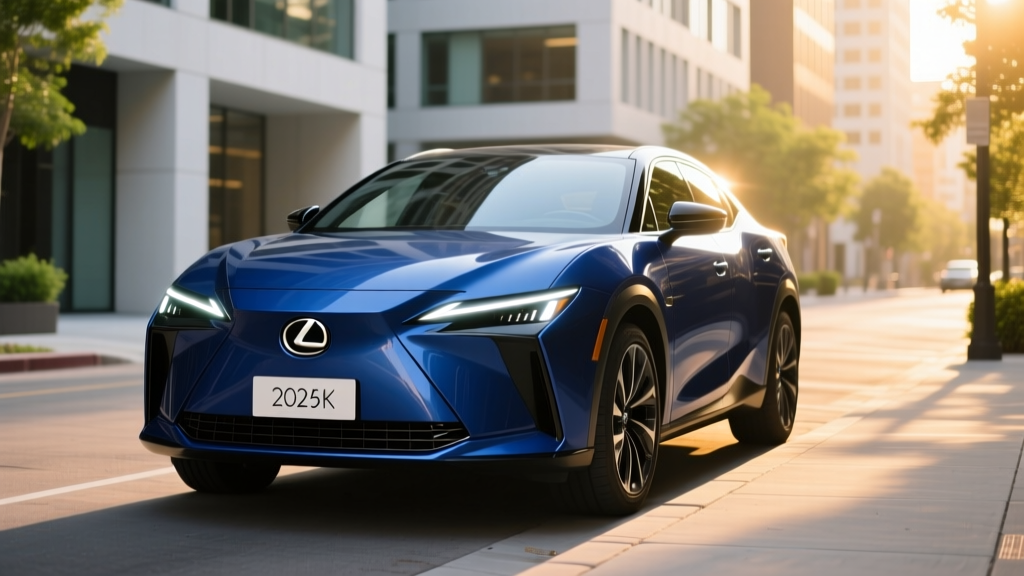
Leasing a Lexus electric car — specifically the RZ 450e, the brand's first dedicated battery-electric SUV — is a decision that lives or dies on the math. The RZ 450e offers a compelling luxury package with Lexus reliability backing, but its 220-mile EPA range (226 miles for the FWD RZ 300e) and premium pricing demand a hard look at total cost of ownership before you sign. This guide breaks down every dollar: federal tax credit eligibility under the current §30D rules, real-world charging versus gas costs, insurance premiums, maintenance savings, and depreciation trends that matter specifically to a Lexus electric car lease in 2026.
2026 Lexus RZ Quick Specs
| Model | RZ 450e AWD | RZ 300e FWD |
|---|---|---|
| EPA Range | 220 mi (expect ~185-200 mi highway/cold) | 266 mi (expect ~225-240 mi real-world) |
| Battery | 72.8 kWh usable, NMC chemistry | 72.8 kWh usable, NMC chemistry |
| DC Fast Charge | Peak 150 kW, 10-80% in ~30 min | Peak 150 kW, 10-80% in ~30 min |
| Level 2 Charge | 11 kW onboard (full charge ~7.5 hrs) | 11 kW onboard (full charge ~7.5 hrs) |
| Horsepower | 308 hp (dual motor) | 201 hp (single motor) |
| 0-60 mph | 5.0 sec | 7.4 sec |
| Efficiency | 102 MPGe combined | 115 MPGe combined |
| Base MSRP | $59,650 (Premium) | $55,150 (Premium) |
| Battery Warranty | 8 yr / 100,000 mi | 8 yr / 100,000 mi |
How Much Does It Really Cost to Own the Lexus RZ Over 5 Years?
The question every prospective Lexus electric car lease buyer asks: what does the total cost of ownership (TCO) actually look like when you add up every expense? Below is a 5-year TCO projection for the RZ 450e Premium AWD, assuming 12,000 miles per year (60,000 miles total), home Level 2 charging at the national average electricity rate, and standard lease terms.
5-Year TCO: Lexus RZ 450e Lease vs. Purchase vs. Gas Lexus RX 350
| Cost Category | RZ 450e (Lease) | RZ 450e (Purchase) | RX 350 AWD (Gas) |
|---|---|---|---|
| Vehicle Cost / Payments (5 yr) | $33,000 (lease payments) | $59,650 (MSRP) | $56,500 (MSRP) |
| Federal Tax Credit (§30D) | $0 (lease: credit goes to lessor) | Up to $7,500 (if eligible) | $0 |
| Fuel / Charging (60k miles) | $4,200 ($0.14/kWh avg) | $4,200 | $9,000 ($3.75/gal, 24 MPG) |
| Insurance (5 yr) | $12,500 ($2,500/yr avg) | $12,500 | $9,500 ($1,900/yr avg) |
| Maintenance (5 yr) | $1,800 | $1,800 | $4,500 |
| Depreciation / Equity | N/A (return at end) | -$22,000 (~63% retained) | -$18,000 (~68% retained) |
| Net 5-Year Cost | ~$51,500 | ~$56,150 | ~$61,500 |
Key takeaway: Leasing the RZ 450e is the lowest upfront path, but you forfeit the §30D federal tax credit because the lessor (Lexus Financial Services) claims it. Some lessors pass the credit through as a capitalized cost reduction — always ask your dealer whether the credit is factored into the lease money factor or cap cost. Purchasing unlocks the credit if you meet all IRS eligibility requirements (detailed below).
Federal Tax Credit: Do You Qualify for §30D on a Lexus RZ Purchase?
The IRS §30D Clean Vehicle Credit offers up to $7,500 for qualifying new EVs, but eligibility depends on a matrix of rules that trip up many buyers. If you're considering a Lexus electric car lease instead of a purchase, the credit technically goes to the leasing company — though many pass savings to the lessee through reduced monthly payments. Here's the current-year checklist:
§30D Eligibility Requirements (Current Year — verify at IRS.gov)
- Income caps: Modified AGI must not exceed $300,000 (married filing jointly), $225,000 (head of household), or $150,000 (single).
- MSRP caps: SUVs, vans, and pickups must have an MSRP at or below $80,000. The RZ 450e qualifies (starts ~$59,650; fully loaded Luxury trim ~$66,000).
- Battery sourcing: The $7,500 credit is split into two $3,750 halves — one for critical minerals sourcing and one for battery component manufacturing. Sourcing requirements tighten annually. Check the fueleconomy.gov tax credit lookup for the specific model year's qualification status.
- Point-of-sale transfer: Since 2024, you can transfer the credit to the dealer at purchase, reducing your out-of-pocket cost immediately rather than waiting for tax filing. This requires dealer registration with the IRS Energy Credits Online system.
- VIN verification: The vehicle must be assembled in a qualifying manner, and the dealer must provide a time-of-sale report confirming eligibility.
Critical caveat for Lexus electric car lease shoppers: Under the IRS commercial clean vehicle credit (§45W), leasing companies can claim the credit on leased vehicles and may — but are not required to — pass the savings to you. This is sometimes called the "lease loophole." Always confirm in writing whether the quoted lease payment already reflects the tax credit benefit.
Charging vs. Gas: Real Cost Per Mile for the Lexus RZ
The strongest financial argument for any EV, including the RZ, is fuel cost. Let's run the math with concrete numbers rather than vague "EVs are cheaper" claims.
Cost Per Mile: Lexus RZ 450e vs. Lexus RX 350
| Metric | RZ 450e (Electric) | RX 350 AWD (Gas) |
|---|---|---|
| Energy efficiency | 33 kWh/100 mi (EPA combined) | 24 MPG combined (EPA) |
| Fuel/energy cost | $0.14/kWh (national avg home) | $3.75/gal (national avg regular) |
| Cost per mile | $0.046/mi | $0.156/mi |
| Annual cost (12,000 mi) | $552 | $1,875 |
| 5-year cost (60,000 mi) | $2,760 | $9,375 |
| 5-year savings (RZ vs. RX) | $6,615 | |
Real-world charging nuances: The $0.14/kWh figure assumes predominantly home Level 2 charging. If you rely on DC fast charging networks (Electrify America, EVgo, Tesla Superchargers via the included adapter), expect $0.35-$0.50/kWh at public stations. A driver who fast-charges 30% of the time would see their blended rate rise to roughly $0.20/kWh, reducing the 5-year savings to approximately $5,100. The RZ 450e peaks at 150 kW on DC fast chargers — adequate but not class-leading. Expect 10-80% in roughly 30 minutes, with a noticeable charge-curve taper above 80% SoC. Preconditioning the battery (automatic when you navigate to a charger in the Lexus app) is essential for achieving peak charge rates in cold weather.
For the RZ 300e FWD, efficiency improves to roughly 29 kWh/100 mi, dropping the home-charging cost per mile to $0.041 and pushing 5-year savings over the RX 350 to approximately $7,100.
Maintenance Savings: Where the Lexus RZ Keeps Paying Back
EVs eliminate the most routine maintenance items that plague gas vehicles. The RZ 450e has no engine oil, no transmission fluid, no spark plugs, no timing belt, and no exhaust system. Here's what that means in real dollar terms over five years:
5-Year Maintenance: RZ 450e vs. RX 350
| Service Item | RZ 450e Cost | RX 350 Cost |
|---|---|---|
| Oil changes (every 10k mi) | $0 | $750 (6 changes × $125 synthetic) |
| Brake pads/rotors | $400 (regen extends life 2-3×) | $1,200 (replacement at ~45k mi) |
| Transmission fluid | $0 (sealed reduction gear) | $350 (flush at 60k mi) |
| Coolant service | $200 (at 100k mi — not in 5-yr window) | $250 |
| Cabin air filter | $200 (every 20k mi) | $200 |
| Tire rotation | $300 (every 7,500 mi) | $300 |
| Tire replacement | $1,400 (EV-specific tires wear ~15% faster due to weight/torque) | $1,200 |
| Wiper blades, misc. | $200 | $200 |
| 5-Year Total | $2,700 | $4,450 |
The maintenance advantage is real but not as dramatic as some marketing suggests. EVs save roughly $1,750 over five years on maintenance, with the biggest wins coming from brake longevity (regenerative braking handles most deceleration, sparing the friction brakes) and the complete elimination of oil changes. The one offset: EV-specific tires cost more and wear slightly faster due to the RZ's 4,600-lb curb weight and instant torque delivery. Budget for a tire replacement around 35,000-40,000 miles.
Insurance Reality: Why the Lexus RZ Costs More to Insure
This is where EV ownership bites back. Insurance premiums for the Lexus RZ 450e typically run 20-35% higher than for the comparably priced RX 350, and it's not arbitrary. Several structural factors drive the gap:
- Higher repair costs: EV battery packs, power electronics, and specialized high-voltage wiring require certified technicians and OEM parts. A minor rear-end collision that might cost $2,500 to repair on a gas vehicle can total an EV if the battery enclosure is compromised.
- Vehicle value: The RZ's MSRP ($55,150-$66,000 depending on trim) places it in a higher insurance tier.
- Repair network limitations: Fewer body shops have Lexus EV certification, which can increase labor rates and repair timelines, both of which insurers price into premiums.
- Total-loss frequency: Insurers are still calibrating battery replacement economics. When in doubt about battery integrity after a collision, they may declare a total loss more readily than on a gas vehicle.
What to expect: National average annual premiums for the RZ 450e range from $2,200 to $2,800 depending on your state, driving record, coverage levels, and deductible. That's roughly $500-$800 more per year than the RX 350. Always get quotes from at least three insurers before signing a lease or purchase — companies like GEICO, Progressive, and State Farm vary significantly on EV pricing, and some now offer EV-specific discounts for low annual mileage or home charging.
Depreciation and Resale: How Well Does the Lexus RZ Hold Value?
EV depreciation has been volatile, and the RZ is no exception. After initial steep drops in 2023-2024 that affected nearly all EVs (driven by Tesla's aggressive price cuts and market saturation), luxury EV residuals have stabilized somewhat but still trail comparable gas vehicles.
Current projections for the Lexus RZ 450e:
- Year 1: ~15-18% depreciation (typical for any new vehicle off the lot)
- Year 3: ~40-45% cumulative depreciation (vs. ~35% for the gas RX 350)
- Year 5: ~55-62% cumulative depreciation (vs. ~48% for the RX 350)
Why the wider gap? Three factors: battery health uncertainty for used buyers, rapid EV technology advancement making older models feel dated, and the fact that federal tax credits on new purchases effectively lower the "real" transaction price, pulling used values down. Lexus brand loyalty and the strong 8-year/100,000-mile battery warranty provide a floor that lesser-known EV brands lack, but expect the RZ to retain roughly 38-45% of MSRP after five years versus the RX 350's 52-55%.
For lease shoppers: Depreciation is the lessor's problem, not yours. If the money factor (lease interest rate) and residual value are set favorably, a Lexus electric car lease insulates you from resale risk entirely. The trade-off is that you build no equity. At lease end, you simply return the vehicle — which is exactly why leasing makes sense for EVs during a period of rapid technology change.
State, Local, and Utility Incentives: Stack Your Savings
Federal credits get the headlines, but state and utility incentives can tip the scales further. These vary dramatically by region and change frequently, so always verify current availability:
Common Additional Incentives (Verify Current Availability)
- California (CVRP): Up to $2,000 rebate for income-qualified buyers (program funding fluctuates — check Energy.ca.gov)
- Colorado: Up to $5,000 state tax credit for EVs with MSRP under $80,000
- New York (Drive Clean Rebate): Up to $2,000 point-of-sale rebate (income-dependent)
- Utility rebates: Many utilities (PG&E, ConEdison, Xcel Energy, Dominion) offer $500-$1,500 rebates for home Level 2 charger installation, plus time-of-use rates that can cut charging costs by 30-40% if you charge overnight.
- HOV lane access: States including California, Colorado, Florida, and Virginia offer single-occupant HOV lane access for EVs — a significant commute-time savings that's hard to quantify but highly valued.
Note: State and local incentive amounts change frequently. Always check official state energy agency websites and your utility provider for current programs before making a purchase decision.
The Lease vs. Buy Decision Framework for the Lexus RZ
Choose a Lexus Electric Car Lease If:
- You want the lowest monthly payment and don't mind perpetual car payments
- You drive under 12,000-15,000 miles per year (excess mileage penalties apply)
- You want to avoid depreciation risk during a period of rapid EV tech advancement
- You don't qualify for the §30D federal tax credit due to income limits (the lessor may still claim it and pass savings through)
- You plan to upgrade to newer EV technology in 3 years
Choose to Purchase the Lexus RZ If:
- You qualify for the full $7,500 §30D credit (income under caps, model meets sourcing requirements)
- You drive more than 15,000 miles per year (lease penalties would erode savings)
- You plan to keep the vehicle 5+ years and build equity
- You want to modify the vehicle (wraps, wheels, tinting beyond dealer options)
- Your state offers substantial purchase-only incentives (some rebates exclude leases)
Frequently Asked Questions
Can I get the federal tax credit on a Lexus RZ lease?
Not directly. On a lease, the §30D credit goes to the lessor (Lexus Financial Services). However, the lessor may factor the credit into the lease as a capitalized cost reduction, lowering your monthly payment. This is not guaranteed — always ask the dealer in writing whether the quoted lease reflects the tax credit benefit. Under §45W (commercial clean vehicle credit), the leasing entity can claim the credit independently.
What's the real-world range of the Lexus RZ 450e on a road trip?
The EPA rates the RZ 450e AWD at 220 miles, but real-world highway driving at 70-80 mph in moderate temperatures yields approximately 185-200 miles. In cold weather (below 32°F), expect 155-175 miles due to battery chemistry limitations and cabin heating demands. The RZ 300e FWD fares better: EPA 266 miles, real-world highway around 225-240 miles, cold weather around 190-210 miles. Plan road trips around 150-mile segments between DC fast chargers for comfort.
Does the Lexus RZ qualify for the full $7,500 tax credit?
Qualification depends on the specific model year's battery component and critical mineral sourcing compliance, which tightens annually. The RZ's battery is manufactured by Panasonic, and sourcing details determine whether it qualifies for the full $7,500 or the partial $3,750. Check the fueleconomy.gov database for the exact model year you're purchasing, and confirm with your dealer at point of sale. All other eligibility criteria (income caps, MSRP caps) must also be met.
How much will home charging cost for the Lexus RZ?
At the national average residential rate of $0.14/kWh, fully charging the RZ's 72.8 kWh battery from empty costs approximately $10.20. A typical daily commute of 30 miles consumes about 10 kWh, costing $1.40. Over a year of 12,000 miles, home charging costs roughly $550-$600. Installing a dedicated 240V Level 2 home charger (40-48 amp circuit) typically costs $1,200-$2,500 including equipment, electrician labor, and permits — factor this into your first-year budget.
Is the Lexus RZ expensive to insure compared to gas Lexus SUVs?
Yes, typically 20-35% more. Expect annual premiums of $2,200-$2,800 for the RZ 450e versus $1,700-$2,100 for the RX 350, depending on your profile. The higher cost reflects EV-specific repair complexity, battery replacement risk, and the vehicle's MSRP. Shop quotes from multiple insurers — EV insurance pricing varies widely between carriers.
What happens at the end of a Lexus RZ lease?
You return the vehicle to the dealer. The lessor inspects for excess wear and mileage (typically 10,000-15,000 miles/year with per-mile penalties of $0.15-$0.25 for overages). You have the option to purchase the RZ at the predetermined residual value stated in your lease contract — compare this to current market values before deciding. You owe no disposal fee or battery-related charges; the 8-year battery warranty transfers with the vehicle.