Understanding the Mach-E Extended Range NCM Battery
The Ford Mustang Mach-E Extended Range (ER) model is equipped with a robust NCM (Nickel Cobalt Manganese) lithium-ion battery pack. Originally launched with a 98.8 kWh total capacity and 91 kWh usable, Ford later deployed an Over-The-Air (OTA) update that adjusted the usable capacity to roughly 88 kWh to preserve long-term battery health and reduce degradation. While the ER battery is generally reliable, its complex Battery Management System (BMS), thermal management loops, and integration with the vehicle's 12-volt electrical system can occasionally present unique troubleshooting scenarios for owners.
Whether you are experiencing sluggish DC fast charging, inaccurate range estimations, or mysterious 12V battery drains, understanding the root causes is essential. This comprehensive troubleshooting guide dives deep into the most common issues affecting the Mach-E Extended Range battery and provides actionable, step-by-step solutions to get your EV back to peak performance.
1. Phantom Drain and 12V Battery Failures
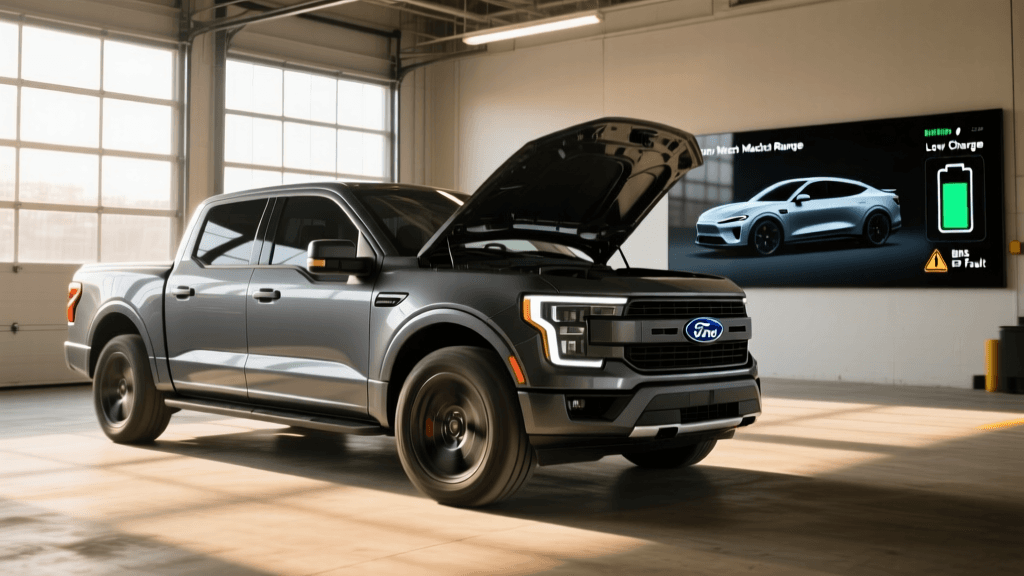
One of the most frustrating issues reported by Mach-E owners is the "Vehicle Unavailable" or "Propulsion Power Reduced" error, which often stems not from the high-voltage Extended Range battery itself, but from the 12V auxiliary battery. The Mach-E uses a DC-DC converter to step down the high-voltage pack to keep the 12V battery charged. However, if the vehicle is left unplugged for extended periods with features like FordPass remote connectivity or cabin overheat protection active, the parasitic drain can deplete the 12V battery. When the 12V battery drops below a critical voltage threshold, the high-voltage contactors physically open, completely disconnecting the main ER battery to protect the vehicle's computers.
How to Troubleshoot and Fix
- Jump-Start the 12V System: Locate the 12V jump-start terminals under the front hood (frunk area). Use a standard lithium jump pack or jumper cables connected to a donor vehicle. Once the 12V system receives enough voltage, the high-voltage contactors will "click" closed, allowing the main ER battery to take over and recharge the 12V system via the DC-DC converter.
- Disable Background Connectivity: If you plan to leave the Mach-E parked at an airport or storage facility for more than a week, disable remote features in the FordPass app and turn off the interior motion sensors via the settings menu to minimize phantom drain.
- Replace with an AGM or Lithium 12V: Many owners proactively replace the stock flooded lead-acid 12V battery with an Absorbent Glass Mat (AGM) or a dedicated 12V lithium-ion battery, which handles the stop-start cycling of the DC-DC converter much better than traditional lead-acid units.
2. DC Fast Charging Speed Throttling
The Mach-E Extended Range battery is capable of accepting a peak charging rate of 150 kW on a DC fast charger. However, a common troubleshooting complaint is arriving at a 350 kW Electrify America or Tesla Supercharger (with adapter) and seeing charging speeds capped at 40 kW to 50 kW. This is rarely a hardware failure; it is almost always a thermal preconditioning issue.
NCM chemistry is highly sensitive to temperature. If the battery is too cold (below 60°F/15°C) or too hot, the BMS will severely throttle the charging current to prevent lithium plating or thermal runaway. To solve this, you must actively precondition the battery.
The Preconditioning Fix
Never just drive to a charger and plug in. Instead, input the charging station into the Mach-E's native SYNC navigation system. When the vehicle recognizes a DC fast charger as the destination, it automatically activates the thermal management system, using grid power (if plugged in) or battery power to heat or cool the battery coolant loops. According to long-term testing and reviews by Car and Driver, properly preconditioning the Mach-E battery via navigation routing can cut your 10% to 80% charging time in half during colder months. If you are using a third-party app like PlugShare or A Better Routeplanner, manually add the charger as a waypoint in the car's native nav system at least 30 minutes before arrival.
3. Range Estimation and BMS Recalibration
The Mach-E's range estimator, colloquially known by EV enthusiasts as the "Guess-O-Meter" (GOM), does not display the EPA-estimated range. Instead, it calculates remaining miles based on your recent driving efficiency, weather conditions, and HVAC usage. Occasionally, the BMS can lose sync with the actual state of charge (SoC) of the individual cell modules, leading to a GOM that displays artificially low range or drops erratically during driving.
Step-by-Step BMS Recalibration Guide
To recalibrate the BMS and force the system to re-measure the true capacity of the Extended Range pack, follow this low-state-of-charge balancing procedure:
- Drive to a Low State of Charge: Drive the vehicle normally until the battery SoC drops to between 5% and 10%. Avoid letting it hit 0% to prevent being stranded, but get it low enough that the BMS begins active cell balancing.
- Let it Rest: Park the vehicle and let it sit for at least 4 to 6 hours. This resting period allows the cell voltages to equalize and the BMS to accurately read the bottom-end voltage curve.
- Charge to 100% Uninterrupted: Plug into a Level 2 home charger (preferably a 48-amp hardwired unit like the Ford Charge Station Pro) and set the charge limit to 100%. Do not interrupt the session.
- The Top-Off Balancing Phase: Once the car hits 100%, leave it plugged in for an additional 2 to 3 hours. The BMS uses this extra time to bleed off high-voltage cells and top off low-voltage cells, ensuring the entire NCM pack is perfectly balanced.
- Reset the Trip Meter: Reset your trip efficiency meter to allow the GOM to begin calculating your new, balanced baseline.
Mach-E Extended Range Battery Specifications & Thresholds
| Parameter | Specification | Troubleshooting Note |
|---|---|---|
| Total Capacity | 91 kWh (Post-OTA) | Software-locked buffer protects cells from over-discharge. |
| Usable Capacity | ~88 kWh | BMS lockout threshold; never truly hits 0 kWh. |
| Peak DC Charging | 150 kW | Requires active navigation preconditioning to achieve. |
| Chemistry | NCM (Nickel Cobalt Manganese) | High energy density but sensitive to extreme cold charging. |
| Warranty Threshold | 70% Retention | Covered for 8 years or 100,000 miles. |
4. Thermal Management System and Coolant Leaks
The Extended Range battery relies on a liquid glycol cooling and heating loop to maintain optimal operating temperatures. A known issue in early 2021 and 2022 build Mach-E models involves coolant leaks at the quick-disconnect fittings located on the underside of the battery pack. If you notice a pink or orange crusty residue near the battery skid plate, or if the vehicle throws a "Propulsion Power Reduced" warning alongside a low coolant message, the thermal management loop is compromised.
The Fix: Do not ignore coolant warnings, as running the battery without adequate thermal management can cause permanent cell degradation. Ford has issued Technical Service Bulletins (TSBs) addressing this. Take the vehicle to a certified Ford EV dealer to have the quick-disconnect O-rings replaced and the coolant lines reseated. The system must then be vacuum-filled with the correct Motorcraft Orange Prediluted Antifreeze/Coolant to ensure no air pockets remain in the battery cooling plates.
Warranty Coverage and Long-Term Degradation
EV owners are naturally concerned about long-term battery health. According to extensive fleet data and analytics published by Recurrent Auto, modern liquid-cooled NCM packs like the one in the Mach-E Extended Range show remarkably low degradation curves, often retaining over 90% of their original capacity after 100,000 miles. The Mach-E's high-voltage battery is backed by Ford's 8-year/100,000-mile warranty, which guarantees the battery will retain at least 70% of its original usable capacity.
If you suspect your battery has degraded beyond this 70% threshold—evidenced by a fully charged 100% SoC yielding significantly less range than when the car was new, even after a BMS recalibration—request a "Battery State of Health" (SoH) diagnostic report from your Ford dealer. This proprietary FORScan diagnostic tool reads the internal resistance and capacity of individual cell modules, providing definitive proof for a warranty claim if the pack requires replacement or module-level servicing.
Conclusion
Troubleshooting the Ford Mustang Mach-E Extended Range battery requires a shift in mindset from traditional internal combustion diagnostics. By understanding the symbiotic relationship between the 12V and high-voltage systems, utilizing native navigation for thermal preconditioning, and performing routine BMS recalibrations, owners can maximize both the daily drivability and the long-term lifespan of their NCM battery pack.