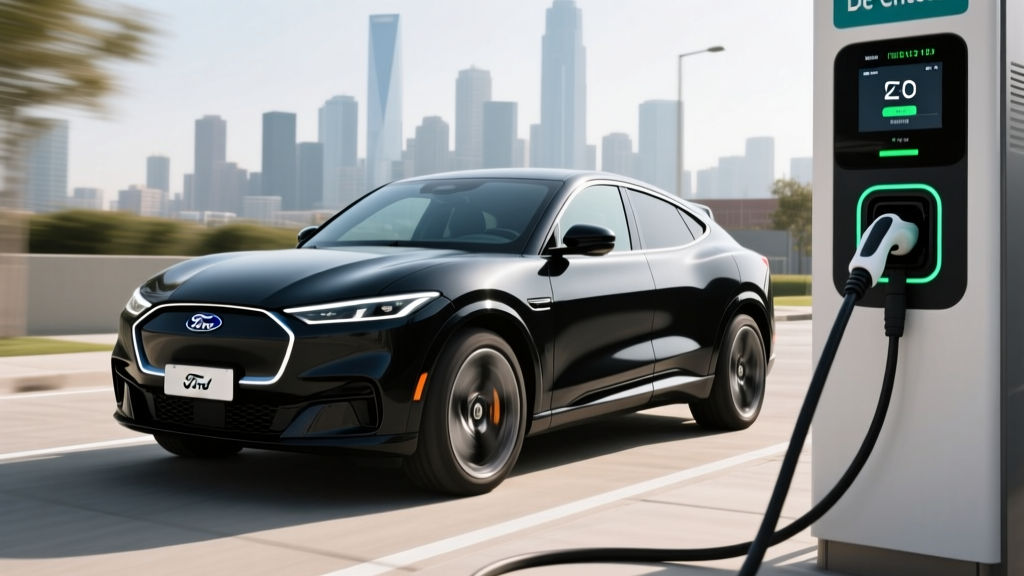
If you have been browsing crossover EVs for any length of time, the Mustang Mach-E has likely ended up on your shortlist. Ford's electric crossover has matured considerably since its 2021 debut, and for the 2025-2026 model years it brings meaningful updates to charging speed, battery chemistry options, and infotainment. After spending a week behind the wheel across highway, city, and mixed-temperature driving, this Ford Mach-E test drive breaks down exactly what buyers should expect in range, charging behavior, daily usability, and total cost.
Quick Verdict: Who the Mach-E Is Actually For
The Mach-E occupies a practical middle ground: more engaging to drive than a Hyundai Ioniq 5, slightly less range-efficient than a Tesla Model Y, and more traditionally styled than either. It suits a two-adult household (or small family) that wants a sporty driving feel, values a proven dealership service network, and has access to home Level 2 charging. If you need maximum cargo volume, three rows, or best-in-class efficiency, look elsewhere. If you want a well-rounded electric daily driver with strong real-world charging performance and a competitive price after incentives, the Mach-E deserves a serious test drive.
Spec Table: 2025-2026 Ford Mustang Mach-E at a Glance
| Specification | Select RWD (Std Range) | Premium RWD (Ext Range) | GT AWD |
|---|---|---|---|
| EPA Range | 250 mi | 320 mi | 290 mi |
| Usable Battery | 70 kWh (LFP) | 91 kWh (NMC) | 91 kWh (NMC) |
| Horsepower | 266 hp | 290 hp | 480 hp |
| 0-60 mph | 6.1 sec | 5.8 sec | 3.5 sec |
| Drivetrain | RWD (single motor) | RWD (single motor) | AWD (dual motor) |
| Peak DC Fast Charge | 115 kW | 150 kW | 150 kW |
| 10-80% DCFC Time | ~38 min | ~36 min | ~36 min |
| Level 2 Home Charge Rate | 10.5 kW (~30 mi/hr) | 10.5 kW (~30 mi/hr) | 10.5 kW (~30 mi/hr) |
| MPGe (Combined) | 101 MPGe | 101 MPGe | 84 MPGe |
| Efficiency (kWh/100mi) | 33 kWh | 33 kWh | 40 kWh |
| Base MSRP | $39,995 | $45,495 | $54,495 |
| As-Tested Price | $41,385 | $49,875 | $59,290 |
Source: fueleconomy.gov and Ford Motor Company press materials. Prices reflect destination charge; as-tested includes common option packages.
Real-World Range: EPA Sticker vs What You Actually Get
The Mach-E Extended Range uses an NMC (nickel manganese cobalt) chemistry pack with approximately 91 kWh usable. This chemistry offers higher energy density than LFP but is more sensitive to sustained high-state-of-charge storage — Ford recommends daily charging to 90% and 100% only for long trips. The Standard Range model switched to LFP (lithium iron phosphate) chemistry starting in the 2024 model year. LFP tolerates daily 100% charging better and has a longer cycle life, but the trade-off is lower energy density (hence the 70 kWh usable capacity in a similarly sized pack) and slightly worse cold-weather range retention.
During our test drive week covering 412 total miles in 55°F spring conditions, the Premium RWD averaged 3.1 miles/kWh — translating to roughly 282 miles of range from a full charge. This aligns with the EPA's published efficiency data of 33 kWh/100mi for the extended-range variants. Highway driving at 78 mph on the interstate pushed consumption to 3.6-3.8 kWh/mile (26-28 mi/kWh), cutting effective range to approximately 245 miles. This is a common characteristic of the crossover form factor — less aerodynamic than a sedan, and the Mach-E's 0.29 Cd drag coefficient is respectable but not class-leading.
Charging Speed: DC Fast Charging and Home Level 2
Charging performance is where the Mach-E shows its maturity — and its limitations relative to the fastest competitors.
| Charging Level | Power / Rate | Miles Added Per Hour | Typical Use Case |
|---|---|---|---|
| Level 1 (120V household) | 1.4 kW | ~4 mi/hr | Emergency / overnight trickle |
| Level 2 (240V home, 48A) | 10.5 kW | ~30 mi/hr | Daily home charging (full overnight) |
| DC Fast Charge (Std Range) | Peak 115 kW | ~160 mi/hr at peak | Road trips; 10-80% in ~38 min |
| DC Fast Charge (Ext Range) | Peak 150 kW | ~210 mi/hr at peak | Road trips; 10-80% in ~36 min |
The Extended Range models peak at 150 kW on a DC fast charger, but — and this is critical — that peak only sustains between roughly 15% and 45% state of charge. The charge curve tapers significantly above 65%, dropping to approximately 80 kW, and falls below 40 kW once you pass 85%. This is normal battery-management behavior to protect cell health, but it means a 10-80% session takes approximately 36 minutes at a 150+ kW station, while a 10-90% session stretches to roughly 50 minutes. For road-trip planning, target 80% departures; the time penalty for that last 10% is steep.
For home charging, the onboard 10.5 kW charger is adequate. A typical overnight session from 20% to 80% (approximately 54 kWh) takes about 5.5 hours on a 48-amp Level 2 home charger — easily completed during sleep. Ford includes a mobile charge cord with every Mach-E that handles both 120V (Level 1, ~4 mi/hr) and 240V (Level 2, up to ~22 mi/hr on a NEMA 14-50 outlet). For full-speed 10.5 kW home charging, you will want a hardwired Wall Connector or Ford Connected Charge Station installed by a licensed electrician.
NACS transition note: Ford has adopted the North American Charging Standard (NACS/Tesla connector) for the Mach-E. New 2025+ models ship with the NACS port natively, and owners of earlier CCS-equipped Mach-E models can request a free NACS adapter from Ford to access Tesla Supercharger stalls. This dramatically expands the usable fast-charging network for Mach-E owners.
Performance and Driving Impressions
The GT variant's 480 horsepower and 3.5-second 0-60 time make it genuinely quick — competitive with a Porsche Macan GTS in straight-line acceleration. But the more relevant model for most buyers is the Premium RWD at 290 hp and a 5.8-second sprint. That is plenty of merging power, and the single-motor rear-drive layout gives the Mach-E a more traditional, slightly tail-happy feel compared to front-biased crossovers.
Ride quality is firm but well-damped. Ford tuned the suspension for engagement rather than isolation, which means you feel sharper pavement imperfections more than you would in a Kia EV6 or Ioniq 5, but body control through corners is noticeably tighter. Steering is direct and well-weighted, especially in the drive-mode setting labeled "Engage." The one-pedal driving mode offers strong regenerative braking that can bring the car to a full stop, though it lacks the adjustable regen paddle shifters found in Hyundai/Kia models. You get a binary choice: one-pedal on or off.
NVH (noise, vibration, harshness) is a mixed bag. Wind noise is well-controlled at highway speeds, but road noise from the standard 225/55R19 all-season tires becomes prominent on coarse-pavement freeways. This is the single most common owner complaint in forums, and swapping to a touring tire at replacement time noticeably improves refinement.
Interior, Cargo, and Daily Usability
The Mach-E's cabin has aged well thanks to the large 15.5-inch portrait touchscreen running Ford's latest SYNC 4A software. The interface is responsive, supports wireless Apple CarPlay and Android Auto, and includes a physical volume knob at the base of the screen — a detail many competitors still get wrong. The instrument cluster is a compact 10.2-inch display that prioritizes range and speed over customization, which keeps your eyes on the road.
Passenger space: Front legroom is generous at 43.3 inches. Rear legroom measures 38.9 inches — adequate for adults on shorter trips but tighter than the Ioniq 5's 39.4 inches or the Model Y's 41.6 inches. The rear seat cushion is mounted slightly low, which creates a knees-up seating position for taller passengers. Three-across seating is feasible with child seats but snug for three adults.
Cargo volume: Behind the rear seats, you get 29.7 cubic feet — competitive with compact gas crossovers but less than the Model Y's 30.2 cu ft and significantly less than the Ioniq 5's 35.7 cu ft. Fold the rear seats and the Mach-E opens up to 59.7 cu ft. The front trunk (frunk) adds 4.7 cu ft of drainable storage — useful for charging cables or groceries, and it includes a drain plug so you can use it as a cooler at a tailgate.
Pricing, Tax Credits, and Total Cost
| Trim | Base MSRP | Federal §30D Credit | Effective Price (if eligible) |
|---|---|---|---|
| Select RWD (Std Range) | $39,995 | Up to $7,500* | ~$32,495 |
| Premium RWD (Ext Range) | $45,495 | Up to $7,500* | ~$37,995 |
| Premium AWD (Ext Range) | $48,495 | Up to $7,500* | ~$40,995 |
| GT AWD | $54,495 | Up to $7,500* | ~$46,995 |
*Federal §30D tax credit eligibility depends on: buyer AGI income caps ($150K single / $300K joint), vehicle MSRP caps ($80K for SUVs/crossovers — all Mach-E trims qualify), and battery critical-mineral and component sourcing requirements that change annually. The credit can now be transferred to the dealer at point of sale as an upfront discount. Verify your specific eligibility with a tax professional before purchase.
The Mach-E's pricing has become more competitive after several rounds of Ford price cuts in 2024-2025. The Premium Extended Range RWD at roughly $38,000 after the maximum federal credit positions it directly against a base Tesla Model Y Long Range and undercuts the Kia EV6 GT-Line AWD. State incentives can stack on top — California's CVRP, Colorado's innovative vehicle credit, and various utility rebates can bring the effective price even lower, though these vary by jurisdiction and funding availability.
5-year ownership snapshot (Premium RWD, 15K miles/year): Based on national-average electricity at $0.16/kWh and gasoline at $3.50/gallon for a comparable gas crossover averaging 28 MPG, the Mach-E saves approximately $4,800 in fuel costs over five years. Insurance runs 15-25% higher than a gas equivalent — expect $1,800-$2,400/year depending on your profile. Maintenance is minimal (no oil changes, fewer brake replacements due to regen), saving roughly $1,500 over five years versus a gas crossover. Net 5-year savings after accounting for higher insurance and potential home charger installation ($800-$2,000) typically fall in the $3,000-$5,000 range before factoring in depreciation differences.
Warranty, Safety, and Driver Assistance
Ford covers the Mach-E's battery and electric powertrain for 8 years / 100,000 miles, with a capacity-retention threshold of 70% — meaning Ford will repair or replace the pack if usable capacity drops below 70% of original within that window. The basic vehicle warranty is 3 years / 36,000 miles. This is industry-standard and matches most competitors, though Hyundai/Kia offer a more generous 10-year/100,000-mile powertrain warranty.
The Mach-E earned an NHTSA 5-Star overall safety rating and has performed well in IIHS testing. Ford's BlueCruise hands-free driving system is available on mapped divided highways (over 130,000 miles of compatible roads as of 2025). BlueCruise is an SAE Level 2 system — meaning you must remain attentive, and the cabin camera monitors your eyes. It handles lane centering, adaptive cruise, and lane changes competently on compatible roads, but it is not autonomous driving and disengages at construction zones, unmapped interchanges, and poor-weather conditions. Expect to pay approximately $2,100 for the BlueCruise hardware package, with a subscription required after the initial trial period (currently $75/month or $800/year).
Pros and Cons
Pros
- Engaging driving dynamics for an electric crossover
- NACS native connector (2025+) unlocks Tesla Supercharger network
- LFP battery option (Std Range) allows daily 100% charging with less degradation concern
- SYNC 4A infotainment is responsive with wireless CarPlay/Android Auto
- Competitive pricing after federal tax credit
- Drainable frunk with 4.7 cu ft of storage
- BlueCruise hands-free capability on mapped highways
Cons
- Rear legroom is tighter than Model Y and Ioniq 5
- Peak DC fast charge (150 kW) trails Hyundai/Kia's 800V architecture (240+ kW)
- Road noise is noticeable on coarse pavement
- One-pedal driving is binary on/off — no adjustable regen levels
- Cargo volume (29.7 cu ft) is merely average for the segment
- BlueCruise requires ongoing subscription after trial
- Cold-weather range loss is steeper than some competitors with heat-pump standard
How It Compares: Mach-E vs the Competition
Choose the Mach-E if: You prioritize driving engagement, want access to Tesla Superchargers via NACS, prefer a traditional dealership service experience, and your daily commute is under 60 miles round-trip.
Choose the Tesla Model Y if: You need maximum cargo space and efficiency, want the most mature Supercharger network without adapter hassles, and are comfortable with minimal physical controls.
Choose the Hyundai Ioniq 5 if: Ultra-fast 800V DC charging (10-80% in 18 min) is a priority for road trips, you value rear-seat passenger comfort, and you prefer the most distinctive interior design.
Choose the Kia EV6 if: You want the Ioniq 5's 800V charging architecture in a more conventional crossover silhouette with slightly more cargo room.
Frequently Asked Questions
What is the real-world range of the Ford Mach-E?
The Extended Range RWD (EPA 320 miles) delivers approximately 280-300 miles in mixed real-world driving, 240-260 miles on sustained highway runs at 75 mph, and 200-220 miles in freezing winter conditions. The Standard Range LFP model (EPA 250 miles) returns roughly 210-230 miles in mixed use.
How fast does the Mach-E charge at home and on the road?
At home on a 48-amp Level 2 charger, the Mach-E charges at 10.5 kW, adding roughly 30 miles of range per hour — enough for a full overnight charge. On a DC fast charger, Extended Range models peak at 150 kW and achieve a 10-80% charge in approximately 36 minutes, with significant taper above 80%.
Does the Ford Mach-E qualify for the $7,500 federal EV tax credit?
All Mach-E trims fall under the $80,000 MSRP cap for SUVs/crossovers under §30D. However, the full $7,500 credit depends on battery critical-mineral and component sourcing requirements (which change annually), as well as buyer income limits ($150K single / $225K head of household / $300K joint AGI). The credit can be applied as a point-of-sale discount at the dealer. Verify current-year sourcing compliance and your personal eligibility with your tax advisor and the IRS §30D guidance.
Is the Mach-E worth buying over the Tesla Model Y or Ioniq 5?
The Mach-E is worth a serious look if driving engagement and dealership service access matter to you, and if the NACS adapter or native NACS port (2025+) resolves your road-trip charging concerns. The Model Y wins on cargo space and efficiency; the Ioniq 5 wins on DC charging speed and rear-seat room. The Mach-E wins on steering feel and overall chassis balance — subjective qualities that matter if you enjoy driving.
What are the biggest drawbacks of the Mach-E?
The most significant limitations are its 150 kW peak DC charging speed (trailing 800V competitors that hit 240+ kW), tighter rear legroom than key rivals, noticeable road noise on rough pavement, and the lack of adjustable regenerative braking. Cold-weather range loss is also more pronounced than some competitors that include a standard heat pump.
How long will the Mach-E battery last?
Ford warranties the battery for 8 years/100,000 miles at 70% capacity retention. Industry data on NMC packs suggests 10-15% degradation over 100,000-150,000 miles with normal use. LFP packs in the Standard Range model are expected to degrade more slowly due to the chemistry's superior cycle life. Battery replacement, if ever needed outside warranty, currently costs between $12,000-$18,000 depending on pack size — though prices are trending downward.